Whatcom & Skagit County
House Washing (Soft Wash) in Whatcom & Skagit County
The short answer
King of Kings soft washes siding across Whatcom and Skagit County — vinyl, fiber cement, cedar, painted wood and stucco. Low pressure and the right solution, never a pressure washer, which drives water behind the laps and into the wall. Licensed, L&I insured, free on-site quote.
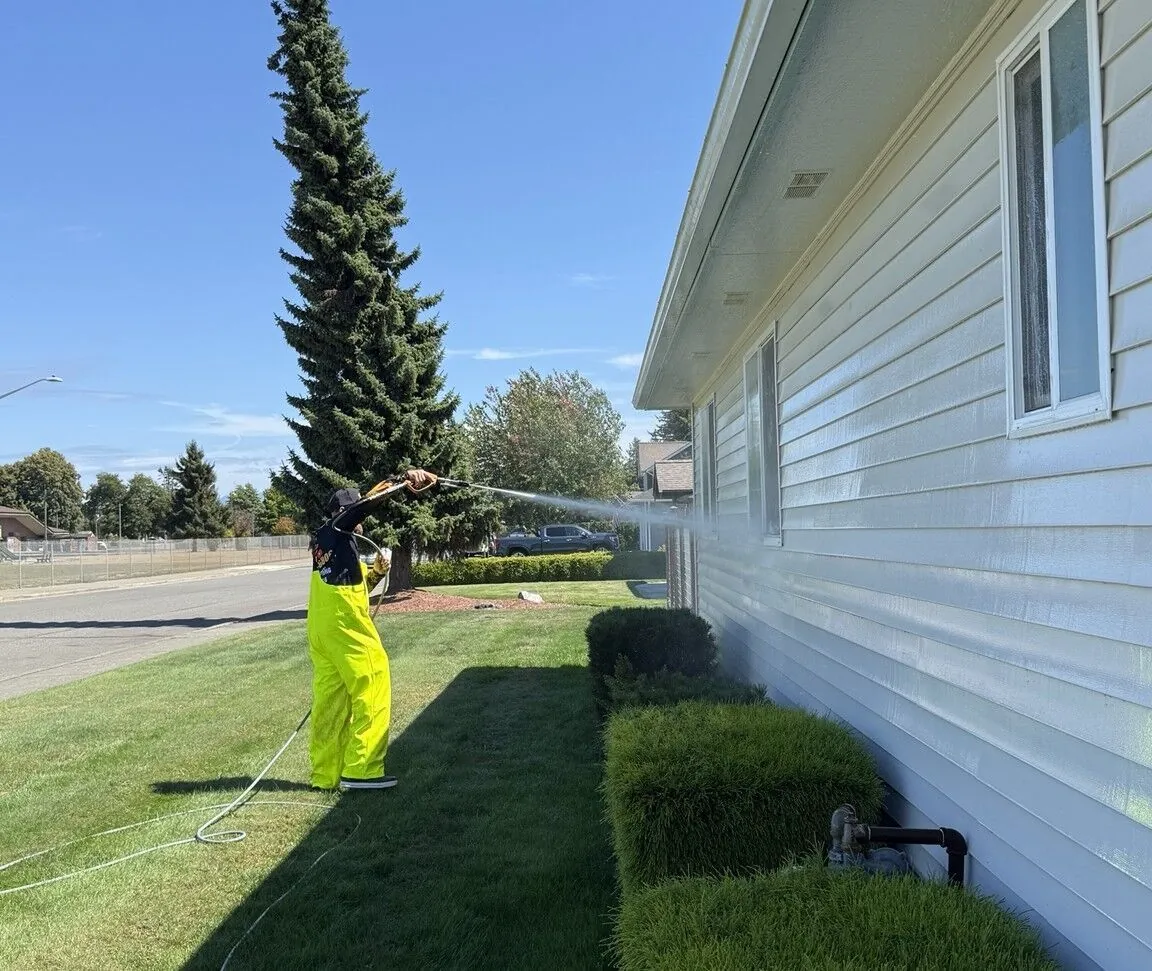

Randy Fee — Owner, King of Kings Window Cleaning
Washington business licence, UBI 605476674 · L&I insured · BBB rated A
Randy runs the company himself, so you are dealing with the owner, not a call centre — and every technician here is personally trained by him. Working Whatcom and Skagit County since 2024.
The exterior walls of a house in this region spend most of the year damp. What grows on them is not really dirt — it is biology, it is concentrated on the sides that get the least sun, and it comes off easily if you use the right method and does considerable damage if you use the wrong one.
The wrong method is a pressure washer. That statement is the reason this is a separate service from pressure washing, and it is worth understanding why rather than taking it on trust.
Why siding must not be pressure washed
Siding is built on the same principle as a shingle roof: overlapping horizontal courses, each lapping the one below, so water running down the wall stays on the outside. Vinyl, fiber cement, wood lap, cedar shingle — all of them work this way, and all of them are designed against water travelling downward.
A pressure washer aimed at a wall drives water upward and sideways, behind the laps. It goes into the gap the siding relies on being a one-way path, past the weather-resistive barrier if there is a gap in it, and into the wall assembly. It also gets in around window and door flashings, which are detailed for gravity-driven water, not for a jet.
Water in a wall cavity in a climate this wet does not dry out quickly. It causes the failures that show up years later as soft sheathing, mould inside the wall, and rot at the sill.
Beyond the water intrusion, force does direct damage: it cracks and permanently etches vinyl, chips and erodes fiber cement, blasts paint off painted wood, splinters and furs cedar, and drives water into stucco. On older vinyl in particular — which is brittle from UV exposure — a pressure washer can crack a panel outright.
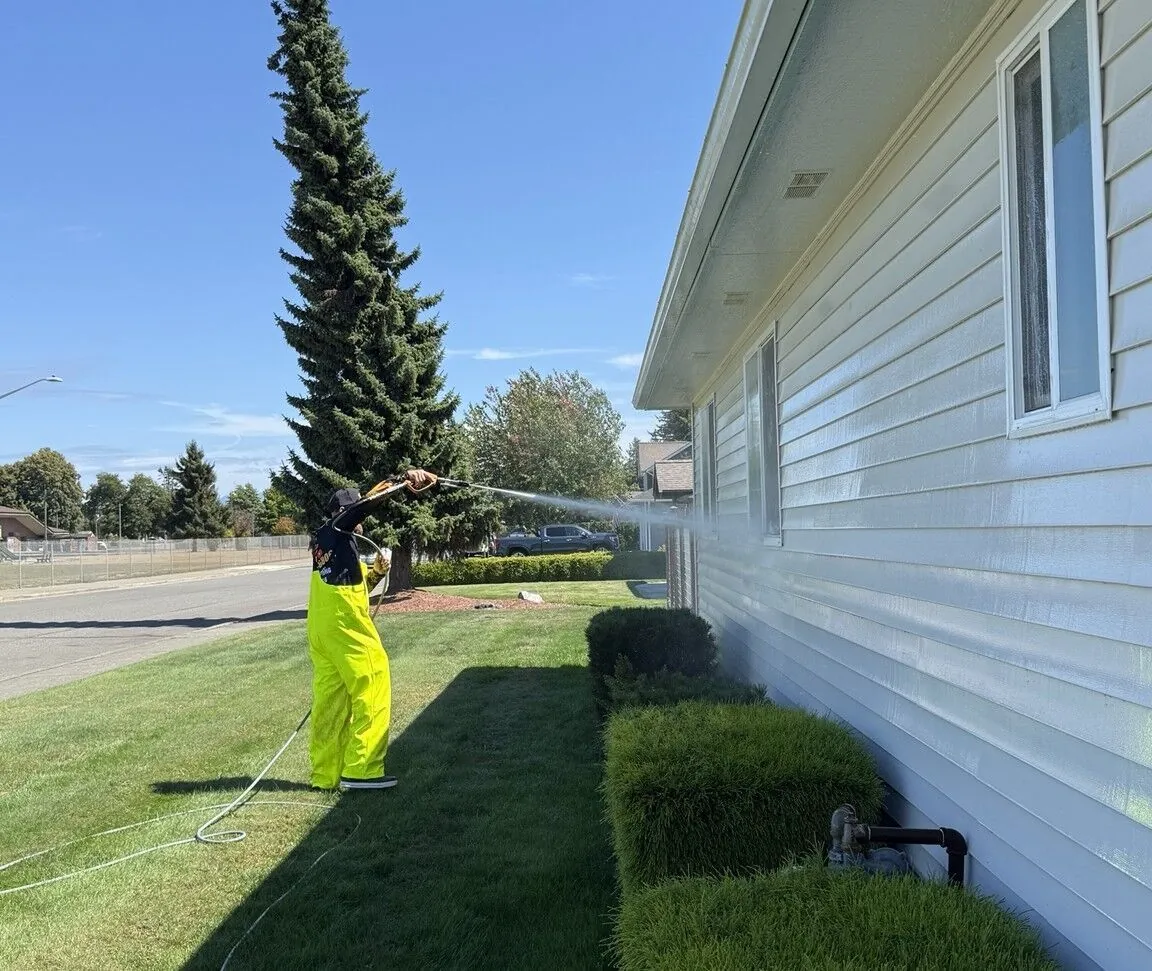
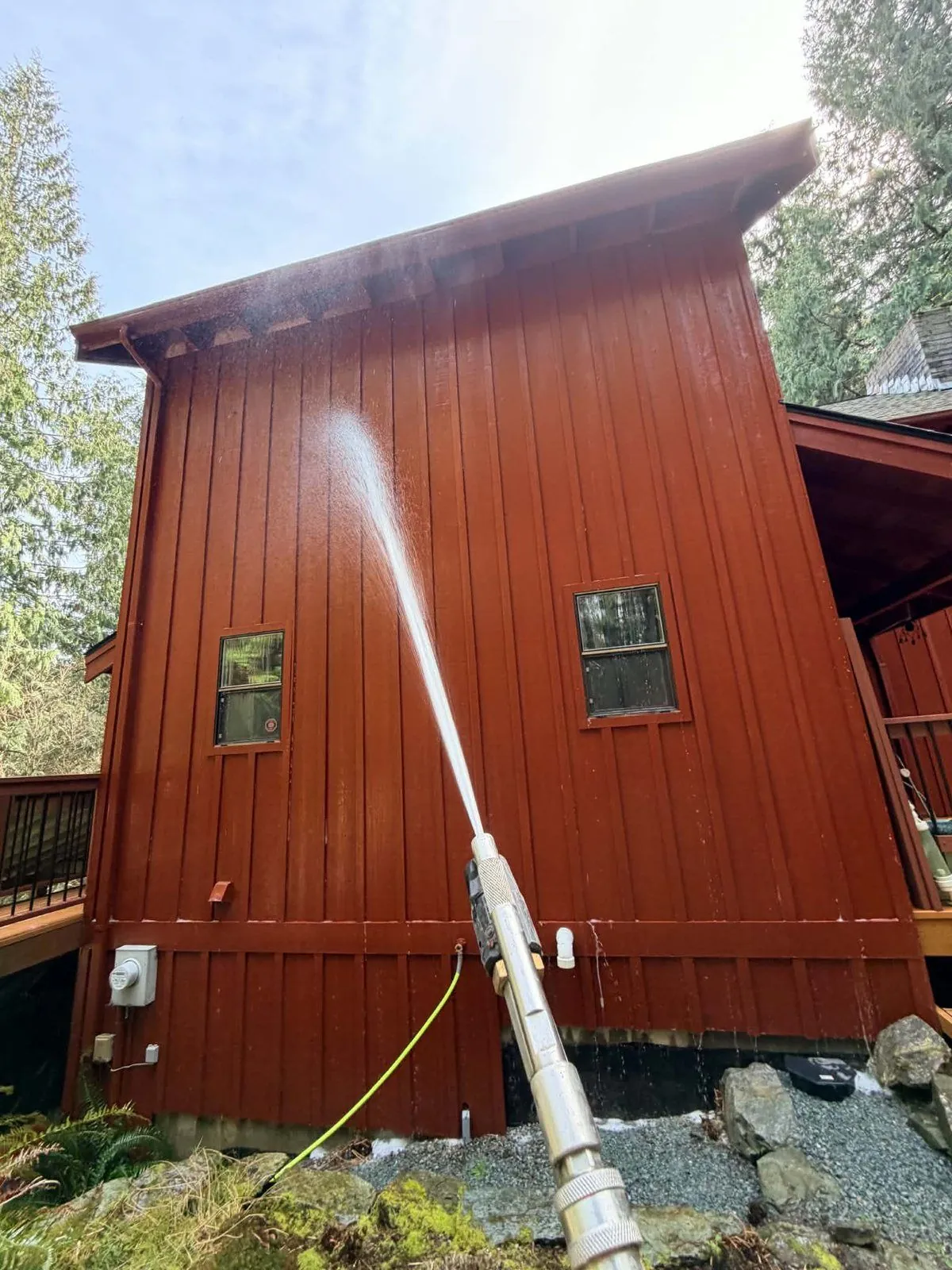
Soft washing does the job instead: pressure at roughly garden-hose level, with a cleaning solution formulated for the growth and the substrate doing the actual work. It is applied, given time to dwell and kill the organism, then rinsed. Slower to look impressive and far better for the building.
What is actually growing on your walls
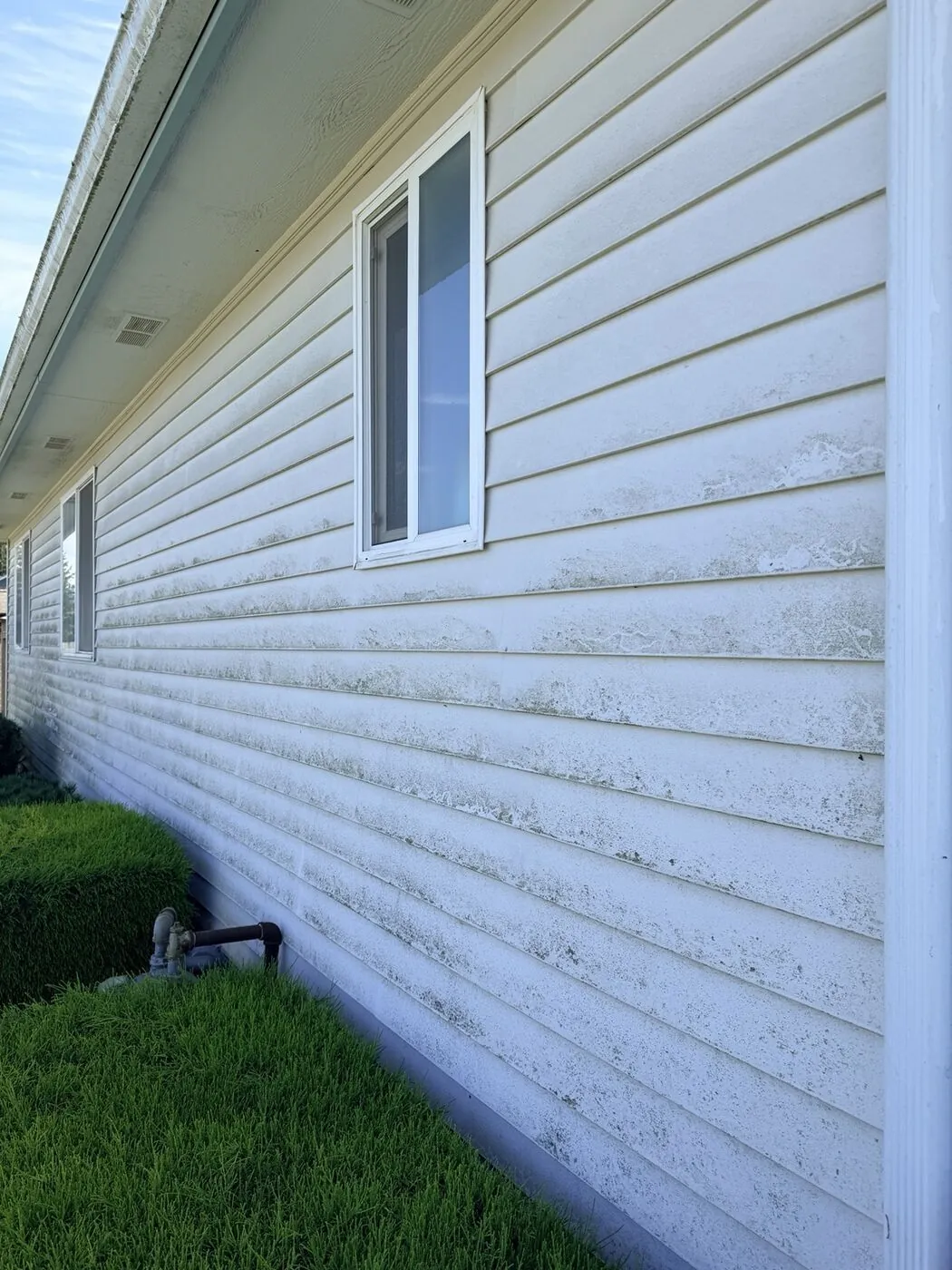
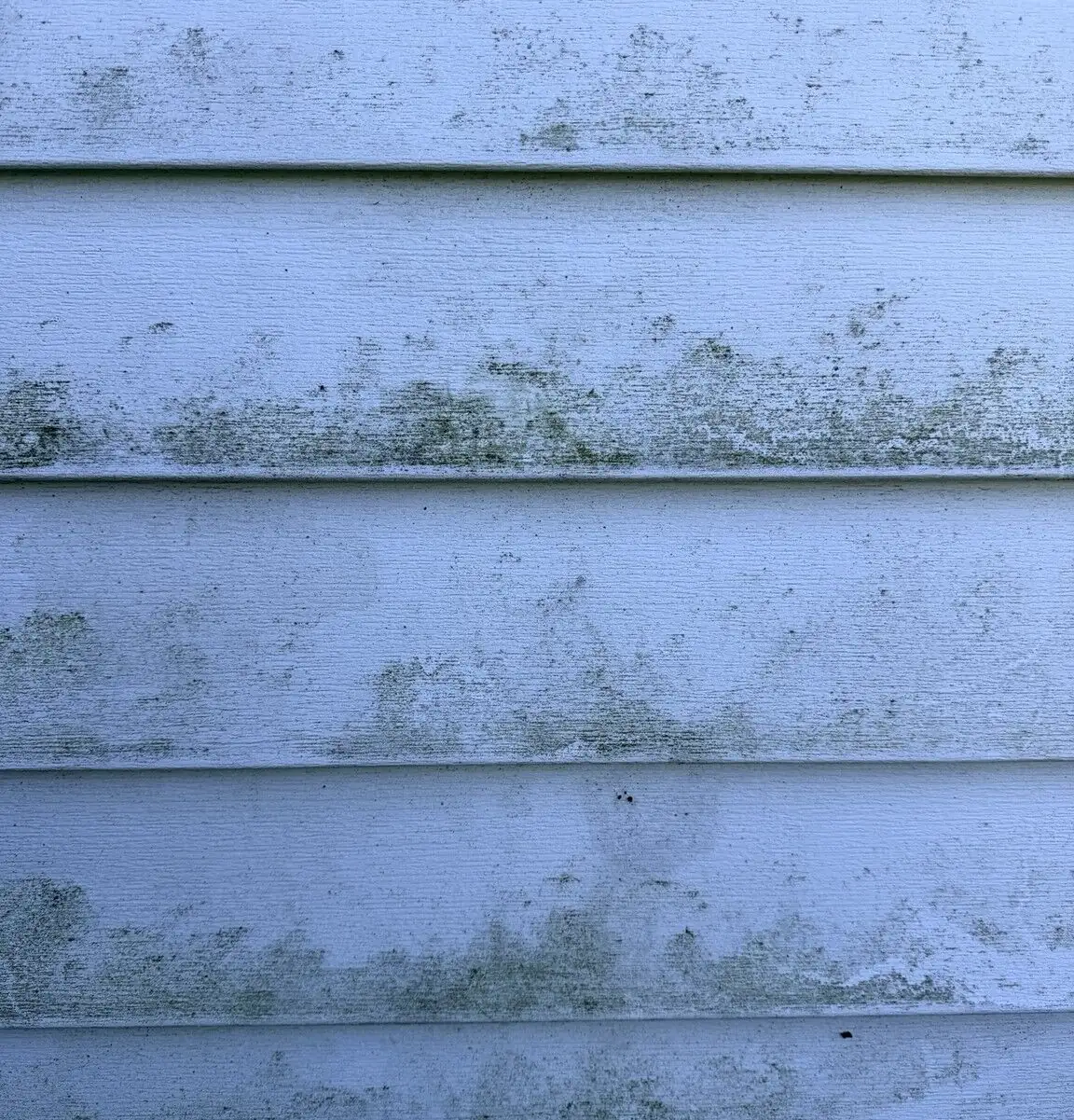
Algae — the green film, heaviest on north and shaded elevations. The single most common thing we remove here. It sits on the surface, feeds on moisture and airborne organic matter, and washes off cleanly once killed.
Mildew and mould — the black speckling and blotching, again concentrated in shade and in the areas that stay damp longest. Frequently found behind shrubs planted too close to the wall.
Moss and lichen — on the lower courses, in the seams, on north-facing cedar shingle, and anywhere splash keeps a surface permanently wet.
Oxidation and chalking — not growth at all. UV degrades the surface of vinyl and painted siding over years, leaving a chalky layer that rubs off on your hand. Washing removes the loose chalk, which usually improves appearance considerably, but it does not restore the finish. Badly oxidised vinyl that has gone matte and faded is not going to come back to gloss, and any contractor implying otherwise is setting you up to be disappointed.
Overflow staining — the vertical dirty streaking below a gutter that has been overflowing. It cleans off, but it will come back until the gutter is dealt with, and we will say so.
Cobwebs, wasp and mud-dauber nests, and general debris in the soffits and under the eaves — cleared as part of the job.
Industrial and agricultural film — near the Cherry Point corridor and out on the farm ground, a fine deposited layer that is neither growth nor ordinary dirt and needs detergent rather than force.
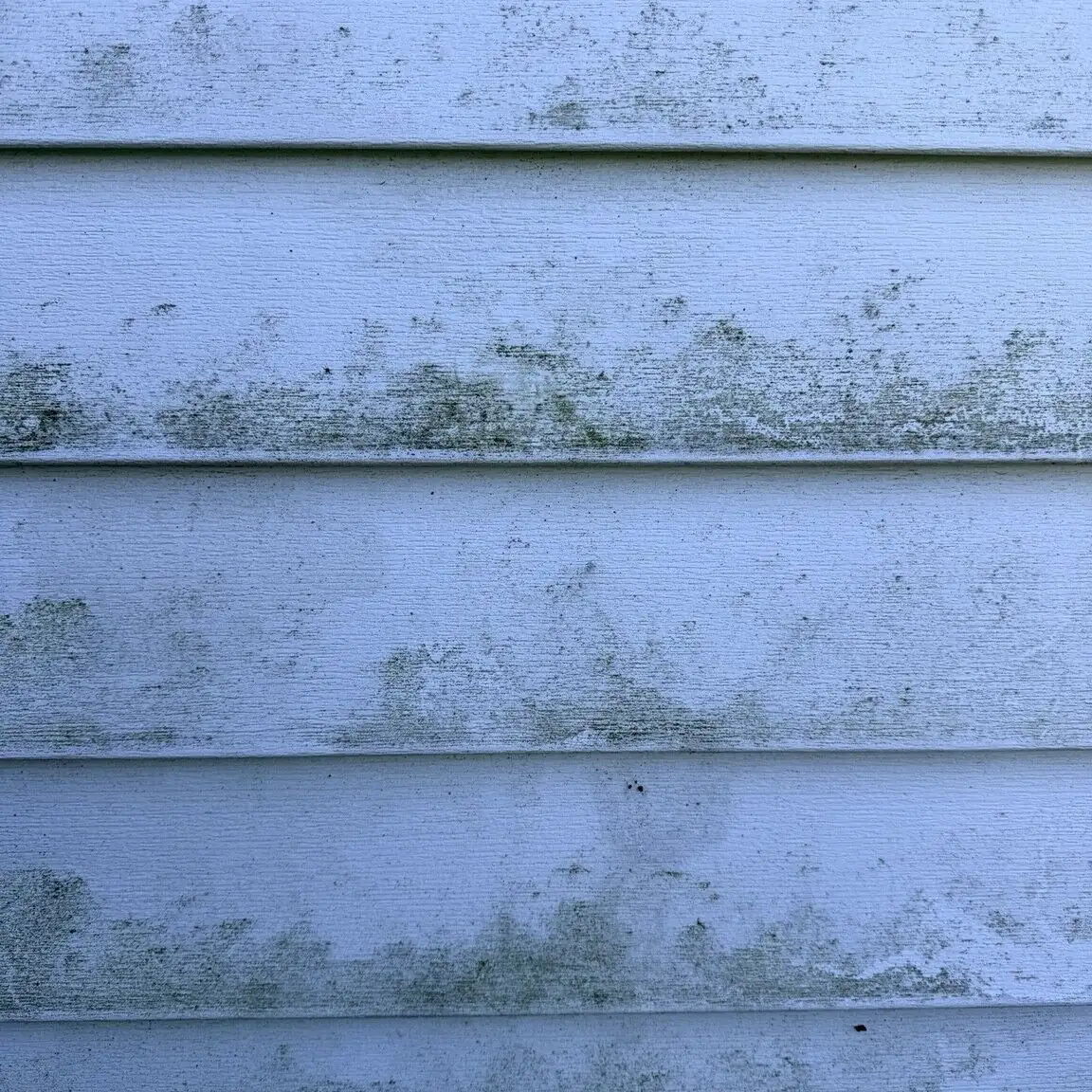 Before
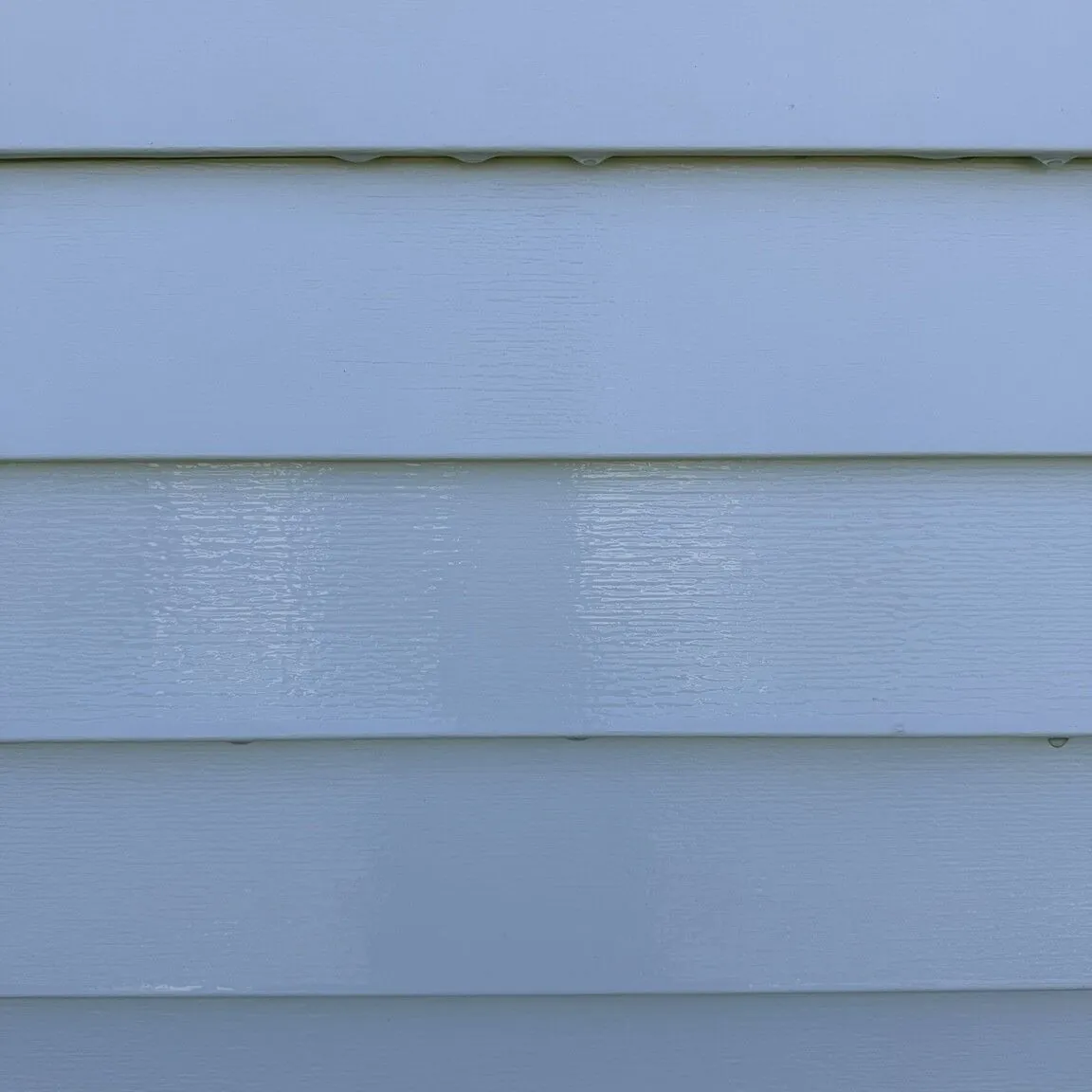 After
What the job covers
- All siding elevations, soft washed
- Soffits and eaves, including cobweb and nest removal
- Gutter exteriors — the visible faces, not the inside channel
- Fascia and trim
- Window and door exteriors, frames and sills — the glass itself is window cleaning and is quoted separately
- Garage doors, entry doors and shutters
- Planting protected and rinsed, before and after
Not included as standard: the roof, the inside of the gutters, hard surfaces under foot, decks and fences, which are all separate services with their own methods.
Protecting what is around the house
This is the part of house washing that separates careful operators from fast ones, and it is worth knowing what should be happening.
Planting gets pre-wetted before any solution is applied. A plant saturated with clean water absorbs far less of anything that lands on it afterwards, and this single step prevents most plant damage.
Sensitive planting gets covered. Newly planted material, anything unusual and anything under the immediate work area.
Everything gets rinsed at the end, generously.
Runoff is directed away from where it should not go. As with all our exterior work, the constraint is sharpest in the Lake Whatcom watershed — Sudden Valley, Geneva and the surrounding catchment — where the lake supplies drinking water and what enters it is a live regulatory issue.
Electrical is checked — exterior outlets, light fixtures, meter bases, and anything with a compromised cover. Water and electricity at a wall is a real consideration and it is checked before rather than discovered during.
Air conditioning and heat pump units get covered or avoided.
Ask any house washing contractor how they handle planting. The answer tells you most of what you need to know about how the rest of the job will go.
When to book
Spring is the busiest window, and for good reason — a winter of damp has left the shaded elevations green, and everybody notices it the first sunny week.
Autumn works well too and is less contended, and going into the wet season with clean walls means the growth starts from nothing rather than from an established base.
Before painting. Washing is the prep. Paint applied over a chalked, algae- covered surface does not bond properly and fails early, and any painter worth hiring will insist the walls are washed first.
Before listing a property. A clean elevation photographs dramatically better, and a green north wall reads as neglect in a way that is out of proportion to what it actually means.
Not in a freeze, and not on a wall in full direct summer sun, where solution evaporates before it can work.
Every two to four years for most houses here, more often on heavily shaded elevations.
The one-elevation option
Worth knowing, because it saves people money.
Growth on a house is rarely evenly distributed. The north side is green; the south side is fine. If the budget is tight, washing the shaded elevations only is a completely legitimate approach, and it addresses the part that actually looks bad and holds moisture.
We will quote it either way and tell you honestly whether the sunny elevations need doing at all this cycle. Selling a whole-house wash to somebody who needs one wall is easy and we would rather not.
What house washing will and will not change
Setting expectations properly, because siding is a surface where several different things get called “dirty” and only some of them wash off.
Comes off completely: algae, mildew, mould, moss, lichen, cobwebs, wasp and mud-dauber nests, general atmospheric dirt, and most overflow staining.
Improves substantially: chalked and oxidised surfaces, which lose the loose powdery layer and look markedly better without being restored; weathered cedar, which cleans up but stays weathered; and long-standing organic staining, which lightens.
Does not change: fading. UV degradation of the pigment in vinyl or paint is a change to the material, not a layer on top of it. A wall that has gone from deep green to pale sage is not dirty. Nor does washing repair cracks, close gaps, restore failed caulking, or do anything about damage under the siding.
The useful test at the quote is simple: if a wet finger on the surface comes away green or grey, it is coming off. If the wall looks the same colour wet as dry, that is the material and washing will not alter it.
Rentals, HOAs and multi-unit buildings
A large share of this work is managed property rather than owner-occupied, and the drivers are different.
Turnover cleans between tenancies, usually bundled with window cleaning and scheduled into the tight window between one tenant leaving and the next arriving.
HOA and condo elevations, where the association owns the exterior and the appearance of the building is a standing agenda item. On multi-building sites the efficient approach is one mobilisation across the whole community — access and equipment are set up once, and the buildings end up matching, which is usually the board’s actual concern.
Vacation rentals, where the exterior is the first photograph a guest sees and the review economy is unforgiving about a green wall.
Pre-sale washes on properties coming to market, generally alongside pressure washing of the driveway and paths.
For managed properties the useful conversation is about scheduling rather than individual jobs — an annual or biennial cycle on the shaded elevations costs less and looks better than reacting when someone complains.
What changes the price
- House size and number of storeys. Square footage of wall, and how much of it is above reach.
- Siding material. Cedar, stucco and failing paint all take longer than vinyl because they are done more gently.
- Condition. Light film is quick. Heavy moss, lichen and years of growth are not.
- Access. Tight side yards, steep ground, mature planting against the wall, decking and outbuildings all slow the work.
- Landscaping. More protection work means more time.
- Detail. Shutters, extensive trim, multiple dormers and decorative elements add real hours.
What we do not do
- We do not pressure wash siding, stucco or any vertical surface.
- We do not paint, stain, seal or carry out repairs.
- We do not remove failing paint as a service — a wash will take off what is already failing, but that is a consequence, not a deliverable.
- We do not resolve moisture problems inside a wall. If we see signs of one, we will tell you what we saw and leave it to the right trade.
- We do not carry out inspections or issue condition reports.
What is in the solution
Homeowners are entitled to ask, and on a wall it matters more than on a driveway because the runoff lands in the beds directly beneath it.
A soft wash solution is typically a dilute cleaner with a surfactant that helps it cling to a vertical surface long enough to work — which is the whole engineering problem with washing a wall, since anything sprayed on it wants to run straight off. The active component is chosen for what is growing and what it is growing on: algae and mildew on vinyl take a different approach from lichen on cedar or biological film on stucco.
The mildest chemistry that will actually do the job is the right one, and that is a judgement made at the wall rather than a single mix used on every house. On cedar, on some coated surfaces, and anywhere the runoff is going somewhere sensitive, the gentler and slower option is the correct one even though it costs more time.
What matters as much as the product is the process around it: pre-wetting, covering, controlling where it goes, and rinsing thoroughly at the end. A carefully applied ordinary solution does less harm than an aggressive one applied carelessly.
Sequence, if you are doing more than one thing
Siding comes third: roof, then gutters, then walls, then glass, then hard surfaces last. Washing walls before the roof and gutters means washing them twice, because everything above sheds downward. Booking together is cheaper than separate visits because access is set up once.
On the day
Before anything is wet, we walk the elevations with you and agree the scope, check that windows and doors are closed, look for damaged screens, open vents, compromised electrical covers and anything on the walls that needs to come off. Furniture, planters and grills move away from the working elevation — we can do that or you can, and it is worth saying which you would prefer when booking.
Planting gets its pre-wet. Covers go on where they are needed. Then the work proceeds elevation by elevation rather than jumping around the house, which sounds obvious and is the difference between an evenly cleaned building and one with patches.
At the end everything is rinsed down, the ground is left as we found it, and if you are there we walk it with you. If you are not, we send photographs. Either way, if something is not right, we would much rather hear it while the equipment is still on your driveway.
Most single-storey houses are a half day. Two-storey houses with detail work run most of a day. It is not a job we like to rush, because the failure mode of rushing a soft wash is streaking, and streaks on a wall are more visible than the growth was.
What each visit covers
| Substrate | Method | Note |
|---|---|---|
| Vinyl | Soft wash, low pressure, solution and dwell | Most common cladding here; old vinyl embrittles and cracks under force |
| Fiber cement | Soft wash only | Cut ends and any breached coating are the vulnerable points |
| Cedar shingle or lap | Gentler solution, saturation controlled | Silvered cedar cleans up and stays grey |
| Painted wood | Soft wash | Sound paint washes; failing paint comes off, and that is a quote conversation |
| Stucco and EIFS | Low pressure, cracking flagged | Water behind stucco is worse than growth on it |
Shaded elevations only is a legitimate booking and we will quote it that way.
Where we do it
House washing is available across the Tier 1 and Tier 2 markets in Whatcom and Skagit County. What grows on a wall varies with exposure as much as anything — salt film at the marine edge in Blaine, Birch Bay and Anacortes behaves nothing like the algae on a shaded wall in Sudden Valley or the deposited film out toward Cherry Point. Your town’s page has the local detail, including how often houses there actually need doing.
Specific house washing problems we get called for
The surfaces this work touches
House Washing (Soft Wash) where you live
Whatcom County
- House washing in Bellingham
- House washing in Ferndale
- House washing in Lynden
- House washing in Blaine
- House washing in Everson
- House washing in Sudden Valley
Skagit County
We also cover Sedro-Woolley, Semiahmoo, Custer, Nooksack, Sumas, Deming, Acme, Maple Falls, Glacier, Kendall, Van Zandt, La Conner, Lyman, Edison, Bow, Alger, Clear Lake, Big Lake, Conway, Concrete, Hamilton, Bay View, Oak Harbor, Point Roberts, Lummi Island, Marietta, Geneva, Wickersham, Rockport, Samish Island and Guemes Island from these bases. Those areas do not have their own page — if you are not sure whether you are inside the area, call and ask.
House washing questions
- Is house washing the same as pressure washing?
- No, and confusing the two is how siding gets damaged. Pressure washing uses force on hard horizontal surfaces. House washing is a soft wash — low pressure, comparable to a garden hose, with a cleaning solution doing the work. Siding has laps and seams that shed water downward; force drives water upward behind them and into the wall cavity.
- Why is the north side of my house always green?
- Because it gets the least sun and stays damp longest, and in this climate damp plus shade grows algae. It is the most common house washing call we get and the growth is on the surface rather than in the material, so it comes off cleanly.
- Will it damage my plants?
- Not if it is done properly. Planting is pre-wetted before the solution goes on, sensitive planting is covered, and everything gets rinsed afterwards. Pre-wetting matters more than people expect — a plant already saturated absorbs far less of anything that lands on it.
- Can you wash painted wood siding?
- Yes, gently. Sound paint washes fine. Paint that is already failing — chalking, flaking or lifting — will come off wherever it was going to come off anyway, and we will tell you that before starting rather than after. On a house due for repainting, washing is what prep looks like.
- How long does it stay clean?
- Typically two to four years on most elevations here, less on a shaded north wall under trees. Growth returns fastest where the wall stays damp, which is why the shaded side often needs doing while the sunny side does not.
- Do you clean stucco?
- Yes, at low pressure and with care. Stucco is porous and cracks are common in older applications, so the goal is to clean the surface without pushing water into the substrate. Any visible cracking gets pointed out, because water behind stucco is a much bigger problem than dirt on it.
- What about the gutters and the soffits?
- The exterior faces of the gutters and the soffits are usually included in a house wash, since they are part of the same elevation. Clearing the inside of the gutters is a separate job — see gutter cleaning.
- Does the house need to be closed up?
- Windows and doors closed, and we will check them before starting. Any open vents or damaged screens are worth mentioning. Outdoor furniture and anything on the walls comes away from the elevation being washed, which we can do or you can.