Whatcom & Skagit County
Roof Cleaning & Debris Removal in Whatcom & Skagit County
The short answer
King of Kings soft washes roofs across Whatcom and Skagit County — low pressure, the right solution for the roofing material, and never a pressure washer. Pressure washing an asphalt roof strips granules and voids most manufacturer warranties. Licensed, L&I insured, free on-site quote.

Randy Fee — Owner, King of Kings Window Cleaning
Washington business licence, UBI 605476674 · L&I insured · BBB rated A
Randy runs the company himself, so you are dealing with the owner, not a call centre — and every technician here is personally trained by him. Working Whatcom and Skagit County since 2024.
A roof in this climate spends most of the year damp and a good part of it in shade. That combination grows things. What grows, how much damage it does, and what can safely be done about it depends almost entirely on what the roof is made of — which is why “roof cleaning” is not one service and should not be quoted as one.
The single most important thing on this page: a pressure washer does not belong on a roof. Everything else follows from that.
Why pressure washing a roof is a bad idea
It is worth being specific, because pressure washing roofs is still sold in this region and it still damages roofs.
An asphalt composition shingle — which is what most houses here have — is a mat saturated with asphalt and surfaced with a layer of mineral granules. Those granules are not decoration. They are the shingle’s UV protection and its weathering surface, and the asphalt underneath degrades quickly once they are gone. A shingle sheds granules slowly over its whole life; that is normal. A pressure washer removes years of that in seconds, and the loss is not recoverable.
High pressure also drives water upward, under the shingle courses, into the layer that is designed to shed water flowing down. Water that gets under a course does not necessarily leak immediately — it soaks the underlayment and the deck, and the consequence arrives later as rot rather than as a drip.
And it voids warranties. Roofing manufacturers are explicit that high-pressure cleaning is not an approved maintenance method. Damage from it is not covered, and on a roof still within its warranty period that is a meaningful thing to throw away for a faster job.
If a quote for roof cleaning is notably cheap and notably fast, ask what pressure is being used. There is usually a reason.
What soft washing actually is
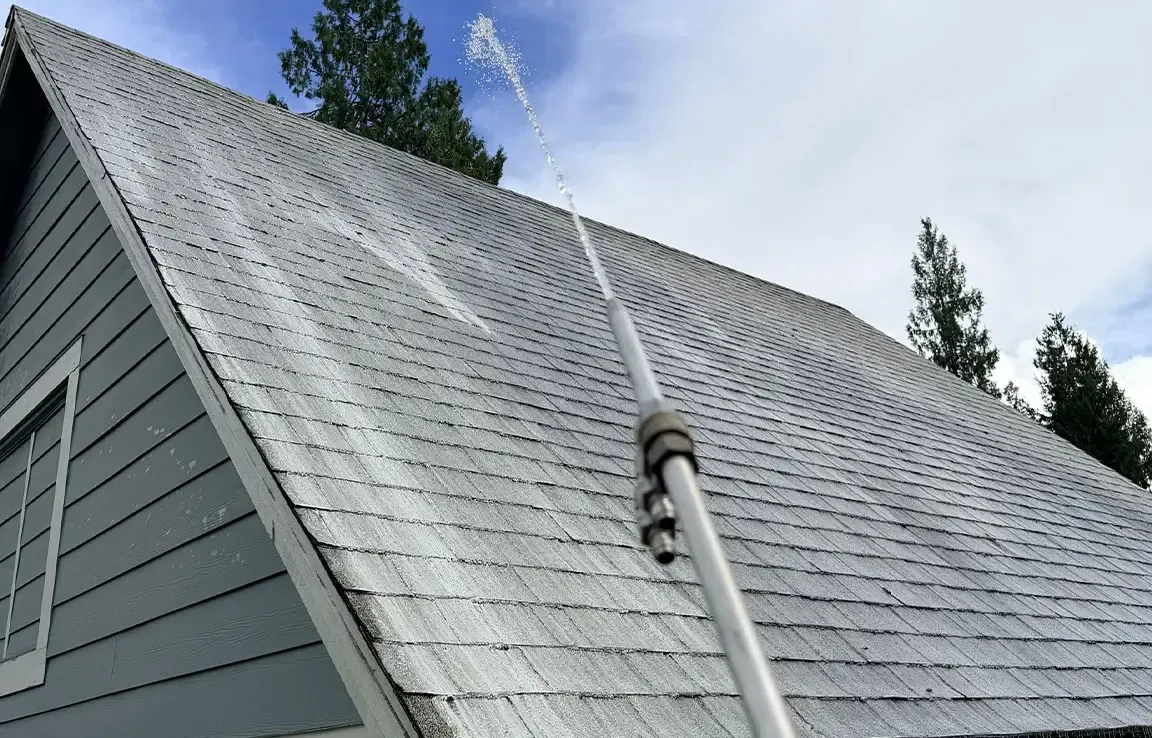
Soft washing replaces mechanical force with chemistry and time.
A cleaning solution appropriate to the roofing material is applied at low pressure — comparable to a garden hose — and left to dwell long enough to kill the organism. The roof is then rinsed gently. The dead growth releases over the following weeks under normal rain and wind, which is why a soft-washed roof continues to improve for a month or two after the visit rather than looking finished the moment the truck leaves.
That delay is the part homeowners are least prepared for, so it is worth saying plainly: an honest soft wash does not look completely finished on the day. Black algae staining lifts immediately and dramatically. Thick moss does not — it dies, goes brown and brittle, and weathers off. Anyone getting all of the moss off a roof on the day is scraping or blasting it, and both of those cost you roof.
Careful operators pre-wet planting below the work area, cover what is sensitive, manage where runoff goes, and rinse everything down afterwards. In the Lake Whatcom watershed — Sudden Valley, Geneva and the surrounding catchment — runoff management is not just good practice, it is a genuine constraint, and the method has to reflect that.
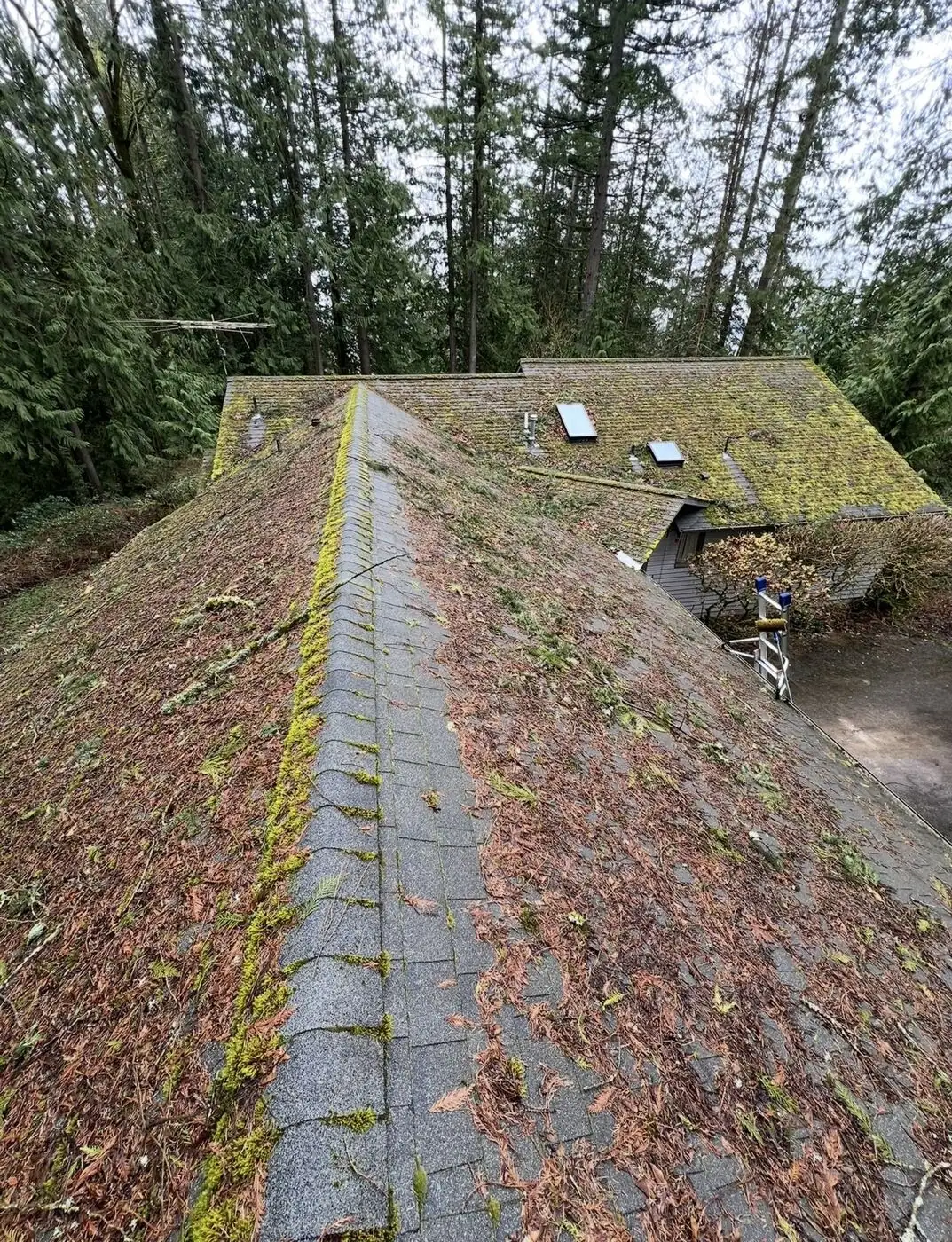 Before
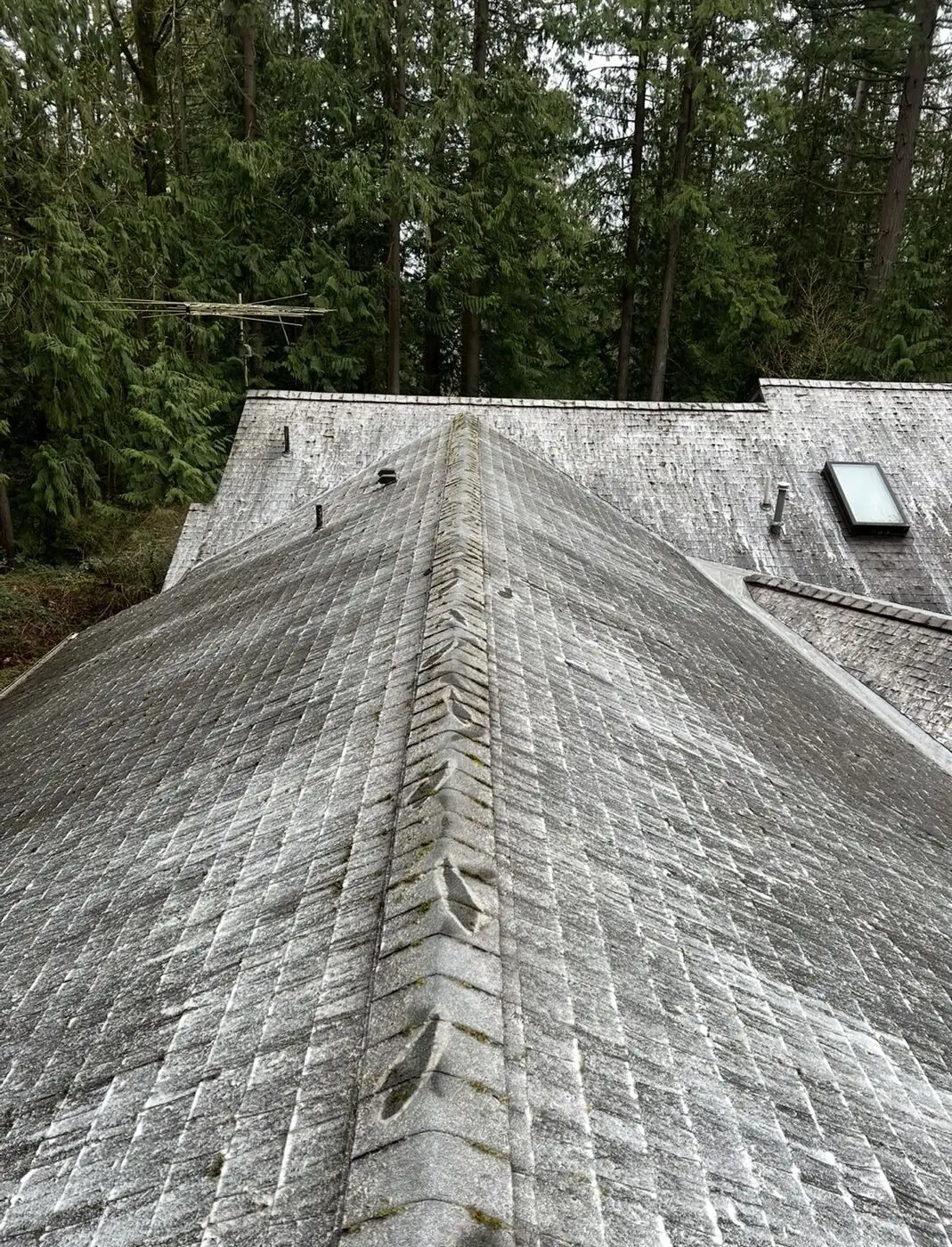 After
The three things growing on your roof
They look similar from the ground and they are biologically unrelated. Treatment differs.
Algae — the black streaks. Almost always Gloeocapsa magma, a cyanobacteria that arrived on the roof as airborne spores and stayed because the surface was damp enough. It feeds partly on the limestone filler used in asphalt shingles, which is why it is so specifically a composition-roof problem. It spreads downward with water flow, producing the characteristic vertical streaking that starts near the ridge. It holds moisture against the shingle and darkens the surface, which raises roof temperature — a real if modest energy cost. More on black algae streaks.
Lichen — the flat, crusty, pale green or grey patches. A symbiotic organism, part fungus and part alga, and the most tenacious of the three. Lichen does not sit on the surface; it anchors into it, and removing established lichen from asphalt takes granules with it no matter how carefully it is done. This is the growth where the honest answer is often “we will kill it and let it weather off over a year”, not “we will remove it today”.
Moss — the green cushions, thickest at the shaded eaves and in the valleys. Structurally the most damaging of the three, and different enough to have its own service: see roof moss removal.
Roof by roof
Composition asphalt shingle — the majority of roofs in both counties. Soft wash only, solution chosen for the growth present, no walking on the roof in hot weather and careful footfall in cold. The granule question above governs everything.
Cedar shake and shingle — common on older Bellingham housing and on architect-designed homes around Chuckanut, Edgemoor and the lake. Wood is absorbent and living, so the solution has to be gentler and saturation controlled. Cedar also holds moss deep in the checking and between the courses, and clearing it aggressively splits shakes. Expectations matter here: weathered cedar cleans up considerably but it does not return to new cedar colour, and any contractor implying otherwise is setting up a disappointment. More on moss on cedar shake.
Standing seam and corrugated metal — increasingly common on new builds and outbuildings throughout the county. Metal does not grow algae the way asphalt does, but it collects organic debris in the seams and it streaks. The consideration is the coating: the factory finish is what makes the roof last, and the wrong chemistry dulls or strips it. Metal is soft washed with a solution chosen for the coating, never scoured. More on metal roof soft washing.
Concrete and clay tile — a smaller share of the housing stock here, mostly on newer builds. Tile is durable but brittle underfoot and the traffic risk is greater than the cleaning risk. Access planning matters more than solution choice.
Torch-down and low-slope membrane — flats, additions, garages and most commercial buildings. Different problem entirely: standing water and debris rather than growth, and the seams are the vulnerability. Cleaning is gentle and the useful part of the visit is usually clearing the drains.

What roof growth actually costs you
Not aesthetics, or not only aesthetics.
Moisture retention. Everything growing on a roof holds water against the surface, which extends the time the roof spends wet in a climate where that is already most of the year.
Granule loss. Lichen anchored into the surface takes granules when it goes, and algae accelerates the breakdown of the filler in the shingle itself.
Freeze damage. Water held in growth at the eaves, then frozen, expands. Relevant across the whole service area and acute in the foothills.
Gutter load. Growth and debris shedding off the roof is what fills the gutters, which is why these two jobs belong together.
Heat. A dark, algae-covered roof runs hotter than a clean one — modest, but real, and it works against the attic ventilation.
Resale. A streaked roof reads as an old roof to a buyer, whether or not it is, and it is one of the first things a home inspector photographs.
When to book
Spring, once the weather has settled enough for a solution to dwell rather than being rinsed off by the next shower, and before the summer growth season.
Early autumn, which in this climate is arguably the better slot — treating before the wet season means the roof goes into winter with the growth dead rather than feeding on six months of rain.
Not in a freeze, and not on a hot roof in full summer sun, when solution evaporates before it can work and shingle surfaces are soft underfoot.
On a cycle of three to five years for most roofs here. Under heavy conifer cover or in the foothills, closer to three. On an exposed roof on the flats, closer to five.

What to expect after the visit
Setting this out because it is where most dissatisfaction with honest roof cleaning comes from — not from the work, but from expecting the wrong timeline.
On the day. Black algae streaking will look dramatically better, often almost entirely gone. Thick moss will look wet and darkened but will still be there. Lichen will look largely unchanged.
Two to four weeks. Moss browns, dries and becomes brittle. It begins shedding in wind and rain. Gutters may collect noticeably more debris during this period, which is normal and is why gutter clearing is usually scheduled after roof work rather than before.
Two to three months. Most of the dead moss has weathered off. The roof looks substantially different from how it looked on the day the work was done.
Six to twelve months. Lichen, which is the slowest, has largely released.
This is what “let the weather do the removal” means in practice. The alternative — getting it all off on the day — requires scraping or pressure, and both cost roof life. We would rather explain the timeline than deliver a faster result that does damage.
What changes the price
Quoted on site, and the drivers are different from most exterior work:
- Roof area and number of planes. A simple gable is straightforward; valleys, dormers, multiple levels and complex geometry all add time.
- Pitch. A steep roof changes the whole method and may mean the work is done entirely from ladders and poles rather than from the surface.
- Roofing material. Asphalt, cedar, metal and tile each need different solution, different pressure, different care.
- What is growing and how much. Light algae streaking is a straightforward treatment. Deep moss cushions in the valleys and established lichen are a heavier job.
- Access and what is below. Mature planting, water features, a pool, or neighbouring property close to the drip line all mean more protection work and more careful runoff management.
- Catchment sensitivity. In the Lake Whatcom watershed the method is more constrained, and constrained methods take longer.
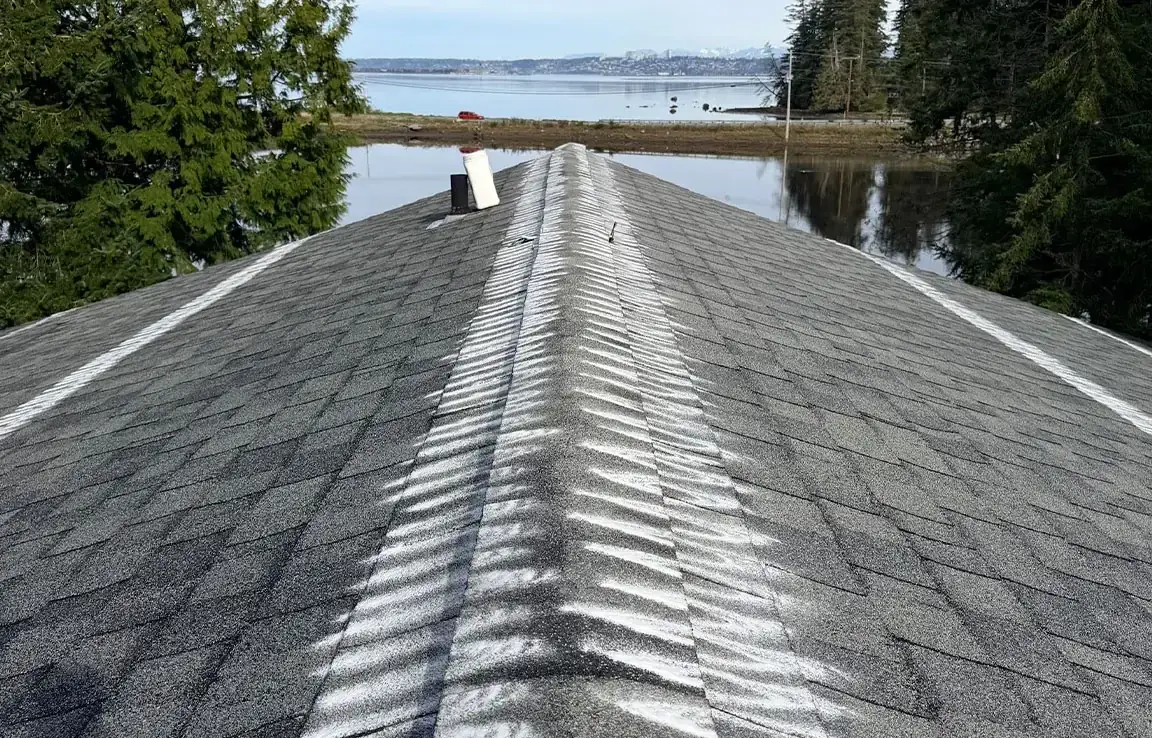
Working safely on a roof
Roof work is the highest-risk thing we do and the risk is not evenly distributed across the year. A wet, mossy, north-facing composition roof in February is one of the more genuinely dangerous working surfaces in residential trades — moss is slick, and the pitch that looks walkable from the ground frequently is not.
Our default is to work off the roof rather than on it wherever the method allows: soft washing is applied at low pressure and can be delivered from ladders and extension equipment on a great many houses without anyone standing on the surface at all. That is better for the operator and better for the roof, because foot traffic on asphalt shingle causes granule loss in its own right — especially on a cold roof, where shingles are brittle, and on a hot one, where they are soft.
Where the roof does have to be walked, it is walked with the right footwear, the right anchor arrangement and an assessment made on the day rather than assumed from the quote. If a roof is not safe to work on in the conditions on the day, we reschedule. That is not us being precious about it.
Where roof cleaning stops and roofing begins
We clean roofs. We do not repair them, and we are careful about the line.
We do not replace shingles, reseal flashings, repair valleys or ridge caps, address leaks, or carry out roof inspections or condition reports. If we can see something — lifted shingles, exposed nail heads, damaged flashing, deteriorated ridge — we will tell you, as an observation from someone who was standing on the roof. That is not an assessment and it is not a substitute for a roofer.
We will also tell you when a roof should not be cleaned. A roof near the end of its service life, with widespread granule loss, curling or brittle shingles, can be damaged by any cleaning method, and cleaning it does not extend it in a way that justifies the spend. That conversation happens at the quote.
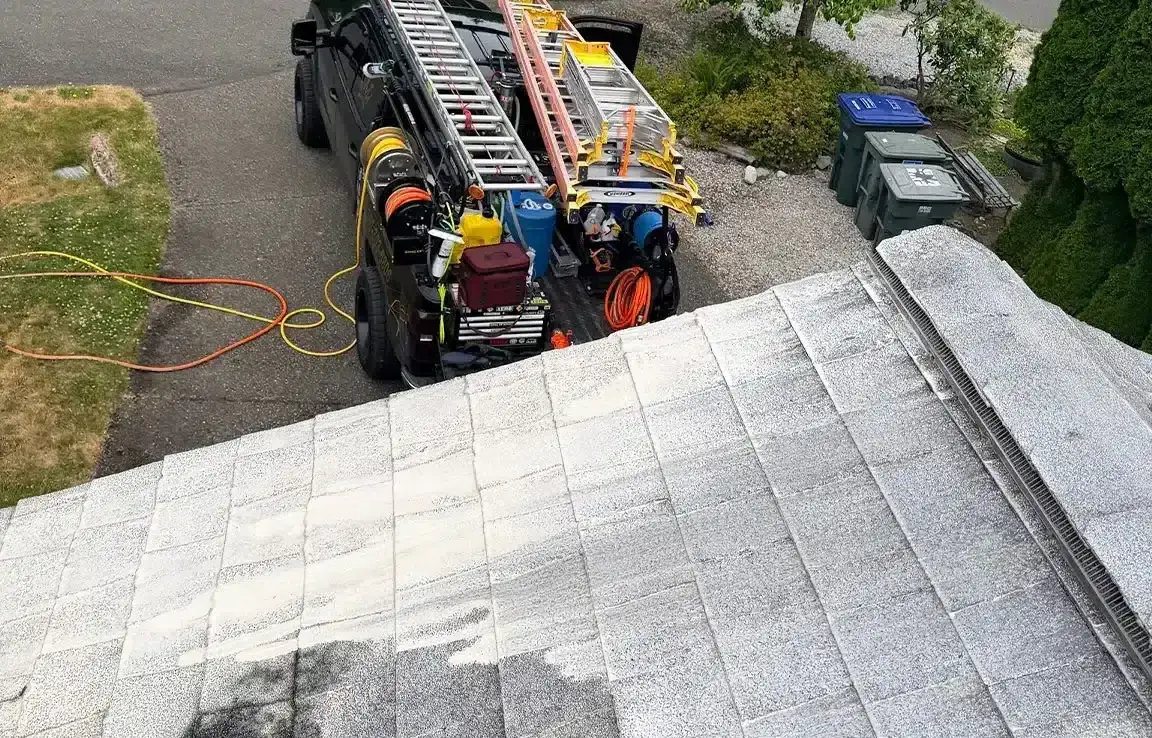
The right order of work
If several things need doing, sequence matters, and getting it wrong means paying twice:
- Roof first. It is the highest surface, and everything that comes off it lands on everything below.
- Gutters second — gutter cleaning — because roof work puts material into them.
- Siding third — house washing — to take off what the first two steps deposited, plus the staining underneath.
- Windows last — window cleaning — because glass is the surface that shows a mistake made above it.
Booking them together is generally cheaper and always less disruptive than four separate visits, because access is set up once.
What each visit covers
| Visit type | What is included | Typical interval here |
|---|---|---|
| Debris clear | Needles and organic matter blown or hand-cleared from field, valleys and around penetrations | Two or three times a year under conifers |
| Soft wash treatment | Algae and biological growth killed with chemistry at low pressure, left to weather off | Three to five years, set by shade rather than appearance |
| Combined roof and gutter | Treatment plus a gutter clean timed for the debris fall afterwards | The usual booking — see below for why |
| Inspection only | Condition report on granule loss, curling, flashings and valleys | Where the roof may be past cleaning |
Never pressure. A composition shingle is a mat coated in adhered granules and the granules are the service life.
Where we do it
Roof cleaning is available in the Tier 1 and Tier 2 markets across Whatcom and Skagit County. Roof growth genuinely varies with rainfall, elevation and tree cover, and it varies a lot — a roof in Glacier is on a different cycle from a roof in Blaine. Your town’s page has the local picture.
If you are not sure what is growing on yours, send a photograph before booking. Algae, lichen and moss look much the same from a driveway and they are three different treatments on three different timelines, and knowing which you are dealing with changes both the quote and what we can honestly promise you about how the roof will look afterwards.
The surfaces this work touches
Roof Cleaning & Debris Removal where you live
Whatcom County
- Roof cleaning in Bellingham
- Roof cleaning in Ferndale
- Roof cleaning in Lynden
- Roof cleaning in Blaine
- Roof cleaning in Everson
- Roof cleaning in Sudden Valley
Skagit County
We also cover Sedro-Woolley, Semiahmoo, Custer, Nooksack, Sumas, Deming, Acme, Maple Falls, Glacier, Kendall, Van Zandt, La Conner, Lyman, Edison, Bow, Alger, Clear Lake, Big Lake, Conway, Concrete, Hamilton, Bay View, Oak Harbor, Point Roberts, Lummi Island, Marietta, Geneva, Wickersham, Rockport, Samish Island and Guemes Island from these bases. Those areas do not have their own page — if you are not sure whether you are inside the area, call and ask.
Roof cleaning questions
- Will you pressure wash my roof?
- No, and you should be wary of anyone who offers to. High pressure blasts the protective granules off asphalt shingles, drives water under the courses, and voids most manufacturer warranties outright. It looks dramatic and it takes years off the roof. Soft washing achieves the same visual result without the damage.
- What is soft washing?
- Low pressure — roughly what a garden hose delivers — combined with a cleaning solution that does the work chemically instead of mechanically. The solution is applied, given time to dwell and kill the growth, then rinsed gently. The organic matter releases on its own over the following weeks rather than being scoured off.
- What are the black streaks on my roof?
- Almost always Gloeocapsa magma, a cyanobacteria that feeds on the limestone filler in asphalt shingles. It spreads in the direction water runs, which is why the streaks are vertical and why they start near the ridge. It is not dirt and it will not wash off with water — it is a living organism and it has to be killed.
- How long does the result last?
- Typically three to five years on a treated roof in this climate, depending on shade, tree cover and elevation. A roof under heavy conifer cover in the foothills will regrow faster than an exposed roof on the flats. It is a maintenance cycle, not a permanent fix, and anyone promising permanent is overselling.
- Will it hurt my plants?
- Not if the job is done properly. Planting beneath the work area is pre-wetted and rinsed afterwards, and sensitive planting is covered. Runoff is managed. This is the part of the job that separates careful operators from fast ones, and it is worth asking any contractor how they handle it.
- Can you clean a cedar shake roof?
- Yes, and it needs a different approach from asphalt — gentler solution, more care about saturation, and realistic expectations about what a weathered shake roof will look like afterwards. Cedar that has gone silver is not going to come back to fresh cedar colour, and we will say so before starting rather than after.
- Does roof cleaning fix my gutters filling up?
- It substantially reduces it, because most of what fills a gutter came off the roof. Clearing the roof of moss and debris and then clearing the gutters is the right order — doing the gutters first means doing them again.
- Is my roof too old to clean?
- Sometimes, and we would rather tell you at the quote. A roof at the end of its life with widespread granule loss, curling or brittleness can be damaged by any cleaning, and cleaning it will not extend it meaningfully. In that situation the honest advice is to spend the money on the roof, not on washing it.