Whatcom County
Roof Cleaning & Debris Removal in Sudden Valley, WA
The short answer
Shaded Sudden Valley roofs grow moss and algae, and whatever rinses off them heads toward Lake Whatcom, a drinking-water lake already on the state's polluted-waters list. We soft wash at low pressure with a solution suited to the roofing, protect planting, and plan the rinse so it stays out of the storm drains.

Randy Fee — Owner, King of Kings Window Cleaning
Washington business licence, UBI 605476674 · L&I insured · BBB rated A
Randy runs the company himself, so you are dealing with the owner, not a call centre — and every technician here is personally trained by him. Working Whatcom and Skagit County since 2024.
I run the Sudden Valley route personally.
A roof in Sudden Valley has two jobs that pull against each other. It has to shed rain from a house that often sits in shade, which is the exact setting moss and algae prefer. And everything that rinses off it, whether rain or a cleaning crew’s water, is on its way toward Lake Whatcom.
Cleaning a roof here means solving the first problem without adding to the second. That shapes the method, the timing and the order of work on every Sudden Valley roof we take on.
What grows on Sudden Valley roofs, and why?
Moss, algae and lichen, in roughly that order of how often we see them on a shaded roof. Shade keeps a roof damp for hours or days after rain, and that damp is what they all need.
- Moss settles first in the grooves between shingles and on the north side of the ridge, then spreads into cushions that hold water against the roof and lift the edges of the courses.
- Algae shows as dark vertical streaks running down from the ridge. On composition shingle it feeds partly on the filler in the shingle and spreads with the water flow.
- Lichen forms flat grey or pale-green rosettes that grip the surface hard and are slow to release even once they are dead.
A good many homes in the community sit under canopy, and on a watershed lot most of those trees are staying. Whatcom County requires a Tree Removal Permit to remove any tree in the Lake Whatcom watershed unless it is part of an approved development. So the shade that grows the moss is, for most owners, part of the house, and the realistic plan is to treat the roof on a sensible interval rather than to remove the cause.
Why does the lake matter most on a roof job?
Because the roof is the largest surface on the house and it is designed to send every drop of water in one direction: into the gutters, down the downspouts and away. On a roof-cleaning day that efficiency works against you, since whatever the rinse carries off the shingles gets delivered quickly to wherever the downspouts discharge.
Lake Whatcom has been on Washington’s 303(d) list of polluted waters since 1998, when it failed the state standard for dissolved oxygen, and it is under a cleanup plan for phosphorus and bacteria. The lake is also the drinking water source for more than 120,000 people. Whatcom County names the Sudden Valley Community Association as the largest development in the watershed and is building stormwater projects there to cut the phosphorus that reaches the lake.
Dead moss and algae are organic matter. Roof grit carries whatever has settled on the roof. Cleaning solution, however carefully applied, is something the lake does not need. None of that should reach a storm drain, and on a roof the drainage system is built in, so the plan has to start at the downspouts.
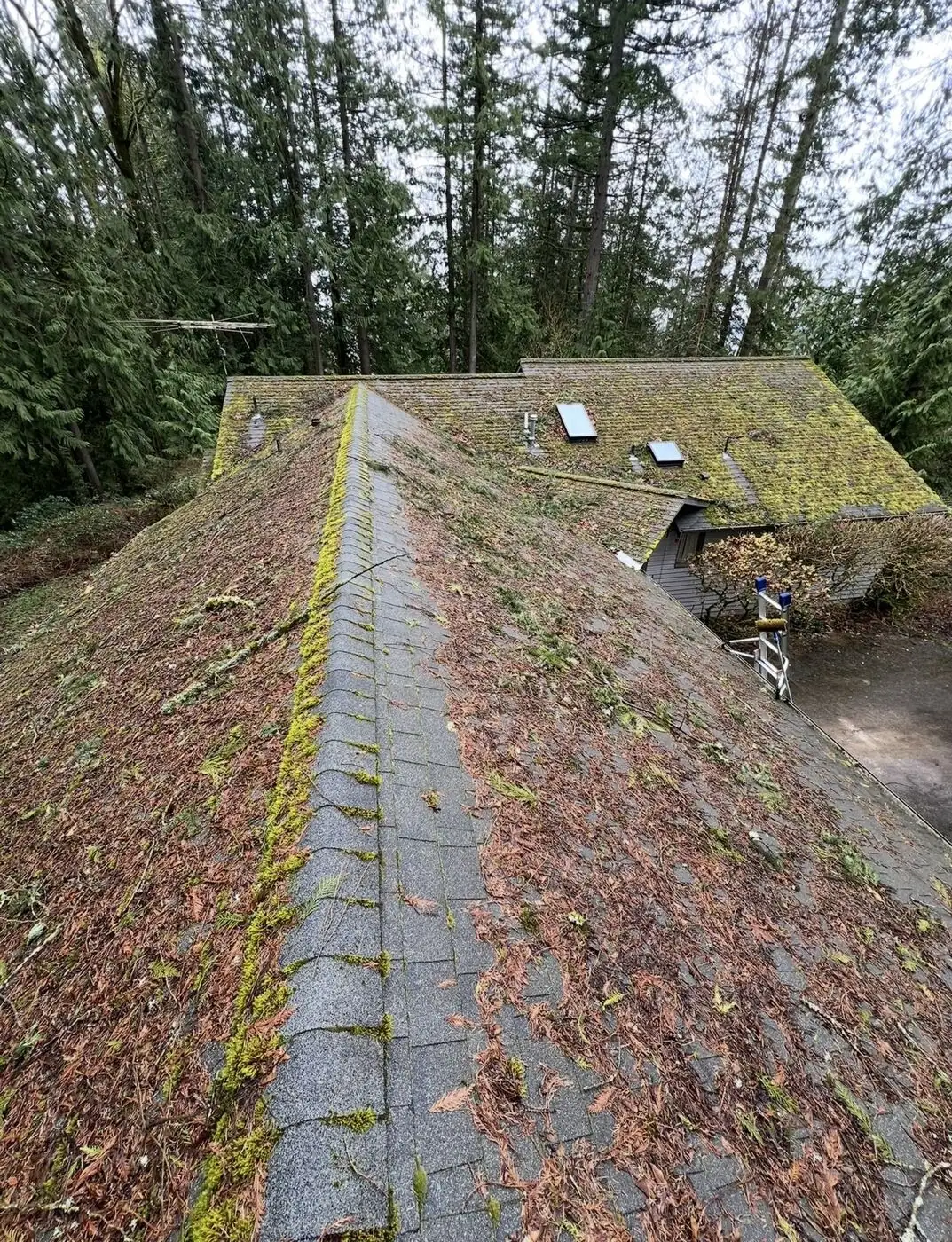 Before
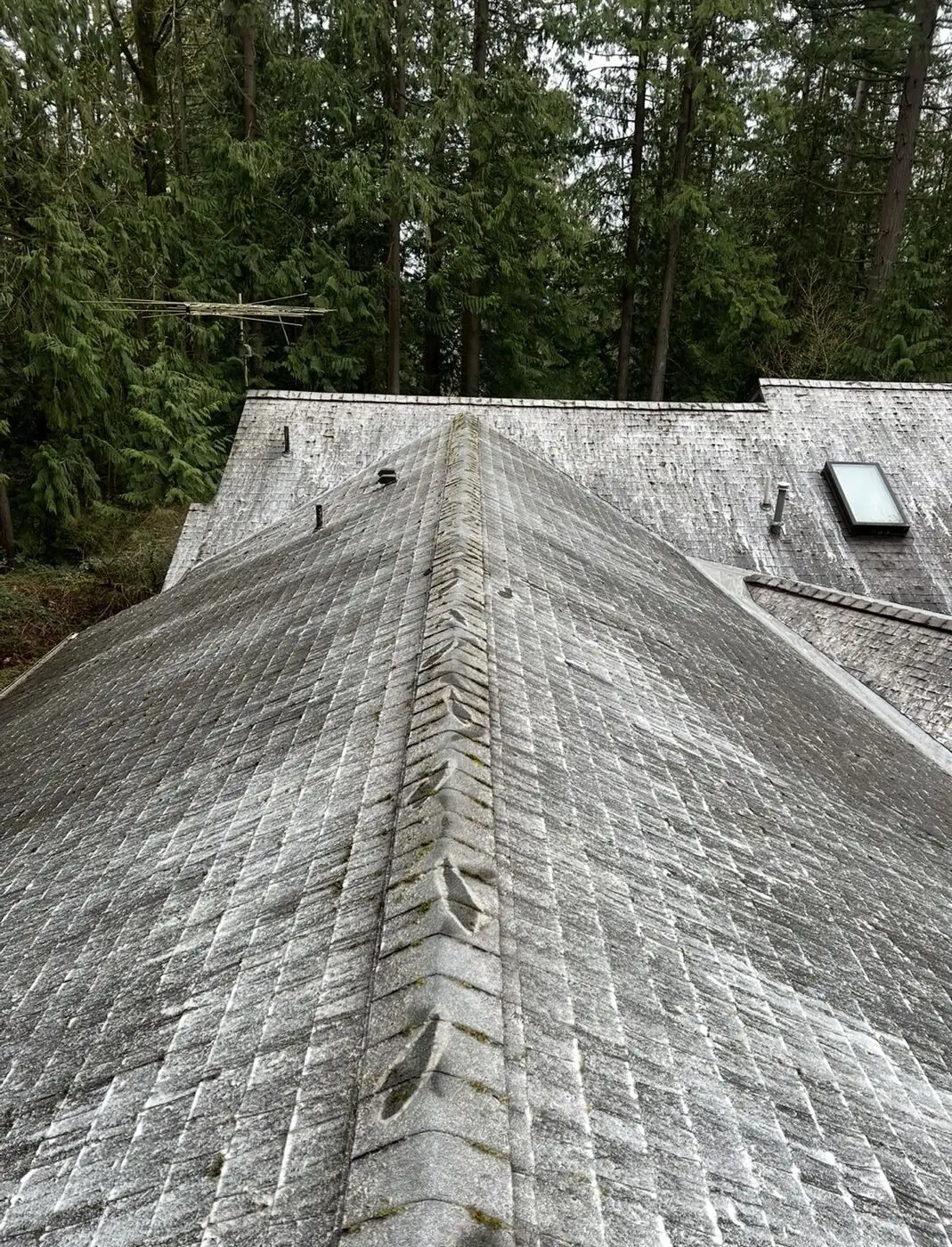 After
How is a Sudden Valley roof cleaned?
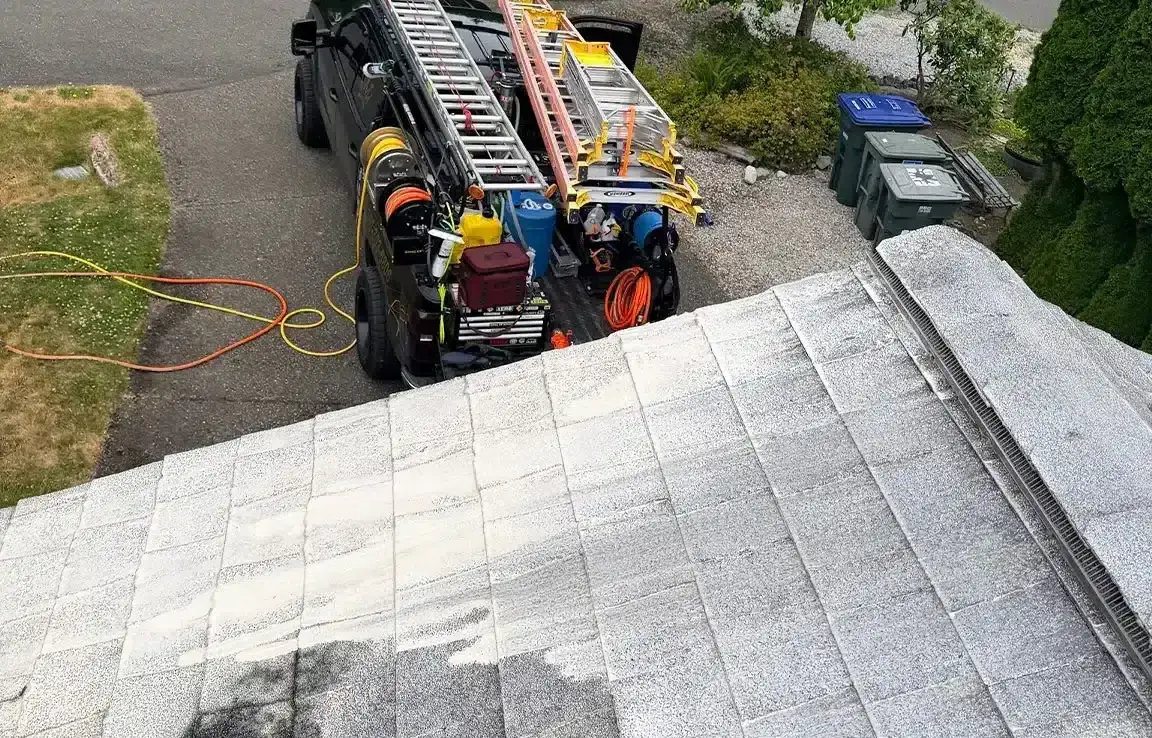
By soft washing, which swaps pressure for chemistry and patience. The solution is chosen for the roofing material, applied at roughly garden-hose pressure, given time to kill what is growing, and rinsed gently. Nobody walks the roof with a pressure wand, and nobody scrapes it.
The material changes the details:
- Composition shingle tolerates a standard soft-wash approach, but its granules are its weather protection and must not be blasted off. The composition asphalt shingle profile explains why.
- Cedar shake and shingle needs a gentler solution and more care still, because the wood fibres lift and fur under force. See the cedar shake roof profile.
- Metal roofing is treated on its own terms, with attention to the coating and the seams.
What you see on the day is not the finished result. Algae streaking usually lifts right away. Thick moss dies, goes brown and loosens over the next few weeks of weather. A roof that looks fully clean an hour after the truck leaves has usually been scraped or pressure washed, and it has lost something doing it.
How do we keep roof runoff away from the drains?
With a routine set up before the solution comes out, and the steps are the same on every Sudden Valley roof:
- Walk the lot first to see where each downspout discharges and where the ground falls, because a driveway that runs to the road is a different problem from a lawn that holds water.
- Deal with the downspouts that empty into a buried line or onto paving, redirecting them onto soil or recovering the rinse where the job allows.
- Cover drain inlets within reach of the work area.
- Soak planting below the roof with clean water before anything is applied, and rinse it again afterwards.
- Apply only what the roof needs, working in sections rather than flooding the whole slope at once.
- Bag the loose moss and debris that comes down, rather than washing it off the edge.
Whatcom County’s washing guidance cites WCC 16.36.050 and asks that wash water be collected and kept out of storm drains and waterways. Our fuller reasoning is on the wash water and storm drains page.

What does a roof clean include?
A standard roof visit covers:
- A look at the roof and gutters from the ground and the ladder before any work starts, with anything that looks like damage pointed out to you.
- Loose moss and debris cleared from valleys and the roof edge by hand.
- Soft wash treatment of the whole roof surface for moss, algae and lichen.
- A gentle rinse where the material and the conditions call for it.
- Protection and rinsing of planting, paths and siding below.
- A clear explanation of what the roof will look like over the following weeks.
Gutters fill with dead moss as a treated roof clears, so most owners book the Sudden Valley gutter cleaning for the same day or a few weeks afterwards.
What drives the cost of roof cleaning here?
The number comes from a visit, and these are the things that move it:
- Roof area, which sets how much solution and time the job takes.
- Pitch and height. A steep two-storey roof needs more setup and more care.
- Material. Cedar is slower and more careful work than composition.
- Amount of growth. Heavy moss cushions take more clearing and treatment than a light green film.
- Runoff control. Downspouts to redirect, drains to cover and planting to protect all add setup time on a watershed lot.
- Access around decks, banks and planting beds.
A roof kept on a regular interval costs less per visit than one left until the moss is lifting shingles.

When is the right time to clean a roof in Sudden Valley?
During a dry spell, whatever the month. The solution needs time on the roof to work, and a heavy shower too soon afterwards washes it off before it has done its job, sending it into the gutters with nothing gained. We watch the forecast and move the date rather than treat a roof with rain on the way.
Spring and early autumn tend to give the most usable weather. Spring treatment means the moss is dead and loosening through the drier months. Early autumn treatment knocks growth back before the long wet season. A hard frost is a reason to wait, because a wet roof at freezing is no place for a technician or a solution.
How long does a treated roof stay clean here?
Longer in sun, shorter in shade, and the trees decide most of it. A roof with open sky above it dries quickly after each shower, and growth takes a long time to come back. A roof under canopy that the owner cannot or will not thin stays damp, and spores find it again sooner. There is no honest single number for the whole community, which is why we would rather look at your roof and your trees and give you an interval for that house.
Two habits stretch the gap between treatments. Keeping the gutters and valleys clear stops debris from holding water on the lower courses, where regrowth usually starts. And catching early green film with a light treatment is far easier on the roof, and on the budget, than waiting for thick cushions to form again.
Do I need to check anything with the association?
Possibly. We have not been able to read the Sudden Valley Community Association’s current rules, and we make no claim about what they cover. If you want certainty on any part of the job, or you are weighing a re-roof after we point out wear, check with the association first.
What related problems should Sudden Valley owners watch for?
Moss that has been growing for years does more than look untidy. Its cushions lift shingle edges and let water work underneath, and the damage is often hidden until the moss is gone. The page on moss under shingles sets out what to look for. We will show you anything we notice, but we are cleaners, not roof inspectors, and a lifted or cracked shingle is a roofer’s call.
Siding under a mossy roof often grows its own green film, and dirty glass below an untreated roof streaks every time it rains, so a roof clean is often the first job in a sequence rather than the only one.
How do I book roof cleaning in Sudden Valley?
Ring (360) 303-6806 and let us know the house is in Sudden Valley. We come and look at the roof, the trees over it and the way the lot drains, then quote the work with the runoff plan included. The owner trains every technician who goes up a ladder for us, and we work under a Washington State business licence and Labor & Industries coverage. More about the service in general is on the main roof cleaning page.
Roof cleaning questions from Sudden Valley homeowners
- Will you pressure wash my roof?
- No. High pressure strips the protective granules from composition shingle, splinters cedar and pushes water up under the courses. We soft wash instead, with low pressure and a solution matched to the roofing, and let time do what force would otherwise do badly.
- Why is the moss still there the day after cleaning?
- Because it has been killed, not scraped. Dead moss turns brown, loosens and weathers off with the rain over the following weeks. Removing thick moss entirely on the day means scraping or blasting it, and both cost roof life.
- What happens to the runoff from my roof?
- It is planned before we start. Downspouts that empty to a drain line are dealt with first, planting below is soaked with clean water, and the rinse is steered onto soil rather than paving, so none of it travels to the storm drains that lead toward Lake Whatcom.
- How often will a Sudden Valley roof need treating?
- It depends on shade more than anything. A roof in open sun may go several years between treatments. One under canopy that cannot be cut back will grow again sooner, and we will give you a realistic interval for your house rather than a sales number.
- Can you clean a cedar roof?
- Yes, gently. Cedar takes a milder approach than composition shingle, with lower solution strength and no scrubbing or pressure at all. We identify the roof on the quote and explain what the treatment will and will not achieve.
- Do I need association sign-off for roof cleaning?
- We have not been able to read the Sudden Valley Community Association's current rules, so we cannot say. If you want to be certain, ask the association before the work is booked.
- Can you tell me whether my roof needs replacing?
- No. We are cleaners, not roofing inspectors. If we see lifted shingles, soft spots or exposed underlayment while we work, we will show you, and the next call should be to a roofer.