Skagit County
Exterior Cleaning in Mount Vernon, WA
The short answer
We clean windows, gutters, roofs, siding, concrete and solar panels across Mount Vernon, the Skagit County seat. The town sits on the Skagit River delta, gets about 32 inches of precipitation a year at the nearest long-record station, and has a housing stock that runs from pre-1939 homes to newer builds, so no two jobs start from the same surface.

Randy Fee — Owner, King of Kings Window Cleaning
Washington business licence, UBI 605476674 · L&I insured · BBB rated A
Randy runs the company himself, so you are dealing with the owner, not a call centre — and every technician here is personally trained by him. Working Whatcom and Skagit County since 2024.
We run the Mount Vernon route on a regular rotation.
Mount Vernon is a river town. The historic downtown sits within the Skagit River delta, the city built its downtown floodwall in phases between 2010 and 2018, and the valley around it grows about 1,000 acres of tulips and daffodils each year.
For a house, that setting means damp ground, long wet winters and a lot of growth on anything that stays in shade. It is the southern end of our regular route, and we treat it as its own market rather than an extension of Whatcom.
What are Mount Vernon’s homes like?
A broad mix, with a solid core of single-family houses. The census counts 13,623 housing units, about 61% of them single-family detached, and 833 mobile homes. The median build year is 1989, but roughly one home in ten (1,309 units) predates 1940, which gives the city far more old painted wood than a quick look at the median would suggest.
City documents name two areas in particular: the historic downtown district and the Eaglemont community development, which contains Beaver Pond. Across the city, about 60% of occupied homes are lived in by their owners, which leaves a sizeable rented share. If you let a house here, we can schedule exterior work around your tenants and send you the result, since the owner is not always the one standing in the driveway.
What that means on a quote:
- Pre-war houses often have painted lap siding, original trim and older glass, all of which want a light hand
- Homes from recent decades, where half the stock falls around a 1989 median, are mostly straightforward soft-wash and pole work
- Manufactured homes get the same methods, with the roof assessed before anyone steps on it
How wet is Mount Vernon, and what does the river add?
The Mt Vernon 3 WNW weather station averaged 32.58 inches of precipitation a year across its 1956 to 2005 record. November was the wettest month at 4.48 inches and July the driest at 1.16 inches, which tells you when growth builds and when surfaces finally dry out.
The Skagit adds its own pressure. It has flooded numerous times since 1897, and in December 2025 an atmospheric river pushed it to a record crest of 37.73 feet in Mount Vernon. The city’s parks plan marks sizable flood-prone areas across most of downtown and the west side, along the river and the Kulshan Creek, Carpenter Creek and Britt Slough corridors. The river also makes a sharp bend here, known as the Avon Turn.
Low, wet ground keeps walls and concrete damp longer after each storm. That is the condition algae and moss thrive in, and it is why north walls, shaded driveways and lower siding courses on this side of the county often look older than the house is.
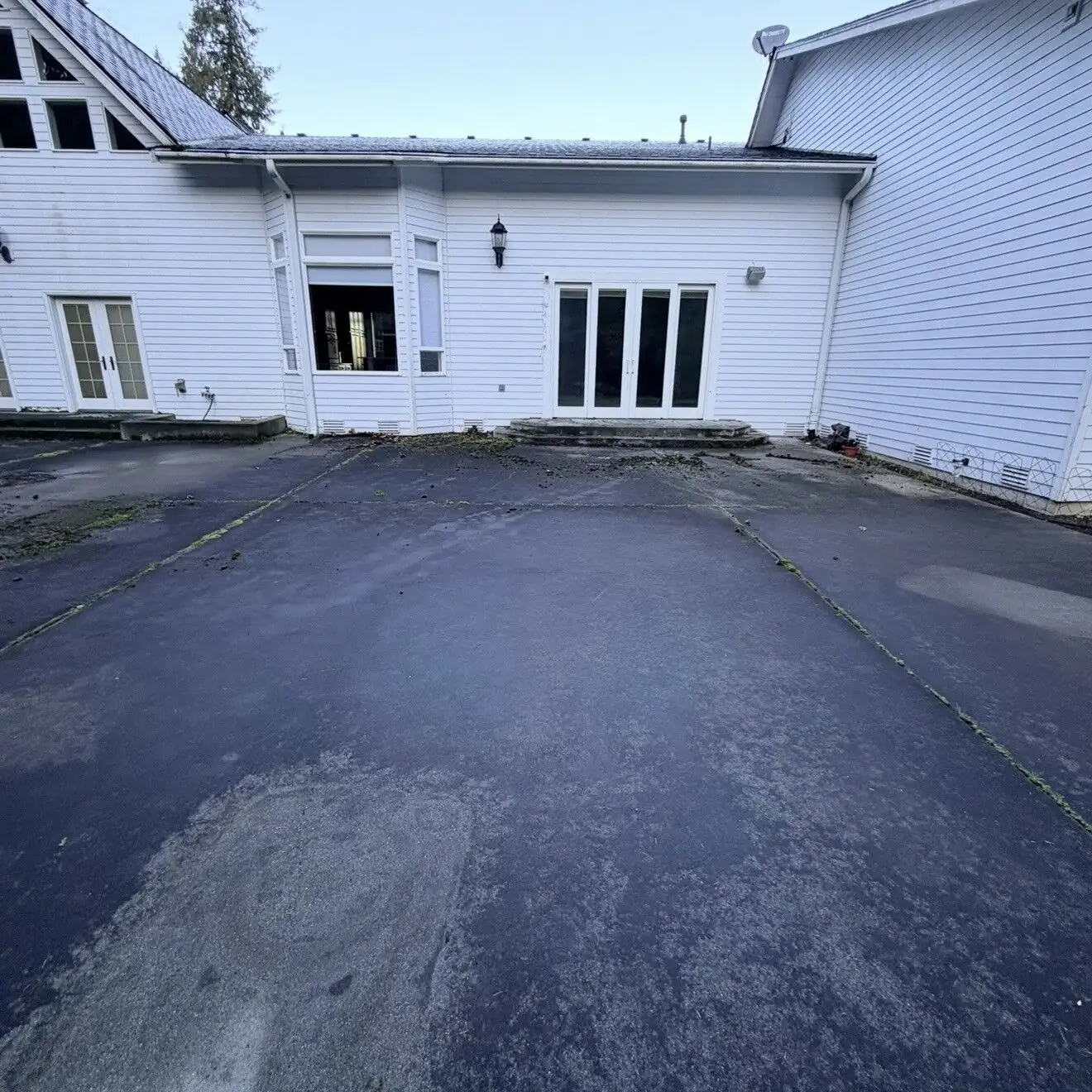
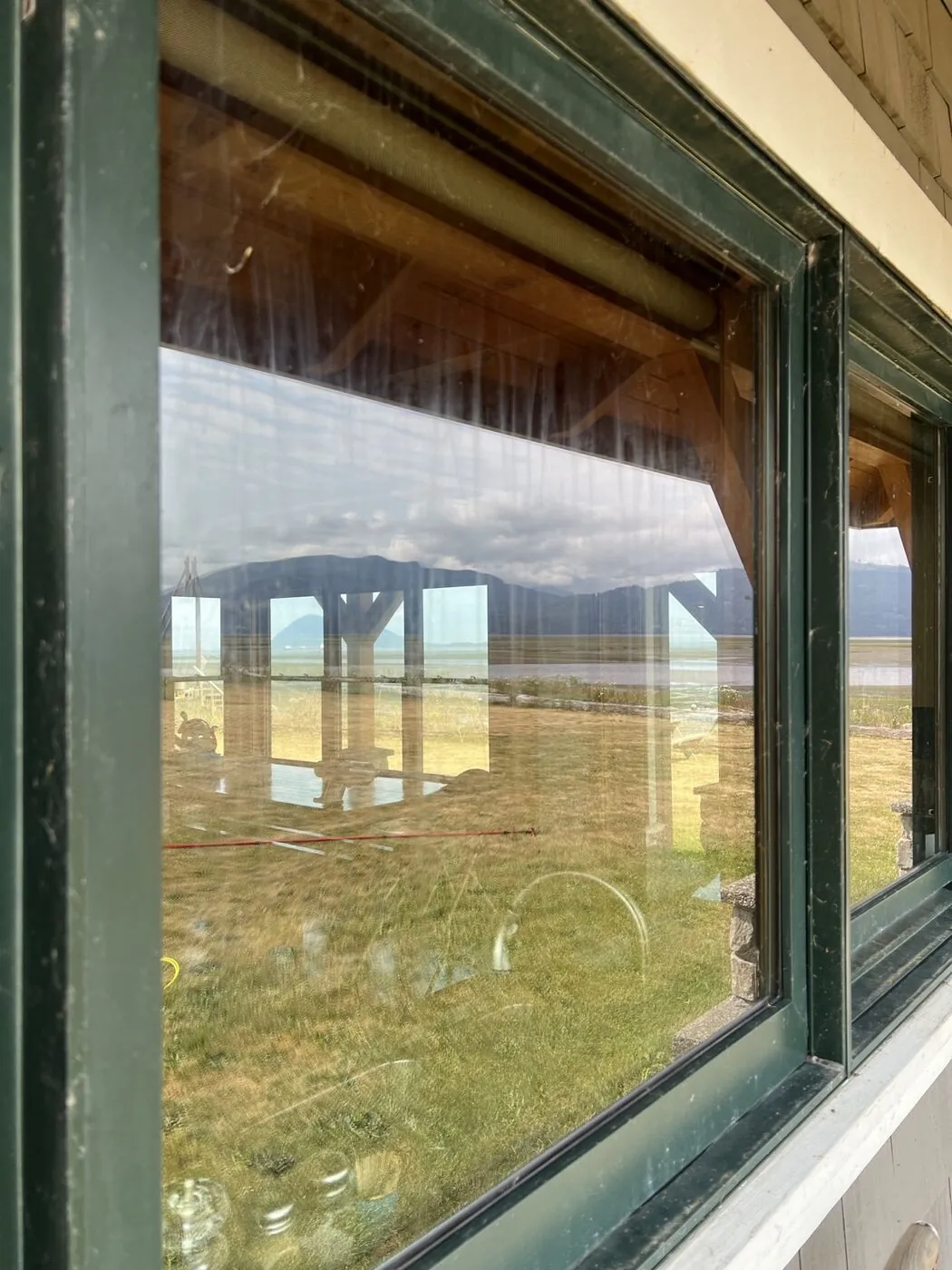 Before
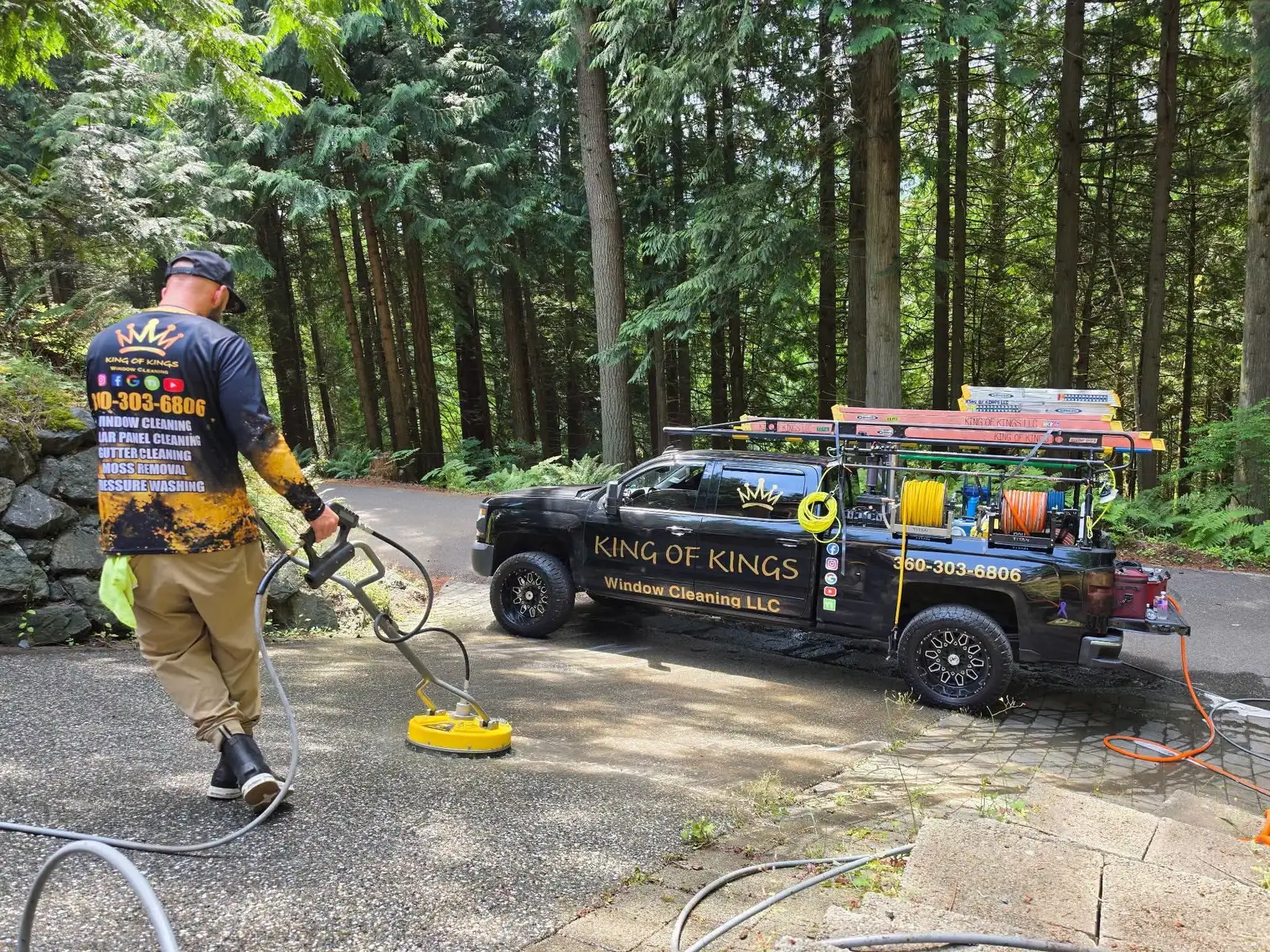
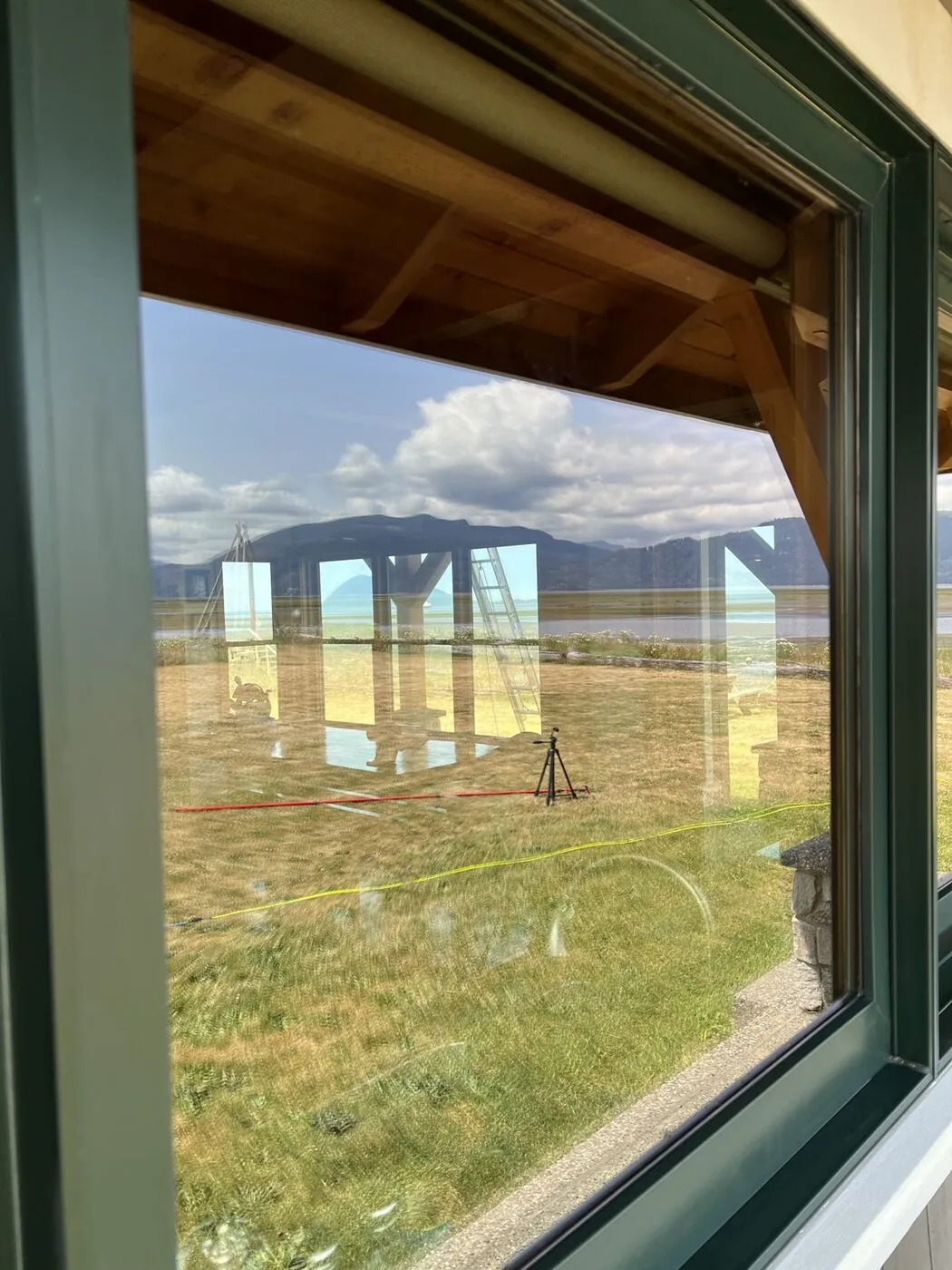 After
What happened on one Mount Vernon driveway?
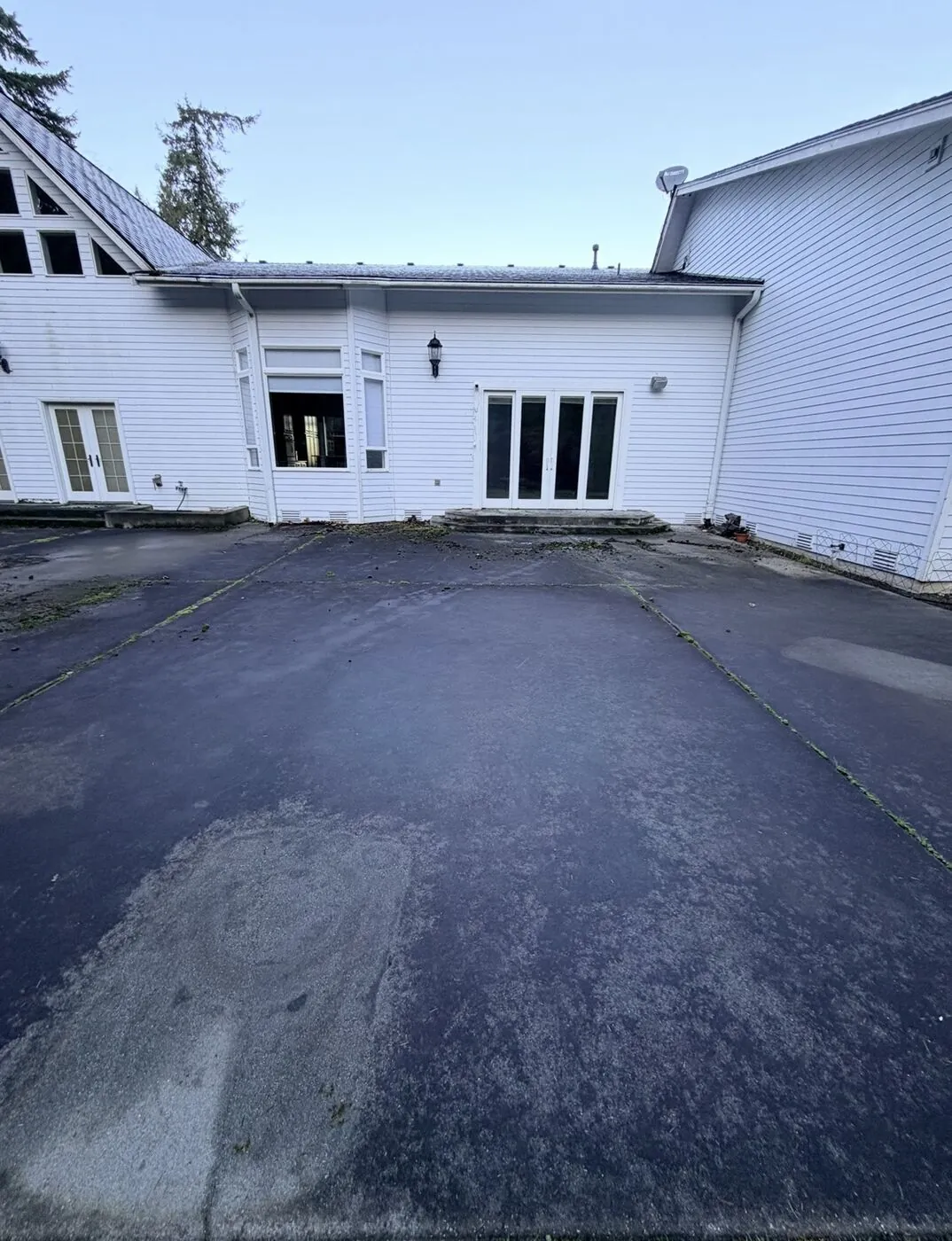
In August 2026 we pressure washed the front entry, garage driveway and walkway at a Mount Vernon home. The concrete had gone almost black with organic growth, the kind of coating that builds on damp concrete over several wet seasons. Before and after photographs were taken on that job.
It is a useful example because many people assume dark concrete is stained for good. Growth sits on the surface and in the pores, and a rotary surface cleaner with a proper rinse takes it off evenly, without the stripes a hand wand leaves. More on how we approach flatwork is on our pressure washing page, which also covers patios, steps and decks.
Window cleaning
Our window cleaning includes interior and exterior glass, screens and tracks. Ground-floor panes get a scrubber and squeegee; upper storeys and glass above decks or conservatories get a water-fed pole.
That pole runs on purified water from the truck. Mount Vernon’s supply is Skagit PUD’s Judy Reservoir system, fed by four streams on Cultus Mountain with a Skagit River diversion as backup, but we could not reach a published hardness figure for it and will not invent one. Carrying our own water keeps the question off your glass entirely.
On older homes with original windows, we slow down around glazing putty and frames that have been through many decades of weather.
Gutter cleaning
Gutters are where a wet November shows up first. Gutter cleaning here means scooping every run by hand, flushing the fine sediment, and running water through each downspout to prove it drains.
On low ground, a blocked downspout does more than overflow. It drops roof water right beside the foundation, where the soil is often already saturated after a storm. We would rather find the clog in October than have you find it in the basement in December.
Most houses here are well served by one cleaning a year in early autumn. Homes under big trees may want a spring visit as well.
Roof cleaning and moss removal
A roof in this valley spends much of the year damp, and shaded pitches grow moss steadily. Roof cleaning is a soft wash matched to the roofing material, and moss removal lifts the growth by hand before treatment, so we are not driving water up under shingles with a pressure wand.
We set the method by what the roof is made of, and we tell you on the quote if a roof looks like it needs a roofer’s attention rather than a clean. We are cleaners, not inspectors, and we will say so rather than guess at what is underneath.
House washing and siding
Siding on the shaded side of a Mount Vernon house often carries a green or black film by late winter. House washing is a low-pressure soft wash: the right solution for the siding, a short dwell, and a gentle rinse from the top down.
On the city’s older painted homes we test a small area before committing to the whole wall, and we point out chalking or peeling paint before the work begins. Vinyl and fiber cement on newer houses take the same approach at a different strength.
Solar panel cleaning
Panels in a wet valley collect a mix of pollen, road film and organic growth around the frame edges. Solar panel cleaning uses purified water and soft brushes, with no abrasives and nobody walking on the array.
Late spring, after the pollen, is a sensible time for panels. If your monitoring shows output drifting down with no obvious cause, dirt is a quick thing to check off before calling the installer.
When is the right time of year to book here?
The station record gives a fair guide. With November the wettest month and July the driest, the valley has a clear drying season, and most exterior work goes better inside it.
- March to May suits roof and moss work, house washing and windows. Growth is easy to see after winter, and walls have a chance to dry once the wash is done.
- Late spring is the moment for solar panels, once pollen has mostly fallen.
- July and August are good for concrete, because a slab dries quickly and the clean result is obvious within the day.
- September and early October are for gutters, ahead of the November rain, and a second round of glass before the short days.
December and January are the months we would rather look than clean. A roof that is green and swollen in the wet is easy to assess, and the quote you get then can be scheduled for the first dry stretch of spring.
What does Mount Vernon’s code say about wash water?
It is strict and specific. Chapter 13.33 of the Mount Vernon Municipal Code covers the drainage system, and three sections matter to exterior cleaning:
- MVMC 13.33.080 prohibits illicit discharges to the public drainage system, and lists soap, detergent, household and commercial cleaning materials and steam-cleaning waste among them.
- MVMC 13.33.080(E) exempts street and sidewalk wash water and routine external building wash-down that uses no detergent.
- MVMC 13.33.150 makes it a violation to let soaps, detergents or washing wastes enter any private drainage system as well as the public one.
That last point is easy to miss. A private yard drain counts, so a crew that rinses soap into it is breaking the rule even if the street grate is untouched.
On the job this means plain water wherever it does the work, drains in the work zone blocked before any solution goes on, and rinse steered to grass or beds. Our wash water and storm drains page lays out how we handle it.
Which neighbouring towns do you serve?
Mount Vernon is part of a Skagit leg that also takes in Burlington and Anacortes. The water connects them too: Skagit PUD bought the systems serving Burlington, Mount Vernon and Sedro-Woolley back in 1939, and the City of Anacortes runs its regional water treatment plant on the east bank of the Skagit near Mount Vernon.
From Whatcom County the same crews come down on a set rotation, so a Skagit booking slots into a planned day rather than waiting for a gap. If your address sits just outside the city and you are unsure whether we cover it, ask and we will tell you plainly.
How do I book?
Phone (360) 303-6806 or request a quote online. We will visit, walk the outside of the house with you, and point out which surfaces have growth, which have staining and which simply need a routine clean.
The price you get covers the work agreed at that walk-round. Randy Fee trains every technician himself, so the person on your roof works to the standard he set, not one borrowed from somewhere else.
What we do in Mount Vernon
Nearby
- Burlington
- Conway (served, no page of its own)
- Big Lake (served, no page of its own)
- La Conner (served, no page of its own)
Mount Vernon questions
- Do you actually come down to Mount Vernon from Bellingham?
- Yes. Skagit County is part of our regular territory, and Mount Vernon sits on the same southern leg of the route as Burlington and Anacortes. A booking here is scheduled into that run rather than treated as a one-off drive.
- My driveway has gone nearly black. Can that come back?
- Usually, yes. Dark concrete on a shaded or damp drive is most often organic growth rather than permanent staining, and a surface cleaner followed by a thorough rinse lifts it. We did exactly that on a Mount Vernon entry, driveway and walkway in August 2026. Oil and rust are different stains, and we will tell you on the quote if we see them.
- Does the flood risk change how you clean a downtown or west-side home?
- It changes what we look at. Low ground holds water longer, so the lower courses of siding and the shaded walls tend to carry more growth, and yard drains matter because the city code covers private drainage as well as public. The cleaning method itself stays the same.
- Will your rinse water be a problem under the Mount Vernon code?
- It should not be. The code exempts a plain-water building wash-down but forbids soaps, detergents and washing wastes from reaching any drainage system, private or public. Where we use a cleaning solution, we block the nearby drains first and steer the rinse onto lawn or planting rather than into a grate.
- Can you clean an older house from before 1939?
- Yes, and older painted wood is where a gentle approach earns its keep. We soft wash rather than blast, test the solution on a small area first, and flag loose or failing paint before we start so nobody assumes the wash caused it.
- Is Skagit PUD water hard enough to spot windows?
- We could not find a published hardness figure for the Judy Reservoir supply, so we will not claim one. For the glass it does not matter, since we clean upper windows with purified water carried in the truck, not water from your outside tap.
- What are your credentials for working in Skagit County?
- The company holds a Washington State business licence and Labor & Industries coverage, which applies across Skagit as it does in Whatcom. If you would like to see the details before the crew starts, just ask.