
Whatcom & Skagit County
Gutter Cleaning in Whatcom & Skagit County
The short answer
King of Kings clears gutters and downspouts across Whatcom and Skagit County — by hand, bagged and taken away, with the downspouts flow-tested before we leave. Conifer needles are the local problem, not leaves, and they need clearing twice a year. Licensed, L&I insured, free on-site quote.

Randy Fee — Owner, King of Kings Window Cleaning
Washington business licence, UBI 605476674 · L&I insured · BBB rated A
Randy runs the company himself, so you are dealing with the owner, not a call centre — and every technician here is personally trained by him. Working Whatcom and Skagit County since 2024.
Gutters are the least interesting part of a house and the most expensive one to ignore. A blocked gutter does not announce itself. It works fine in light rain, overflows in heavy rain when nobody is standing outside watching, and the damage it causes — soaked fascia, wet crawlspace, undermined footings, siding stained from the top down — arrives years later, priced as a structural repair.
In this part of Washington the job is also genuinely different from gutter cleaning in most of the country, for one reason: it is not about leaves.
The local problem is needles, not leaves
Almost every piece of gutter-cleaning advice written for a national audience assumes a deciduous autumn — leaves fall over a few weeks, you clear them, you are done until next year. That model does not describe a house under Douglas fir, western red cedar or hemlock.
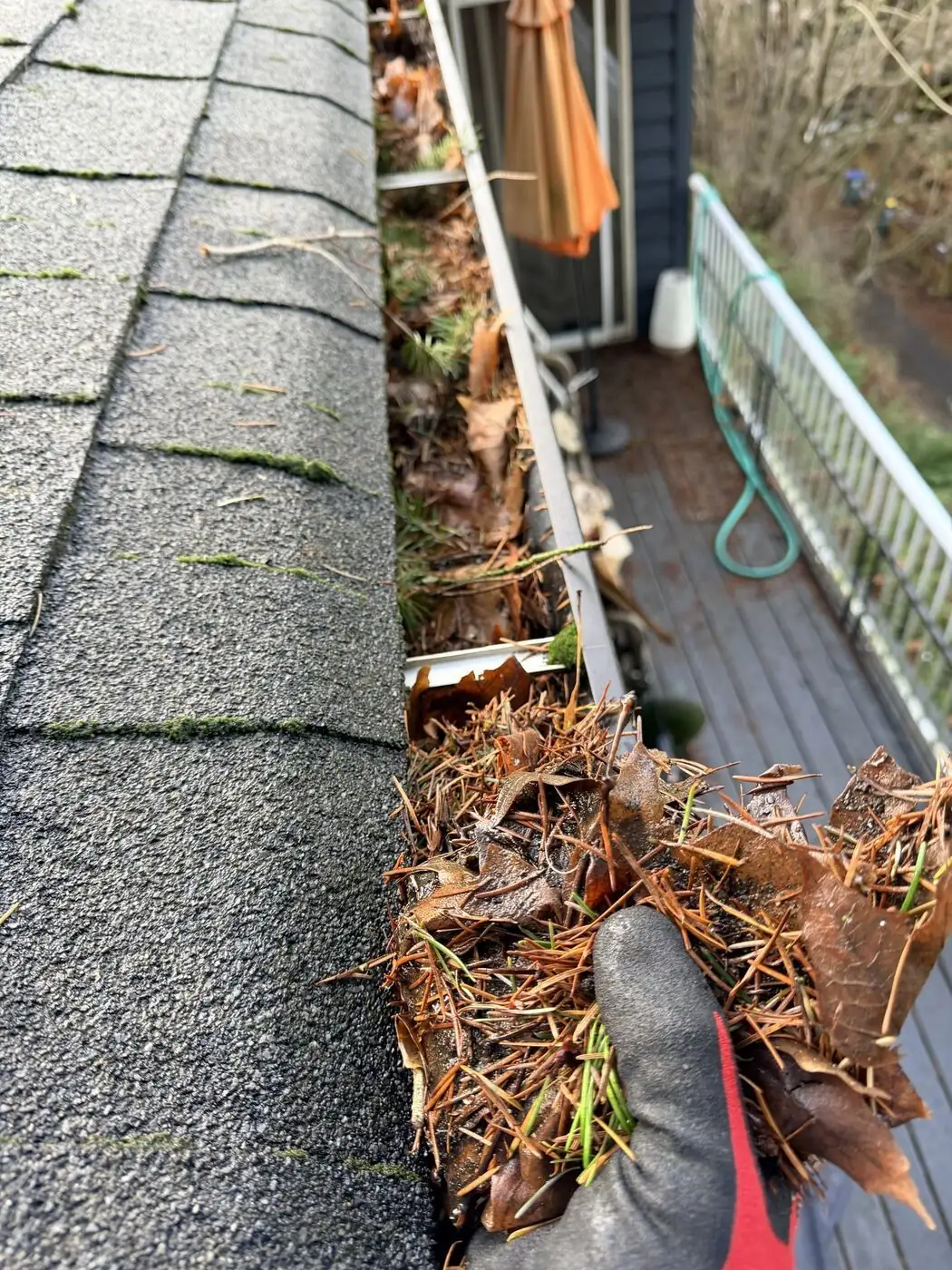
Conifers shed year-round, with a heavier drop in late summer and autumn but never a clean stop. The needles are small, they are stiff, and critically they mat. A layer of fir needles knits into a dense felt that holds water rather than letting it through, packs into the downspout outlet, and forms a plug that a leaf blower will not move. Under that mat, silt accumulates and turns into a soil layer — which is why gutters in this region grow moss, and occasionally grow seedlings.
Big-leaf maple adds a second problem in the neighbourhoods that have it, because the leaves are large enough to bridge a downspout outlet on their own and the seeds get into everything.
The practical consequence: a gutter here can look clear from the ground and be completely blocked. The mat sits at the bottom, below the line of sight from below, and the first evidence is water coming over the front edge in a downpour.
How much water is actually involved
Worth having a number, because the volumes surprise people.
An inch of rain falling on a 1,500 square foot roof is roughly 900 gallons of water. That has to leave the roof, travel the length of the gutter, turn down the downspout and get away from the house. Bellingham sees something on the order of three feet of rain a year; the foothills around Deming, Acme, Maple Falls and Glacier see substantially more.
Every one of those gallons that does not make it into the downspout goes over the front edge of the gutter and lands directly at the base of the wall — the exact place a house is least able to cope with it.
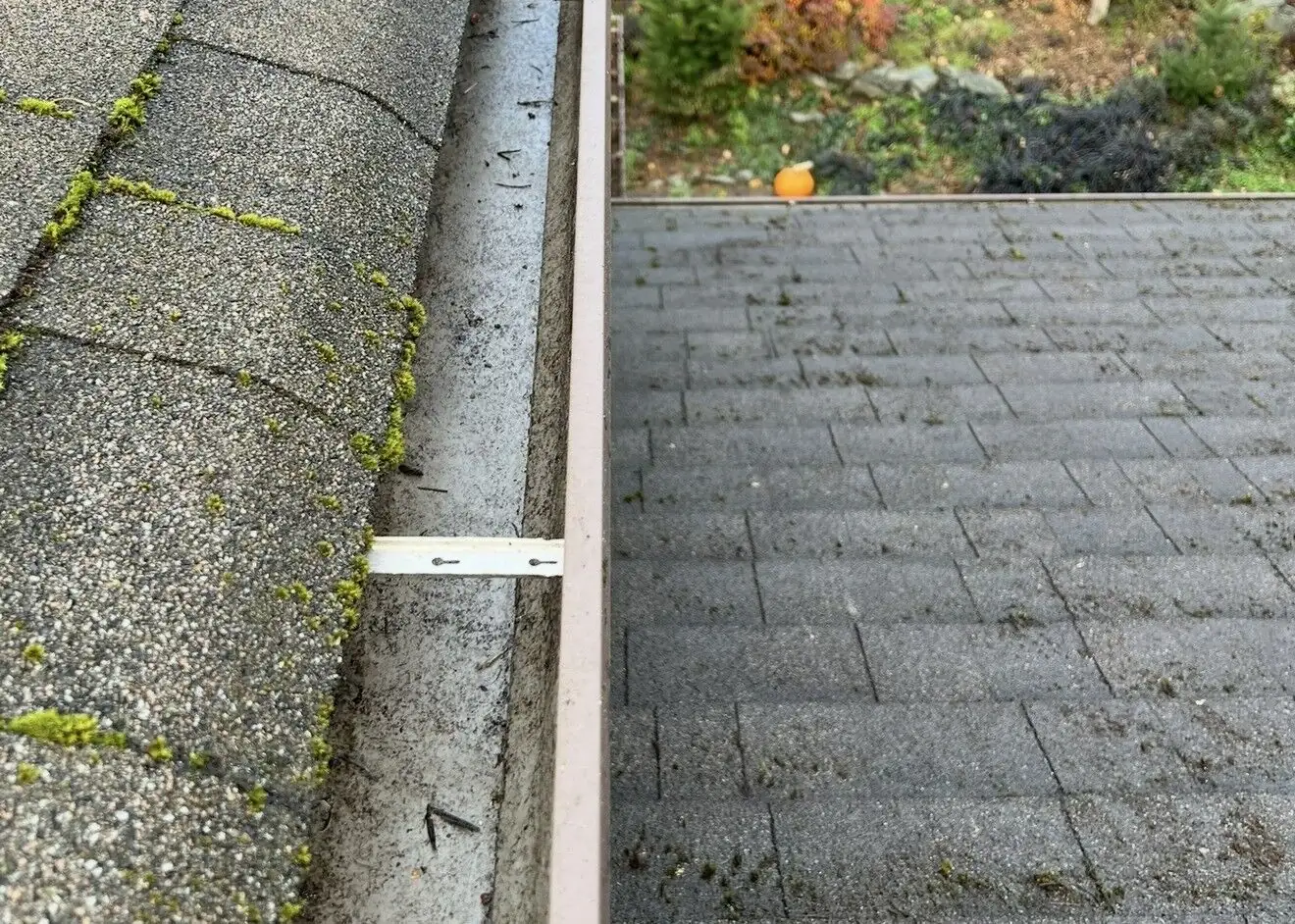
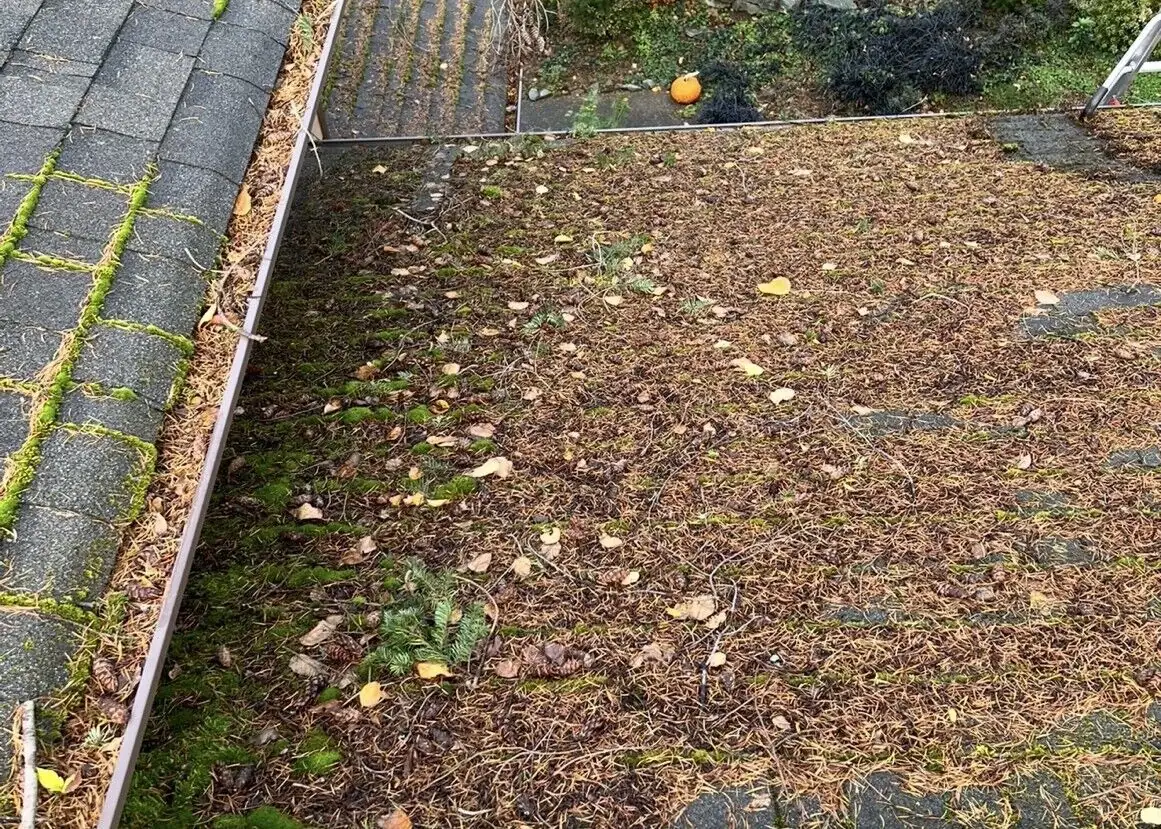 Before
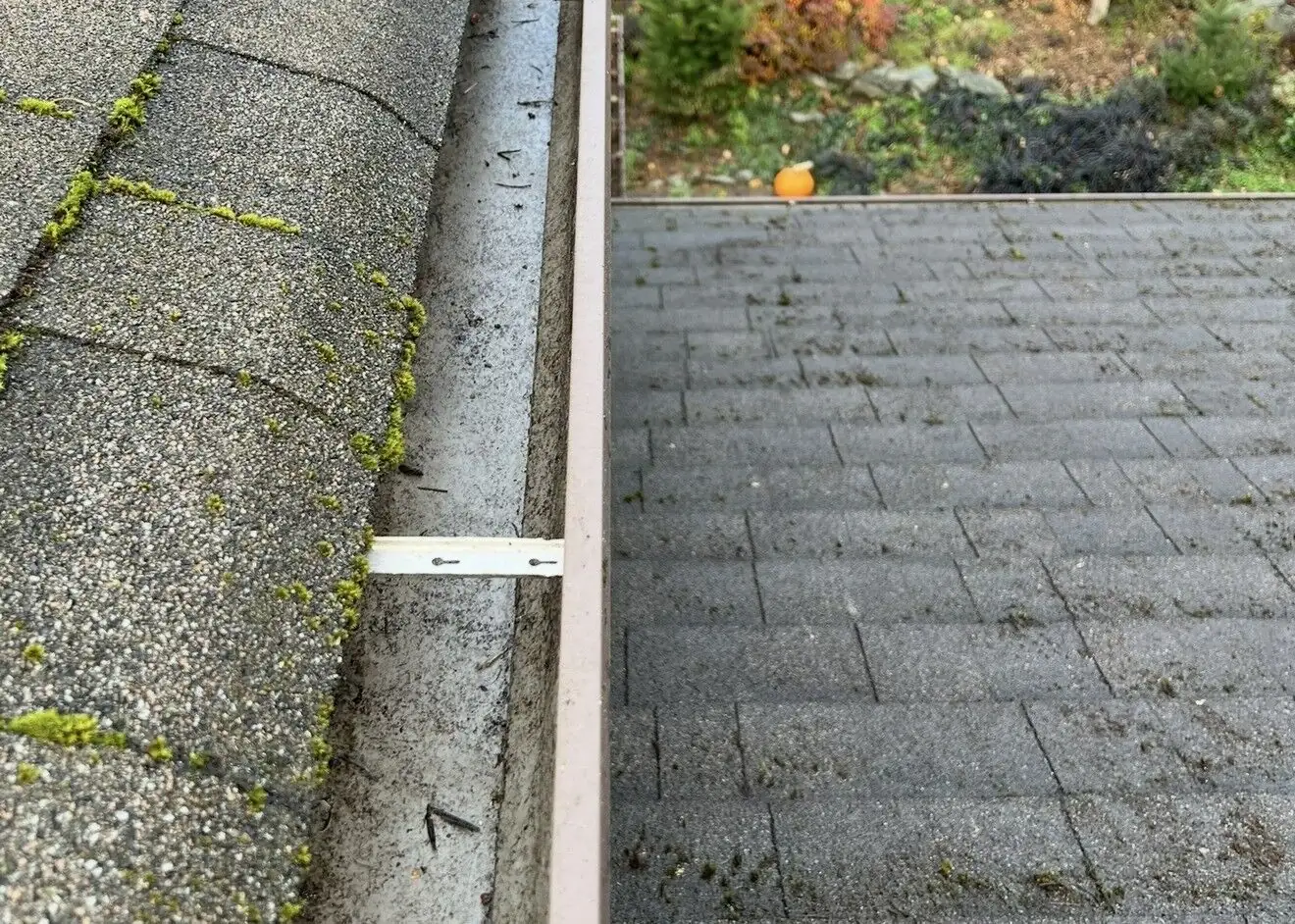 After
What blocked gutters actually damage
In rough order of how expensive the surprise is:
Fascia and soffit. The board behind the gutter stays wet, and wet wood in this climate does what wet wood does. Rot in the fascia often means the gutter’s fixings have nothing sound to hold onto, so the repair is the board and the gutter run.
The wall and the siding. Water sheeting over the front edge runs down the siding, and on the shaded elevations it keeps the surface damp long enough for algae and mildew to establish. Staining that starts under a gutter is a diagnostic sign, not a cleaning problem.
The foundation and the crawlspace. This is the expensive one. Water dumped at the base of a wall saturates the ground against the footing, and in a region with this much winter rain a crawlspace does not dry out between events. Damp crawlspaces bring their own long list of consequences.
The gutter itself. Standing water plus organic debris is corrosive, and a gutter carrying a permanent load of wet silt is heavy enough to pull its own fixings out of the fascia over a few seasons.
Ice, in the foothills. At elevation — Glacier, Maple Falls, Kendall — a gutter holding water going into a freeze is a gutter holding ice, and ice is much heavier and does not care about the fixings.
What the job involves
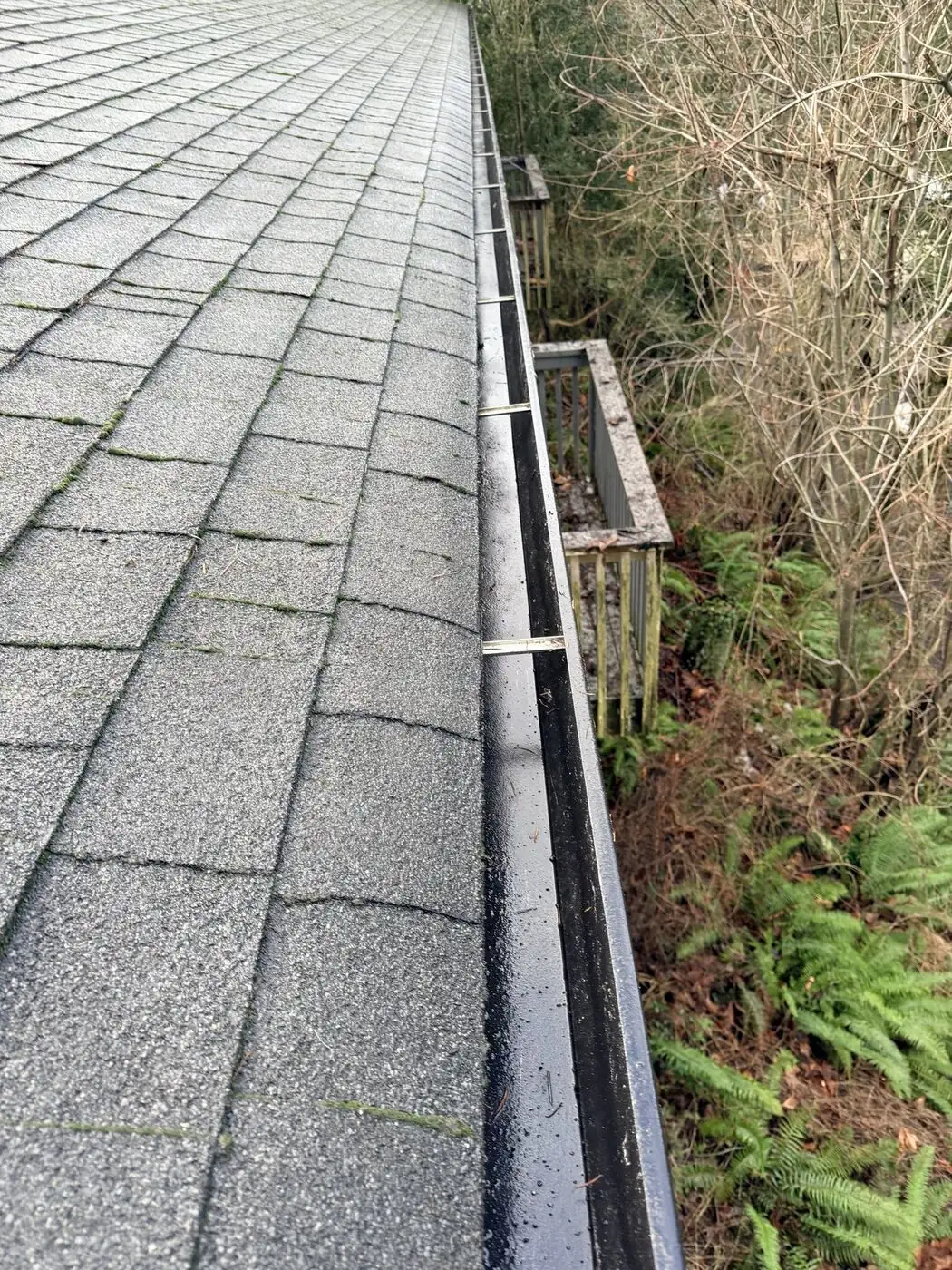
- Hand-clearing the full run, both sides of the house, with debris bagged
- Debris removed from site — not blown onto the roof, the deck or the beds
- Downspouts cleared and flow-tested, every one
- Gutter interiors wiped down of the silt layer where it has built up
- Outlets and elbows checked for the plug that forms just past the bend
- A condition note on anything we can see — loose spikes, separated seams, sagging runs, rust, rot behind the gutter
- Ground left clean, splash rinsed off siding and glass
Quoted separately: gutter brightening (the exterior face), roofs with genuinely difficult access, and buildings over two storeys.
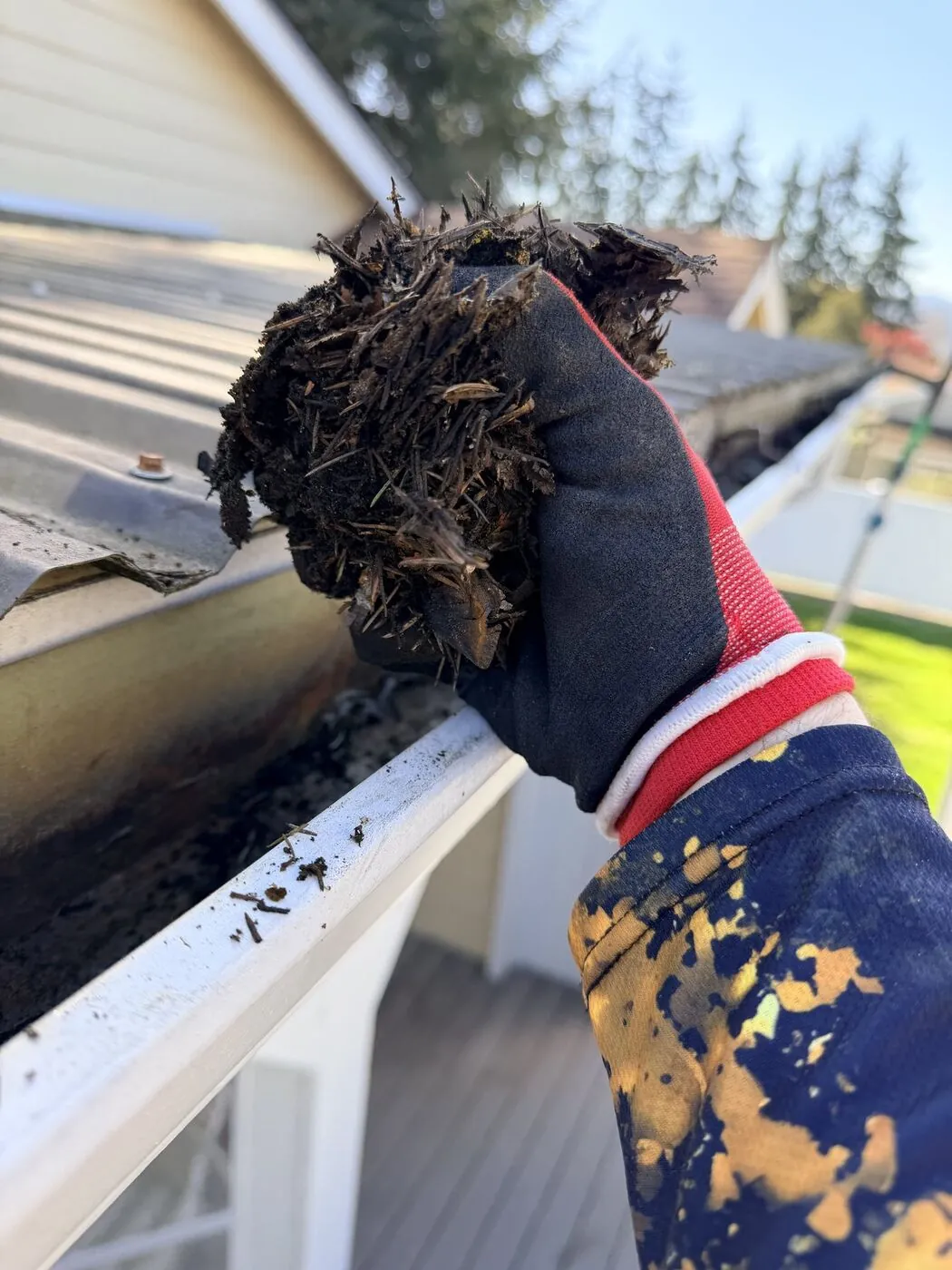
Why hand-clearing rather than blowing
Blowing gutters out is faster, and on a house with light leaf debris it is a legitimate method. It is the wrong method here for three reasons.
First, it does not clear a matted needle plug. A blower moves loose material; a felt of wet fir needles is not loose material.
Second, it puts everything it does move onto the roof, the siding, the windows, the deck and the planting — and on a roof, a redistributed layer of organic debris is exactly what moss wants.
Third, and most usefully, hand-clearing means somebody sees the gutter. Every pulled spike, separated seam, corroded section and soft patch of fascia we have ever flagged was found because someone was looking into the gutter rather than pointing a machine at it from six feet away.
Downspouts are where the failures hide
A gutter is the visible half of the system and the half that gets the attention. Most of the failures are in the other half.
The classic one is a plug at the outlet — the hole in the gutter floor where the downspout starts — or just past the first elbow, where debris travelling in water hits a change of direction and stops. Neither is visible from the ground. Both will let light rain through and back up completely in heavy rain, which is why a homeowner’s experience of a blocked downspout is usually “it was fine and then suddenly it wasn’t”.
Then there are underground lines. A lot of houses here run downspouts into buried pipe going to a storm connection, a dry well or a daylight outlet somewhere down the slope. Those lines block with silt and root intrusion, and when they do, the water has nowhere to go but back up the downspout and over the gutter. We flow-test to the ground and tell you what happens; if it backs up there, the problem is in the buried line and it is a drainage job.
Gutter guards, honestly
Guards are sold as the end of gutter cleaning. In this region they are not, and it is worth being straight about what they do and do not do.
What they do well: keep large deciduous leaves and twigs out, reduce the frequency of clearing, and keep birds and rodents from nesting in the gutter.
What they do not do: stop conifer needles. A fir needle is thin enough to drop through most mesh apertures, and where it does not, needles mat on top of the guard instead — which is worse, because water then runs over the whole assembly rather than into it, and clearing the mat means removing the guard.
Fine grit and shingle granules also pass through nearly everything and build the silt layer underneath, which is where moss starts.
The honest summary: guards are a reasonable investment on a house under deciduous trees, a mixed one under conifers, and never a substitute for someone looking at the system twice a year.
When to book
Late autumn, once the deciduous drop has finished, is the most important visit of the year. Going into a Whatcom or Skagit winter with clear gutters is the whole point of the exercise.
Spring, to clear what came down over winter and the seed and blossom drop that follows.
Under conifers, twice more than that — realistically three to four visits a year on a heavily treed lot. This is the single most common thing homeowners underestimate here.
After a windstorm, if there were trees involved. A big drop event can block a system in one afternoon.
Before listing a house. Overflow staining on siding and a visibly loaded gutter both read as deferred maintenance to a buyer, and both are cheap to resolve.
What we look at while we are up there
Not an inspection, and we are careful to say so. But someone at gutter height with their hands in the system sees things, and we would rather tell you:
- Spikes or hangers pulling out of the fascia
- Seams separating at the corners and joins
- Sagging runs holding standing water, which means the fall is wrong
- Rust or perforation in older steel gutters
- Soft or discoloured fascia behind the gutter line
- Moss and debris on the roof itself, which is where the gutter debris is coming from and which is a roof problem rather than a gutter one
- Downspouts discharging against the foundation rather than away from it — often just a missing extension, and one of the cheapest fixes on any house
What changes the price
Quoted on site. The things that move it:
- Linear feet of gutter, which is the base — a rambler with a simple roofline is a very different number from a house with dormers, valleys and three separate roof planes.
- Storeys and access. Single-storey on level ground is straightforward. Two-storey over a deck, a slope, or mature planting is slower and needs more equipment.
- Roof pitch. A steep roof changes how the gutter is reached and, on some houses, rules out working from the roof entirely.
- How long it has been. A system cleared last spring is a maintenance visit. A system with three years of matted needles, silt and moss is a different job, and there is more of it to carry away.
- Downspout count and complexity. Long runs, multiple elbows and buried connections all take longer to clear and test properly.
- Guards. Removing and refitting guards adds real time, and on some proprietary systems the clips are fragile enough to be worth quoting separately.
Gutter brightening is priced separately from clearing, because it is a different process on a different surface — the outside face rather than the inside channel.
Access and safety, and why it is a real question
Gutter work is roof-height work, done in the wettest months of the year, on surfaces that are slick with exactly the organic material being cleared. It is the part of exterior maintenance most likely to injure whoever attempts it.
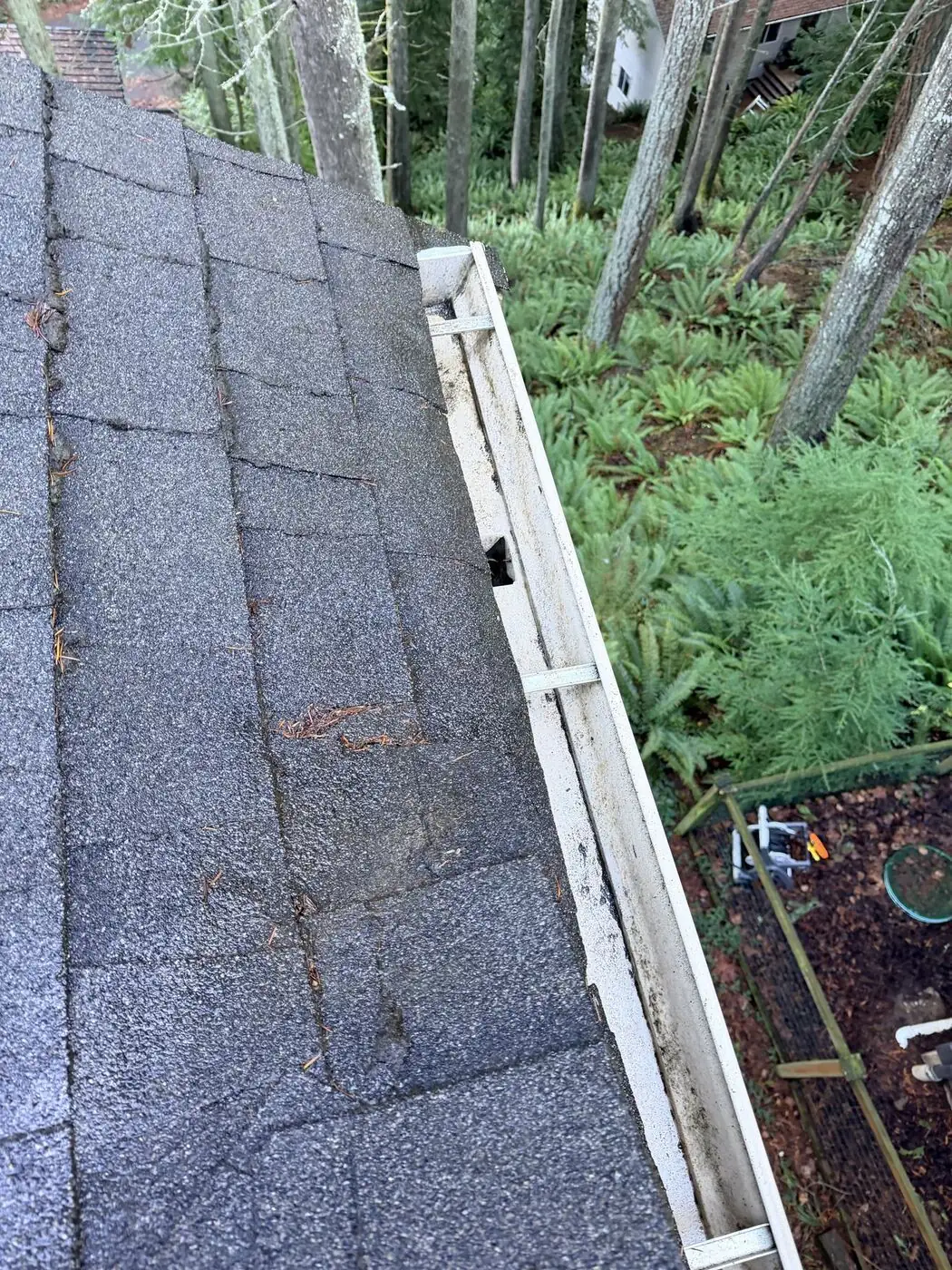
The failure mode is almost always the same: a ladder footed on soft wet ground, or leaned against the gutter itself — which is a thin aluminium channel fixed into a board that may already be rotten. Gutters are not structural. They are not designed to take a ladder’s load, and the ones most likely to fail under it are the ones most in need of clearing.
We foot ladders properly, use standoffs so the load goes onto the roof edge or the wall rather than the gutter, and work off the roof only where the pitch and the surface make that sensible. Where a run genuinely cannot be reached safely, we say so and quote for what can be done, rather than improvising at height on someone else’s property.
Insurance on work at this height is not a formality — an uninsured fall on your property becomes your problem in a way most homeowners have never had cause to think about.
What we do not do
- We do not install gutters, and we do not fit gutter guards.
- We do not repair, reseal, reslope or replace gutter runs, or repair fascia.
- We do not clear buried drain lines — we flow-test to the ground and tell you what we find.
- We do not carry out formal inspections or issue condition reports. What we report is what someone standing at the gutter could see.
Where a job needs any of the above, we will tell you what we think is going on and leave you to bring in the right trade. We would rather be clear about the boundary than take on work we are not the right people for.
The connected problems
Gutters sit in the middle of the exterior system, which is why this job so often turns up work that is really something else.
If the gutter fills faster than it should, look at the roof — moss and debris shedding off the roof is what fills gutters, and clearing the gutter without addressing the source means doing it again sooner.
If the siding under the gutter is stained or green, that is overflow that has been happening for a while, and house washing deals with the mark once the cause is fixed.
If the water is getting away from the gutter but pooling on the path below, that is drainage, and it is worth knowing before winter rather than during it.
What each visit covers
| Visit type | What is included | Typical interval here |
|---|---|---|
| Standard clean | Bulk debris removed and bagged, trough flushed, every outlet and downspout run and confirmed discharging, hangers checked in passing | Once a year on an open lot; up to four under mature Douglas fir |
| Outlet clear only | Blocked downspouts cleared where the trough itself is sound | On demand, usually mid-storm |
| Brightening | Exterior gutter face treated for bonded residue — a separate surface | Every few years, booked alongside a clean |
| Commercial and multi-unit | Hung gutters plus internal drains, parapet scuppers and flat-roof drainage | Scheduled contract, ahead of the wet season |
Debris leaves with us rather than going into the beds. No price band is published because the count of storeys, the roof pitch and what overhangs it decide the job.
Where we do it
Gutter cleaning is available across the entire service area — every market in Whatcom County, every market in Skagit County, and Oak Harbor. Frequency recommendations genuinely differ by town, because tree cover and rainfall do. Pick your town below and the page will say what the schedule looks like there.
Specific gutters problems we get called for
Gutter Cleaning where you live
Whatcom County
- Gutters in Bellingham
- Gutters in Ferndale
- Gutters in Lynden
- Gutters in Blaine
- Gutters in Everson
- Gutters in Sudden Valley
Skagit County
We also cover Sedro-Woolley, Semiahmoo, Custer, Nooksack, Sumas, Deming, Acme, Maple Falls, Glacier, Kendall, Van Zandt, La Conner, Lyman, Edison, Bow, Alger, Clear Lake, Big Lake, Conway, Concrete, Hamilton, Bay View, Oak Harbor, Point Roberts, Lummi Island, Marietta, Geneva, Wickersham, Rockport, Samish Island and Guemes Island from these bases. Those areas do not have their own page — if you are not sure whether you are inside the area, call and ask.
Gutters questions
- How often do gutters need cleaning here?
- Twice a year is the baseline in this climate — late autumn once the deciduous leaves are down, and again in spring. Under conifers it is three or four times, because needles drop year-round rather than in one seasonal burst. A house with no trees within fifty feet can sometimes stretch to once, but that is the exception in Whatcom and Skagit County, not the rule.
- Do you clean by hand or blow them out?
- By hand, with the debris bagged and taken away. Blowing gutters out is faster and it puts everything on your roof, your siding, your deck and your planting — and it does not clear a matted needle plug, which is the actual problem here. Hand-clearing also means we see the gutter, which is how the loose spikes and the rusted-through sections get found.
- Do you check the downspouts?
- Every one, and we flow-test them before leaving. A clear gutter feeding a blocked downspout is not a working system, and downspout blockages are invisible from the ground — the first sign is usually water coming over the front of the gutter in the next heavy rain.
- What about underground drain lines?
- We flow-test to the point where the downspout enters the ground and tell you what we find. If water backs up there, the blockage is in the buried line, which is a drainage job rather than a gutter job. We will say so plainly rather than clearing the gutter and letting you discover it in November.
- Can you get moss out of the gutters?
- Yes, and it is more common here than most people expect. Moss establishes in the silt that builds along the bottom of a gutter and holds water like a sponge, which is why a mossy gutter can overflow even when it looks clear from below.
- Do gutter guards mean I never need this done?
- No, and anyone who tells you otherwise has not worked on a house under Douglas fir. Guards handle leaves reasonably well. Conifer needles are thin enough to pass through most mesh or to mat on top of it, and fine grit still builds underneath. Guards change the frequency and the method; they do not end the job.
- Will you tell me if something is damaged?
- Yes — loose or pulled spikes, separated seams, sagging runs, rusted sections, rotten fascia behind the gutter. That is an observation from someone standing at the gutter, not a formal inspection or a condition report, and we are careful about the difference.
- Is the mess cleaned up?
- Debris is bagged and removed, and the ground beneath the work is left as we found it. Splash on siding or windows from the flow test gets rinsed off before we go.