
Whatcom County
Gutter Cleaning in Blaine, WA
The short answer
Blaine gutters take their heaviest load in November, December and January, when each month averages close to six inches of precipitation on the local record. We clear troughs by hand, bag the debris, flush and check every downspout, and keep the rinse out of the street drains, ideally in late summer or early autumn before that rain begins.

Randy Fee — Owner, King of Kings Window Cleaning
Washington business licence, UBI 605476674 · L&I insured · BBB rated A
Randy runs the company himself, so you are dealing with the owner, not a call centre — and every technician here is personally trained by him. Working Whatcom and Skagit County since 2024.
I run the Blaine route personally.
A Blaine gutter spends most of the year doing very little and then three months doing almost everything. The town’s long weather record puts November, December and January at close to six inches of precipitation each, against barely more than an inch in July. That lopsided year is the whole reason timing matters for this job here.
What follows is how we handle Blaine gutters: what goes wrong with them, what a visit covers, and where the water and the debris end up.
Why is winter so hard on Blaine gutters?
Because the rain arrives in one long block. The Blaine weather station, whose records run from 1893 to 2016, averages 40.60 inches of precipitation a year, and a large share of it lands between November and January. Those three months average roughly 5.6 to 5.85 inches each.
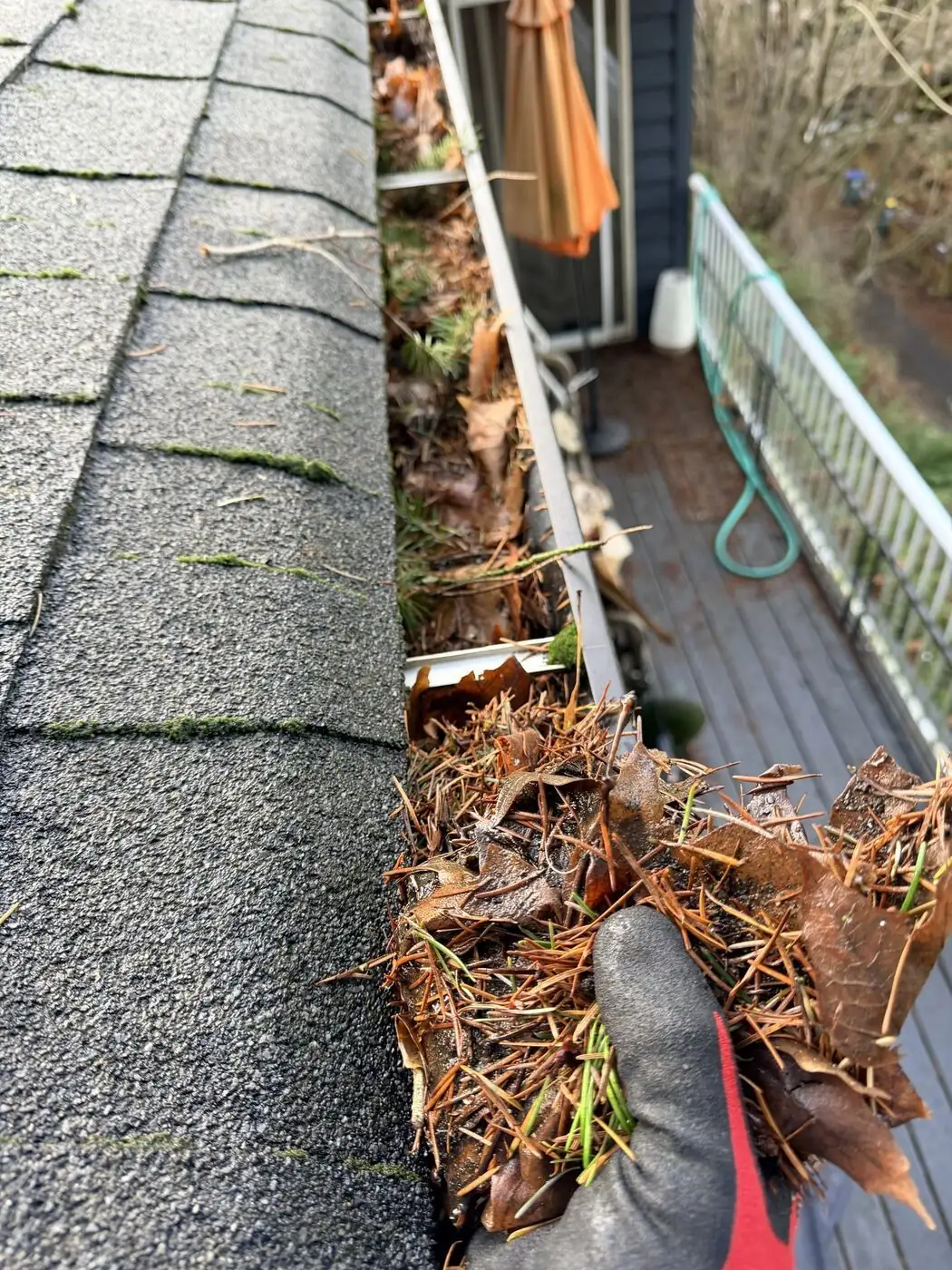
A gutter’s capacity is fixed. When it is clear, it handles a heavy storm without trouble. When a third of its depth is packed with needles, moss and shingle grit, the same storm spills over the front edge. The overflow runs down the siding, soaks the ground along the foundation and, over a winter, leaves a stain line or a soft patch of soil right where you least want it.
The summer barely helps. July averages 1.15 inches, which is enough to wet the debris but nowhere near enough to flush it. Material that settled in spring sits and compacts until autumn, and then the first serious rain tries to push all of it toward the downspouts at once.
What ends up in the gutters here?
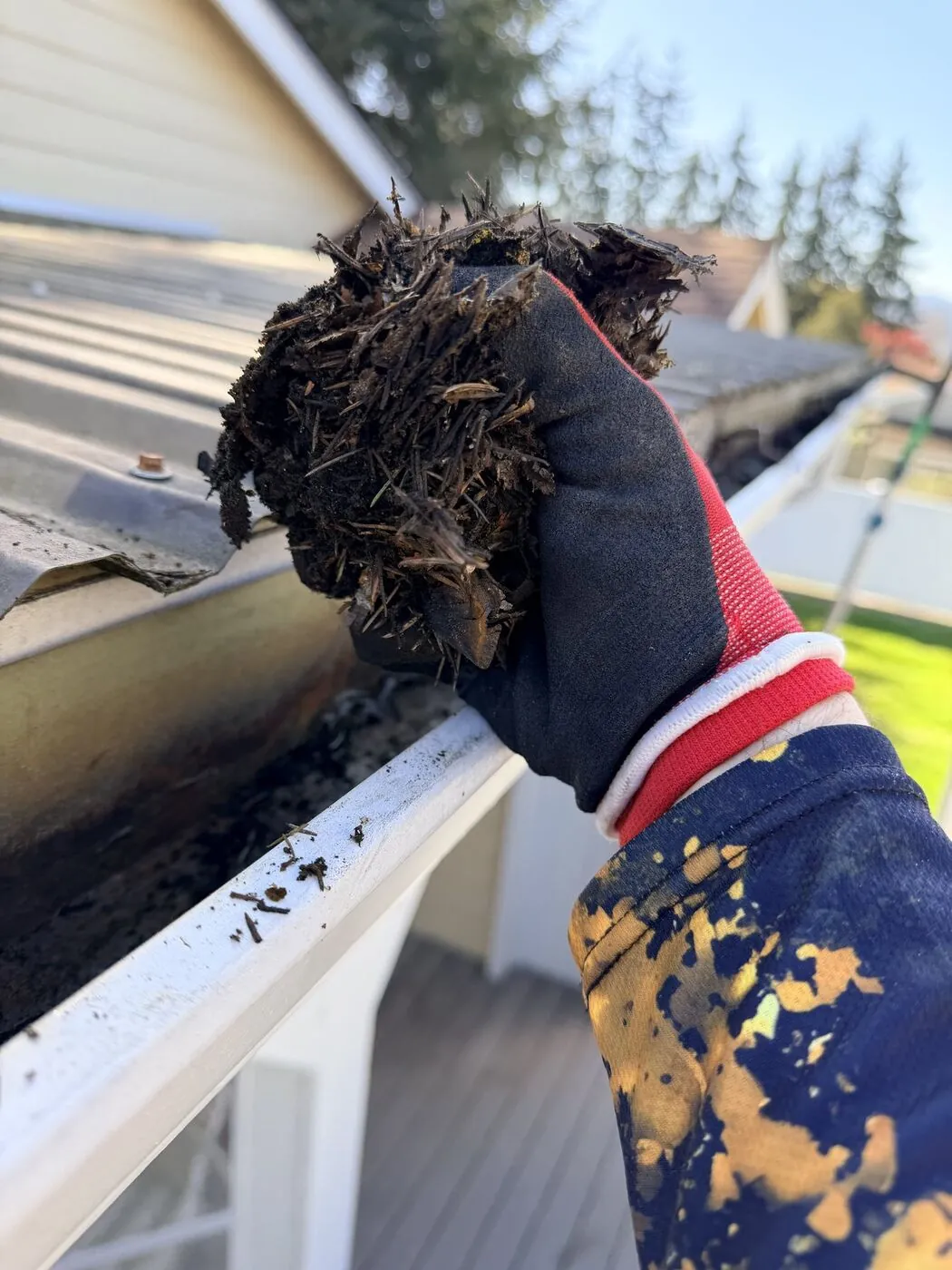
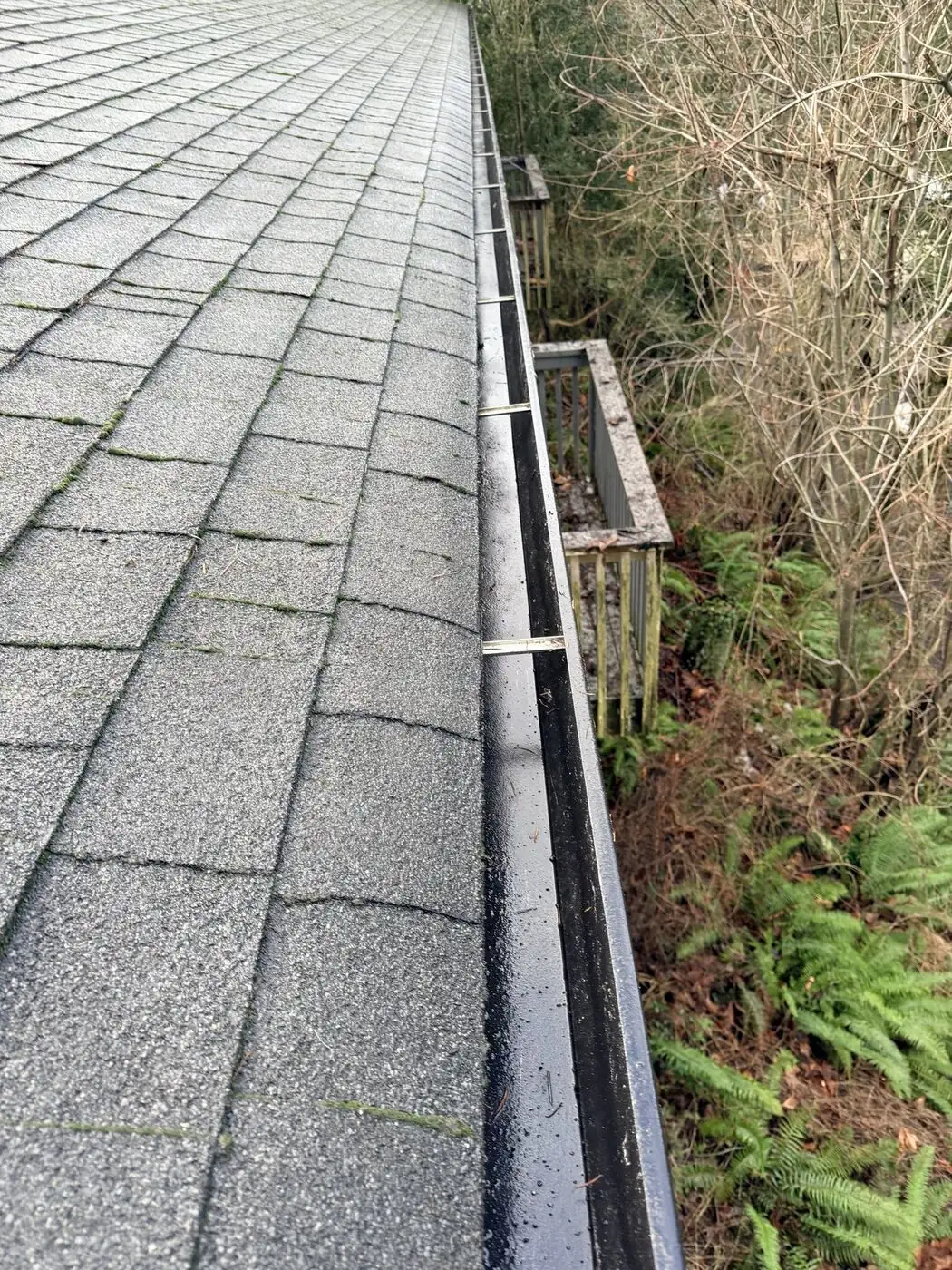
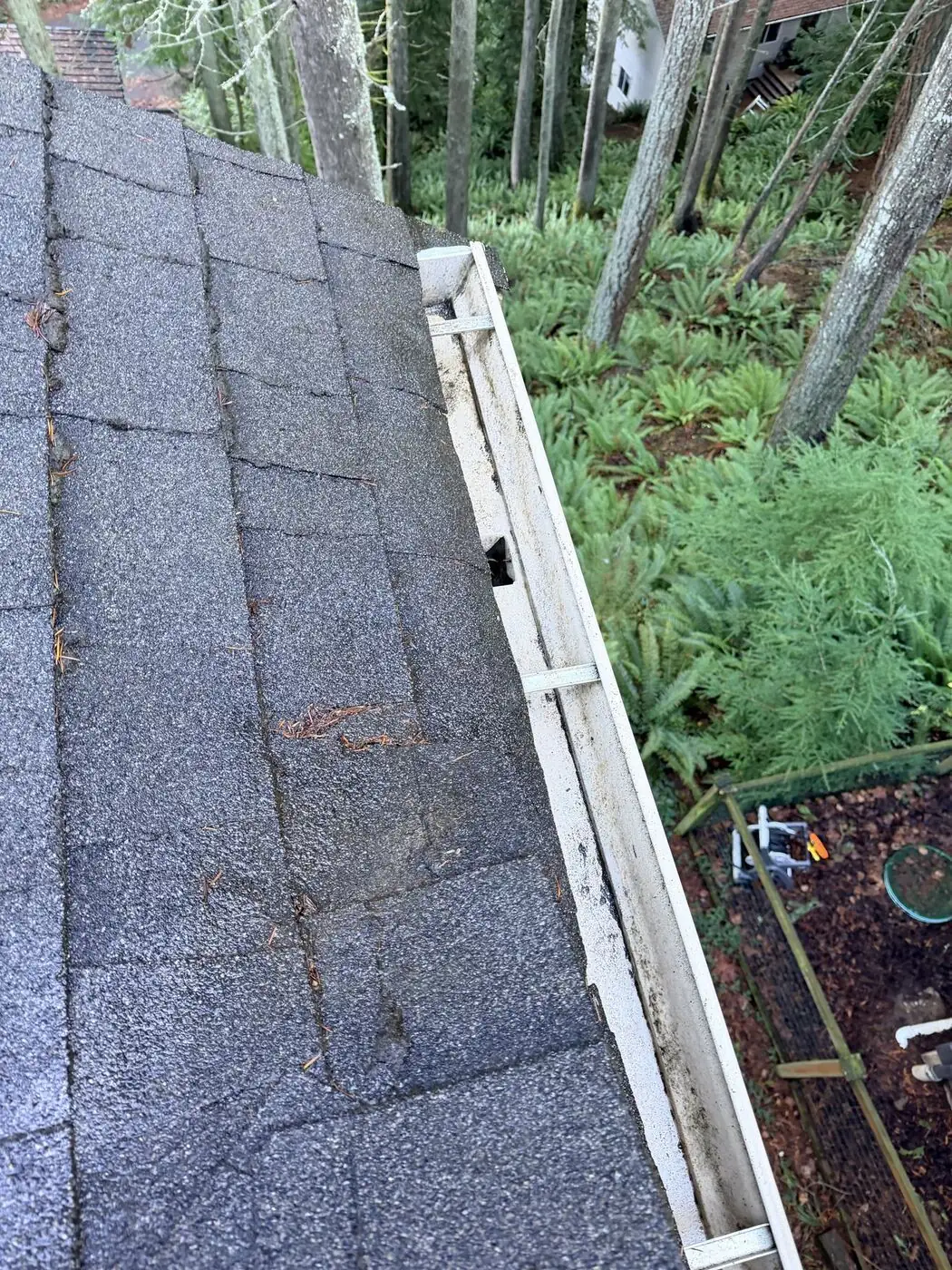
Mostly the same things as anywhere wet and green, in different proportions from house to house. Conifer needles, broadleaf leaves, seed pods, moss that has let go of the roof, and the fine granules composition shingles shed as they age are the usual mix. Where the roof has been growing moss, the gutters below it are usually the first to show it, because every heavy rain washes loose clumps downhill.
Two details are worth knowing. Moss in a gutter keeps growing if it stays damp, and in a climate as cool as Blaine’s it often does. And shingle granules are heavy; they settle at the bottom of the trough and around the outlet, which is exactly where a blockage does the most harm.
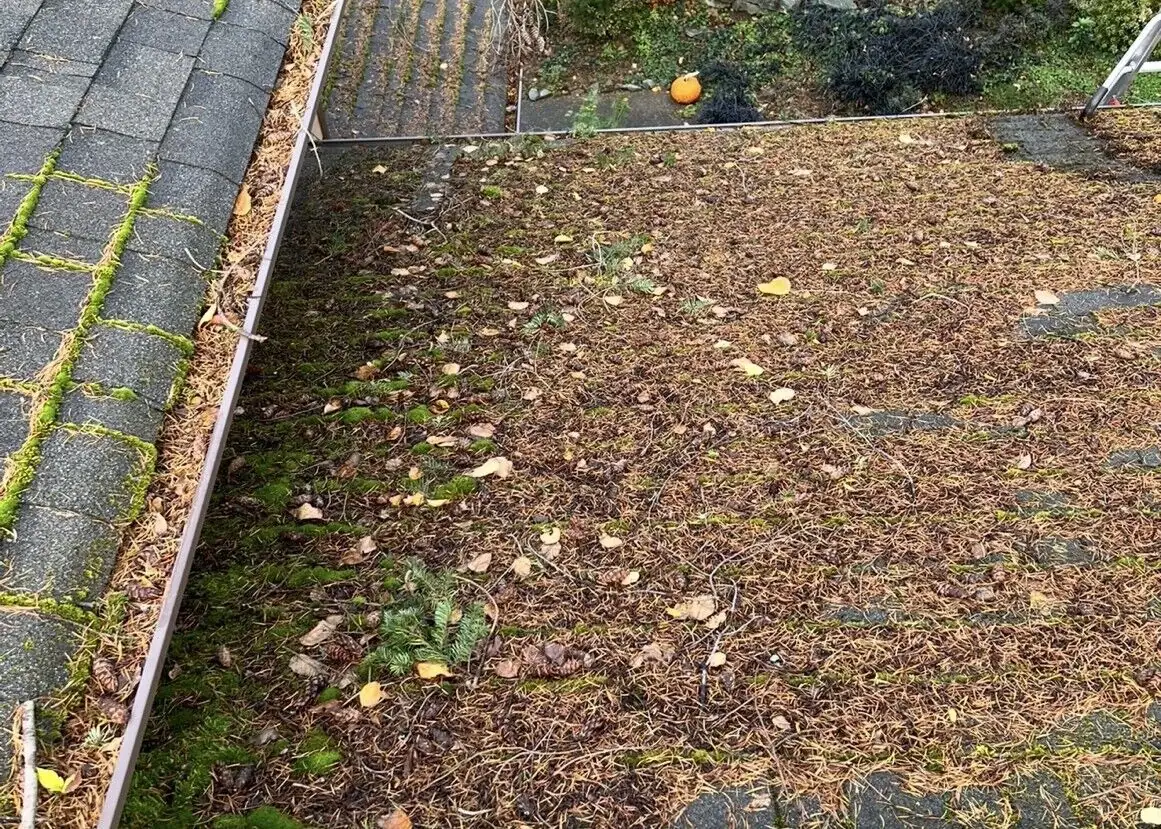 Before
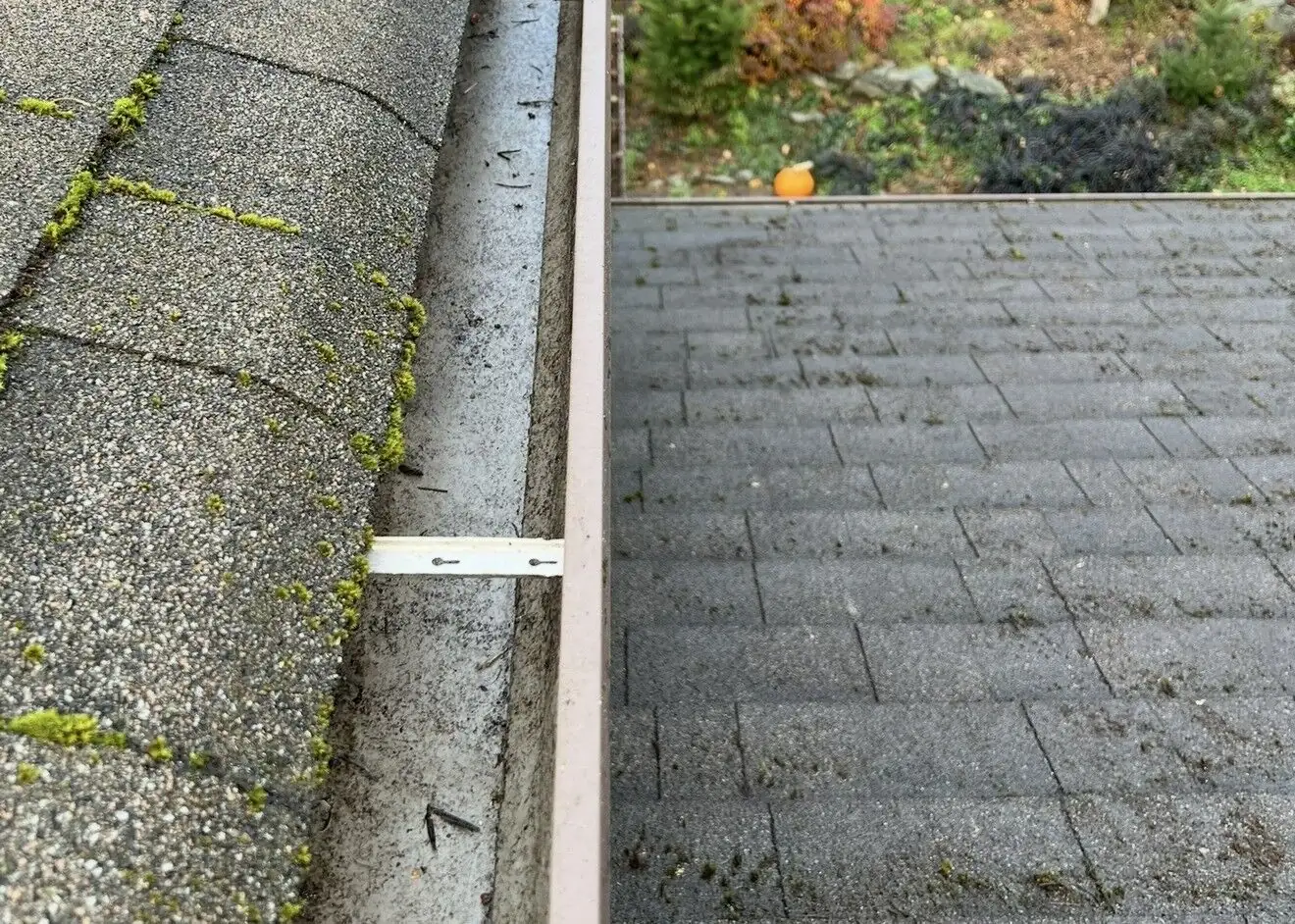 After
What does a gutter visit include?
A standard Blaine clean-out covers:
- Every trough cleared by hand, from a ladder or the roof edge depending on access, with the debris bagged as we go
- Outlets opened and any packed material around the drop removed
- Downspouts flushed from the top, with each one watched to confirm water comes out freely at the bottom
- A low-volume rinse of the troughs so the remaining silt moves to the outlet rather than sitting in the corners
- Debris removed from the roof edge, paths and planting beds below
- A short report at the end: what we found, any run that holds water, and any bracket or seam that looks tired
Brightening the outside face of the gutters, clearing moss from the roof itself, and cleaning the windows below are separate items. They are easy to add, and doing them in the right order saves work.
How do you clear gutters without damaging them?
By hand first, and water second. Blowing gutters out with a leaf blower is quick, but on a wet Blaine day it sprays compacted muck across the siding and windows and leaves the heavy grit where it was. Scooping by hand removes the material instead of moving it.
We set ladders on stand-offs so the weight goes against the wall or roof edge rather than the gutter lip, which matters on older aluminium and on any run that has already been bent once. Where a roof is walkable and dry enough to be safe, we work some runs from above. Where it is steep, mossy or slick, we stay on the ladder.
Downspouts get flushed rather than assumed. Plenty of gutters look clean from the ground and still back up because an elbow halfway down the wall is packed solid. If a downspout will not clear with water, we say so rather than force it.
Are older Blaine houses any different?
Often, yes. The census counts 387 Blaine housing units built in 1939 or earlier, roughly one in seven of the town’s 2,793. Houses that old have usually had their gutters replaced at least once, and what is on them now varies: some carry modern seamless aluminium, others older sectional runs with more joints to leak.
On these houses we pay attention to fascia boards and brackets. A gutter that has overflowed for years can soften the timber behind it, and the only honest thing to do is show you what we see. We are not a roofing or carpentry firm, so the call on repair is yours and your contractor’s, but you should hear about it.
Newer homes, and there are plenty with a median year built of 1994, tend to have longer continuous runs and fewer seams. Their weak point is usually the outlet and the downspout, not the trough.
What decides the price of a Blaine gutter clean?
We quote on site and without charge, and the figure depends on the house rather than a flat rate. The main drivers:
- Total length of gutter and the number of downspouts
- Height and access, from a single-storey ranch to a steep two-storey with a walkout
- How much is in them, since a gutter left for three winters takes far longer than one done last year
- Roof condition, because a slick or mossy roof limits working from above
- What else is booked, since combining a gutter clean with roof or window work shares the set-up
We give you the number before we start and it does not change once we are up the ladder.
When is the right time to book in Blaine?
Late summer into early autumn is the sweet spot. By then the spring growth has dropped, the dry weather has made the debris lighter to lift, and you are ahead of the November rains. July, the driest month on the Blaine record, is also a good time for heavily treed lots that want two cleans a year.
A second visit in late spring suits houses with a lot of overhanging growth or a roof that sheds moss. We would rather clean twice at the right times than once at the wrong one.
If you already have water pouring over the front of a gutter in winter, call anyway. A blockage in the middle of the wet season is worth clearing, weather permitting, rather than leaving it to soak the foundation until spring.
Where does the rinse water go?
Onto the ground, not into the street. Blaine Municipal Code 13.01.040 prohibits storm or surface water discharges to the public drainage system unless they meet city public works standards, and we treat gutter slurry as exactly the sort of thing that rule is there to stop. Debris is bagged. The small amount of rinse we use is directed to lawn or planting beds where it can soak in.
There is a second angle worth knowing. Blaine’s storm water utility bills by impervious surface under BMC 13.01.015, and one billing unit equals a single-family house or 4,200 square feet of roofs, driveways and patios. In other words, the city already counts your roof as part of its drainage load. Gutters and downspouts are how that water is meant to leave the roof in an orderly way, and a blocked system sends it across the ground instead. Our general approach to containment is on the wash water and storm drains page.
What should you watch for between cleans?
A few signs are worth a look from the driveway during the wet months, ideally in the middle of a proper downpour rather than a drizzle.
Water sheeting over the front lip of a gutter, rather than dribbling at a joint, points to a blockage somewhere along that run. A downspout that stays quiet while the gutter above it is full is almost always packed at the top outlet or at an elbow. Plants sprouting along the roof edge mean there is enough soil in the trough to grow them, which in a Blaine winter is a lot of wet weight hanging off the fascia.
Lower down, look at the ground. A trench worn into a flower bed, splash marks climbing the bottom of the siding, or a patch of lawn that stays boggy long after the rest has drained usually sits directly under a gutter that has been overflowing. None of these need an emergency call, but they are a good reason not to leave the autumn clean until after Christmas.
What other problems start in the gutters?
More than people expect. A gutter that overflows every winter is a symptom, and the cause is sometimes above it and sometimes below. Our page on overflowing gutters walks through the usual reasons, from a packed outlet to a run that has lost its fall toward the downspout.
The black tiger-striping on the outside face of gutters is a different issue and a different clean, covered under gutter brightening. And if the gutters keep filling with moss, the roof is usually the source; the Blaine roof cleaning page explains how we deal with that without harming the shingles.
How do I book a gutter clean in Blaine?
Ring (360) 303-6806, or use the contact page if that is easier. We will look at the runs, the downspouts and the roof above them, and quote the work on the spot. The full scope of the service, as we do it across the county, is on the main gutter cleaning page, and everything else we offer in town is gathered on the Blaine locations page.
Gutters questions from Blaine homeowners
- How often should a Blaine house have its gutters cleaned?
- Once a year suits an open lot with little overhanging growth. Twice, in late spring and again in early autumn, suits a house with trees close by or a roof that sheds a lot of moss. We will tell you which after we have seen what comes out.
- Can you clean gutters in the middle of winter?
- Yes, if the weather allows safe ladder work, and an overflowing gutter in December is worth dealing with. It is simply better to clear them before November, when the local record shows the wettest three months beginning.
- Do you check the downspouts as well?
- Every time. We run water through each downspout from the top and watch where it comes out. A trough can be spotless and still overflow if the outlet or the pipe below it is packed.
- What do you do with the debris?
- It is bagged and taken away, or left for your green bin if you prefer. It does not get washed down the driveway into the street drain, which Blaine's code does not allow.
- My house is over eighty years old. Will the ladder damage the gutters?
- We use stand-offs so the ladder rests against the wall or roof edge rather than the gutter lip, and on older or fragile runs we tell you on the walk-round what we can and cannot lean on.
- Can you also clean the outside of the gutters?
- Yes. The black streaking on the face of gutters is a separate job called brightening. We can quote it alongside the clean-out, and it is often worth doing at the same visit as a house wash.
- Will you tell me if a gutter is damaged?
- We point out anything we notice, such as a sagging run, a split seam or a loose downspout. We are cleaners rather than gutter installers or inspectors, so for repairs we suggest you call a specialist.