
Gutters Overflowing in Heavy Rain
The short answer
A gutter that overflows in heavy rain is usually not too small. It is holding a compacted mat of conifer debris and silt that has taken up the depth the water needed. Douglas fir and western red cedar are the two species that drive it here, and the fix is clearing the trough and the outlets, not replacing the gutter.
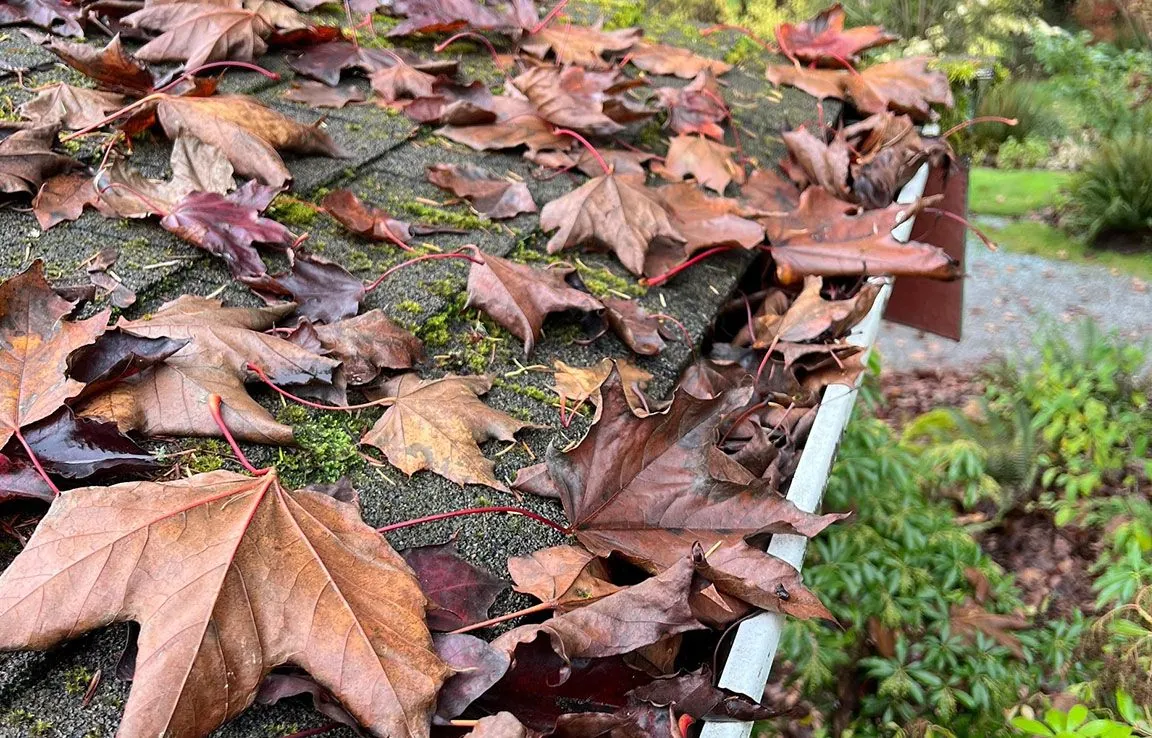
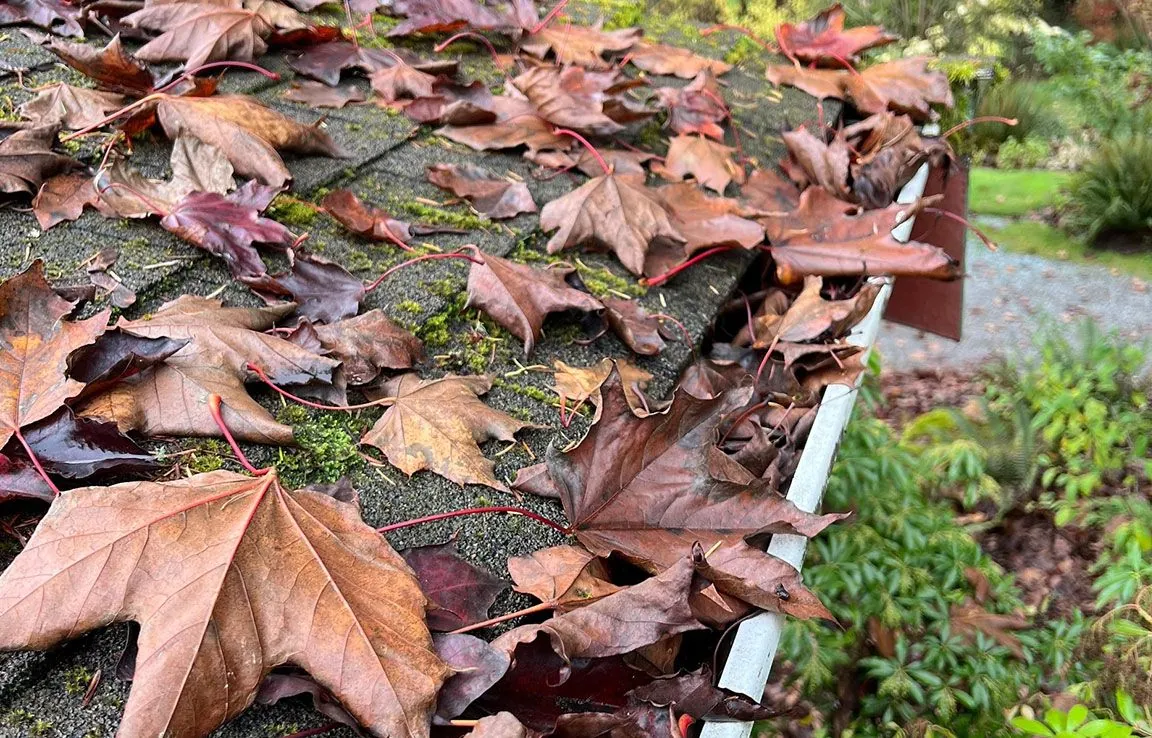
The call almost always arrives during a storm, and it almost always comes with a theory attached: the gutters are too small, or they were installed wrong, or the roof is throwing too much water at them.
Usually none of those. The gutter is the right size and it was installed correctly. It simply does not have the depth it used to, because something is sitting in the bottom of it.
What is actually in the trough
Clearing a loaded gutter in this region turns up three distinct layers, and they behave differently.
On top is the obvious material — leaves, cones, twigs, the occasional tennis ball. This is the layer people picture, and it is the least of the problem. Bulk debris blocks an outlet when it happens to land on one, but it sits loosely and water finds its way past.
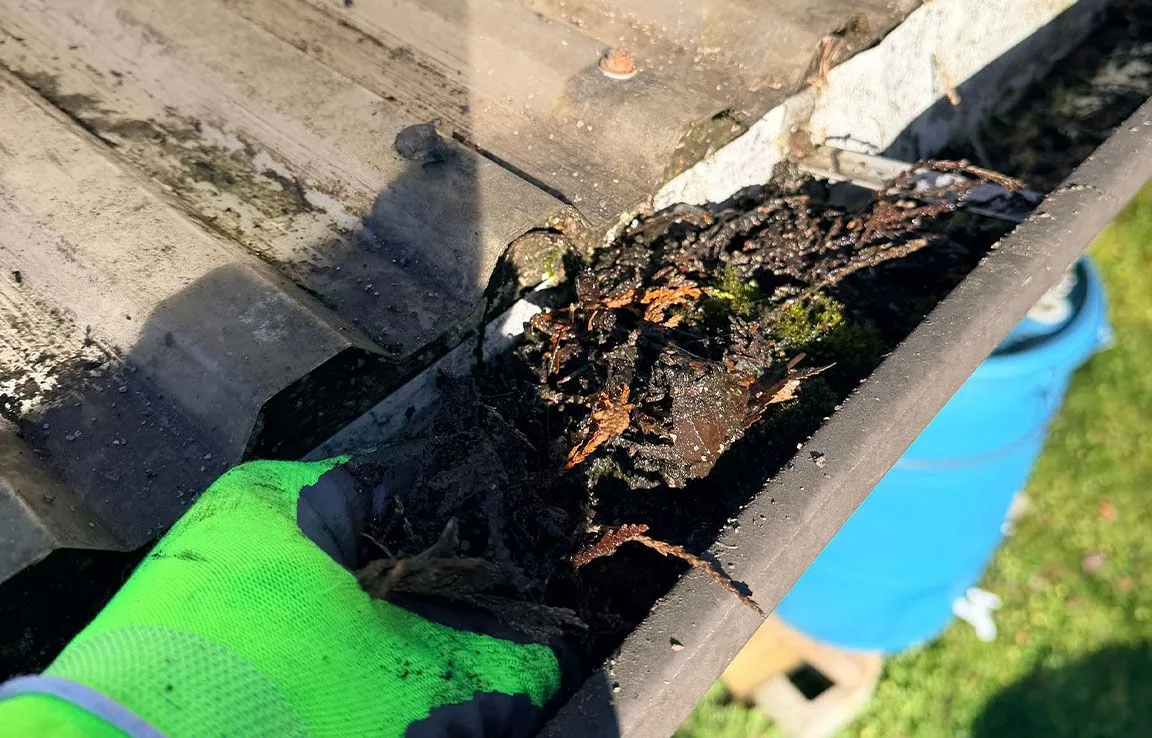
Underneath is a dense felt of needles, compacted by rain into something closer to a mat than a pile. This is the layer that causes overflows, and it is the one that is invisible from the ground. It lies flat, it holds water like a sponge, and it takes up the depth the trough needed in a downpour.
At the bottom is silt — roof grit, shingle granules, breakdown from the felt above, and windblown dust. It is heavy, it holds moisture permanently against the metal, and it is the reason a neglected steel gutter rusts from the inside.
A gutter carrying all three has lost most of its usable capacity while still looking, from the driveway, entirely fine.
Tree by tree — what is landing up there
Which trees are near the house changes the schedule more than anything else, and it is worth knowing what you have.
Douglas fir is the defining problem of gutter maintenance in this region. Sheds needles continuously with a heavy autumn drop, and the needles mat into the felt described above. Also drops cones, which are large enough to block an outlet by themselves.
Western red cedar sheds in flat sprays rather than individual needles, and those sprays knit into an even more effective mat than fir does. Cedar debris also breaks down slowly, so it accumulates rather than composting away.
Western hemlock produces very fine needles and small cones — the fine needles pass through almost any guard mesh and go straight into building the silt layer.
Big-leaf maple, common through the river valleys and older neighbourhoods, drops leaves large enough to bridge a downspout outlet whole, plus an enormous quantity of seeds in spring that germinate happily in gutter silt.
Alder, which colonises disturbed and damp ground throughout both counties, drops small cones and catkins that behave like gravel in a gutter.
Birch and ornamental cherry in planted neighbourhoods contribute fine twiggy debris and blossom drop, which is a spring problem rather than an autumn one and catches people who only clean in November.
 Before
 After
Telling a blockage from a capacity problem
Four checks, and they can mostly be made from the ground during rain.
Where the water leaves. Over the front edge along the whole run means the trough is loaded. Over one corner only means fall or settlement. Behind the gutter means a drip-edge or fascia problem, which is a different trade.
Whether the downspout is running. Put a hand on the downspout in heavy rain. A silent, dry downspout under an overflowing gutter is a blocked outlet, not a full trough — and that is a ten-minute fix rather than a whole-house clean.
Whether it got worse gradually. A gutter that coped two winters ago and does not cope now has not shrunk. Progressive failure is accumulation.
What is growing in it. Anything green and rooted means silt deep enough to hold a seed, which means the trough has been at reduced capacity for at least a season.
What clearing it actually involves
Bulk debris out by hand, then the trough flushed so the felt and silt layers leave rather than simply being redistributed, then every outlet and downspout checked individually by running water through it and confirming it discharges.
That last step is the one most often skipped, and it is the one that decides whether the gutter still overflows next month. A clean trough feeding a blocked downspout overflows exactly as enthusiastically as a dirty one.
Debris is bagged and removed rather than dropped into the beds below, and the run is checked for loose spikes and separated joints on the way past, because a ladder is already there and finding a failing hanger now is worth more than finding it in February.
What to do now
- Wait for heavy rain and watch where the water leaves. Over the front edge along the whole run means a loaded trough. Over one corner means fall or settlement. Behind the gutter is a different trade.
- Put a hand on the downspout while it is raining. A dry downspout under an overflowing gutter is a blocked outlet — a ten-minute fix, not a whole-house clean.
- Look for anything green and rooted in the trough. That means silt deep enough to hold a seed, so the gutter has run at reduced capacity for a season or more.
- Count what overhangs the roof. Douglas fir, cedar and hemlock set the schedule; open lawn sets a much cheaper one.
- Clear the outlets before the next front, even if the full clean waits. Function first, appearance second.
- Book the clean before the wet season, not after the first overflow.
The part that is not about the gutter
The reason this is worth doing on a schedule rather than on a complaint is where the water goes when the gutter stops working.
A functioning gutter collects roof runoff and delivers it to a downspout, which moves it away from the building. A loaded one delivers the same volume straight down the wall and into the ground at the base of the foundation, every time it rains, through a wet season that runs October into May.
That is the mechanism behind a surprising share of the damp crawlspaces, stained siding bands, settled paths and rotted fascia ends in this region — and none of it presents as a gutter problem by the time anyone calls about it.
Full method, materials and scheduling is on the gutter cleaning page. If the streaking on the outside face is bothering you as much as the overflow, that is a separate treatment — see gutter brightening.

Randy Fee — Owner, King of Kings Window Cleaning
Washington business licence, UBI 605476674 · L&I insured · BBB rated A
Randy runs the company himself, so you are dealing with the owner, not a call centre — and every technician here is personally trained by him. Working Whatcom and Skagit County since 2024.
Questions about this
- Does overflowing mean my gutters are too small?
- Almost never. Undersized gutters are a real thing, but they are rare on houses built in the last forty years, and they fail consistently in every heavy rain rather than progressively worse each season. If the same gutter coped three years ago and does not cope now, nothing about its size changed. What changed is how much of its depth is occupied by debris and silt.
- Why does it overflow at the front edge rather than the end?
- Because the trough is full along its length. Water arriving from the roof has nowhere to go but over the nearest edge, which is the front. Overflow concentrated at one end usually means the fall is wrong or that end has settled; overflow along the whole run means the trough is loaded.
- My gutters look clear from the ground. Why are they still overflowing?
- The layer that causes most overflows is invisible from the ground. Fine needles and grit compact into a dense felt that sits flat in the bottom of the trough, and from below the gutter reads as empty. The test is depth, not appearance, and it has to be made from a ladder or with a camera.
- Water is running down behind the gutter, not over the front. Is that the same problem?
- No, and it matters. Water behind the gutter means it is getting between the trough and the fascia — usually a failed or missing drip edge, or a gutter that has pulled away at the top. That one is a carpentry question before it is a cleaning question, and it rots fascia quietly for years.
- How often does this need doing where I live?
- It is decided by what is overhanging the roof, not by the calendar. A house on open lawn with nothing above it can genuinely manage one visit a year. A house under mature Douglas fir needs four, and no gutter guard on the market changes that number.
- Will gutter guards stop it?
- They change the problem rather than removing it. Guards keep leaves and cones out, which is worth something under maples and alders. Fine hemlock and fir needles pass through almost any mesh and go straight into building the silt layer underneath, where they are now harder to reach because there is a guard in the way.
- Is an overflowing gutter actually urgent?
- It is not an emergency, but it is not cosmetic either. The water is being delivered to the base of the wall and the foundation instead of to the downspout, every time it rains, for the wettest half of the year. That is the mechanism behind most of the damp-crawlspace and settled-path complaints we get asked about afterwards.
Last updated