
Whatcom & Skagit County
Window Cleaning in Whatcom & Skagit County
The short answer
King of Kings cleans windows inside and out across Whatcom and Skagit County — glass, screens, tracks and sills, on homes and commercial buildings. Owner Randy Fee trains every technician personally. Licensed, L&I insured, hundreds of five-star reviews, and a free on-site quote before any work starts.

Randy Fee — Owner, King of Kings Window Cleaning
Washington business licence, UBI 605476674 · L&I insured · BBB rated A
Randy runs the company himself, so you are dealing with the owner, not a call centre — and every technician here is personally trained by him. Working Whatcom and Skagit County since 2024.
Clean glass is the cheapest thing you can do to a house that changes how it feels inside. It is also the job most often done badly, because the difference between a window that is clean and a window that only looks clean from four feet away is mostly invisible until the sun hits it at the wrong angle.
We clean windows across Whatcom and Skagit County — Bellingham, Ferndale, Lynden and Blaine through to Mount Vernon, Burlington, Sedro-Woolley and Anacortes — on houses, rentals, storefronts and new builds. What follows is what the work actually involves, what changes the price, and what we will and will not promise.
What is on your glass, and why it matters which
Most window-cleaning frustration comes from treating three different problems as one. They are not, and they do not come off the same way.
Dirt is anything sitting on the surface — dust, pollen, splash, cobweb, bird mess, road grime. It has not bonded to anything. It comes off with water, detergent and a squeegee, and every clean handles it.
Film is dirt that has combined with moisture and dried in place. This is the one people underestimate. Pollen that got rained on and dried in the sun, road film on a house near a highway, industrial haze near a refinery corridor, agricultural dust after a dry harvest week — all of it ends up as film. Film does not rinse. A pressure rinse moves it around and leaves a smear pattern, which is why so many people report that their windows look worse after they have washed them. Breaking film takes a detergent stage and physical contact.
Deposit is mineral, and it is a different category altogether. Sprinkler overspray that dries on the glass, rain running off a mineral-stained sill, hard water from a well — each leaves calcium and magnesium behind when the water evaporates. Fresh deposit comes off with a treatment made for it. Old deposit that has been through enough cycles begins to attack the glass surface, and at that point it has stopped being a cleaning problem. Etched glass cannot be cleaned clear. It looks cloudy in the same places no matter what you do, and the honest answer is that it is a replacement decision.
We identify which of the three you have standing at the window, on the quote, before any money changes hands.
What is included in a standard clean
- Exterior and interior glass on every accessible opening
- Screens removed, washed, dried and replaced in the opening they came from
- Tracks and sills vacuumed and wiped — the grit that collects here is what grinds out weatherstripping and wears the rollers
- Frames wiped where they are washable
- Cobweb removal around the openings and the eaves directly above them
- A walk-round with you at the end, in daylight, at the window
Quoted separately because access and risk vary so much: skylights, glass balustrades, conservatory and sunroom glass, storm windows, and post-construction glass.
Not included, so nobody is surprised: condensation between the panes of a sealed unit. That is a failed seal. The moisture is inside the glass unit, no external cleaning reaches it, and anyone who tells you they can clean it is selling you something that cannot work. It is a glazing repair.
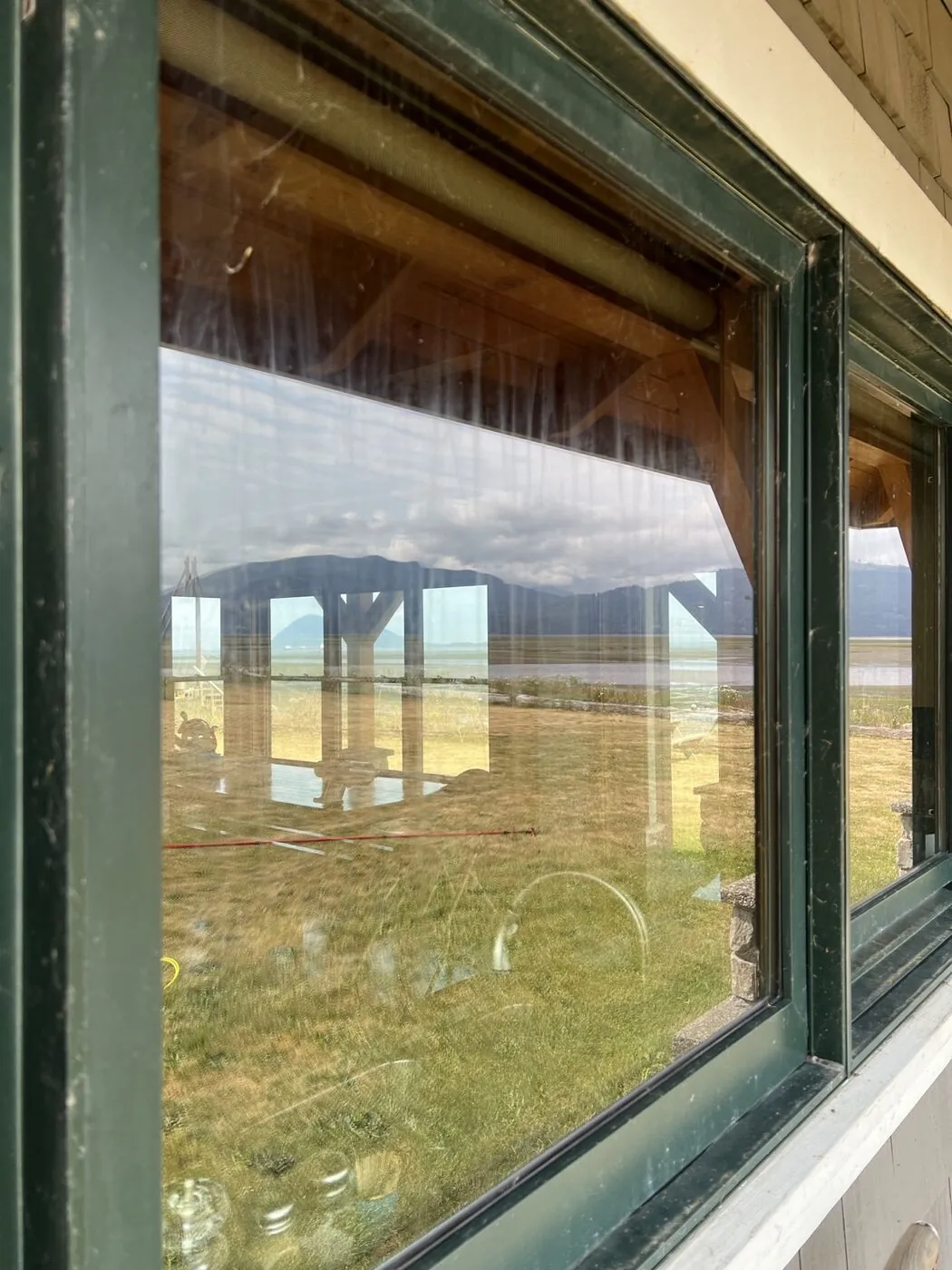 Before
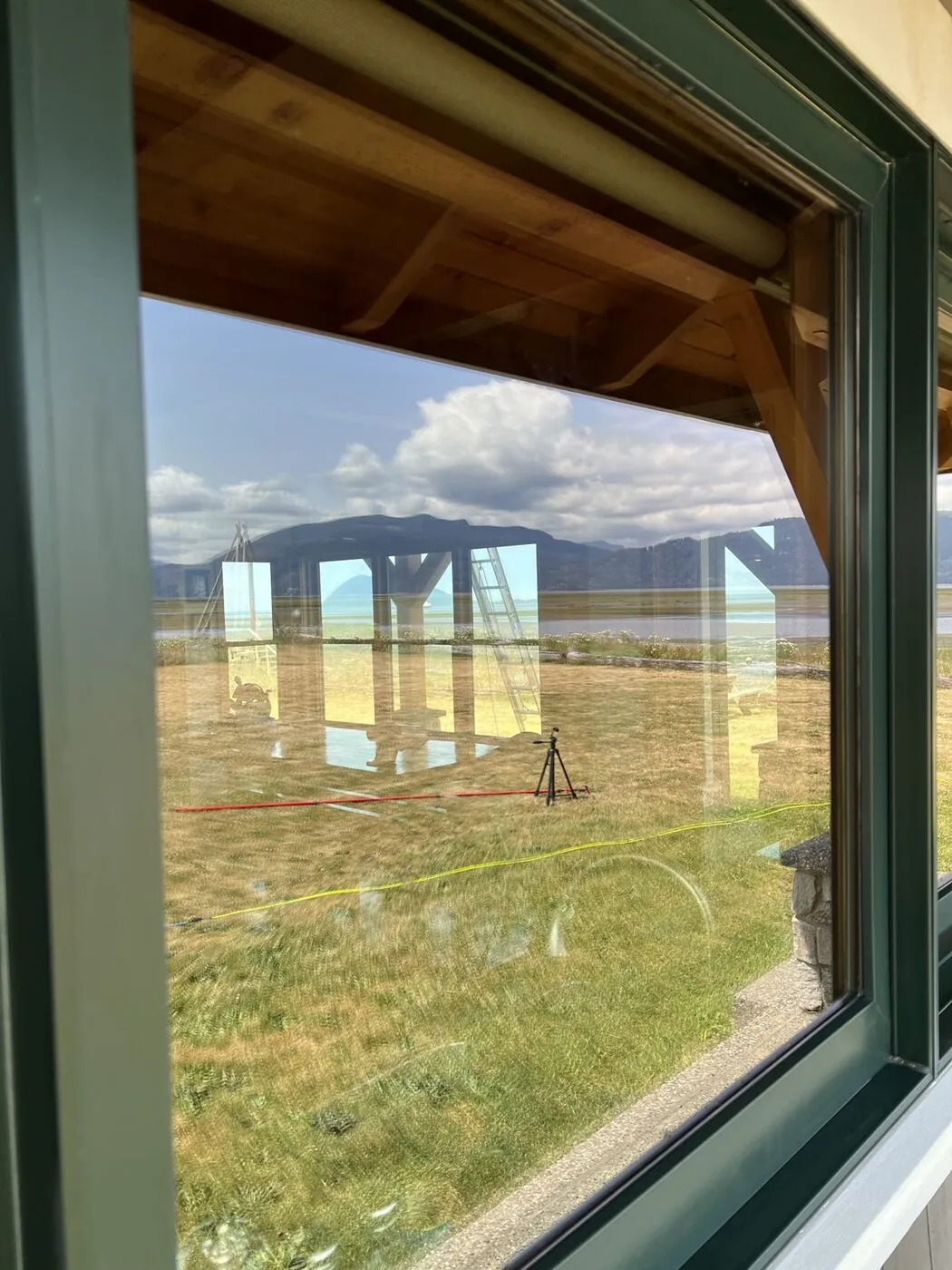 After
How the work is done
Two methods, chosen per window rather than per house, because the right tool for a ground-floor sash is the wrong tool for a gable window over a deck.
Traditional, for reachable glass
A detergent solution, a scrubber worked over the whole pane to break the film, then a squeegee pulled in a controlled pattern to take the water and everything in it off the glass in one movement, with the edges detailed by hand. There is no substitute for physical contact when the problem is bonded film, and on accessible glass this remains the fastest route to a genuinely clear pane.
Water-fed pole, for height and obstruction
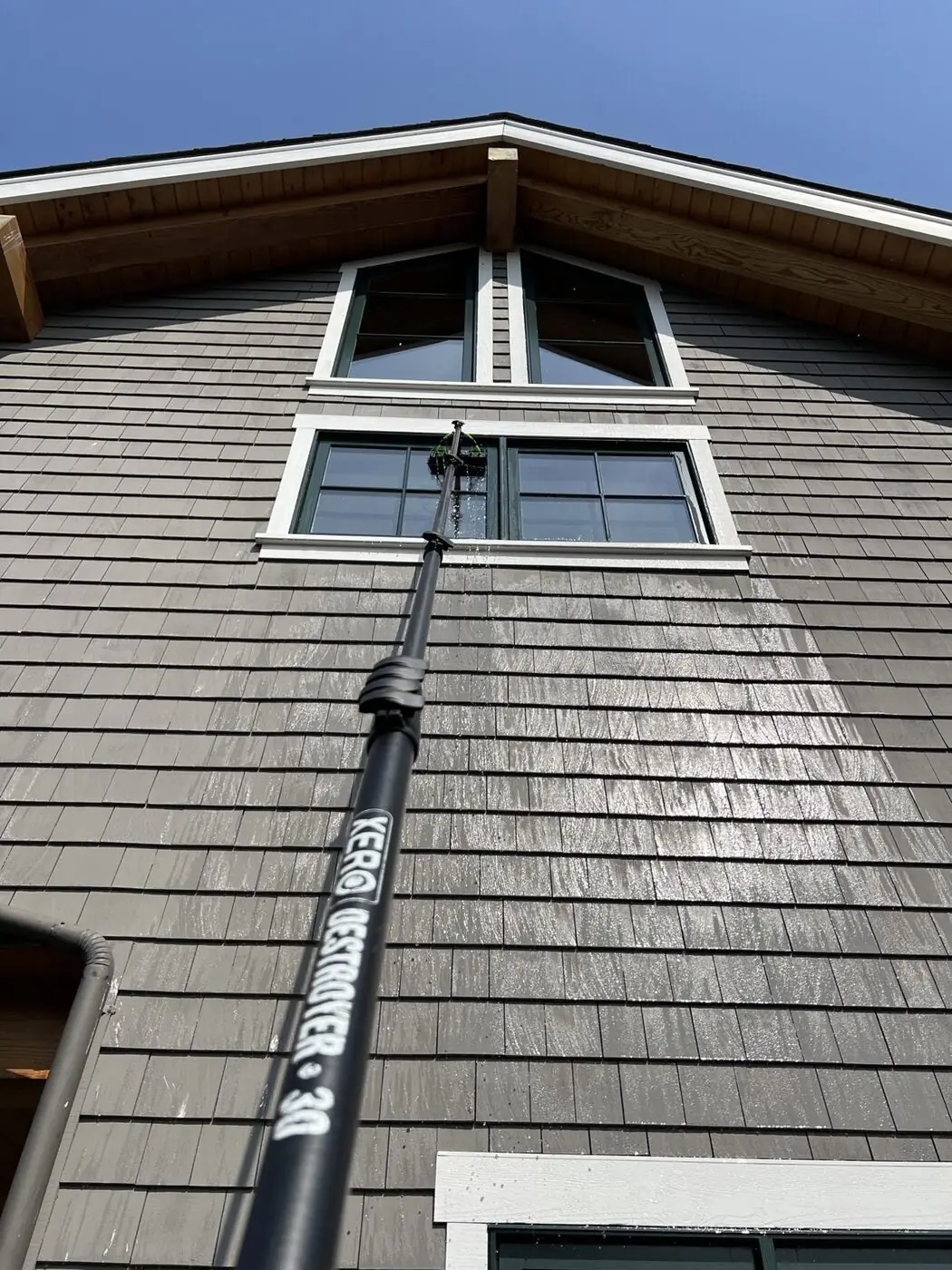
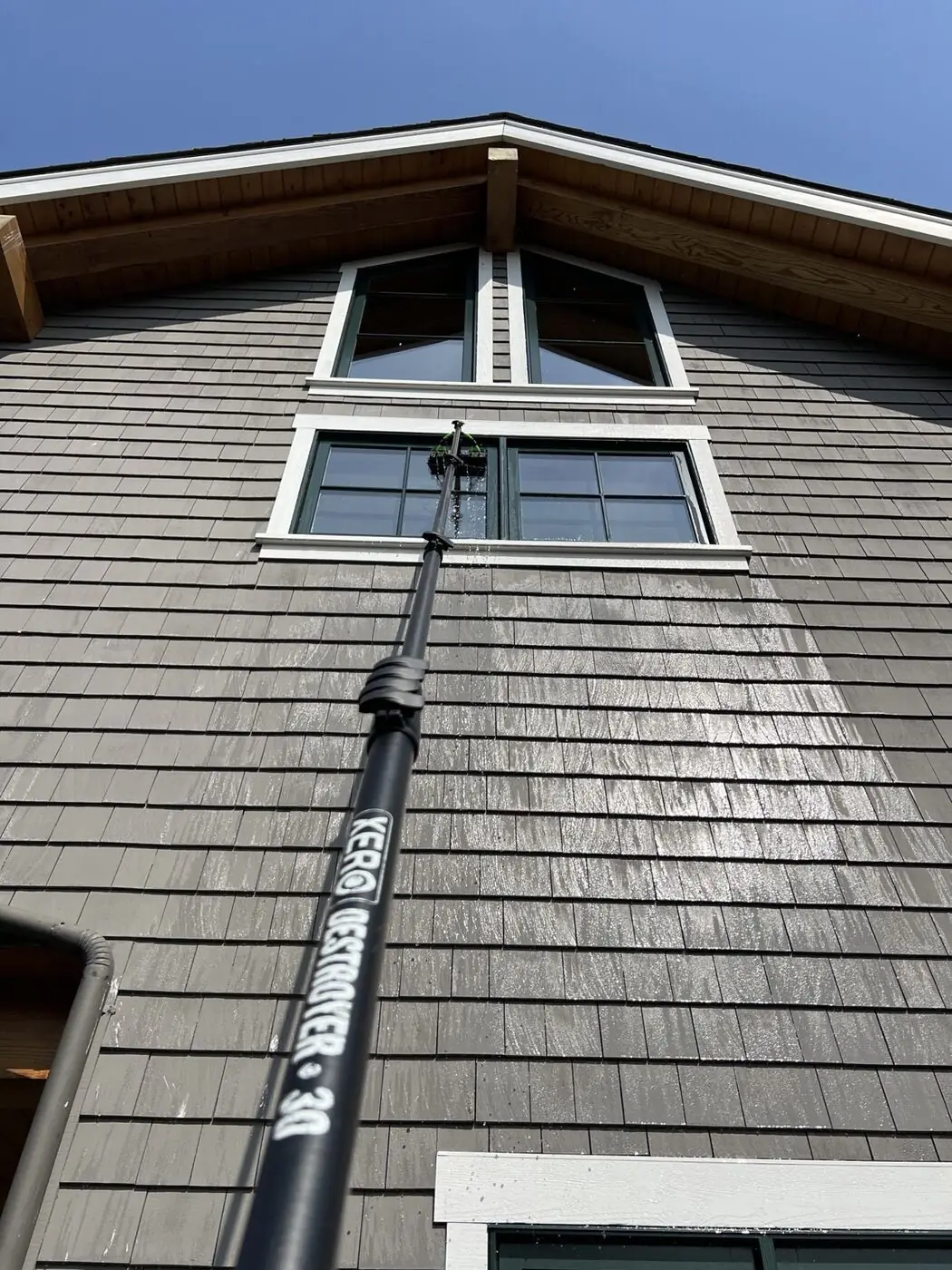
Upper storeys, and anything above a deck, a slope, a conservatory roof or a planting bed, get a brush on a telescopic pole fed with purified water.
The purified water is the point, not the pole. Ordinary water carries dissolved minerals; when it evaporates off the glass, the minerals stay behind as spots. Strip them out and the water dries clean, which means the glass can be left to sheet dry with no squeegee contact at all. It is what makes it possible to clean a second-storey window properly without putting a ladder somewhere a ladder should not go.
We carry our own water and filtration. On a property with hard water that matters twice over — it means we are not putting the cause of the spotting back onto the glass we just cleaned, and it means we can work on a house with the water shut off or between tenants.
Where hard-water deposit is present and treatable, it is a separate stage before the general clean, using a product made for mineral rather than for dirt.
What changes the price
Quoted on site, every time, and it comes down to five things.
- Opening count. The base, but only the base.
- Pane size. A newer build with six large picture windows can take longer than an older house with thirty small ones. More glass, worse reach, more care needed on each pull.
- Access. Ground-floor glass on open lawn is quick. Second-storey glass over a deck, a hedge or a slope is not, and a stairwell window is its own project.
- Condition on arrival. Maintenance versus restoration. This is the single biggest swing, and it is why the first clean on a neglected property costs more than every clean after it.
- Extras. Screens, tracks, skylights, balustrade glass, storm windows, french doors.
Two things worth knowing before you compare quotes. The second clean almost always costs less than the first, because we are maintaining rather than restoring. And a number quoted over the phone by someone who has not seen the house is a guess — in an area where condition varies this much street to street, usually a guess that favours whoever gave it.
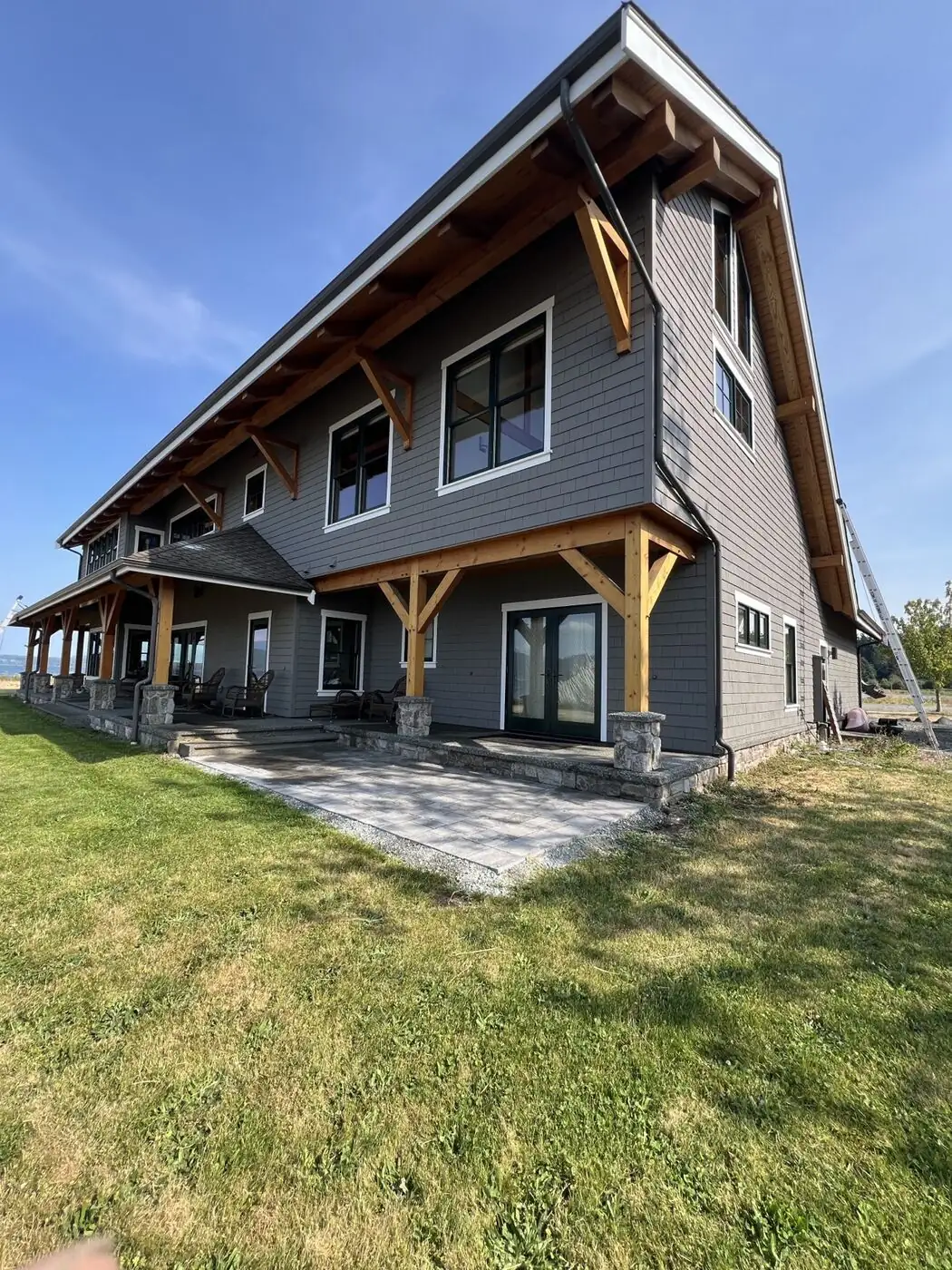
When to book
Spring. The most-booked window of the year and the most useful one. Winter in this region leaves rain splash, organic film in the frame corners, and interior condensation residue. Clearing it in March or April means the light half of the year is spent looking through clean glass rather than at it.
Early autumn. After the summer dust has settled and before the weather turns. In the agricultural parts of the county this is the more important of the two visits, because harvest dust undoes a summer clean within weeks.
Before listing a house. Clean glass changes how a room photographs more than almost anything else at the same price, because it changes the light in the room rather than the contents of it.
After construction or a remodel. New builds leave the worst glass we see: mortar splash, silicone, adhesive from factory labels, paint overspray, and sometimes all four on brand-new panes still under warranty. It is a specialist clean and it is quoted separately — see below for why doing it wrong is expensive.
The one time we will tell you to wait is a hard frost. Cleaning glass at or below freezing is bad for the glass and bad for the result.
The problems people call us about
Most calls are one of a handful of things, and several of them have their own page because the answer is longer than a paragraph:
- Hard water spots on glass — treatable when fresh, permanent once etched
- Construction overspray and paint on glass — the highest-risk clean there is
- Screen cleaning and repair — the most misdiagnosed complaint we get, because the glass is usually fine and you are looking through a dusty screen at it
- Skylight cleaning — access, seals and the debris that collects in the well
- Salt spray on waterfront glass — a Blaine, Birch Bay, Anacortes and island problem specifically
What separates a good clean from a fast one
A few things, none of them exotic, all of them the difference between glass that looks clean for months and glass that looks clean until it rains.
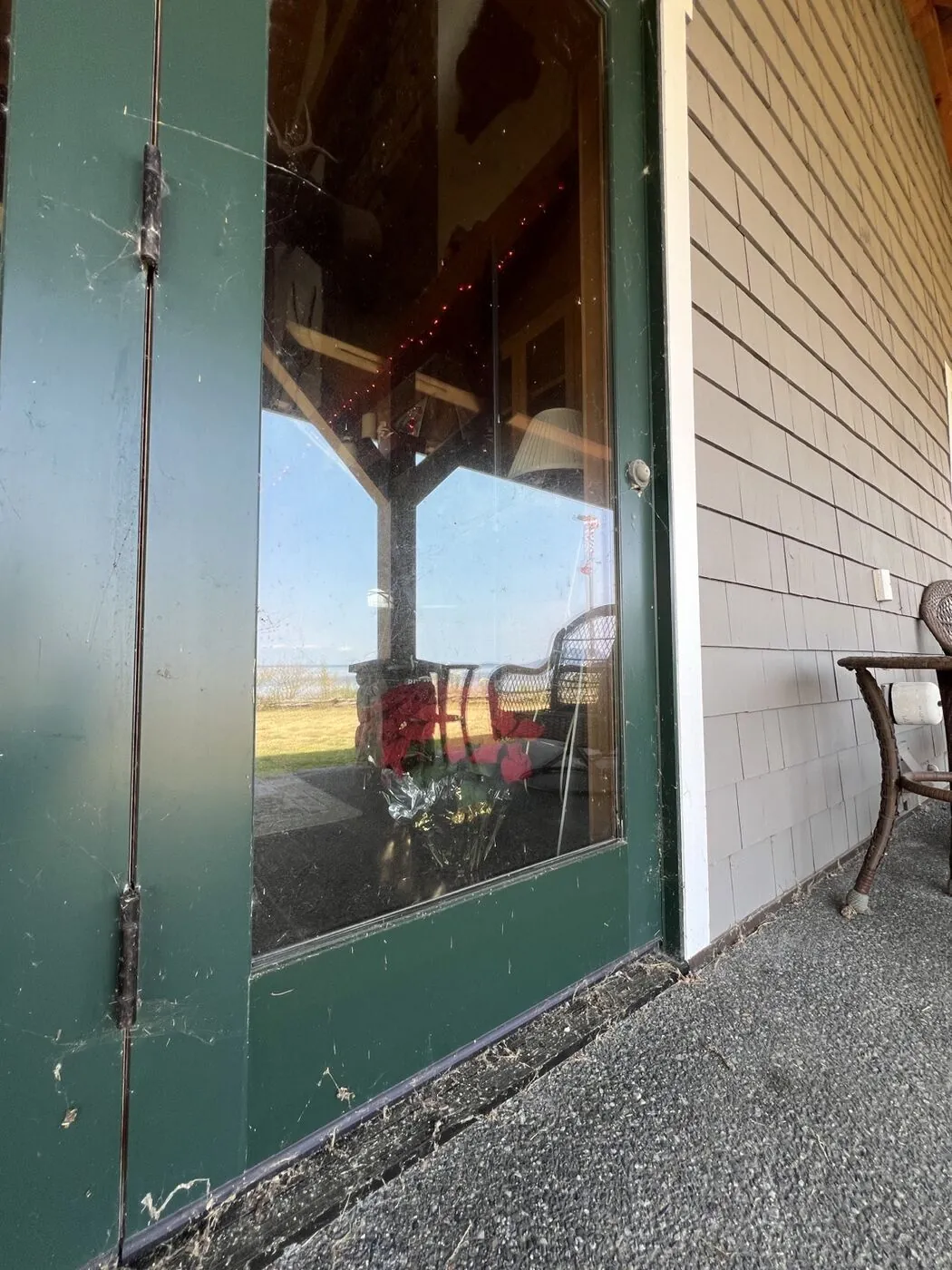
Detailing the edges. Most of what people notice on a badly cleaned window is in the last inch: a line of standing water at the bottom of the pane that dries into a visible band, or a corner the squeegee never reached. That perimeter work is slow and it is what the extra time buys.
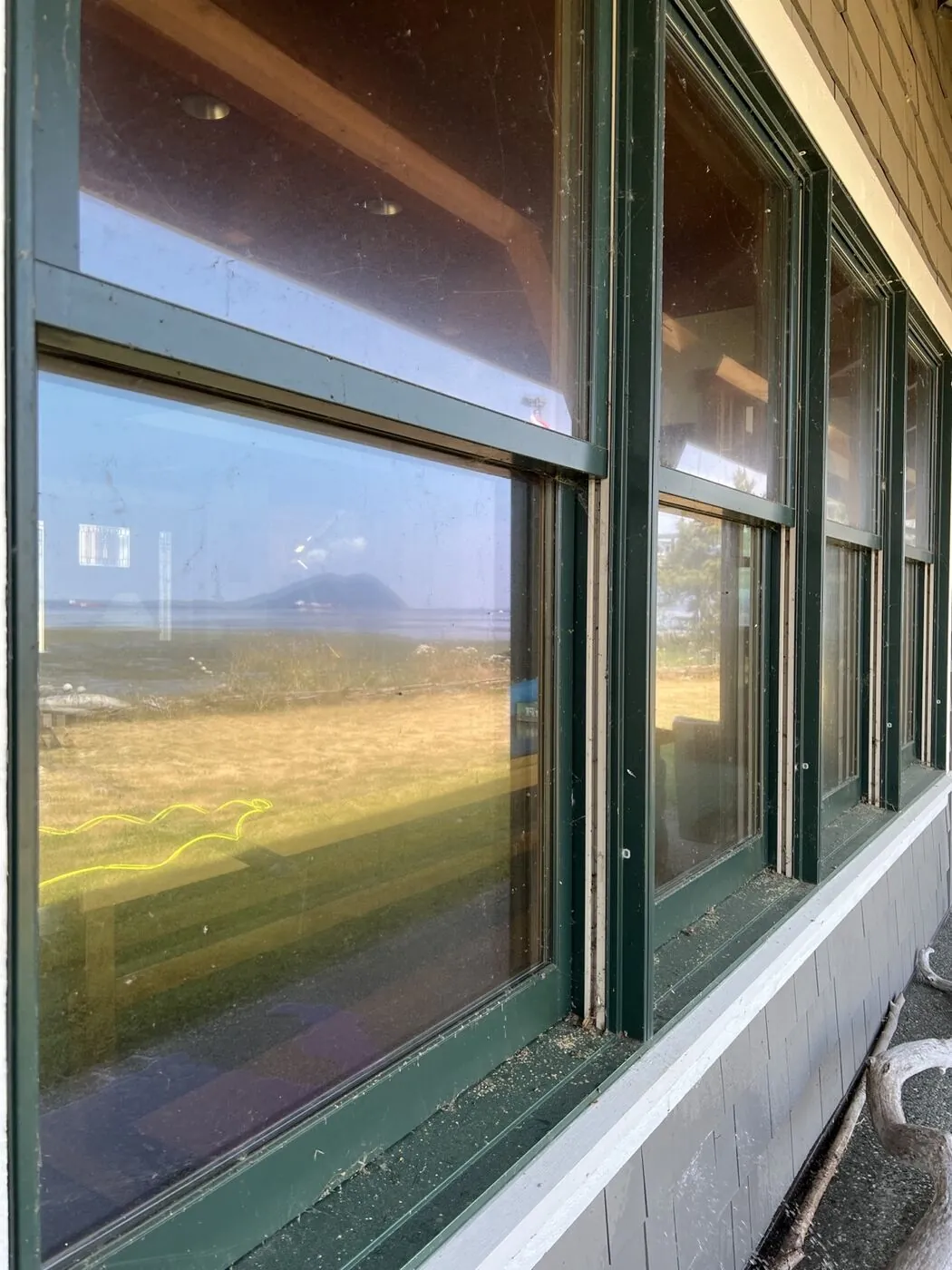
Working the whole pane, not the middle. Film builds unevenly and is heaviest at the bottom and the windward edge. A scrubber run over the centre and a fast squeegee pull leaves a pane that reads clean from indoors and filthy from outside.
Handling the screens properly. Screens hold an extraordinary amount of fine dust and are the single most common reason someone believes their newly cleaned windows are not clean. They also need to go back into the opening they came out of — screens are made to the opening, not to a standard, and a swapped pair rattles for the next decade.
Knowing when to stop. Etched glass, failed seals, latent scratching in tempered panes, coatings that look like film — all of these are cases where more effort makes things worse rather than better. Recognising them is worth more than technique.
Not putting hard water back on. Rinsing with unpurified water on a hard-water property re-creates the problem in the act of solving it.
What we do not do
Stated plainly, because scope creep in this trade usually happens on the day and under pressure:
- We do not clean between the panes of a sealed unit. That is a failed seal and a glazing repair.
- We do not remove paint, silicone or adhesive as part of a standard clean — that is post-construction work, priced and approached differently.
- We do not repair or reglaze windows, replace sashes, or fix failed hardware.
- We do not clean glass we cannot reach safely, and we identify those on the quote rather than on the day.
- We do not carry out inspections or issue condition reports. We will tell you what we can see, and that is an observation, not an assessment.
Who does the work
Randy Fee owns King of Kings and trains every technician on the crew himself. On a company this size that is not a marketing line — customers name him directly in their own reviews. He founded the business in March 2024, and in under three years it has collected hundreds of five-star reviews and seven local awards, including Cascades Best Gold for Best Cleaning Service from The Bellingham Herald in two consecutive years.
The company holds a Washington State business licence and carries Labor & Industries coverage, and is rated A by the Better Business Bureau. Ask for the details before work starts and you will get them — that is a reasonable question and anyone who gets cagey about it has told you something.
What happens on the day
We arrive in a marked vehicle and walk the property with you before anything gets wet, agreeing what is in scope and flagging anything we can see that will not come off. Interior work means access to the rooms, and boots come off. Screens come out and go back into the openings they came from — not into whichever opening is nearest, which is how screens end up not fitting.
At the end we walk it with you, in daylight, at the windows. If something is not right, that is the moment to say so, and we will fix it before we leave.
Getting a quote
Call (360) 303-6806, or ask for a quote through the site. We come out, walk the property with you, and tell you three things: which of the three problems your glass actually has, what the work involves, and what it costs.
There is no charge for the visit, no obligation attached to it, and no pressure to book anything else while we are there. If gutters or the roof are contributing to what is on your glass we will say so, because it is relevant — not because it is an upsell.
What each visit covers
| Visit type | What is included | Typical interval here |
|---|---|---|
| Standard residential | Interior and exterior glass, screens washed and refitted, tracks and sills vacuumed, frames wiped, cobwebs cleared, walk-round at the end | Twice a year; three times on a shaded or heavily treed lot |
| Exterior only | Exterior glass and accessible frames | On request — a false economy where winter condensation film builds inside |
| Restoration first clean | Standard scope plus hard-water treatment where the deposit is still liftable | Once, then the maintenance interval |
| Post-construction | Mortar, silicone, adhesive and overspray removal on new glass | One-off, quoted separately |
| Skylights and overhead glazing | Overhead glass, surrounding well cleared | Added to any visit while the pole system is set up |
No price band is published, because we do not quote a house we have not seen. The drivers are listed further down and the quote is free and on site.
Where we do it
Window cleaning is available in every market we serve — all of Whatcom County, all of Skagit County, and Oak Harbor. Pick your town below for what the work looks like where you actually live: the conditions are genuinely different in Glacier than they are in Anacortes, and the pages say so.
The surfaces this work touches
Window Cleaning where you live
Whatcom County
- Windows in Bellingham
- Windows in Ferndale
- Windows in Lynden
- Windows in Blaine
- Windows in Everson
- Windows in Sudden Valley
Skagit County
We also cover Sedro-Woolley, Semiahmoo, Custer, Nooksack, Sumas, Deming, Acme, Maple Falls, Glacier, Kendall, Van Zandt, La Conner, Lyman, Edison, Bow, Alger, Clear Lake, Big Lake, Conway, Concrete, Hamilton, Bay View, Oak Harbor, Point Roberts, Lummi Island, Marietta, Geneva, Wickersham, Rockport, Samish Island and Guemes Island from these bases. Those areas do not have their own page — if you are not sure whether you are inside the area, call and ask.
Windows questions
- How much does window cleaning cost?
- It is quoted on site, because the number depends on more than the window count — pane size, access, and how long it has been since the last clean all move it. A house cleaned last season is a maintenance visit; a house with three years of build-up is a restoration visit and costs more the first time and less every time after. A price given over the phone without anyone looking at the property is a guess.
- Do you clean inside and outside?
- Both, as standard, along with screens, tracks and sills. Exterior-only is available and costs less, but in this climate interior condensation film builds through the winter, so most people book both at least once a year and alternate after that.
- How often should windows be cleaned in this area?
- Twice a year suits most homes here — spring, after the winter grime, and early autumn, after the summer dust settles. Waterfront properties and homes near the industrial corridors often want a third visit. Commercial storefronts run monthly or quarterly.
- Will hard water spots come off?
- Usually, and we will tell you before we start. Fresh mineral spotting lifts with a dedicated treatment. Spotting that has been through years of wet-and-dry cycles can etch the glass surface itself, and an etch is permanent — no amount of cleaning removes it. We check on the quote so nobody pays for a result that was never available.
- Do you do second-storey windows?
- Yes, with a water-fed pole running purified water, which means the glass is cleaned from the ground rather than off a ladder propped on your deck or your planting. Where the reach genuinely is not safe, we say so rather than improvise.
- Do you need to get inside my house?
- For interior glass, yes — someone needs to be home, or arrangements made. Exterior-only work needs nobody there at all, as long as we can get around the property and gates are unlocked.
- Are you licensed and insured?
- The company holds a Washington State business licence and carries Labor & Industries coverage, and is rated A by the Better Business Bureau. Ask for the details before work starts and you will get them.
- What if I am not happy with the result?
- Tell us while we are still there. We walk the property with you in daylight at the end of every job for exactly this reason — the only useful check on window cleaning is looking through it. If something is missed, we fix it then.