Whatcom County
Exterior Cleaning in Blaine, WA
The short answer
We clean windows, gutters, roofs and siding across Blaine, from the older houses of the original town site to the newer homes of East Blaine and out toward Semiahmoo. Blaine is wet from November through January, cool all year, and served by moderately hard well water, and each of those changes how we work here.

Randy Fee — Owner, King of Kings Window Cleaning
Washington business licence, UBI 605476674 · L&I insured · BBB rated A
Randy runs the company himself, so you are dealing with the owner, not a call centre — and every technician here is personally trained by him. Working Whatcom and Skagit County since 2024.
We run the Blaine route on a regular rotation.
Blaine sits at the top of the county with the border on one side and salt water on another, and it is a town of two ages. The census puts its median year built at 1994, which makes it look like a young place. It also counts 387 homes that went up in 1939 or earlier. Both kinds of house are on the same streets, and they do not need the same care.
We work Blaine as part of the north-county route out of Bellingham. This page covers what the town’s weather, water and rules mean for the outside of a house here, and where to go for each service.
What kind of housing stock does Blaine have?
A mixed one, weighted toward detached family homes. Of the 2,793 housing units the census counts in Blaine, 1,997 are single-family detached houses, so most of what we clean here is a standalone home with its own roof, gutters and walls rather than a shared building.
The age spread is the interesting part. A median year built of 1994 means half the stock is newer than that, and much of our Blaine work is on houses from the last thirty-odd years, which usually means manufactured siding, composition roofs and double-glazed units. Alongside those sit the pre-war houses, roughly one in seven of the total. A January 2015 draft of the City’s land-use element describes Central Blaine, the original town site, as having a number of older homes and businesses built around the turn of the 20th century. That document was a draft, so treat it as a description rather than a formal designation, but it matches what the census numbers suggest.
For us the practical point is that a Blaine quote has to start with a look at the house itself. A 1990s two-storey and a century-old cottage two streets apart are different jobs with different risks.
What does the Blaine climate do to the outside of a house?
It keeps it wet and cool for a long stretch of the year. The long-running Blaine weather station, with records from 1893 to 2016, averages 40.60 inches of precipitation annually. November, December and January each average between about 5.6 and 5.85 inches. July averages 1.15.
Temperatures are mild in both directions. The station’s average annual maximum is 57.7°F and its average minimum is 40.9°F. That combination matters more than the rainfall total on its own. A surface that seldom gets properly warm, and stays damp for months, is exactly the surface moss, algae and mildew like best. Shaded roof planes and the walls that never see direct sun are where it shows first.
One caveat on the numbers: the station record ends in 2016 and the most recent years in it are marked provisional. The pattern it shows, a very wet winter and a short dry summer, is the part we plan around.
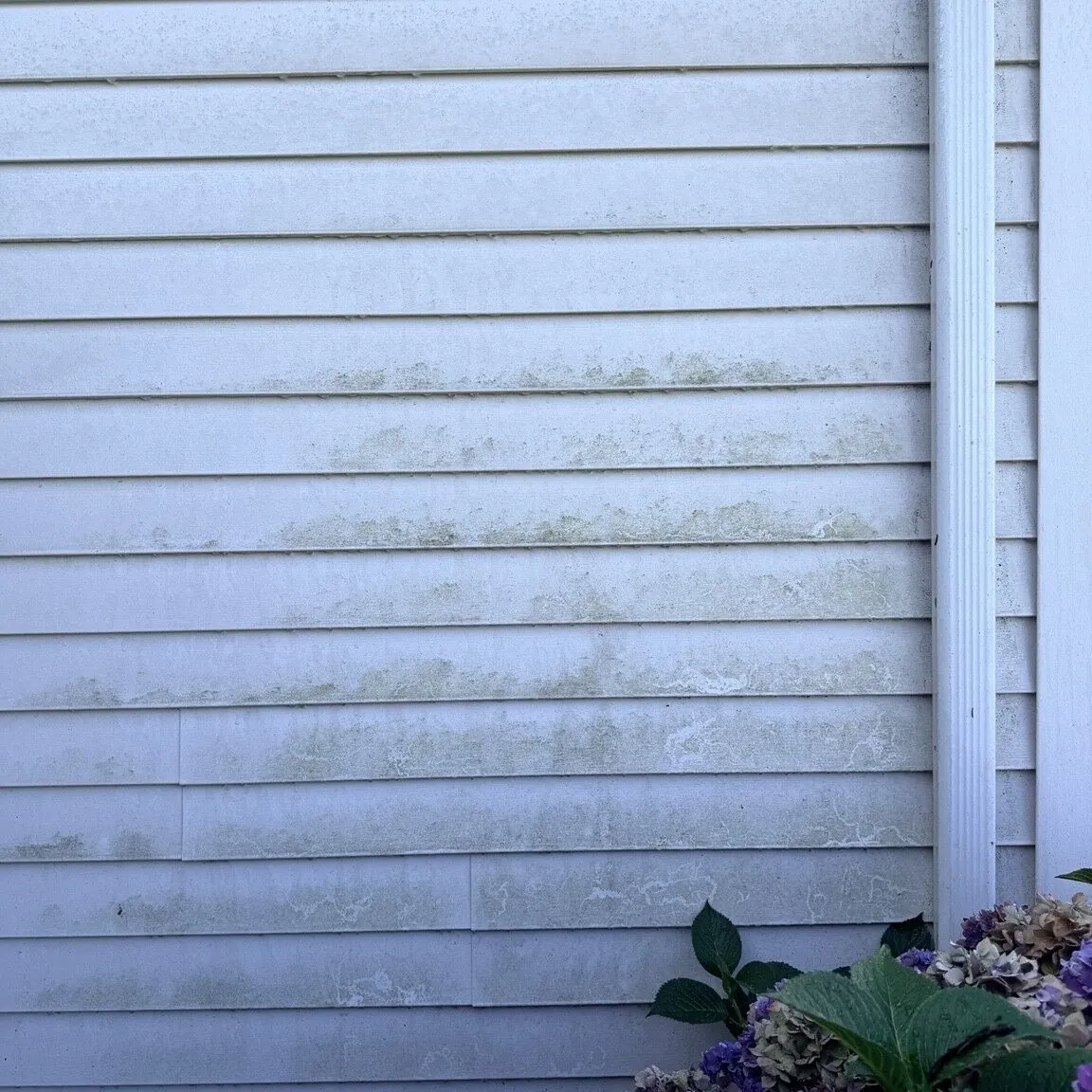 Before
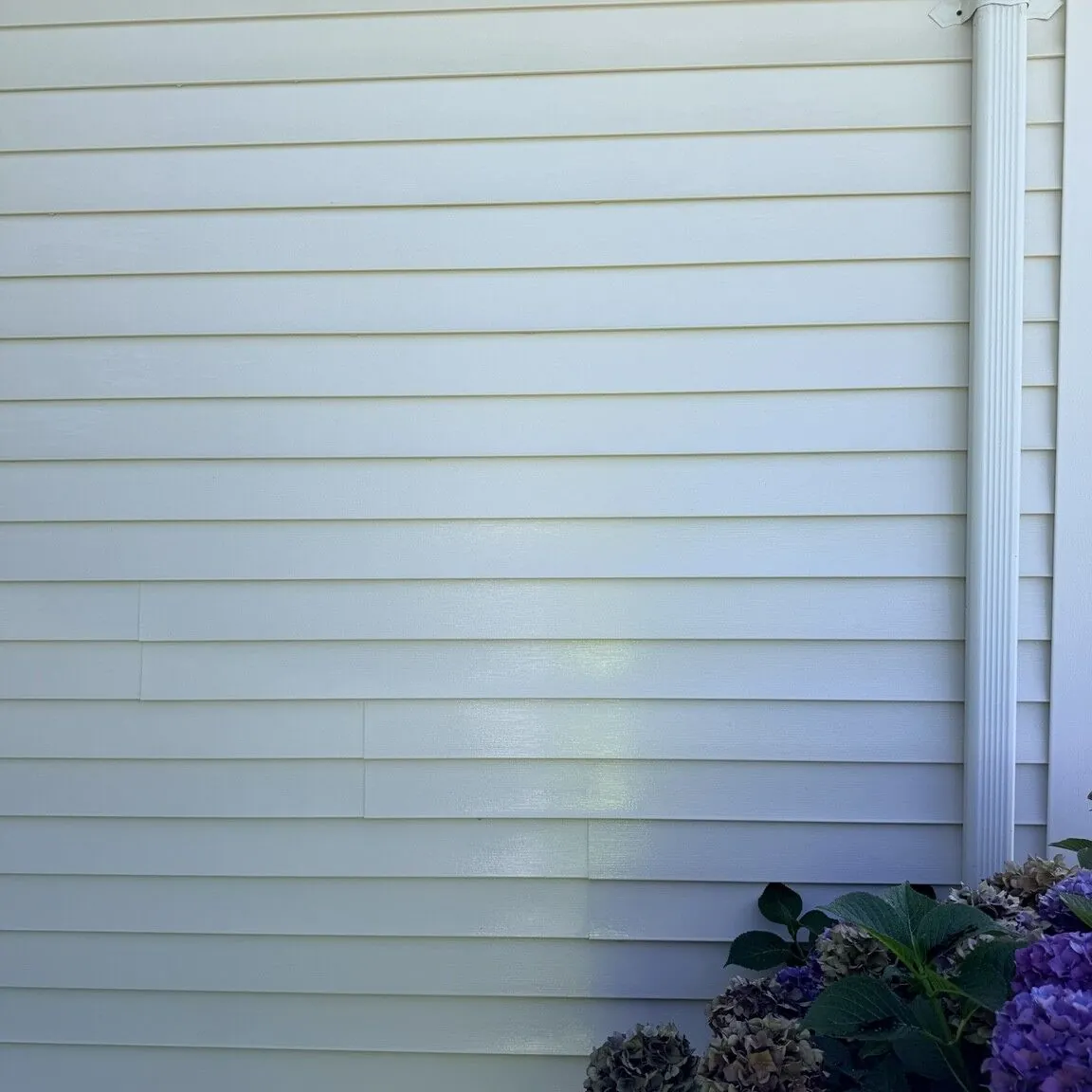 After
Does Blaine’s tap water change how you clean?
It changes how we clean glass, mostly. The City’s 2020 water quality report describes a supply drawn from several deep wells in the City of Blaine’s well field, treated with a small amount of chlorine. The same report gives hardness as typically 50 to 95 mg/L, which it calls moderately hard, with seasonal peaks as high as 120 mg/L.
It also notes that iron and manganese can show up as reddish, rusty deposits or surface film, and that the water’s pH averages about 8.0. None of that is a problem for drinking. It is a problem when the same water is sprayed onto a window and left to dry, because what evaporates is the water and what stays is everything dissolved in it.
That is why our window work runs on purified water carried on the truck. For rinsing siding and hardscape, where a trace of mineral does no visible harm, the property’s own supply is fine.
How do Blaine windows hold up?
Better than you might fear and worse than you would like. The long wet season leaves a steady film of rain splash and airborne grime, and on older frames it also leaves organic growth in the corners where glass meets putty or trim. Sprinkler overspray on moderately hard water adds spotting on the lower panes of many houses.
Most Blaine homes do well on two cleans a year, one after the rain eases and one in early autumn. The details, including what we do differently on pre-war sash windows, are on the Blaine window cleaning page.
What happens to gutters through a Blaine winter?
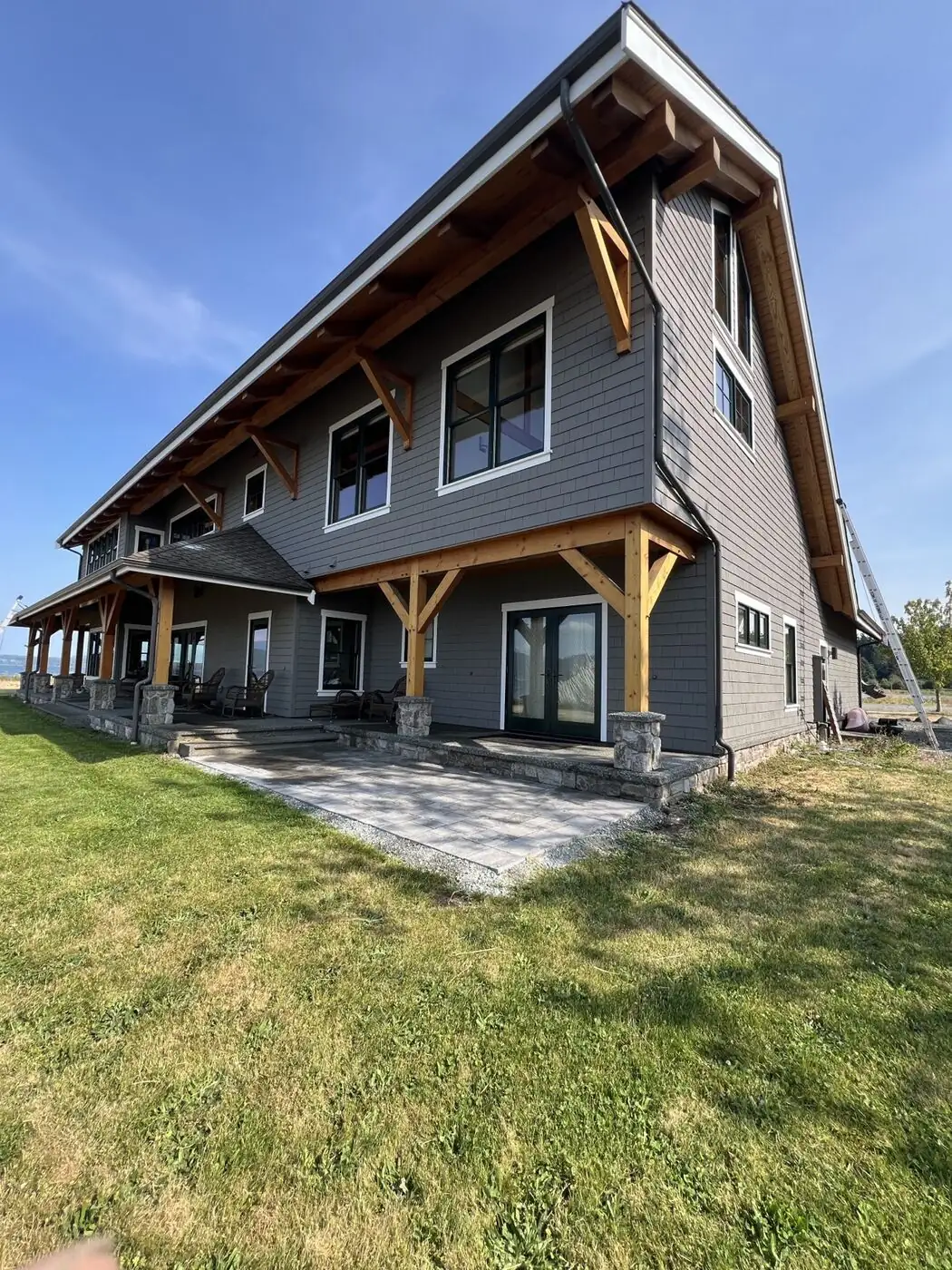
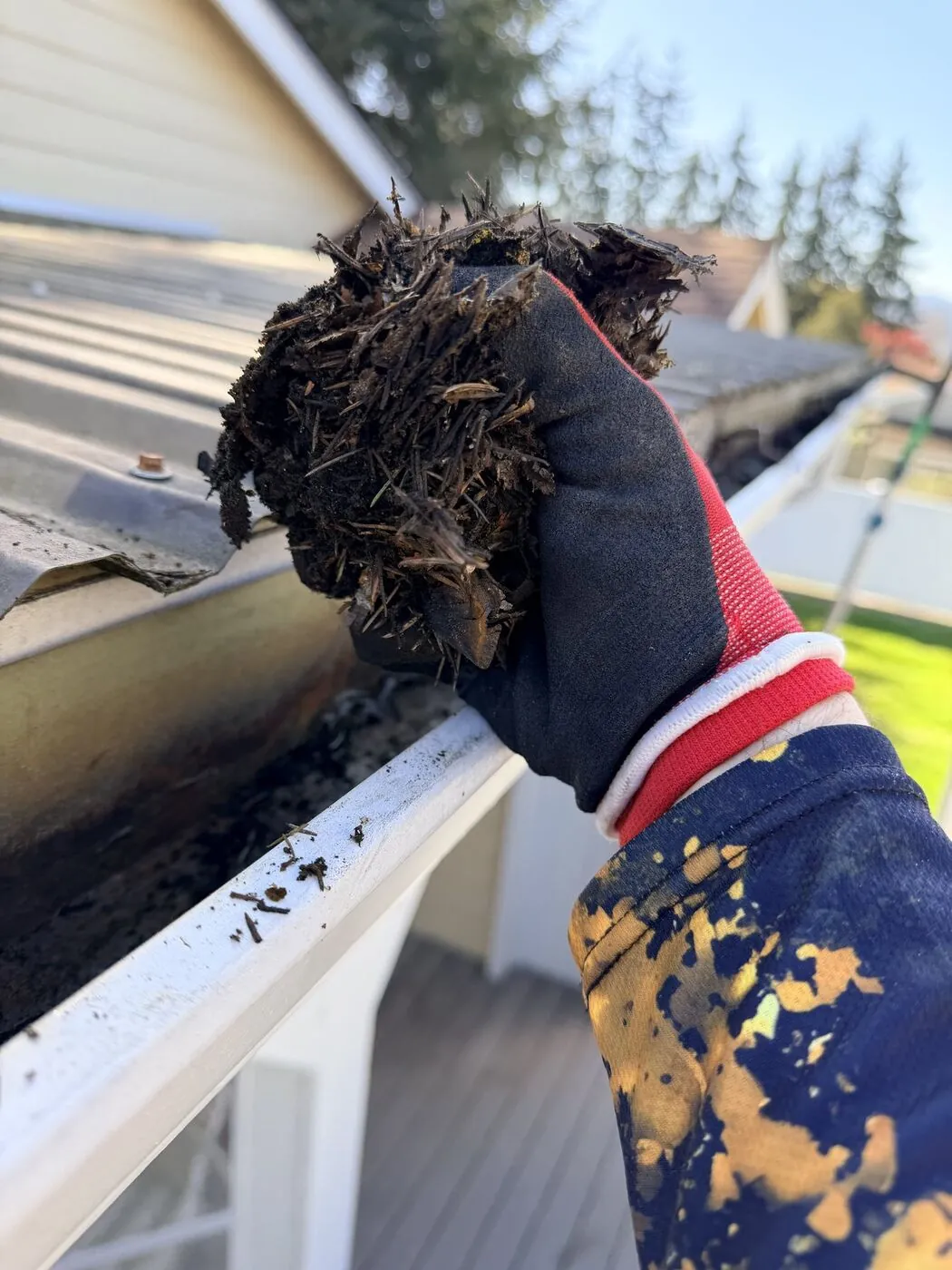
They carry the heaviest load of the year in the three wettest months, which is exactly when a blockage does the most damage. A gutter that is half full of needles and roof grit in October will overflow in the first real November storm, and water that spills over the front edge lands against the foundation or across a path.
The fix is a clean before the rain sets in, with the downspouts checked end to end rather than just the troughs scooped out. What that visit includes is set out on our Blaine gutter cleaning page.
Do Blaine roofs need moss treatment?
Many of them do, eventually. A cool, damp climate with a short dry season gives moss a long growing year, and the north and shaded faces of a composition roof are where it takes hold. Left alone, moss holds water against the shingles and lifts their edges.
We clean roofs with a low-pressure soft-wash method rather than a pressure washer, because blasting a shingle roof removes granules along with the growth. How we approach the different roof types found here is on the Blaine roof cleaning page.
What about siding and the rest of the house?
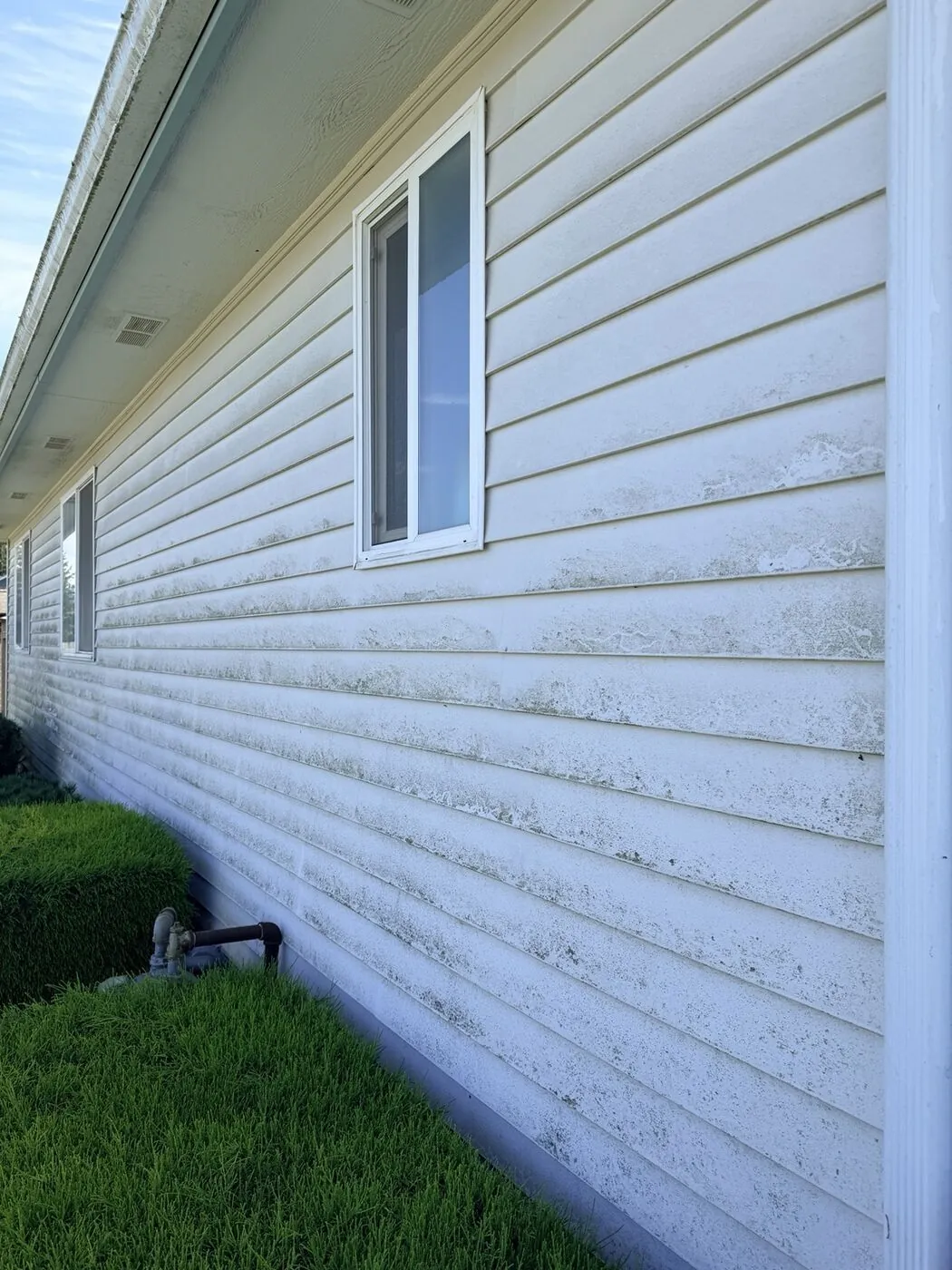
Siding takes the same damp, just more slowly. Green growth on the lower courses and the shaded side wall is the common Blaine complaint, along with grey film under eaves and, on some houses, rusty streaks where irrigation water has been hitting the wall.
A soft wash handles most of it without forcing water behind the cladding. The full approach, and what we do about those rust-coloured marks, is on the Blaine house washing page.
We also cover the rest of the exterior here:
- Windows, inside and out, with screens, tracks and sills
- Gutters and downspouts, cleared by hand and flushed
- Roofs, soft-washed for moss and algae
- Siding, soft-washed from the foundation to the eaves
- Driveways, paths and patios, pressure-washed where the surface can take it
- Solar panels, rinsed with purified water
What rules apply to wash water in Blaine?
Blaine Municipal Code 13.01.040 is the one that governs us. It prohibits storm or surface water discharges to the public drainage system, directly or indirectly, unless they comply with the city’s public works standards. We found no section of Blaine’s code that names pressure washing or building wash-down specifically, so we read the general rule strictly: rinse water goes to ground, not to a drain.
The reason the code exists is spelled out in BMC 13.01.020, which says the storm water chapter is meant in part to keep local waters suitable for contact recreation and for shellfish and fish habitat. That is not an abstract concern here. Drayton Harbor was downgraded for shellfish harvest because of fecal bacteria pollution, a Shellfish Protection District followed in 1995, and the downgrade was expanded to the whole harbor in 1999.
Our wider approach to rinse water, containment and what we will not put down a drain is on the wash water and storm drains page.

How is Blaine laid out, and does it change the work?
The same 2015 draft land-use element divides the city into three planning areas: Central Blaine, West Blaine (Semiahmoo), and East Blaine. It describes East Blaine as a 1,182-acre area annexed in February 1996 and characterised by low-density single-family homes, and notes that the Resort Semiahmoo site in West Blaine was annexed in 1974.
Because the source is a draft, we use those names only as a rough map and would check them against the adopted plan before relying on them. For scheduling, though, the broad picture holds up: older houses cluster near the original town site, newer and more spread-out homes sit to the east, and the Semiahmoo side has its own mix. We quote each on what we find.
The waterfront is part of the town’s character too. Semiahmoo Spit once held the Alaska Packers Association cannery, which closed in 1981; the land became Semiahmoo Resort, opened in 1987. Across the water, Blaine Harbor holds 629 boat slips behind a heavy rock breakwater, and the 67-foot concrete and steel Peace Arch has stood since Sam Hill dedicated it on September 6, 1921. We cannot give you a measured figure for how much salt spray reaches any particular street, and we will not invent one. What we do instead is look closely at the side of a house that faces the water when we quote, rather than assume either way.
Which nearby areas do you cover from Blaine?
The rest of the north county, on the same runs. Neighbouring Birch Bay has its own page, as does Ferndale. We also take work around Custer and on the Semiahmoo side. If you are unsure whether your address is on the route, ask; the answer is usually yes.
How do I book a visit in Blaine?
Call (360) 303-6806 or use the contact form. We will come to the house, walk round it with you, and explain which surfaces need cleaning, which need a gentler hand because of their age, and what can wait. The price you get is for the work in front of us, and nothing starts until you have agreed to it.
If you are selling, or getting a house ready for guests over the summer, say so when you call. It helps us suggest an order that makes sense, roof and gutters before windows, so nothing lands on fresh glass, and it helps us fit the visit into a Blaine run that suits your date.
What we do in Blaine
Nearby
- Birch Bay
- Semiahmoo (served, no page of its own)
- Custer (served, no page of its own)
- Point Roberts (served, no page of its own)
Blaine questions
- Do you actually come up to Blaine, or only work Bellingham?
- Blaine is on our regular route. We are based in Bellingham and schedule the north end of the county in runs, so a Blaine booking is grouped with other work nearby rather than treated as a special trip.
- Which services can I book for a Blaine house?
- Window cleaning, gutter cleaning, roof cleaning and house washing each have their own Blaine page, and we also handle moss removal, pressure washing and solar panel cleaning here. Any of them can be combined on one visit.
- My house was built before 1940. Is that a problem?
- Not a problem, just a different job. Older houses tend to have more trim, older paint and original details, so we use lower pressure, go slower, and point out anything fragile on the walk-round before we touch it.
- Will you use my outside tap?
- For some rinsing, yes, but our window work runs on purified water we bring ourselves. Blaine's city water is moderately hard by its own 2020 report, and we would rather not dry those minerals onto glass we just cleaned.
- Where does your rinse water go?
- Onto lawn and planting beds wherever the ground allows, and away from street drains. Blaine's code prohibits discharges to the public drainage system outside city standards, and Drayton Harbor has a shellfish history the town takes seriously.
- What is the best time of year for a full exterior clean in Blaine?
- Late spring through early autumn. July is by far the driest month on the local record, so surfaces dry quickly and treatments have time to work before the November-to-January rain arrives.
- How do I get a price?
- Call (360) 303-6806 or send a request online. Someone comes out, walks the property with you and gives you a figure for the work you actually want, at no charge.