Whatcom County
Roof Cleaning & Debris Removal in Blaine, WA
The short answer
Blaine roofs stay cool and wet for months, which suits moss, algae and lichen. We remove the growth with a low-pressure soft wash and hand work rather than a pressure washer, protect gutters and planting, and schedule the job for the drier months, when July averages only 1.15 inches of precipitation on the town's long-term record.

Randy Fee — Owner, King of Kings Window Cleaning
Washington business licence, UBI 605476674 · L&I insured · BBB rated A
Randy runs the company himself, so you are dealing with the owner, not a call centre — and every technician here is personally trained by him. Working Whatcom and Skagit County since 2024.
I run the Blaine route personally.
A roof in Blaine has an easy time in July and a hard time for most of the rest of the year. The town’s long weather record averages 40.60 inches of precipitation annually, most of it between late autumn and winter, and the temperature rarely climbs high enough to dry a shaded roof plane quickly. That is the recipe for moss, algae and lichen, and it is why roof cleaning here is a matter of when and how as much as whether.
This page explains how we clean Blaine roofs, why we do not use a pressure washer on them, and how the job fits the town’s short dry season.
Why do Blaine roofs grow moss so readily?
Because they spend so long wet and cool. The Blaine weather station’s average annual high is 57.7°F and its average annual low is 40.9°F. Moss does not need warmth; it needs moisture and time, and a roof here gets months of both. November, December and January each average between about 5.6 and 5.85 inches of precipitation, and a shaded roof plane can go the whole winter without drying out.
The growth follows the shade. North-facing planes, sections under overhanging trees, and the lower part of a roof where the eaves stay damp are usually the first to turn green. Once moss is established, it acts like a sponge, holding water against the shingles long after the rain stops, and its roots work under the shingle edges. Algae shows up differently, as dark streaks running down the slope, and lichen as small, crusty grey-green patches that grip tightly.
What sort of roofs are on Blaine houses?
Mostly the roofs you would expect on a town whose housing has a census median year built of 1994. A house built in the mid-1990s may still be on its original composition roof or may already be on its second, and either way a composition shingle is the covering we see most. Our composition shingle profile covers how those shingles are made and what shortens their life.
Blaine also has 387 housing units built in 1939 or earlier, and older houses have had more time to be re-roofed in whatever was fashionable at the time. So we never assume composition before we have looked, because cedar and metal each want a different touch. Cedar, which absorbs water and softens as it ages, is covered on our cedar shake roof profile. Metal roofs take a softer rinse again, and we describe that on the metal roof soft washing page.
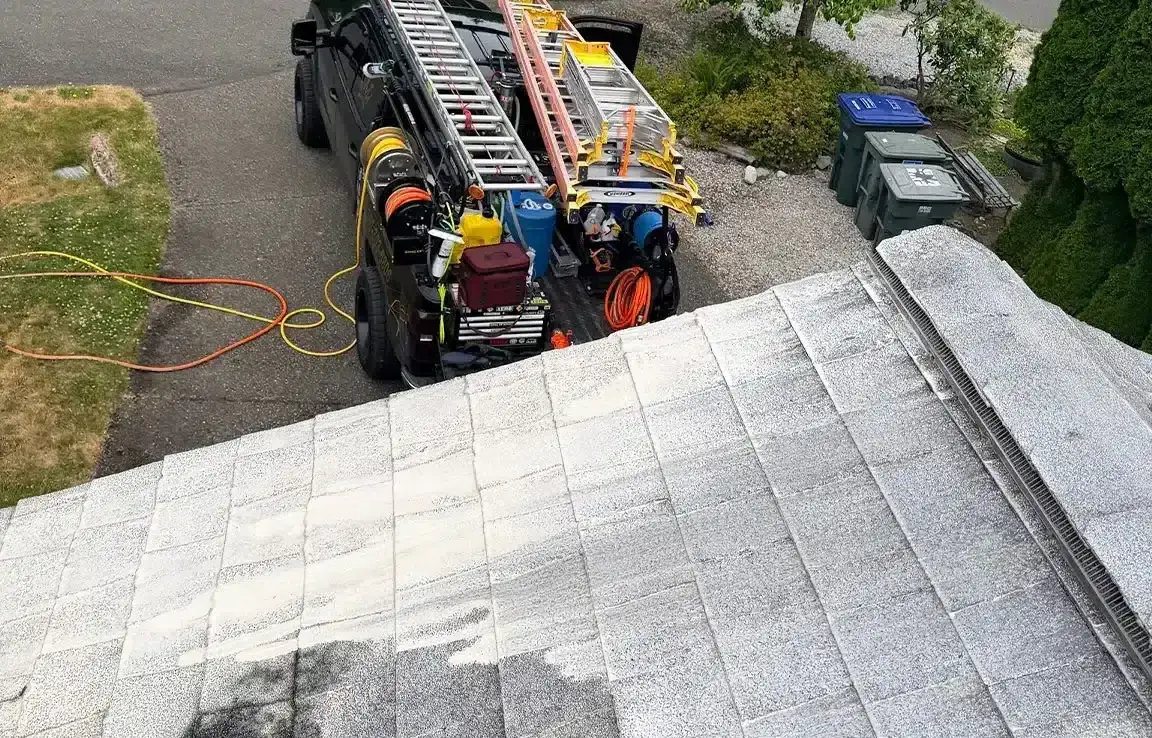
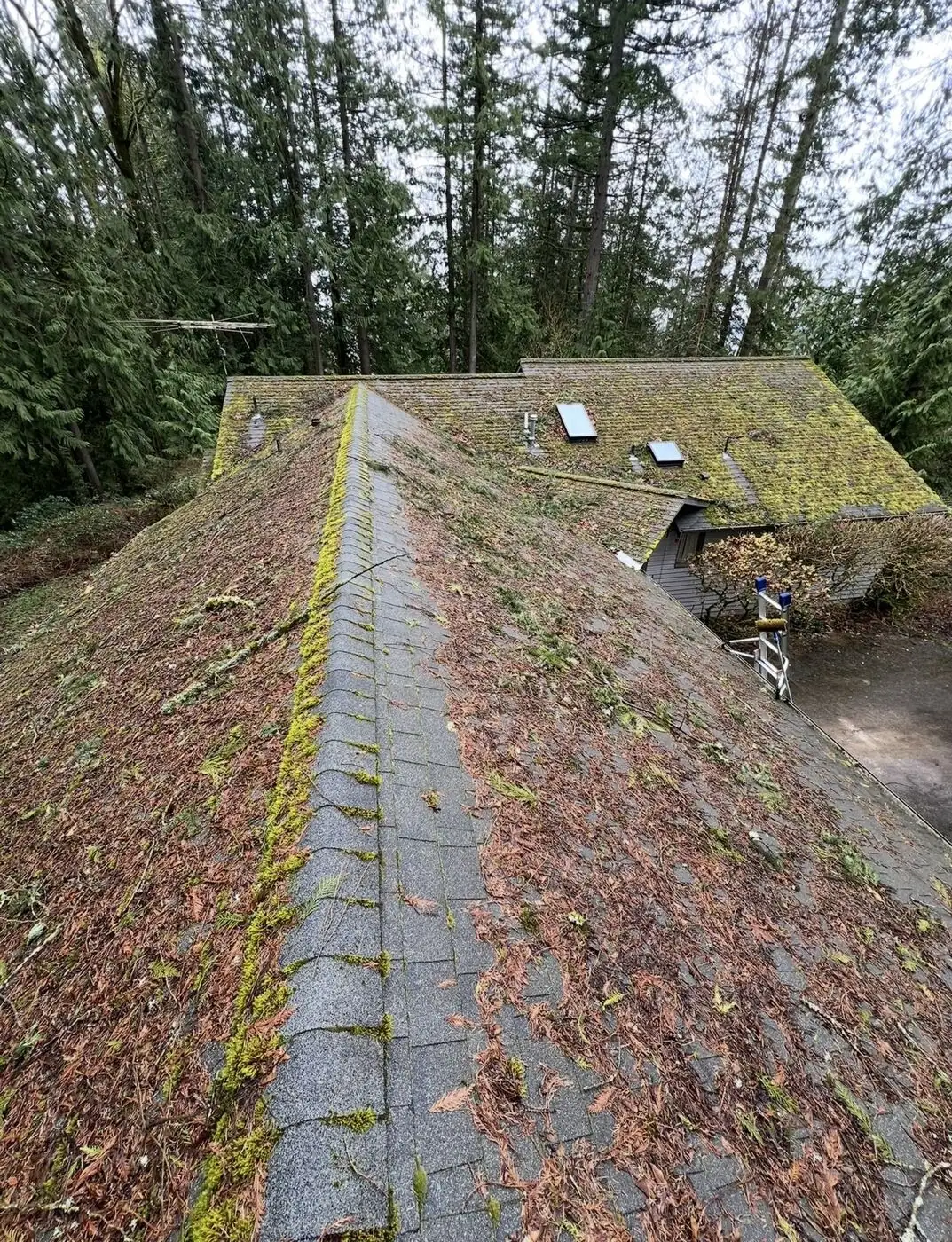 Before
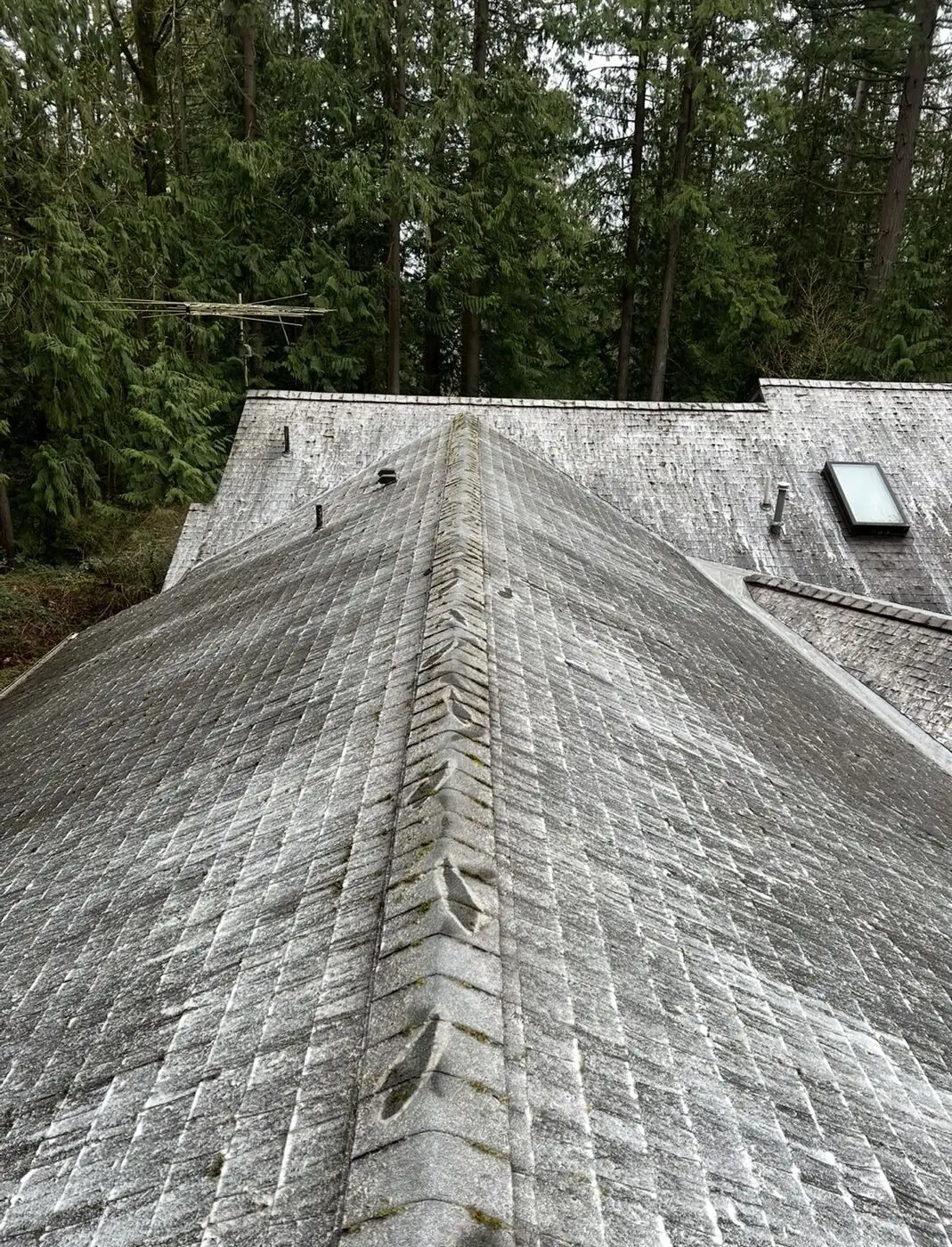 After
What does a Blaine roof clean include?
A standard roof clean covers:
- A look at the roof from the ground and the ladder before anything is applied, to plan access and spot fragile areas
- Heavy moss removed by hand, with brushes and scrapers designed not to lift shingle edges
- A soft-wash application across the affected planes, at low pressure, to loosen the remaining growth and the algae streaks
- Dwell time for the solution to work, followed by a low-pressure rinse where the surface calls for it
- Protection for gutters, walls and planting, with plants wetted before and after
- Gutters cleared of the moss and grit the roof sheds, when booked together
- A report of anything we noticed, such as cracked, lifted or missing shingles
Moss sometimes keeps going under the shingles rather than just sitting on top. Our page on moss under shingles explains why that happens and what can be done about it.
Why no pressure washer?
Because a pressure washer cleans a roof by damaging it. Composition shingles are coated with mineral granules that shield the asphalt underneath from sunlight. A high-pressure jet strips those granules along with the moss, and a roof that looks clean the day after can age years in an afternoon. On cedar, pressure splinters the soft wood and opens the grain to more water.
Soft washing works the other way round. The solution does the loosening, so the only force applied is a gentle rinse. Heavy growth is removed by hand first, so there is less for the solution to deal with. The result is slower to achieve and slower to come back, which is the right trade in a climate that will be trying to regrow the moss from the first week of autumn.

What decides the price of a Blaine roof clean?
Every roof is quoted in person and for free. The figure depends on:
- Roof area, measured across all planes rather than the house footprint
- Pitch and height, since a steep two-storey roof needs more set-up and more care than a low single-storey one
- The covering, with cedar and older shingles taking longer than newer composition
- How much growth there is, from light algae streaking to a thick green mat on a north plane
- Access, including trees, conservatories, decks and tight side yards
- Gutter work and other services booked at the same visit
You get the number before we start, in writing if you would like it that way.
When is the best time to clean a Blaine roof?
In the dry part of the year, which in Blaine is short. July averages 1.15 inches of precipitation on the town’s long-term record, a fraction of what any winter month brings. That dry spell matters for three reasons: the solution works better on a dry roof, the roof has time to dry out afterwards before the rain resumes, and a dry roof is far safer to work on.
We clean roofs in spring and autumn too, when the forecast allows, but we would rather move a date than clean in steady rain. Freezing mornings are also a no, because a frosted roof is not a safe place to stand.
If the moss is already thick, a spring clean gets the worst of it off before the summer, and a lighter maintenance visit can follow in a year or two.

Where does the runoff go?
Onto open ground, not into the storm drains. Blaine Municipal Code 13.01.040 prohibits any discharge to the public drainage system that does not comply with city public works standards. Roof runoff during a clean is exactly that sort of discharge, so we direct it to lawn and beds, block downspouts where needed, and do not let it run down the driveway to the street.
The city’s storm water utility makes the connection between roofs and drains explicit. Under BMC 13.01.015 it bills by impervious surface, and one billing unit equals a single-family house or 4,200 square feet of roofs, driveways and patios. Your roof is, in the city’s arithmetic, part of the drainage system, which is a good reason to be careful about what we wash off it. Our approach is set out in full on the wash water and storm drains page.
What problems tend to follow roof moss?
Gutters first. Moss that loosens over the winter slides down the roof and packs the gutters and outlets, which is why a roof clean and a gutter clean belong on the same visit. The Blaine gutter cleaning page covers that part of the job.
Beyond the gutters, a roof that has held moss for years may have shingle edges that have lifted or granule loss where the growth sat thickest. We will show you what we see, but we are cleaners rather than roofers, and any repair or replacement decision is for a roofing contractor.
How often should a Blaine roof be cleaned?
There is no single interval, and anyone who gives you one without seeing the roof is guessing. A sunny, open roof with little overhanging growth may go several years between cleans. A north-facing plane under trees may want attention every couple of years. The pattern usually becomes clear after the first clean: we can see how quickly growth returns and suggest a sensible cycle from there.
What can you do to slow the moss down between cleans?
Quite a lot, and most of it costs nothing but a weekend.
Light is the biggest factor. Branches that hang over a roof keep it shaded and drop needles and leaves that hold moisture, so trimming them back, with an arborist where the tree is large, makes a visible difference to how fast growth returns. On a Blaine roof that already spends its winters cool and damp, every extra hour of sun helps.
Debris is the second. Needles and leaves that collect in valleys and behind chimneys form little wet mats, and moss loves to start there. Clearing them off with a soft broom from a ladder, or having it done, removes the seed bed before anything takes hold.
Water is the third. Gutters that overflow keep the lowest courses of shingles wet, and downspouts that discharge onto a lower roof keep that section soaked all winter. Extending a downspout so it carries water off the roof below is a simple change that often stops a stubborn patch of growth.
What we would not recommend is scrubbing at moss yourself with a stiff brush or a garden pressure washer. It is easy to lift shingle edges or strip granules, and a roof is a bad place to lose your footing.
How do I book a roof clean in Blaine?
Call (360) 303-6806 or send a request through the contact page. We will look at the roof with you, explain what is growing on it and where, and quote the work on the spot. The general method we use across the county is described on the main roof cleaning page.
Roof cleaning questions from Blaine homeowners
- Will you pressure wash my roof?
- No. A pressure washer strips the protective granules off composition shingles and can split cedar. We use a low-pressure soft wash, brushes and hand tools, and let the cleaning solution do the heavy work.
- How soon does the moss come back?
- It depends on shade and on how the roof faces. An open, sunny roof can stay clean for several years; a north-facing plane under trees will start to regrow sooner. We will tell you what to expect for your roof specifically.
- Is it safe to walk on my roof?
- Sometimes. We judge each roof on pitch, surface and how slick it is on the day. Where walking is not safe we work from ladders and the ground with extension equipment, and if a roof cannot be cleaned safely we will say so.
- Will the cleaning harm my garden?
- We wet plants before and after, cover delicate ones, and keep the solution to the strength the job needs. Runoff is directed to open ground rather than to the street drain.
- Can you tell me if my roof needs replacing?
- We can tell you what we saw while cleaning, such as cracked or lifted shingles or bare patches. We are not roofers or inspectors, though, so a decision about repair or replacement belongs with a roofing contractor.
- Should the gutters be cleaned at the same time?
- Yes. Loosened moss and grit end up in the gutters, so we clear them after the roof, and booking both together costs less than two separate visits.
- What time of year is best for a Blaine roof?
- Late spring to early autumn, with midsummer ideal. The dry months give the roof time to dry, the solution time to work, and the crew a safer surface to stand on.