
Whatcom & Skagit County
Commercial Window Cleaning in Whatcom & Skagit County
The short answer
King of Kings cleans storefronts, offices and multi-storey glass across Whatcom and Skagit County on a scheduled route — weekly, monthly or quarterly, before opening or after close. Licensed, L&I insured, and the same crew each visit so nobody has to explain the building twice.

Randy Fee — Owner, King of Kings Window Cleaning
Washington business licence, UBI 605476674 · L&I insured · BBB rated A
Randy runs the company himself, so you are dealing with the owner, not a call centre — and every technician here is personally trained by him. Working Whatcom and Skagit County since 2024.
Commercial glass is a different product from residential glass, sold to a different person for a different reason. A homeowner books a window clean because the windows are dirty. A business books one because the front of the building is the first thing a customer sees, and because nobody on the payroll should be standing on a ladder in the entrance.
What follows is how the work runs, what the frequency should be, and where the honest limits are.
Who this is for
Retail and storefronts — the largest part of this work. Downtown Bellingham, Fairhaven, Barkley Village, the Guide Meridian corridor, and the main streets of Ferndale, Lynden, Blaine, Mount Vernon, Burlington, Sedro-Woolley and Anacortes. Entrance glass, display windows, and anything the customer touches on the way in.
Restaurants, cafés and bars. Higher-frequency work, driven by grease film, condensation and heavy hand contact, and almost always scheduled outside service hours.
Offices and professional suites — medical and dental practices, legal and accounting offices, clinics, agencies. Interior and exterior on a monthly or quarterly cycle, usually with more interior glass than a retail unit and more constraints on when a stranger can be in the space.
Multi-tenant and mixed-use buildings, where the common glass belongs to the landlord and the tenant glass belongs to the tenant, and the scope needs to be written down clearly before the first visit.
Apartment blocks, HOAs and condominium buildings — common areas, lobbies, stairwell glass and, where it is in scope, unit exteriors.
Auto dealerships and showrooms, which are almost all glass and where the appearance of it is directly part of the sales floor.
Schools, churches and institutional buildings, often on a termly or seasonal rather than monthly cycle.
Vacation rentals and hospitality, where turnover scheduling governs.
Frequency, and why one interval for all the glass is wrong
The most common mistake in commercial window cleaning is treating a building’s glass as one surface with one schedule. It is not, and paying to clean all of it at the fast-soiling interval is expensive.
Entrance and door glass is the fast-soiling surface. Hands, weather, foot traffic, spray off the sidewalk, and in food service, grease carried on the air. This is what customers stand directly in front of and it is where dirty glass actually costs you something. Weekly or fortnightly for most retail; more for food service.
Ground-floor display and frontage glass soils more slowly — weather and road film rather than contact. Fortnightly to monthly suits most.
Upper-storey exterior glass soils slowly and is mostly weather-driven. Quarterly is usually sufficient, twice a year on some buildings.
Interior glass depends entirely on the space. An office with partition glass and a lot of hand contact needs it regularly; a warehouse mezzanine does not.
The sensible arrangement is a mixed schedule: entrance glass frequently, the rest of the building on a longer cycle, all under one agreement with one invoice. That is nearly always cheaper than the flat interval, and it puts the money where the customer’s eye actually lands.
What a scheduled route actually gives you
The value of a commercial agreement is not a lower per-visit rate. It is predictability, and there are four parts to it.
The same crew. A crew that has cleaned your building before knows which entrance is unlocked at seven, which panel is out of square, where the water and the outlet are, which planter has to move, and what the manager notices first. That knowledge is worth real time on every visit, and it is why a rotating cast of subcontractors never quite gets there.
A schedule you can rely on. The point of a route is that it happens without anybody chasing it. If you are calling to ask when the window cleaner is coming, the arrangement has already failed.
Working around your hours, not through them. Before opening for retail, after close for hospitality, agreed quiet windows for offices and clinics.
One invoice. Monthly, against an agreed schedule and rate.
Working outside business hours
Most of this work happens early. Storefront glass gets cleaned before the doors open, so that the first customer of the day sees the result and nobody has to step around equipment.
That means keys, codes, alarm arrangements and access agreements — all of which get settled in writing before the first visit rather than improvised on the morning. For premises where a crew cannot be unaccompanied, we schedule to a window when someone is there.
It also means we are frequently the first people at a property in the morning, which puts us in a position to tell you about things you would otherwise find out later: a broken pane, a forced door, graffiti, water where it should not be, a light out over the entrance. Not part of the service, but a reasonable thing to pass on, and we do.
Multi-storey work, and where we stop
Worth being direct about the limit, because it is a real one.
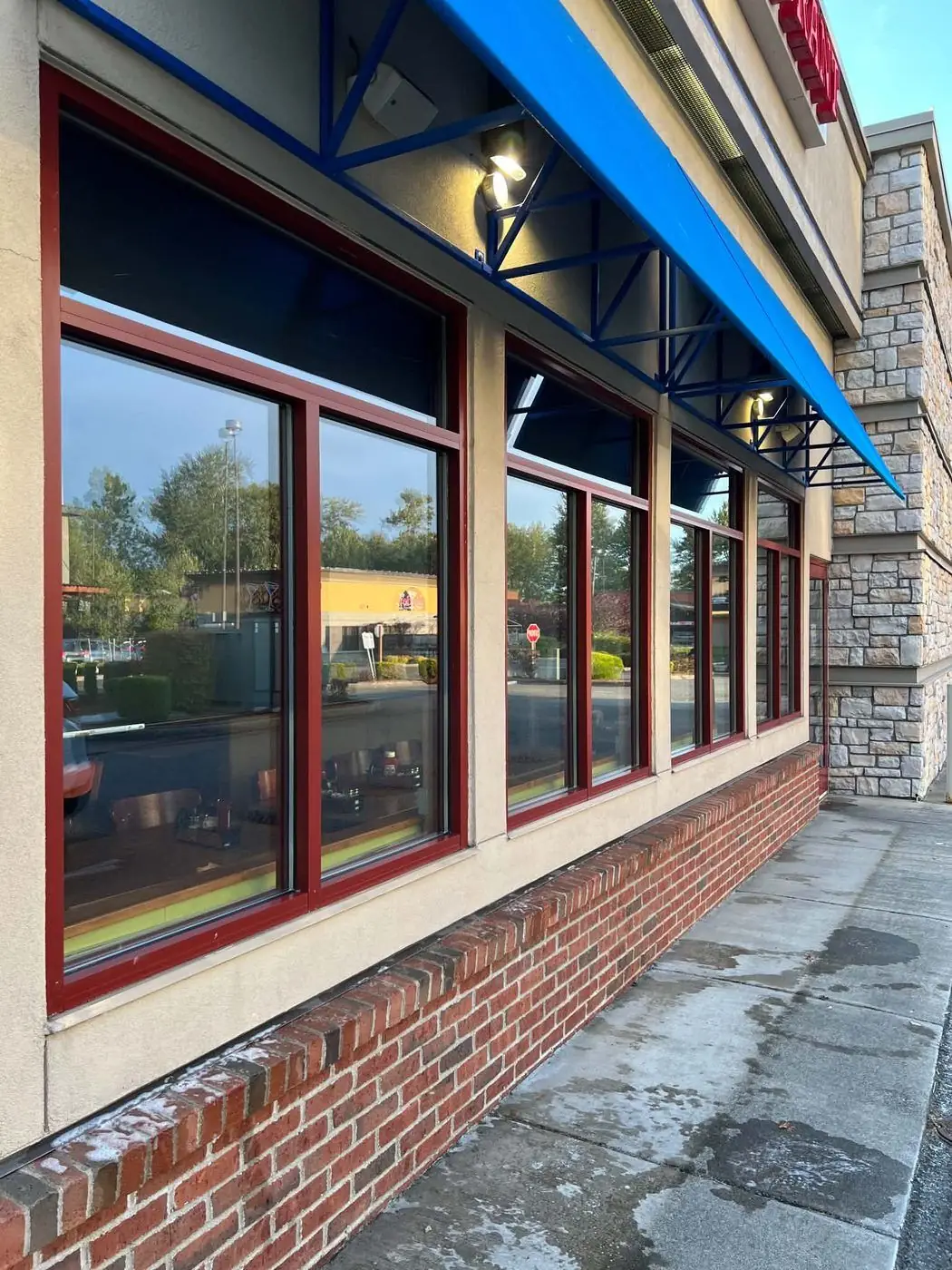
We clean multi-storey glass to the height a water-fed pole system reaches — practically, that covers most of the commercial building stock in Whatcom and Skagit County, which is predominantly two to four storeys. Pure water on a telescopic pole means upper glass is cleaned from the ground: no ladders in a pedestrian entrance, no lift blocking a parking area, no disruption below.
We do not do high-rise work. Rope access, bosun’s chair, suspended platform and swing-stage work are a separate discipline with their own certification and equipment, and taking on a building that needs them would be irresponsible. If your building is beyond pole height, we will tell you at the walk-round and you should engage a high-rise specialist.
That limit almost never bites in this market. It occasionally does in downtown Bellingham, and being straight about it is better than finding out on the day.
Post-construction and new fit-out
A different job from maintenance cleaning, priced and approached separately.
New commercial glazing arrives carrying mortar and grout splash, silicone smears, adhesive residue from factory labels, paint overspray and construction dust. Getting it off is skilled work, and getting it wrong is expensive: modern commercial glazing is heavily tempered, and tempered glass carries latent surface debris from the tempering process that aggressive blade work can drag across the pane, producing fine scratching over the whole surface. The scratches are caused by the tool; the vulnerability came from the factory. The resulting argument about who pays for a full storefront’s glass is one nobody enjoys.
So post-construction is quoted as its own scope, by people who know what is under the blade, and it is not folded into a first regular visit as though it were the same thing.
What is included
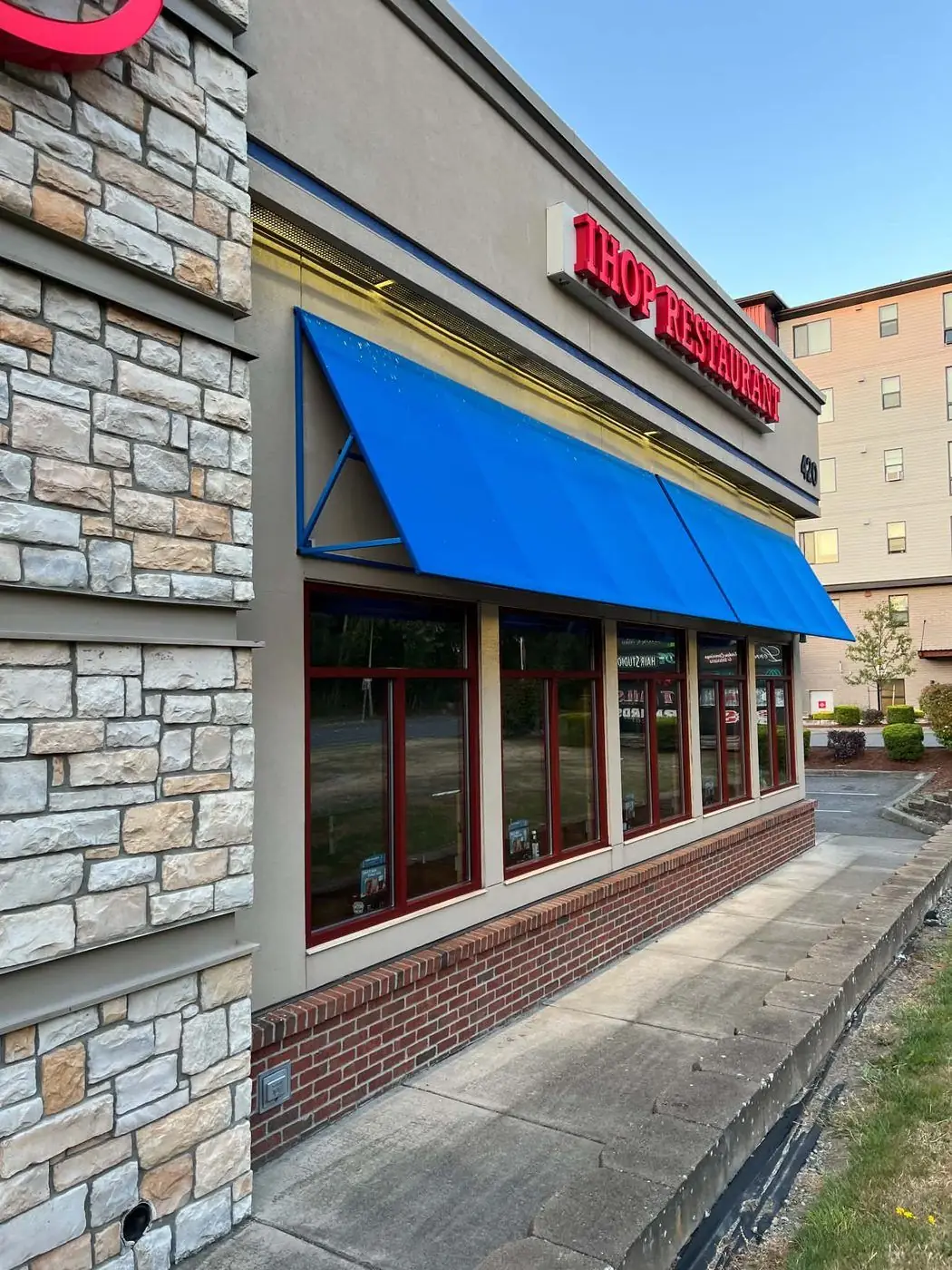
- Exterior glass, to pole height
- Interior glass, where in scope
- Entrance doors, including frames, push plates and the glass either side
- Frames, sills and tracks at ground level
- Cobweb removal around entrances, signage and soffits
- A note on anything we spot — damaged glass, failed seals, hardware problems
Quoted separately: post-construction cleans, signage and awnings, skylights and atrium glazing, and interior glass partitions in unusual quantity.
Beyond the glass
Most commercial buildings need more than window cleaning, and the same access visit can cover it:
Entrance walkways and hardstanding — see pressure washing. On a commercial property this is a liability question as much as an appearance one: a mossy entrance step in November is a slip claim waiting to happen, and “it is on the maintenance schedule” is a much better position than the alternative.
Building exteriors — see house washing, which covers commercial siding and cladding with the same soft-wash method.
Gutters and roof drainage — see gutter cleaning. Commercial buildings frequently have internal drains, parapet scuppers and flat-roof drainage rather than hung gutters, which is a different inspection and a different clearing method.
Bundling these into one scheduled arrangement is generally cheaper and always easier to administer than managing three contractors against three calendars.
Why a business should care beyond appearance
Not a hard sell, but the reasons are real and they are not the ones usually given.
Glass is the first impression, and it is unconscious. Nobody walks into a shop thinking about the windows. They form an impression of how well the business is run in the first few seconds, and the front of the building supplies most of it. Clean glass does not get noticed; dirty glass does.
Natural light is a working condition. Filmed glass measurably reduces the light entering a space, and in a region with this little winter daylight, that matters more here than it would somewhere sunnier. Offices with clean glass are simply better places to spend a February afternoon.
Nobody on your payroll should be doing it. This is the practical one. Asking a member of staff to clean the outside of a shopfront means a person on a ladder or a chair, usually untrained, usually without the right equipment, on your premises and your liability. It is not a saving.
Display and merchandising depend on it. A window display seen through filmed glass is a display you paid for and are not getting.
Landlords and leases. A commercial lease frequently makes the tenant responsible for the condition of the frontage, and some make it explicit. Worth knowing what yours says.
What changes the price
- Pane count and total glass area.
- Frequency. A weekly route has a lower per-visit rate than an occasional call-out, because the glass is being maintained rather than restored.
- Interior, exterior, or both.
- Height, and how much is reachable from the ground.
- Access constraints — out-of-hours work, escorted access, security procedures, restricted parking, pedestrian management.
- Frontage type. A dealership showroom and a small office suite with the same square footage are not the same job.
- Condition at the start. The first visit on a neglected building is a restoration visit and is priced accordingly, once.
How the pure-water system works on a commercial building
Worth explaining, because it is the reason upper-storey commercial glass can be done without disrupting the ground floor.
Water is filtered to remove all its dissolved minerals, then fed up a telescopic carbon-fibre pole to a brush at the top. The brush agitates the glass, the pure water carries the dirt off, and because there is nothing dissolved in the water, it dries leaving nothing at all — no spotting, no residue, no squeegee needed. The glass is left to sheet dry.
For a commercial building that means several practical things. Nobody is on a ladder in a doorway. There is no lift occupying a parking bay or a sidewalk. The work happens from the ground, quickly, and the operator is watching the whole frontage rather than one pane at a time. Frames and seals get rinsed as part of it, which conventional squeegee work does not do.
The trade-off is that pure water needs a slight dwell — a pane cleaned this way looks wet and unfinished for a few minutes before it dries clear. On a shopfront being cleaned before opening this is a non-issue. It occasionally surprises a manager watching from inside.
Ground-floor and entrance glass is generally still done conventionally, with detergent and a squeegee, because hand contact and grease respond better to physical contact and because the result is instant on the glass people are about to walk past.
Scope, written down
The single most common source of friction in commercial cleaning agreements is scope that was agreed verbally and remembered differently. Ours gets written down, and it names:
- Which glass — exterior, interior, or both, and to what height
- Which elevations, including whether rear and service frontages are in
- Whose glass, in a multi-tenant building — landlord common areas, tenant frontages, or both
- Frequency by area, since it is usually mixed
- Access arrangements — times, keys, codes, escort requirements
- What is excluded — signage, awnings, skylights, atrium glazing, anything above pole height
- Rate and invoicing cycle
It takes twenty minutes at the walk-round and it prevents every argument that would otherwise happen in month four, when somebody assumed the rear elevation and the stairwell glass were included and nobody had written down that they were not.
What we do not do
- We do not do high-rise work requiring rope access, suspended platforms or swing stages.
- We do not clean signage faces, awnings or canopies as part of standard window cleaning — they are quoted separately where we can do them.
- We do not repair glazing, replace failed sealed units, or fix door hardware. We report what we see.
- We do not carry out building inspections or condition reports.
- We do not fold post-construction cleaning into a maintenance visit.
Getting started
A walk-round first, on site, with whoever will be managing the arrangement. We count the glass, look at the access, identify what is in scope and what is not, and talk about frequency by area rather than proposing one interval for the whole building.
You get a written scope, a schedule and a rate. If insurance documentation is needed for a landlord or a property manager, that is provided up front. Then the route runs, and the intention is that you stop thinking about it.
There is no minimum term and no cancellation clause to argue about. A scheduled arrangement should hold because it is working, not because it is difficult to leave.
What a commercial schedule covers
| Property type | Typical scope | Typical frequency |
|---|---|---|
| Storefront and retail | Entry glass, display windows, door glass at eye level | Monthly or fortnightly — entry glass needs far more than the rest of a building |
| Office | All accessible glass inside and out, plus entry | Quarterly, with entry more often |
| Restaurant and food service | Entry, frontage and interior partitions | Monthly, before service hours |
| Apartment and HOA common areas | Common-area glass, lobbies, stairwells | Quarterly |
| Vacation rental and property management | Full residential scope on turnover | On changeover, inside the window between guests |
Early-morning or after-hours by default, so a clean front does not mean a closed door. Same crew each visit, and an invoice that matches the agreement.
Where we do it
Commercial window cleaning is available across Whatcom and Skagit County, with the densest coverage in Bellingham, Ferndale, Lynden, Mount Vernon, Burlington and Anacortes — the commercial centres where a scheduled route makes sense for both sides. If you are outside those and want regular service, ask: it depends on whether we can build a sensible route around you, and we would rather answer that honestly than sign up a building we cannot service reliably.
For a single unit or a small frontage, the quickest way to start is a photograph of the building and a note of your opening hours. That is usually enough to give you an indicative frequency and rate before anyone walks the site.
Commercial Window Cleaning where you live
Whatcom County
Skagit County
We also cover Sedro-Woolley, Semiahmoo, Custer, Nooksack, Sumas, Deming, Acme, Maple Falls, Glacier, Kendall, Van Zandt, La Conner, Lyman, Edison, Bow, Alger, Clear Lake, Big Lake, Conway, Concrete, Hamilton, Bay View, Oak Harbor, Point Roberts, Lummi Island, Marietta, Geneva, Wickersham, Rockport, Samish Island and Guemes Island from these bases. Those areas do not have their own page — if you are not sure whether you are inside the area, call and ask.
Commercial questions
- Can you work outside business hours?
- Yes, and for most storefronts that is the point. Early morning before opening is the usual slot; after close works for restaurants and bars. A crew on a ladder in your entrance at eleven on a Saturday is not what anyone wants, and it is not how a scheduled route should run.
- How often do storefront windows need doing?
- Entrance glass and anything at hand height is the fast-soiling surface — fingerprints, spray, weather and foot traffic. Most retail runs weekly or fortnightly on the entrance and monthly on the rest. Offices are typically monthly or quarterly. The right answer is usually a mixed frequency rather than one interval for all the glass.
- Do you clean upper storeys?
- Up to the height a water-fed pole system reaches, which covers most of the commercial stock in this area — that is the majority of buildings in downtown Bellingham, Ferndale, Lynden, Mount Vernon and Burlington. Genuine high-rise work needing rope access or a lift is outside what we do, and we will say so rather than take the booking.
- Is it the same crew each time?
- That is the intention and it is one of the main reasons scheduled work is worth having. A crew that knows which door is unlocked, which panel sticks, where the water is and what the manager cares about does a better job in less time than a rotating team ever will.
- Are you insured for commercial premises?
- The company is a registered Washington business and carries Labor & Industries coverage. Property managers and landlords frequently ask for documentation before work starts, which is a reasonable request and one we would rather receive early than on the morning of the first visit.
- Do you do post-construction cleans?
- Yes, and they are quoted separately from maintenance work. New commercial glass carries mortar splash, silicone, adhesive labels and paint overspray, and tempered glass can scratch permanently if it is approached the wrong way. It is a specialist job, not a first regular visit.
- Can you invoice monthly?
- Yes. Scheduled commercial work is normally invoiced on a monthly cycle against an agreed schedule and rate, rather than per visit.
- What if a visit falls on a bad day for us?
- Tell us and we move it. A scheduled route only works if it flexes around your business — a delivery day, an event, an inspection. What we try to avoid is the schedule quietly drifting until nobody knows when we are coming.