Whatcom & Skagit County
Moss Removal in Whatcom & Skagit County
The short answer
King of Kings removes moss from roofs, walkways and pavers across Whatcom and Skagit County. Bulk moss is lifted by hand, what remains is treated in place, and the weather takes the rest — never scraped, never pressure washed. Licensed, L&I insured, free on-site quote.

Randy Fee — Owner, King of Kings Window Cleaning
Washington business licence, UBI 605476674 · L&I insured · BBB rated A
Randy runs the company himself, so you are dealing with the owner, not a call centre — and every technician here is personally trained by him. Working Whatcom and Skagit County since 2024.
Moss is the defining roof problem of this part of Washington. Not algae, which is mostly a staining issue, and not lichen, which is slow and stubborn but sits on the surface. Moss is the one that takes roofs apart, and it does it by a mechanism most homeowners have never had explained to them.
This page is about that mechanism, what can be done about it, and why the right answer takes months rather than an afternoon.
What moss actually is
Moss is a bryophyte — a primitive plant with no vascular system, no flowers and, importantly, no true roots. What looks like a root system is a mat of rhizoids, fine filaments whose job is anchorage rather than nutrient uptake. Moss does not feed on your roof. It has no interest in the shingle at all.
What it needs is moisture, shade and something to hold onto. A north-facing composition roof under conifer cover in a region that receives three feet of rain a year supplies all three, permanently.
Two properties of moss matter for what it does to a building.
It holds water. Moss absorbs and retains many times its own dry weight, and it releases that water slowly. A moss cushion on a roof is a sponge sitting against the roofing material, keeping it wet long after the rain has stopped and long after an unmossed roof would have dried.
It grows outward and downward into gaps. Moss colonises edges, seams and any place where two surfaces meet, because those places hold moisture longest. On a shingle roof, that means the lower edge of every course.
The mechanism — why moss is different from algae
An asphalt shingle roof works on one simple principle: overlapping courses, each lapping the one below, so water always runs downhill across the top of the assembly and never gets underneath it. Everything else — the underlayment, the flashing details — is backup for when that principle is compromised.
Moss compromises it directly.
Growth establishes along the exposed lower edge of a shingle, where debris collects and moisture lingers. As the colony expands, it grows back under the leading edge of the course above. Moss is soft, but it is persistent and it is growing against a shingle that is only held down by an adhesive strip and its own weight. Over seasons, the colony physically lifts the course.
Once a course is lifted, two things follow.
The first is that the seal is broken, and a lifted shingle is a shingle the wind can get under.
The second is worse. The moss sitting in that gap is saturated, and moss wicks water by capillary action — upward, against gravity, into the space under the course. Water that gets under a shingle is water in contact with the underlayment and eventually the deck. It does not usually announce itself as a drip. It announces itself years later as rot in the sheathing.
Then there is freezing. Water held in moss at the eaves and in the valleys expands when it freezes, and it expands in a gap that moss has already opened. Across the service area this matters; in the foothills — Deming, Acme, Kendall, Maple Falls, Glacier — it is a routine annual event.
None of this applies to algae. Algae stains a roof and holds a little surface moisture. Moss dismantles it.
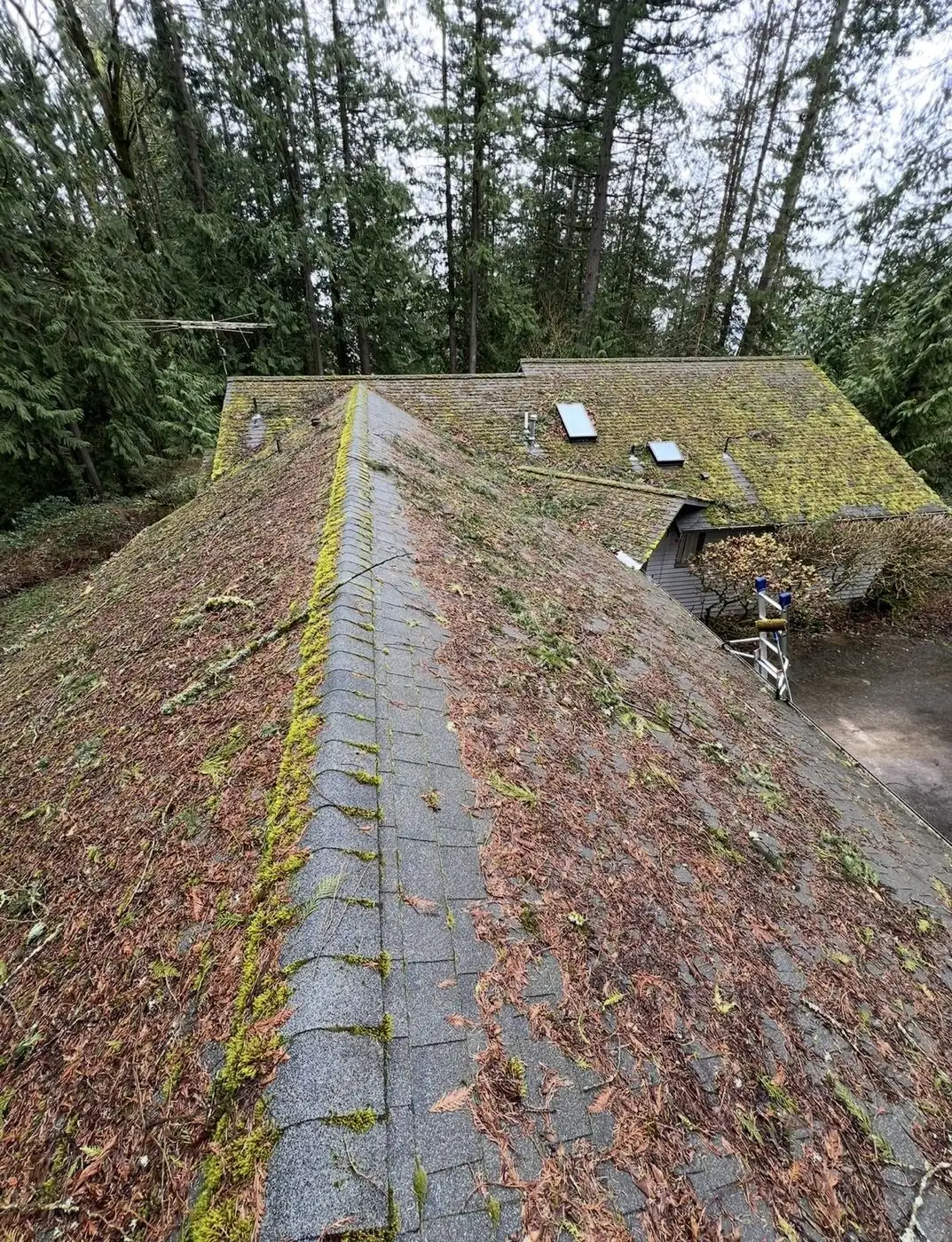
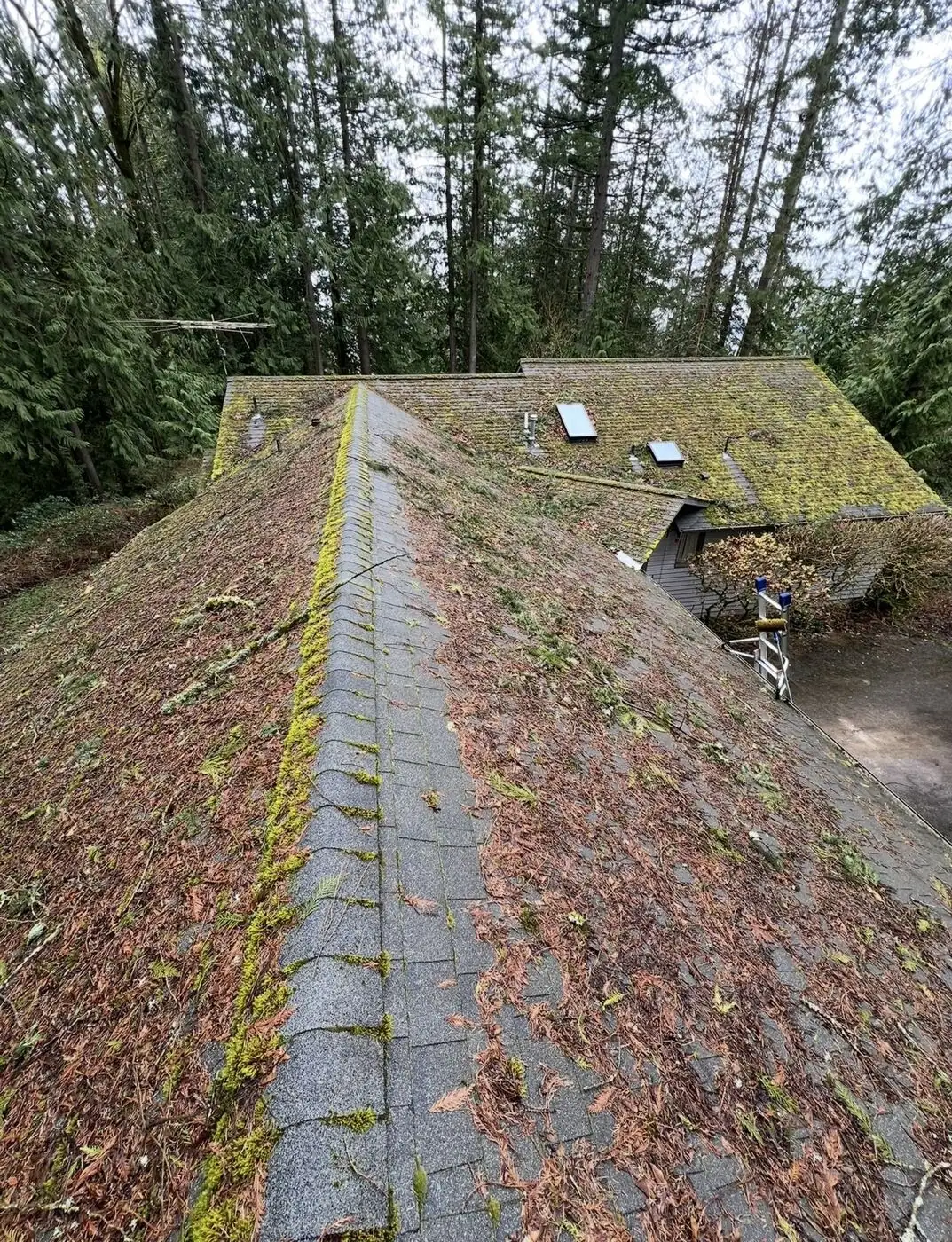 Before
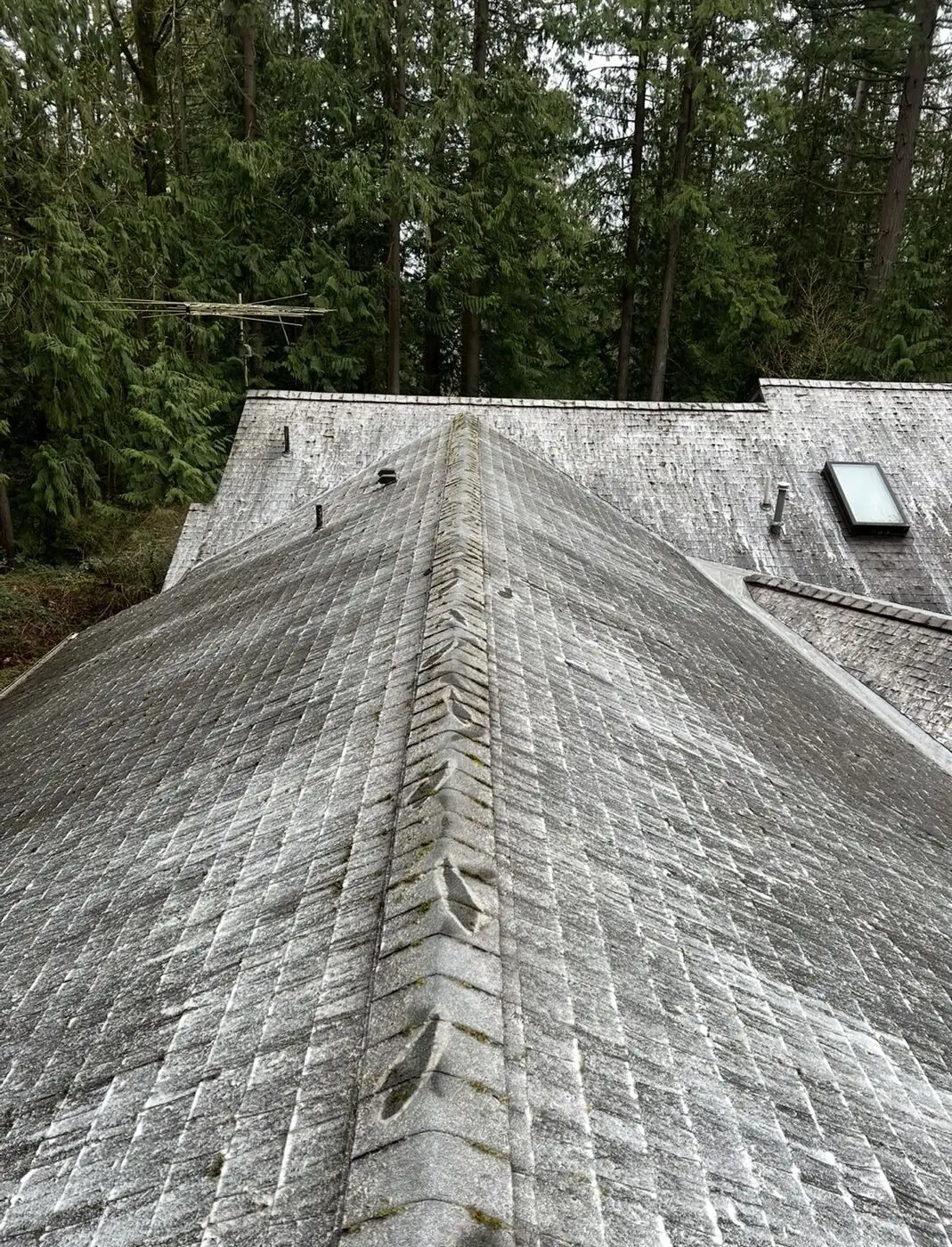 After
Where moss grows on your roof, and why there
Moss is not evenly distributed and its pattern tells you something.
North-facing slopes, first and worst, because they get the least sun and stay damp longest.
Under and near overhanging trees, where shade and constant organic debris combine. The debris matters as much as the shade — it holds moisture and gives moss a seedbed on an otherwise unfriendly surface.
Valleys, where two roof planes meet and water, needles and grit all concentrate.
Along the eaves, the coldest part of the roof and the last part to dry.
Around penetrations — chimneys, vents, skylights, dormers — where flashing creates edges and shelter.
The lower third generally, on any roof, because water travelling down the slope has been in contact longest by the time it gets there.
If moss is confined to the north slope and the eaves, the roof is behaving normally for this region. If it is across the whole roof including south-facing planes, the roof has been wet for a long time and there is usually a shade or debris problem driving it.
How the moss actually comes off
Three stages, in order, and the order is the whole method.
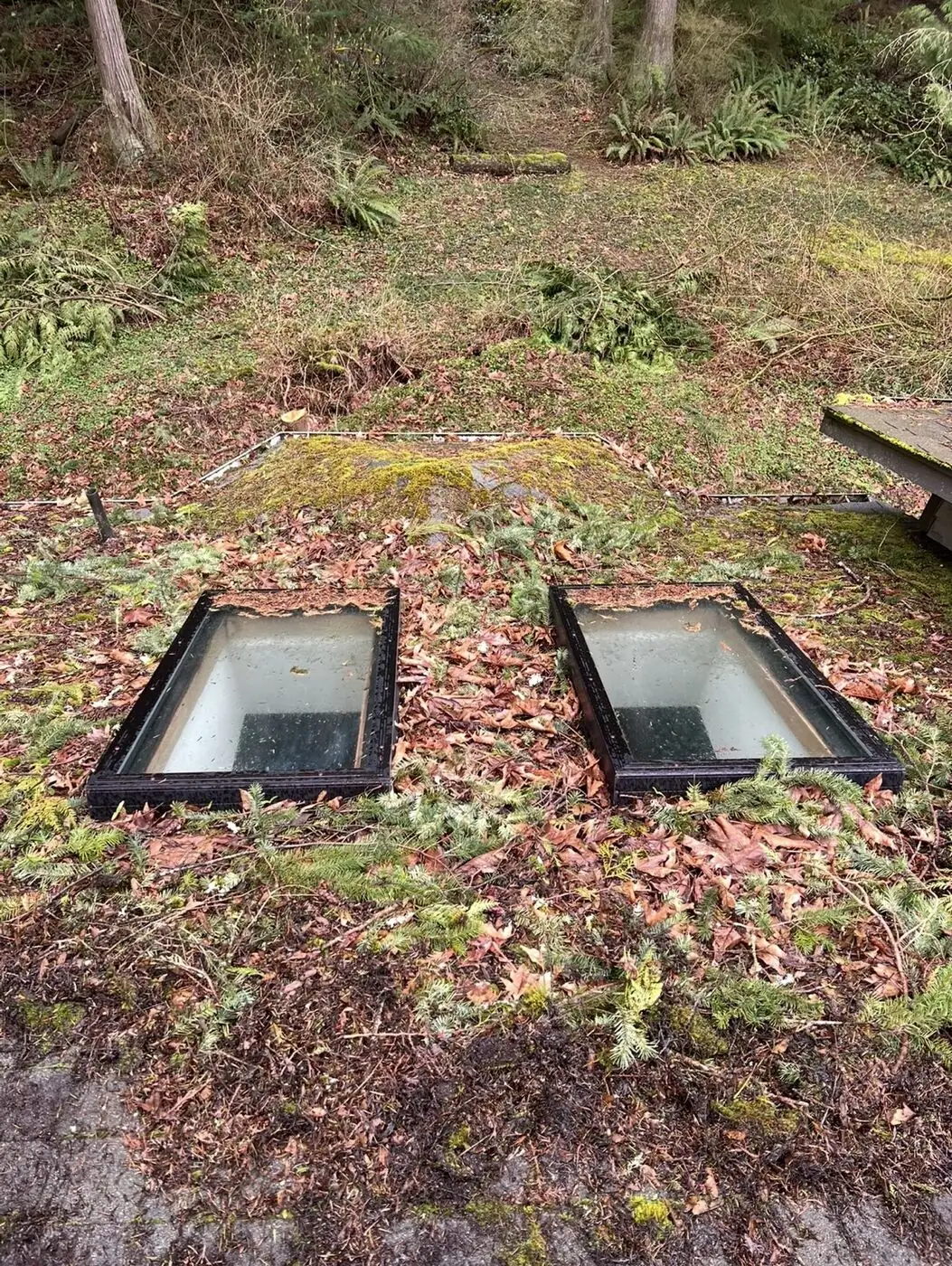
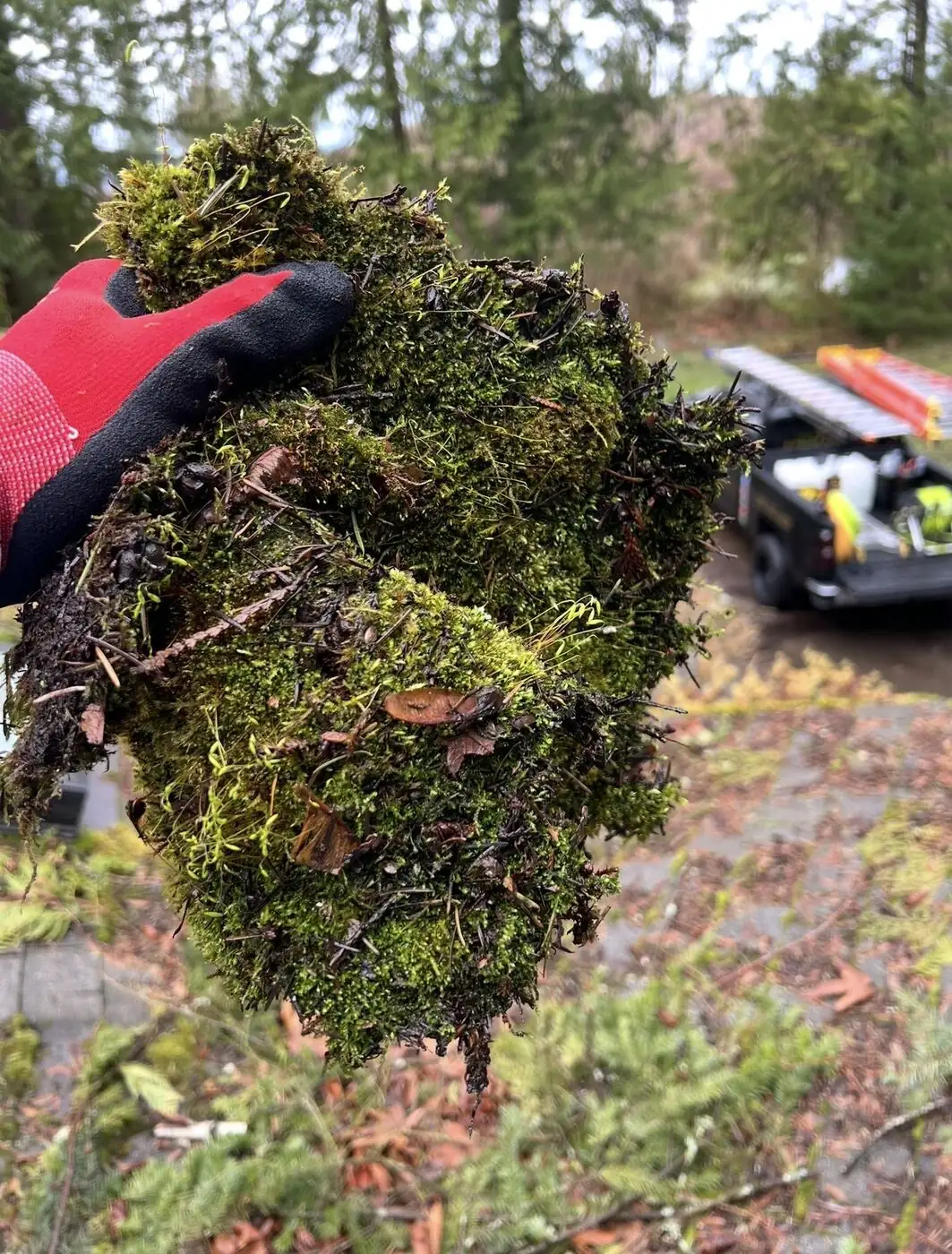
One — the bulk is lifted by hand. Thick moss cushions carry real weight and hold a great deal of water, and there is no reason to leave that sitting on a roof for three months waiting for the weather. It comes off by hand, gently, working with the direction of the courses rather than against them. Hand-lifting loose bulk is not scraping: the mass releases with light pressure because moss has no true roots holding it, and nothing is being dragged across the granule surface. The same applies to the mats that build on walkways and pavers, where the bulk lifts off in sheets.
Two — what remains is treated in place. Hand-lifting takes the cushion. It does not take the rhizoid mat left behind on the surface, and it does not reach the growth under the leading edge of the course — which, as described above, is the part actually damaging the roof. That is what the treatment is for. It kills the remaining growth including the part no tool should be going anywhere near.
Three — the weather finishes it. The killed remnant dries, shrinks, loses its grip and sheds progressively under normal wind and rain over the following weeks and months. Nothing scours the surface. Nothing lifts a course. The granules stay where they belong.
What we do not do, at any stage, is force it:
Pressure washing blasts granules off the shingle and drives water up under the courses — the exact gap the moss has been opening. It is the single worst thing that can be done to an asphalt roof and it voids most manufacturer warranties. There is more on the roof cleaning page.
Scraping with tools takes granules wherever moss is bonded, and reaching the sub-course growth with a blade means lifting shingles that are meant to stay sealed down. A scraped roof looks transformed on the day and has lost years.
Wire brushing does both at once and is the fastest way to age a roof.
The difference between lifting bulk moss by hand and scraping a roof is the difference between taking the weight off and taking the surface off. It is worth asking any contractor which of the two they are proposing.
The cost of this method is patience for the final stage, which is why we explain the timeline before taking the booking rather than after.
What the visit involves
- Assessment first — what is growing, how established it is, which roof material, what the access is, and whether the roof is in a condition to be treated at all
- Protection — planting pre-wetted, sensitive planting covered, runoff routed away from where it should not go
- Treatment applied at low pressure, chosen for the roofing material and the catchment
- Dwell time — the solution has to stay wet on the growth long enough to work
- Gentle rinse where the material and the method call for it
- Loose surface debris cleared from valleys and around penetrations, by hand
- Gutters checked, because treated moss will shed into them over the following weeks
- A condition note on anything visible — lifted or missing shingles, exposed fasteners, damaged flashing, deteriorated ridge
The timeline, honestly
Days one to seven. The moss dies. Visually, very little changes. This is the stage that worries people who were expecting an immediate transformation, and it is normal.
Weeks two to six. The moss browns, dries and becomes brittle. It starts to break up and shed in wind and rain. Debris in the gutters increases noticeably.
Months two to three. The bulk of the dead moss has weathered off. The roof looks substantially different from how it looked on the day.
Months six to twelve. Whatever was most firmly anchored — and any lichen present — finishes releasing.
Gutter clearing is normally scheduled after moss treatment for exactly this reason. Doing it before means doing it twice.
Keeping it off
Three levers, in descending order of how much difference they make.
Cut back what overhangs the roof. This is the big one and it is not a product. Branches over a roof block drying sun, drop organic debris that gives moss a seedbed, and keep humidity high at the surface. Trimming them back extends the interval between treatments more than anything else available.
Keep the roof clear of debris. Needles and leaves accumulating in valleys and along the eaves are the substrate moss establishes in. A roof that gets cleared does not offer moss anywhere to start.
Metal at the ridge. Zinc or copper strips fitted at the ridge release trace ions into runoff that moss struggles to establish in. Useful as prevention on a clean roof, largely useless against established growth, and limited to the paths the water actually takes. Worth fitting during a reroof. Fitted by roofers.
What does not work: moss killers applied once and expected to last, gutter guards (unrelated problem), and the various sprays sold for lawns, which are formulated for a different surface and can stain roofing.
Moss, lichen and algae are not the same problem
Quickly, because they get conflated and the treatments differ:
Moss is the green cushion. Structural. Treated and weathered off.
Lichen is the flat, crusty, pale grey-green patch. It anchors into the surface rather than sitting on it, is the most tenacious of the three, and typically takes six to twelve months to release after treatment. More on telling lichen from moss.
Algae is the black vertical streaking. A staining problem rather than a structural one, and the fastest to respond. Covered on the roof cleaning page.
Most roofs in this region carry at least two of the three, which is why the assessment matters and why a single quoted price for “roof cleaning” without anyone looking at the roof tells you very little.
When to treat
Early autumn is the best window. Treating before the wet season means the growth goes into the rainy months dead rather than feeding on them, and the winter weather does the removal work for free.
Spring is the second-best, once the weather has settled enough for the solution to dwell rather than being rinsed off by the next shower.
Not during a freeze, and not on a hot roof in full sun, where solution evaporates before it can act.
On a three-to-five-year cycle for most roofs here — nearer three under heavy conifer cover or at elevation, nearer five on an exposed roof on the flats.
What it costs, and what moves it
Quoted on site, always, because moss loading is the single most variable thing we price. The drivers:
- How much moss, and how established. Light colonisation along one eave is a modest job. Cushions two or three inches deep across a north slope and packed into the valleys is a different one.
- Roof area, pitch and complexity. Valleys, dormers, multiple planes and levels all add time — and valleys are exactly where the heaviest moss is.
- Roofing material, per the section above.
- Access, and what is underneath. Mature planting, water features, a neighbouring property at the drip line, or a steep drop below the eaves all mean more protection work.
- Catchment. In the Lake Whatcom watershed the method is constrained and constrained methods take longer.
- Whether the gutters go with it. They usually should, and doing both in one mobilisation is cheaper than two visits.
What we will not do is quote moss removal over the phone from a description. Moss is the service where a sight-unseen number is least likely to survive contact with the actual roof.
Safety, and why we mostly stay off the roof
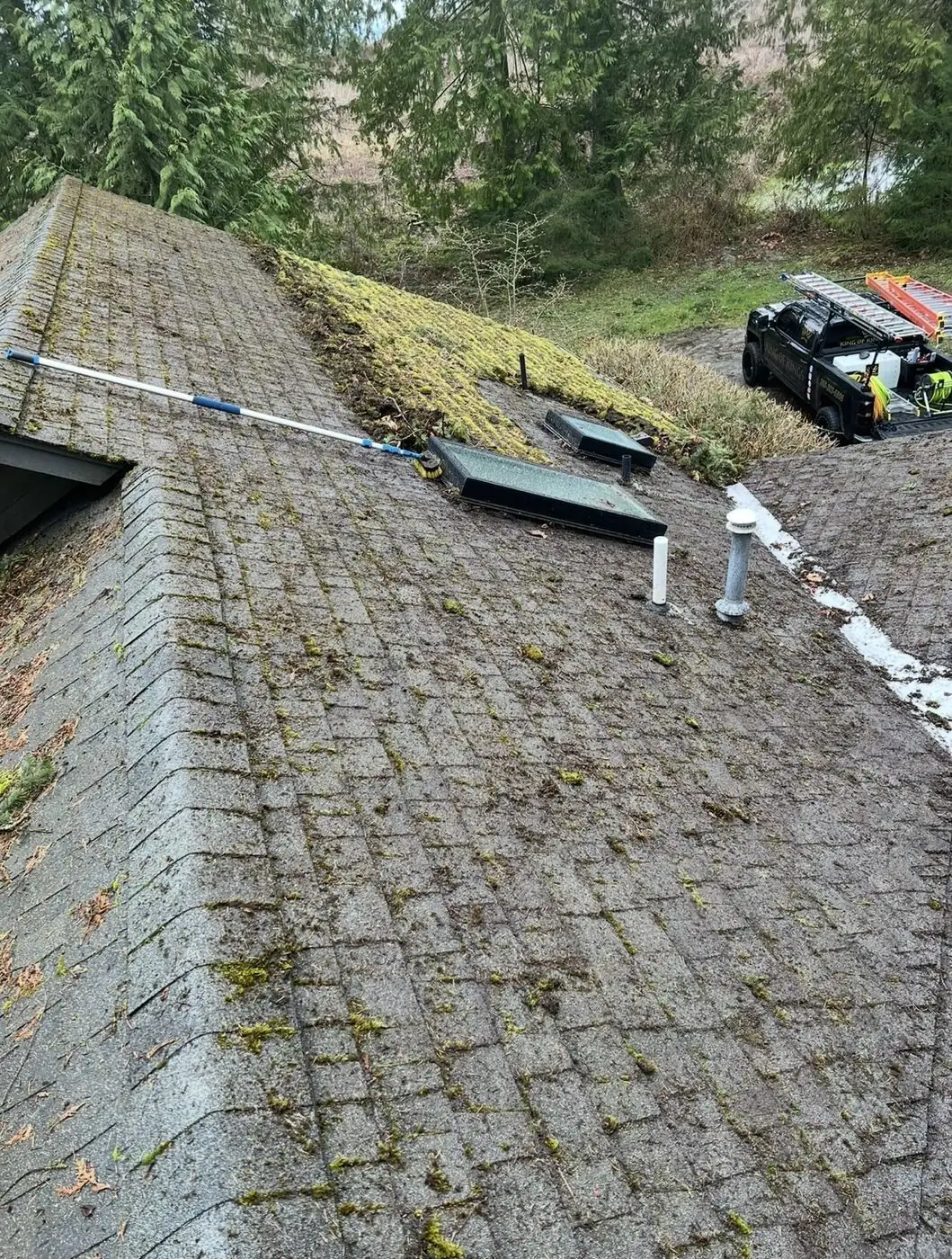
Our default is to treat from ladders and extension equipment rather than by walking the surface, and that preference is about the roof as much as about the operator. Foot traffic on asphalt shingle causes granule loss in its own right — worse on a cold roof, where shingles are brittle, and worse on a hot one, where they are soft. A moss-covered roof adds a slick layer over both.
Where a roof does have to be walked, that is a judgement made on the day, in the conditions on the day, with the right footwear and anchor arrangement. If it is not safe, we reschedule rather than improvise. That is not caution for its own sake — it is that the alternative is somebody falling off a two-storey house.
When a roof should not be treated
Sometimes the honest answer is not to do the job.
A roof at the end of its service life — widespread granule loss, curling or cupping shingles, brittleness, multiple patched areas — can be damaged by any treatment, and treating it does not extend it enough to justify the money. Heavy moss on a roof in that condition is usually a symptom of age rather than the cause of it.
We would rather tell you that at the quote and lose the job than take payment for work that would be better spent on a roof. That conversation happens standing in your driveway, before anything is booked.
We do not repair roofs, replace shingles, reseal flashings or carry out inspections or condition reports. What we report is what someone who was on or at the roof could see, offered as an observation.
What each visit covers
| Stage | What happens | Timing |
|---|---|---|
| Bulk lift | Heavy growth lifted off by hand — moss is not rooted into the shingle and thick growth comes away in mats | Day of the visit |
| Treatment | What remains is treated at low pressure, matched to the substrate | Same visit |
| Weathering | The treated growth dies, dries, loses grip and leaves with the weather | Following weeks and months |
| Gutter clear | Everything killed above comes down; the system is cleared before winter | Two months after |
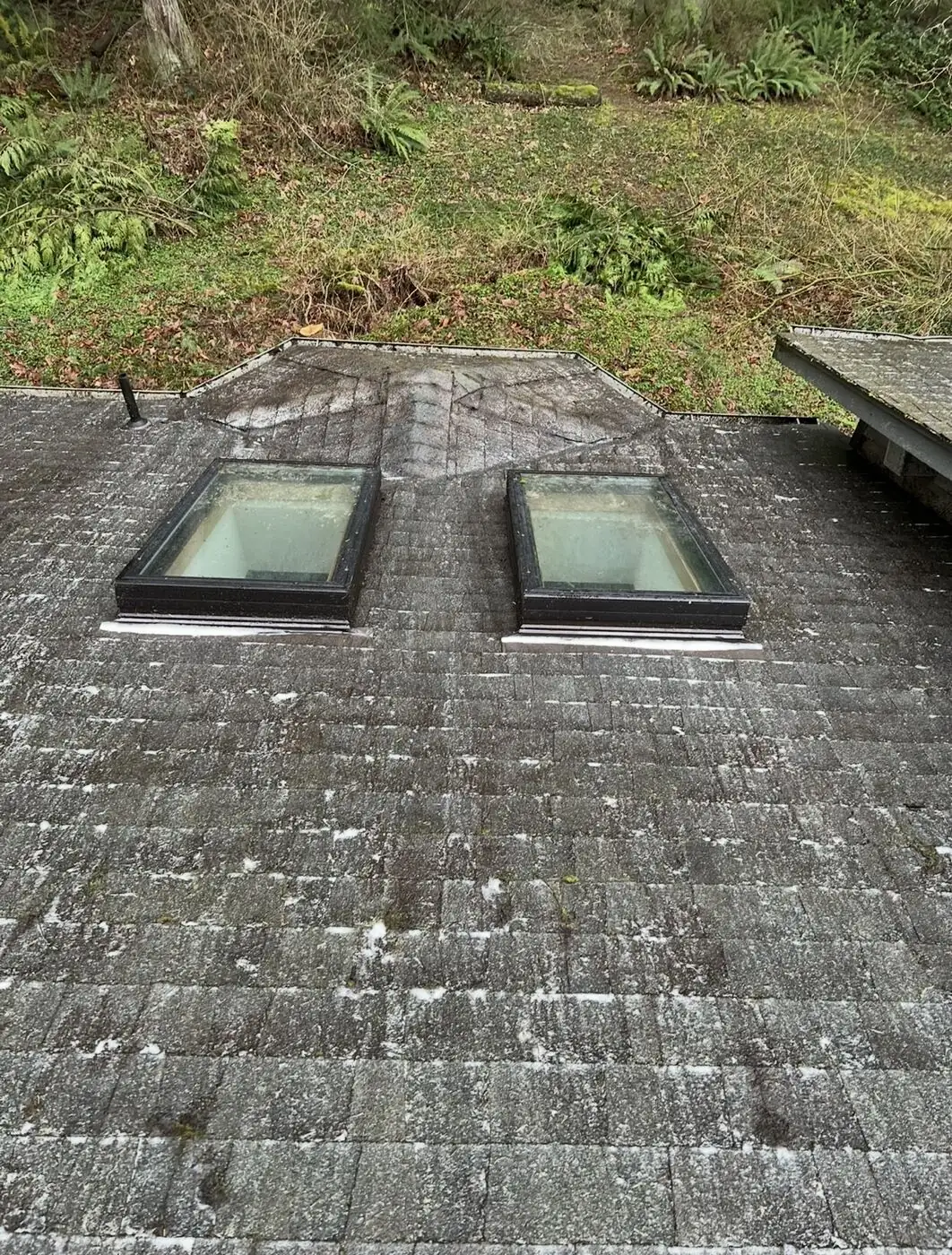
A moss job does not look finished on the day it is done. It looks finished two months later, and that is the method working rather than the method failing.
Where we do it
Moss removal is available in every market we serve across Whatcom and Skagit County — it is the one service that genuinely applies everywhere here, because the climate that grows it does not stop at a town boundary. Intensity varies enormously though: a shaded roof in Glacier or Sudden Valley is on a completely different cycle from an exposed roof in Lynden or Blaine. Your town’s page has the local picture.
Specific moss removal problems we get called for
Moss Removal where you live
Whatcom County
Skagit County
We also cover Sedro-Woolley, Semiahmoo, Custer, Nooksack, Sumas, Deming, Acme, Maple Falls, Glacier, Kendall, Van Zandt, La Conner, Lyman, Edison, Bow, Alger, Clear Lake, Big Lake, Conway, Concrete, Hamilton, Bay View, Oak Harbor, Point Roberts, Lummi Island, Marietta, Geneva, Wickersham, Rockport, Samish Island and Guemes Island from these bases. Those areas do not have their own page — if you are not sure whether you are inside the area, call and ask.
Moss removal questions
- Do you scrape the moss off?
- No. We lift the bulk moss by hand, which takes the weight and the water off without dragging anything across the granule surface, and then treat what remains in place. Scraping with tools is different and we do not do it — it takes granules wherever moss is bonded, and reaching the growth under the courses with a blade means lifting shingles that are meant to stay sealed down.
- My roof looks fine in summer — do I still have moss?
- Very possibly. Moss goes dormant in dry weather, shrinks and turns brown or grey, and becomes genuinely hard to see from the ground. It is not dead; it rehydrates and resumes growing with the autumn rain. A roof inspected in August can look clear and be carrying a substantial moss load.
- How long before the moss is gone?
- The moss dies within days of treatment. Physical removal happens over the following weeks and months as it dries, becomes brittle and weathers off in wind and rain — usually two to three months for the bulk of it. That patience is the whole point: the weather removes it without taking granules with it.
- Does moss actually damage a roof or just look bad?
- It damages it, and by a specific mechanism. Moss establishes at the lower edge of a shingle and grows back underneath it, physically lifting the course and breaking the seal. Once a course is lifted, water can travel back up under it by capillary action — which defeats the single thing a shingle roof depends on. Add freeze expansion and it is a real structural issue, not a cosmetic one.
- Will it come back?
- Yes, eventually — this is Whatcom County. Typically three to five years on a treated roof, faster under heavy shade and in the foothills. Cutting back overhanging branches extends that more than any product does. Anyone promising a permanent solution is selling something.
- Can you treat moss on things other than the roof?
- Moss on gutters, siding, fences, decks and hardscape is common here and is generally handled as part of the relevant service — gutter clearing, house washing or pressure washing. Moss on walkways and steps is worth treating as a safety issue rather than an appearance one.
- Is the treatment safe around plants and pets?
- Handled properly, yes. Planting under the work area is pre-wetted and rinsed afterwards, sensitive planting is covered, and runoff is managed. Keep pets off the treated area until it has dried and been rinsed. In the Lake Whatcom watershed the method is more constrained and we adjust it.
- Do zinc strips work?
- As prevention on an already-clean roof, reasonably well — rain carries a trace of zinc down the surface and moss struggles to establish in it. They do very little to moss already growing, the effect weakens further down the roof, and areas the runoff does not reach get no benefit. They are worth fitting when a roof is replaced. They are fitted by roofers, not by us.