Whatcom & Skagit County
Pressure Washing in Whatcom & Skagit County
The short answer
King of Kings pressure washes driveways, patios, walkways, decks and fences across Whatcom and Skagit County. Hard surfaces get pressure; siding and roofs get a soft wash instead. Slippery moss on steps and paths is a safety job, not a cosmetic one. Licensed, L&I insured, free on-site quote.
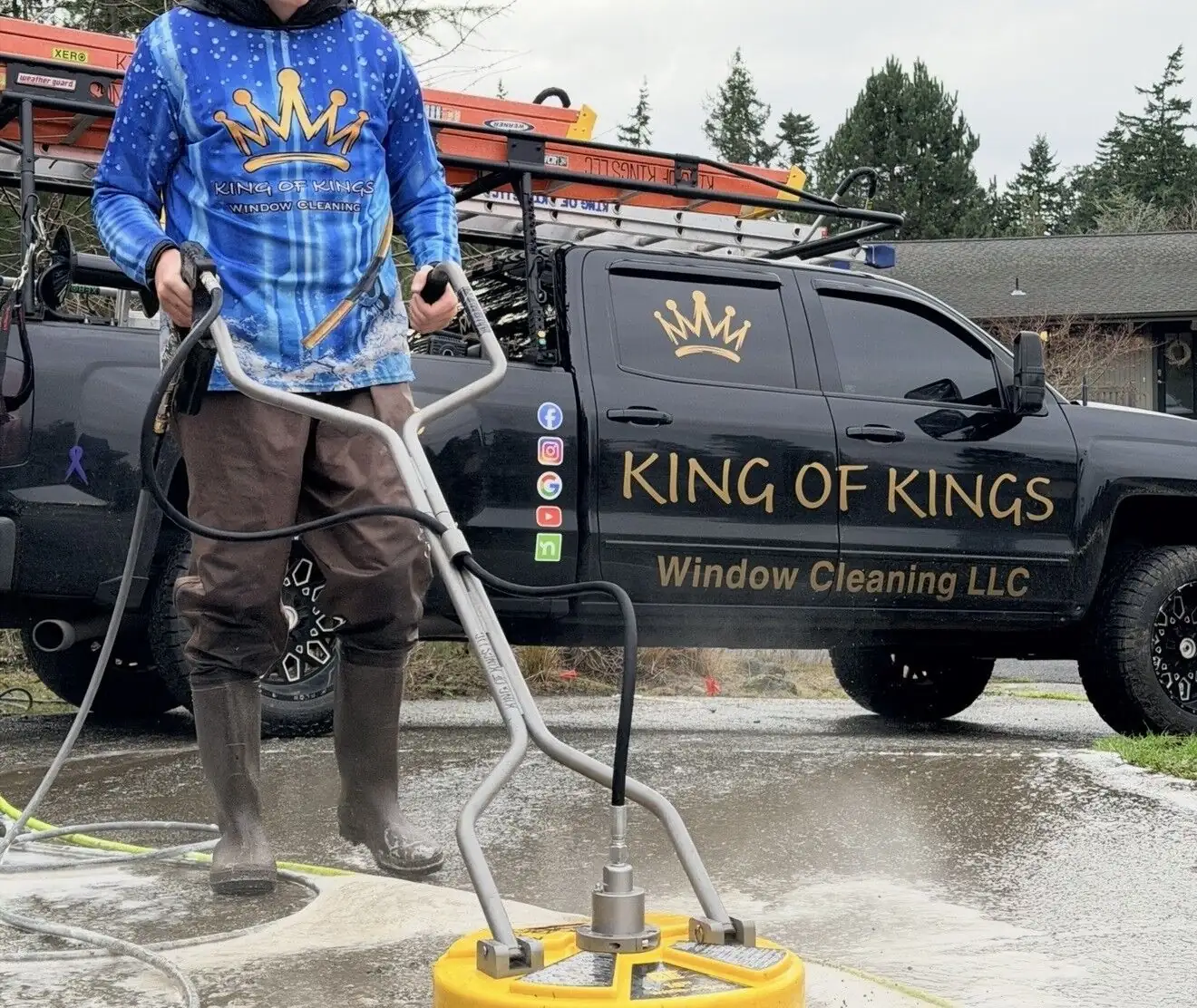

Randy Fee — Owner, King of Kings Window Cleaning
Washington business licence, UBI 605476674 · L&I insured · BBB rated A
Randy runs the company himself, so you are dealing with the owner, not a call centre — and every technician here is personally trained by him. Working Whatcom and Skagit County since 2024.
Pressure washing is the service most likely to be sold as one thing and delivered as another. The machine is capable of stripping paint off wood and etching a permanent pattern into concrete, and the difference between a good result and expensive damage is almost entirely about knowing when not to use the pressure it is capable of.
So the first thing worth stating is the boundary. In this business, pressure belongs on hard horizontal surfaces: concrete, pavers, brick, stone. It does not belong on siding, and it certainly does not belong on a roof. Those get a soft wash instead, and there are separate pages for house washing and roof cleaning.
What we actually pressure wash
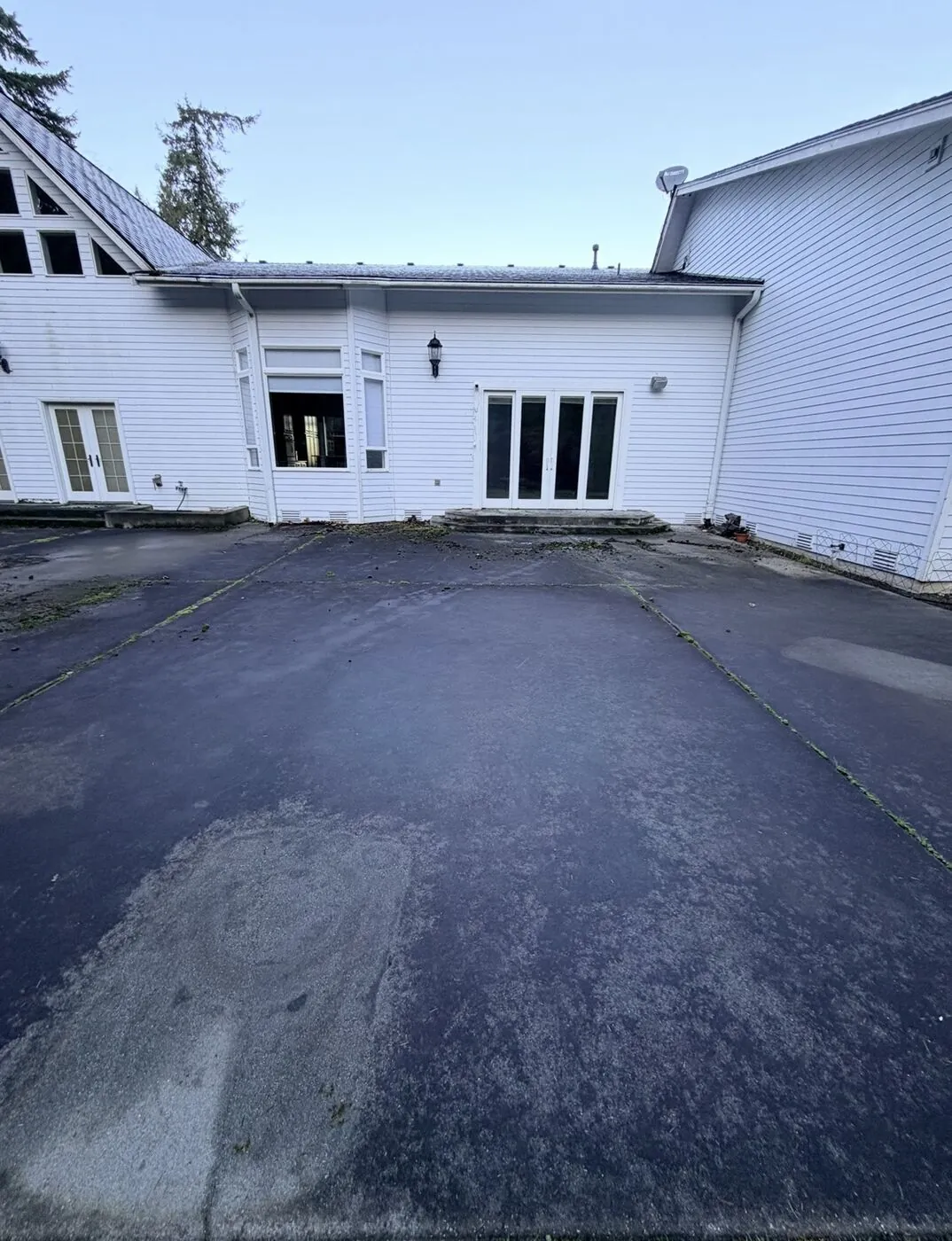
Driveways and parking areas. Concrete, asphalt, pavers and exposed aggregate. Usually the largest single surface on a property and the one where the before-and-after is most dramatic.
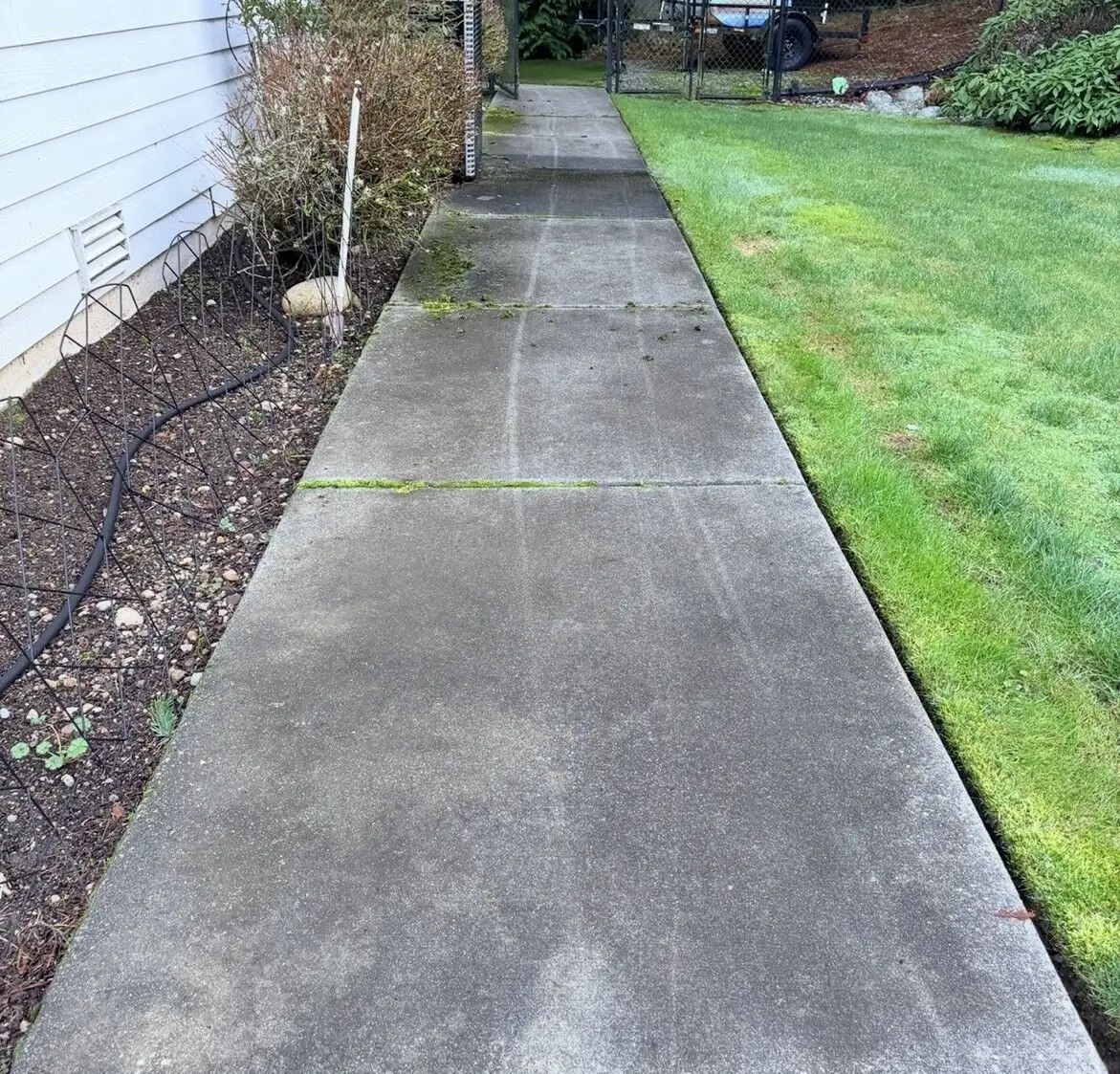
Walkways, paths and steps. The highest-value work we do, and not for cosmetic reasons — see the section on slip risk below.
Patios and pool surrounds. Concrete, pavers, flagstone, stamped concrete.
Decks. Softwood, hardwood and composite, each at very different pressures.
Fences. Cedar and treated softwood, generally to remove the grey-green biological film rather than to strip them.
Retaining walls, steps and hardscape. Block, stone and concrete.
Garbage and recycling areas, and commercial hardstanding. Unglamorous and frequently the reason a commercial client calls in the first place.
The slip hazard nobody prices properly
Of everything on this page, this is the part worth taking seriously.
For roughly eight months of the year, exterior concrete in Whatcom and Skagit County is damp. Damp concrete in shade grows a biological film — algae mostly, with moss establishing in the joints and along the edges. That film is imperceptibly slippery when damp and genuinely dangerous when wet.
The places it matters are the places people use every day without thinking: the front steps, the path from the driveway to the door, a sloped walkway down the side of the house, the back step to the garden. These are exactly the surfaces that stay shaded, and exactly the surfaces someone walks on carrying groceries in the rain in November.
A slip on a wet mossy step is one of the more common ways people get seriously hurt at home, and older residents are disproportionately affected. Clearing that film is among the cheapest risk reductions available on a property, and it is why we will suggest doing the steps and paths first if a budget has to be prioritised — ahead of the driveway, which is usually what the homeowner rang about.
More on slippery driveways and walkways.
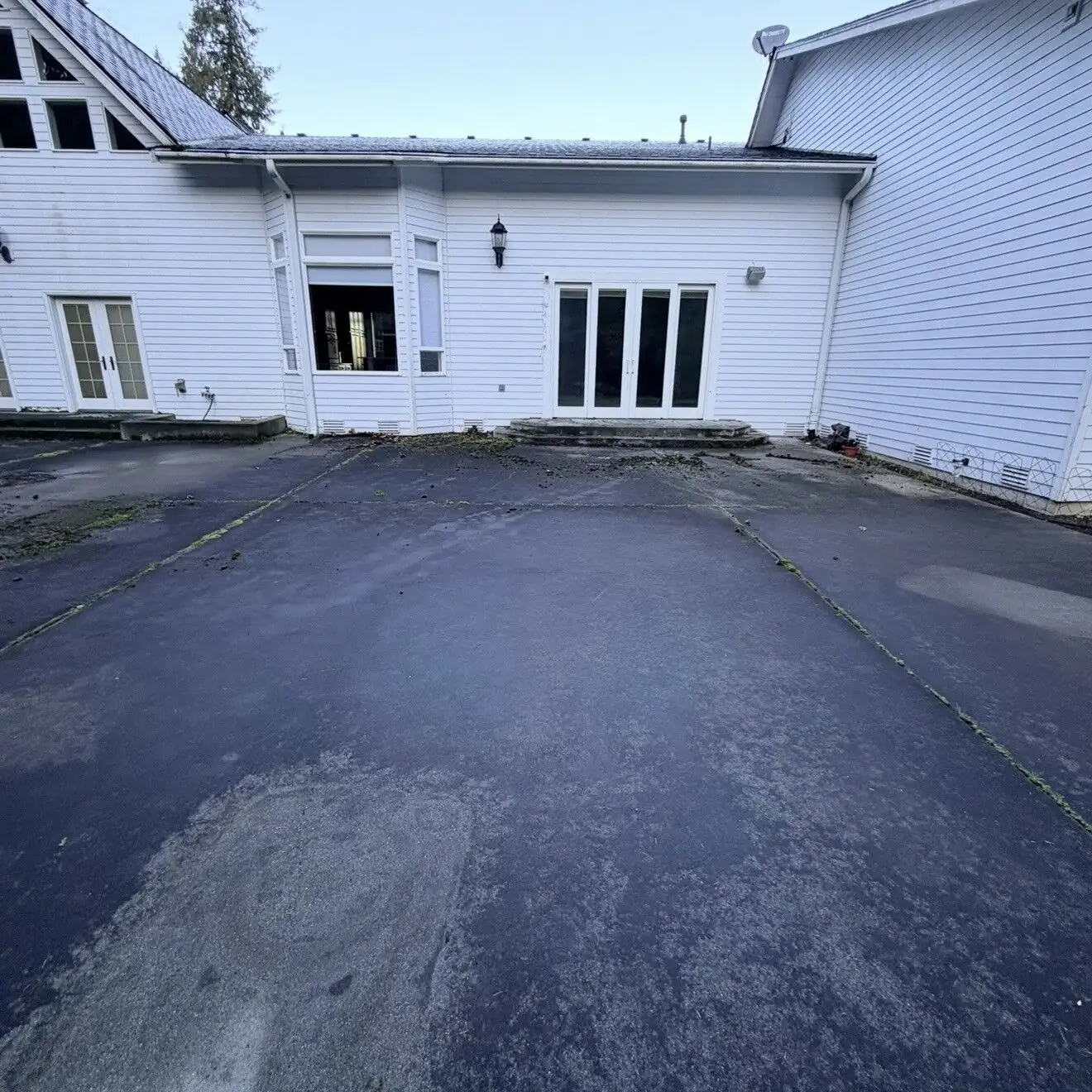 Before
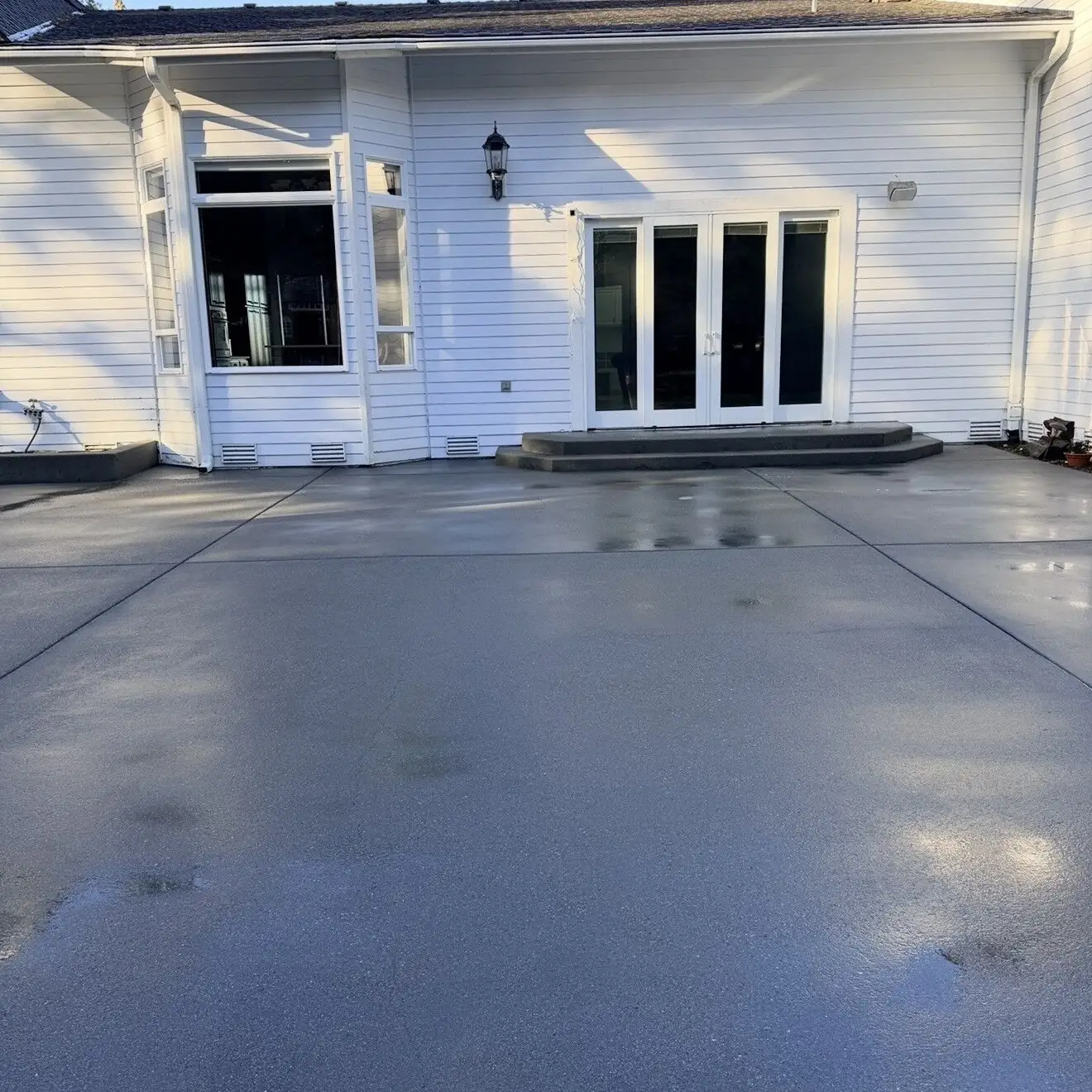 After
Surfaces, and what each one can take
The pressure is not a setting on the machine so much as a decision about the material in front of you.
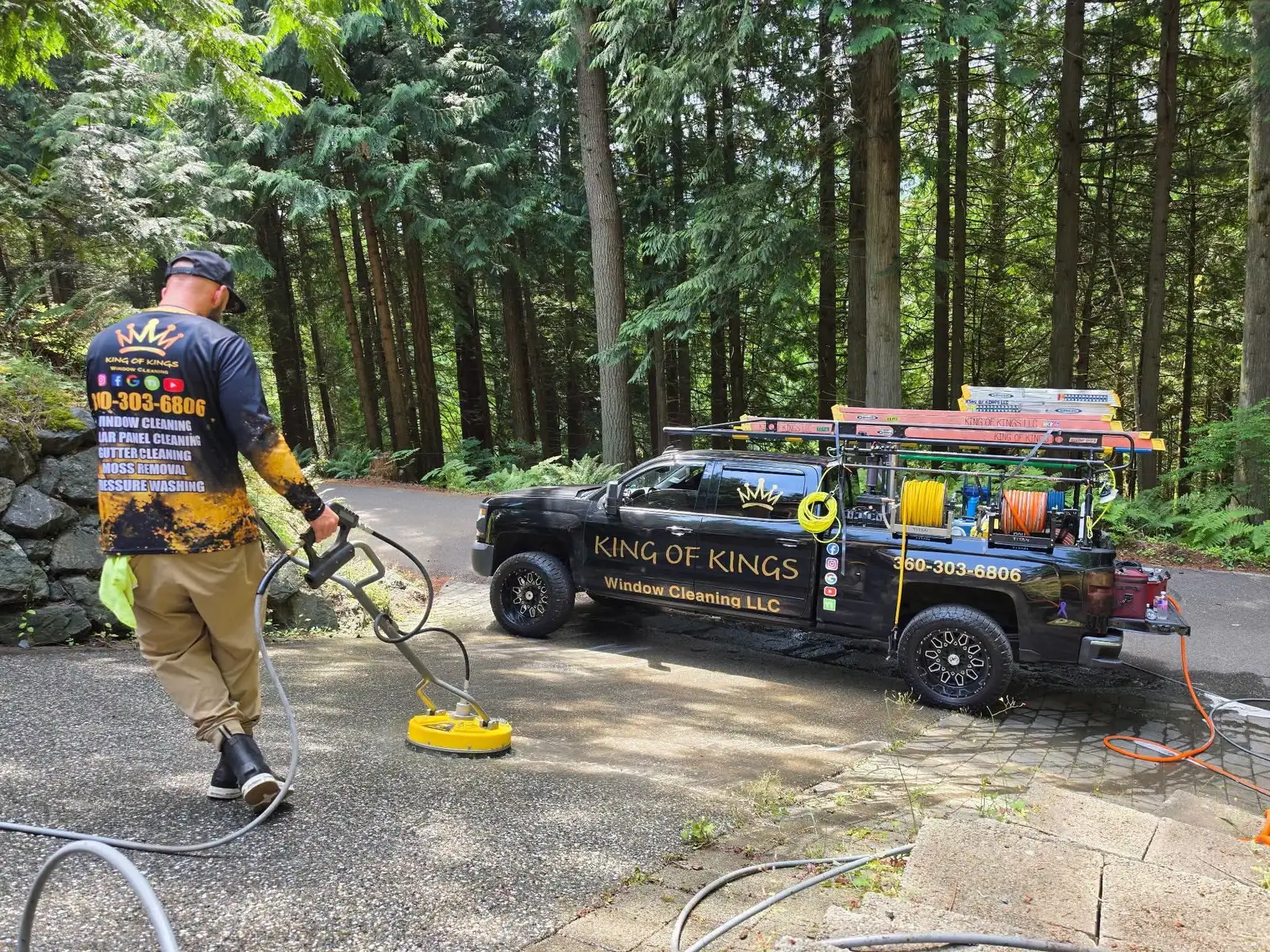
Concrete takes the most, and still has a limit. Overdone, the cement paste at the surface erodes and exposes the aggregate beneath, leaving a rougher, more porous surface that soils faster and grows more. Worse, an operator working with a narrow nozzle rather than a surface cleaner leaves wand marks — visible arcs and stripes where the passes overlapped unevenly. Those are permanent, and they are the single most common complaint about cheap driveway cleaning. A flat surface cleaner, which encloses two rotating jets under a shroud, produces an even result and is the correct tool for slabs.
Pavers and segmental block clean well, but the pressure lifts the jointing sand out of the gaps. That sand is structural — it is what stops pavers rocking and shifting — so a proper paver clean includes re-sanding the joints afterward. An operator who does not mention re-sanding has not thought about it.
Brick varies enormously by age. Modern brick is fine. Older, softer brick and lime mortar can be eroded by pressure that concrete would shrug off, and once mortar joints are opened up, water gets into the wall.
Softwood decking is the material most often ruined. Too much pressure raises the wood grain, leaving a furred surface that feels rough underfoot, weathers faster and takes stain unevenly forever after. Decks are cleaned at low pressure, usually with a cleaning solution doing most of the work and the wand doing very little.
Composite decking has its own manufacturer requirements, and exceeding them voids warranties. Some composites should never see a pressure washer at all.
Asphalt softens in heat and erodes under high pressure. Cleaned gently, if at all.
Natural stone depends entirely on the stone. Sandstone is soft; granite is not. Judged case by case.
Where the water goes
This gets less attention than it should, and in this county it genuinely matters.
Wash water from exterior cleaning carries whatever was on the surface — organic material, detergent, and on driveways, oil and vehicle residue. That water is not supposed to enter the storm drain system, which in most of this area discharges to creeks, to the bay, or to the lake without treatment.
The constraint is sharpest in the Lake Whatcom watershed — Sudden Valley, Geneva and the surrounding catchment — because the lake is the drinking-water supply for a large part of the county, and phosphorus and sediment loading into it is a live, long-running local issue with real regulation attached.
Practically, managing runoff means directing wash water onto landscaping and vegetated ground where it can filter rather than into the nearest drain, blocking or diverting inlets where necessary, containing and collecting on jobs where the contamination warrants it, and using the mildest chemistry that will do the job.
Ask any pressure washing contractor where the water is going. If the answer is a blank look, that tells you something about how the rest of the job will be done.
What changes the price
- Area. Square footage is the base for slab work.
- Surface and condition. Light surface film is a fast job. Years of established moss, embedded lichen or heavy oil staining is not.
- Access. Whether the machine and hoses can reach, whether there is a water supply, and how far the equipment has to be carried.
- Re-sanding, on paver work.
- Runoff management. Sites needing containment or diversion take longer.
- Sealing, if you want it — a separate step, priced separately.
- Delicacy. Old brick, natural stone and softwood decking take longer precisely because they are done gently.
When to book
Spring, when winter has left a full season of biological growth and everybody wants their outdoor space back. This is the busiest window.
Autumn, before the wet season, which is arguably the smarter slot for anything that is a slip risk. Clearing the steps in October means the winter is spent walking on clean concrete rather than on algae.
Before an event, before listing a property, or ahead of a photography appointment. Clean hardscape changes how a property reads more than its cost suggests.
Not in a freeze. Water on concrete in freezing conditions is a hazard to create rather than remove, and equipment does not appreciate it either.
About sealing
A sealer applied after cleaning extends the result on concrete and pavers, makes subsequent cleaning easier, and reduces staining.
Two honest caveats. First, sealer is a maintenance item, not a permanent treatment — it wears, particularly in vehicle tracks, and needs redoing on a cycle. Second, some sealers make a surface more slippery when wet, which on steps and sloped walkways is precisely the wrong outcome. Where slip resistance matters, either an additive is used or the surface is left unsealed.
The equipment, in plain terms
Two numbers describe a pressure washer, and the one that matters most is the one nobody advertises.
PSI is pressure — the force at the nozzle. It gets all the marketing attention and it is the number most capable of doing damage.
GPM is flow — gallons per minute. Flow is what actually carries dirt away, and it is why a professional machine cleans a driveway several times faster than a consumer unit with a similar PSI figure. Cleaning is mostly a function of volume, not force. This is also why the professional answer to a stubborn surface is rarely “turn the pressure up”.
Hot water matters more than pressure on anything greasy. Heat does to oil what force cannot, which is why commercial kitchen surrounds, refuse areas and oil-stained driveways get hot water where a patio does not need it.
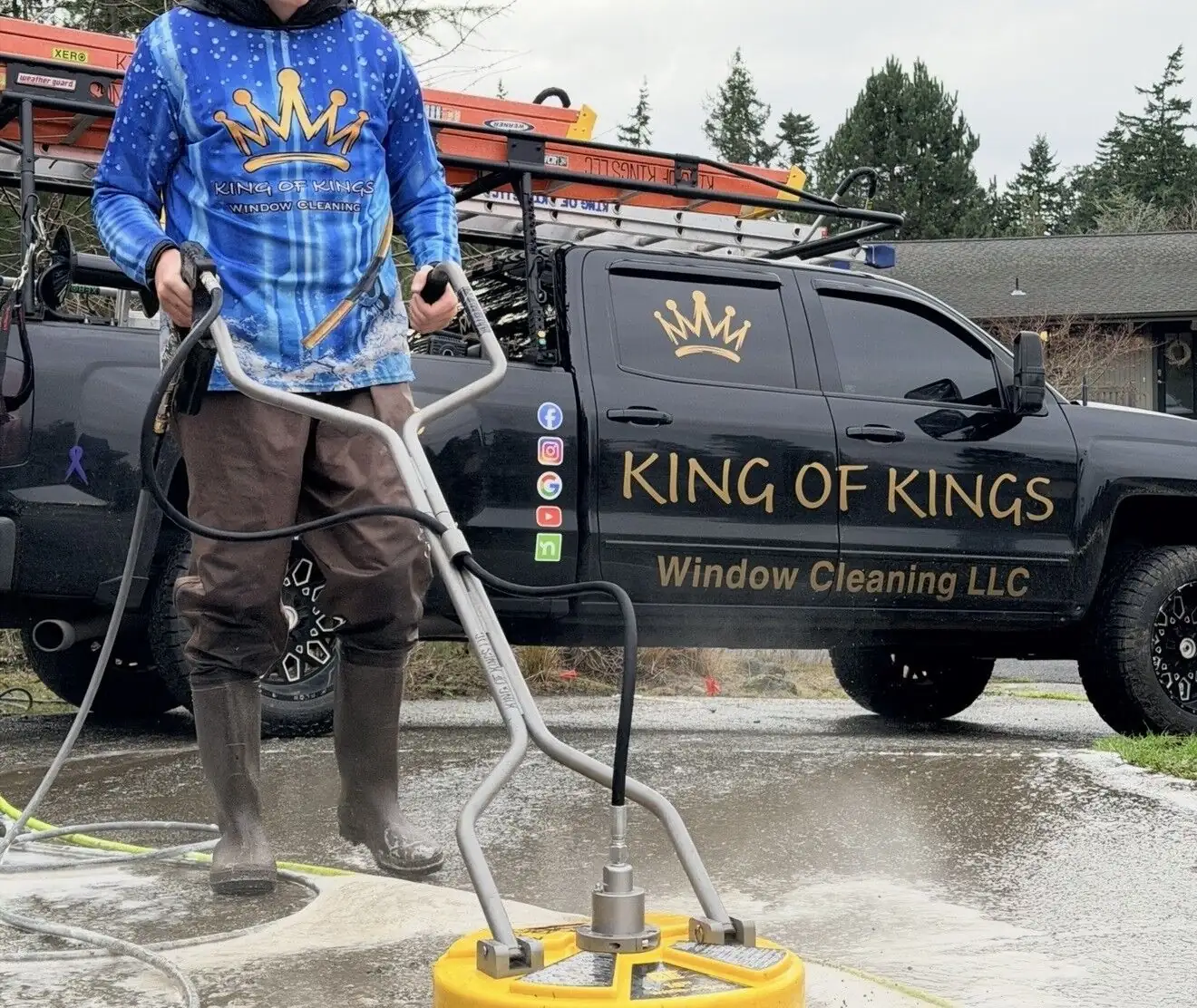
The surface cleaner — the round shrouded attachment with jets rotating underneath — is what produces an even result on flat work. It holds a constant distance from the surface and overlaps its own passes, which is exactly what a hand-held wand cannot do. If someone is cleaning your driveway with a wand alone, expect stripes.
Nozzle choice runs from a wide fan to a pencil-thin jet, plus the rotary “turbo” nozzle that concentrates force into a spinning point. The turbo nozzle is the one that etches concrete and destroys decking, and it has a narrow set of legitimate uses.
What the result actually looks like
Managing this in advance saves disappointment, because concrete is not uniform.
Clean is not new. Pressure washing removes what is on and in the surface. It does not remove age. A twenty-year-old driveway comes out looking like a clean twenty-year-old driveway, and the areas that have weathered differently will still look different.
Edges show. If we clean a driveway and stop at the property line, the boundary is going to be visible, because the adjacent surface is still carrying years of film. Same for a patio that meets an uncleaned path. Worth deciding the scope with that in mind.
Some staining is permanent. Deep oil, old rust, and anything that has chemically altered the surface will lighten rather than disappear.
Pavers move slightly. Cleaning lifts jointing sand and the surface settles minutely as it is re-sanded. Normal.
It will grow back. In this climate, on a shaded surface, one to three years. That is not a failure of the clean; it is what living in a temperate rainforest means.
Different across the service area
Hard-surface growth tracks shade and rainfall closely, so the maintenance cycle varies as much as it does on roofs.
In the foothills and along the Mount Baker corridor — Deming, Acme, Van Zandt, Kendall, Maple Falls, Glacier — high rainfall and dense conifer cover mean paths and driveways green over quickly, and tannin staining from needle drop is routine. Annual cleaning is realistic here.
Around Lake Whatcom, in Sudden Valley and Geneva, the same heavy shade applies, with the watershed constraint on how the work is done.
In Bellingham, it varies by neighbourhood. Mature-tree areas — Edgemoor, Fairhaven, Silver Beach, Whatcom Falls, Columbia — hold damp far longer than the open newer developments at Cordata, Barkley or the Guide Meridian corridor.
On the agricultural flats through Lynden, Everson, Mount Vernon and Burlington, surfaces are more exposed and dry faster, so biological growth is slower — but field dust and farm traffic put a different kind of soiling on driveways and hardstanding.
At the marine edge — Blaine, Birch Bay, Semiahmoo, Anacortes and the islands — salt is the additional factor, and it is hard on metal fixings, railings and anything with a coating on it.
For landlords, HOAs and property managers
Hard surfaces are where the liability sits on a managed property, and it is worth being blunt about that.
Shared walkways, entrance steps, communal patios and parking areas are used by people who did not choose them and did not inspect them. A slip on a mossy communal step is a claim, and “it was on the maintenance list” is a much better position than “nobody had looked at it”. A scheduled autumn clean of the circulation routes — the paths people actually walk, not the decorative areas — is inexpensive relative to what it protects against.
Turnover cleans between tenancies are the other common request, usually alongside window cleaning, and they run on the tight scheduling window between one tenant leaving and the next arriving.
What we do not do
- We do not pressure wash siding, stucco or roofs. Those are soft-wash surfaces.
- We do not strip or refinish decks, apply stain, or do carpentry.
- We do not repair, resurface or replace concrete, or repoint brickwork.
- We do not clean anything where the pressure required would exceed what the material can take — we will tell you at the quote rather than discovering it on the surface.
The connected work
Pressure washing is usually one part of a wider exterior clean, and sequencing matters. Hard surfaces come last, after the roof, the gutters and the siding, because everything above sheds onto everything below and doing the driveway first means doing it twice.
If your paths are green, look at what is shading them. If your driveway stains in one particular spot every winter, look at the downspout above it — gutter discharge landing on a slab is a common and easily fixed cause. And if the siding above a patio is dirty, it is worth doing house washing in the same visit while the equipment and the access are already set up.
Getting the sequence right on a whole-property clean
When several things are booked together — which is common, and cheaper than separate visits — the order is not arbitrary:
- Roof, because it is highest and everything comes off it downward.
- Gutters, which catch what the roof work releases.
- Siding, taking off what the first two deposited plus its own growth.
- Windows, because glass shows any mistake made above it.
- Hard surfaces last — driveway, paths, patio, deck — because every stage above rinses material onto the ground.
A contractor who cleans the driveway first is going to be cleaning it again, or leaving you with a driveway that looks worse at the end of the day than it did at the start.
What each surface needs
| Surface | Method | What to expect |
|---|---|---|
| Broom-finish concrete drive or path | Surface cleaner at working pressure, solution first where growth is present | The dramatic before-and-after line; grip restored |
| Exposed aggregate, stamped or coloured concrete | Lower pressure, more dwell | Clean, with the finish intact — no etching, no striping |
| Pavers with sand joints | Lower pressure, joint sand checked afterwards | Sand loss is the risk, not the stone |
| Brick and older lime mortar | Gentle only | Joints erode under pressure; we will say where we stop |
| Composite and timber decking | Soft wash | Force furrows timber and hazes composite |
Runoff is managed and planting is pre-wetted and rinsed. Where a slab is spalling or has lost its cream layer, cleaning improves it and does not resurface it.
Where we do it
Pressure washing is available across the Tier 1 and Tier 2 markets in Whatcom and Skagit County. Growth rates on hard surfaces vary a lot with shade and rainfall — a north-facing path in Glacier or Sudden Valley is a different maintenance proposition from an open driveway in Lynden. Your town’s page has the local detail.
Specific pressure washing problems we get called for
The surfaces this work touches
Pressure Washing where you live
Whatcom County
Skagit County
We also cover Sedro-Woolley, Semiahmoo, Custer, Nooksack, Sumas, Deming, Acme, Maple Falls, Glacier, Kendall, Van Zandt, La Conner, Lyman, Edison, Bow, Alger, Clear Lake, Big Lake, Conway, Concrete, Hamilton, Bay View, Oak Harbor, Point Roberts, Lummi Island, Marietta, Geneva, Wickersham, Rockport, Samish Island and Guemes Island from these bases. Those areas do not have their own page — if you are not sure whether you are inside the area, call and ask.
Pressure washing questions
- Will you pressure wash my siding?
- No — siding gets a soft wash. High pressure drives water behind lap siding and into wall cavities, strips paint and stain, and etches vinyl permanently. It is the wrong tool for a vertical surface with laps in it. See house washing for how siding is actually done.
- Can concrete be damaged by pressure washing?
- Yes, and it is more common than people think. Too much pressure, or a nozzle held too close or moved too slowly, erodes the cement paste at the surface and exposes the aggregate. The result is a permanently rougher, more porous surface that gets dirty faster and holds more growth. Concrete is cleaned with the right pressure and a surface cleaner, not a turbo nozzle waved about.
- How long will it stay clean?
- On a driveway or path in this climate, typically one to three years before growth becomes noticeable again, depending on shade and drainage. A north-facing path under trees regrows fast. A south-facing driveway in the open stays clean much longer. A post-clean sealer extends it on some surfaces.
- Do you clean decks?
- Yes, with the pressure dropped well down and the technique adjusted for the material. Softwood decking damages easily — too much pressure raises the grain, furs the surface and leaves permanent wand marks. Composite decking has its own rules and the manufacturer's guidance governs.
- What about the green slippery stuff on my steps?
- That is the job we would prioritise over any of the cosmetic ones. Algae and moss on steps, walkways and sloped paths is a genuine fall hazard for eight months of the year here, and it is one of the cheapest risks on a property to eliminate.
- Where does the dirty water go?
- That depends on the site, and it matters more here than in most places. Wash water carrying detergent, oil or organic material is not supposed to go into a storm drain, and in the Lake Whatcom watershed the rules are tighter again. We manage runoff to suit the site and we will tell you what we are doing.
- Do I need to be home?
- Not usually, as long as we have access to the areas being cleaned and to an outside tap if the job needs one. We will walk it with you at the end if you are there, and send photographs if you are not.
- Can you get oil stains out of a driveway?
- Sometimes, and it depends on how long it has been there and how porous the concrete is. Fresh oil often lifts substantially with a degreaser and hot water. Old oil that has soaked deep into the slab may lighten rather than disappear. We will tell you which we think you have before starting.