Vinyl Siding
What it is
Vinyl is the most common siding in Whatcom and Skagit County on anything built since the 1970s, and the most forgiving surface to soft wash. Two things decide the outcome: whether the panels have gone brittle with age, and whether what you are looking at is growth on the surface or oxidation in the material — only one of those washes off.
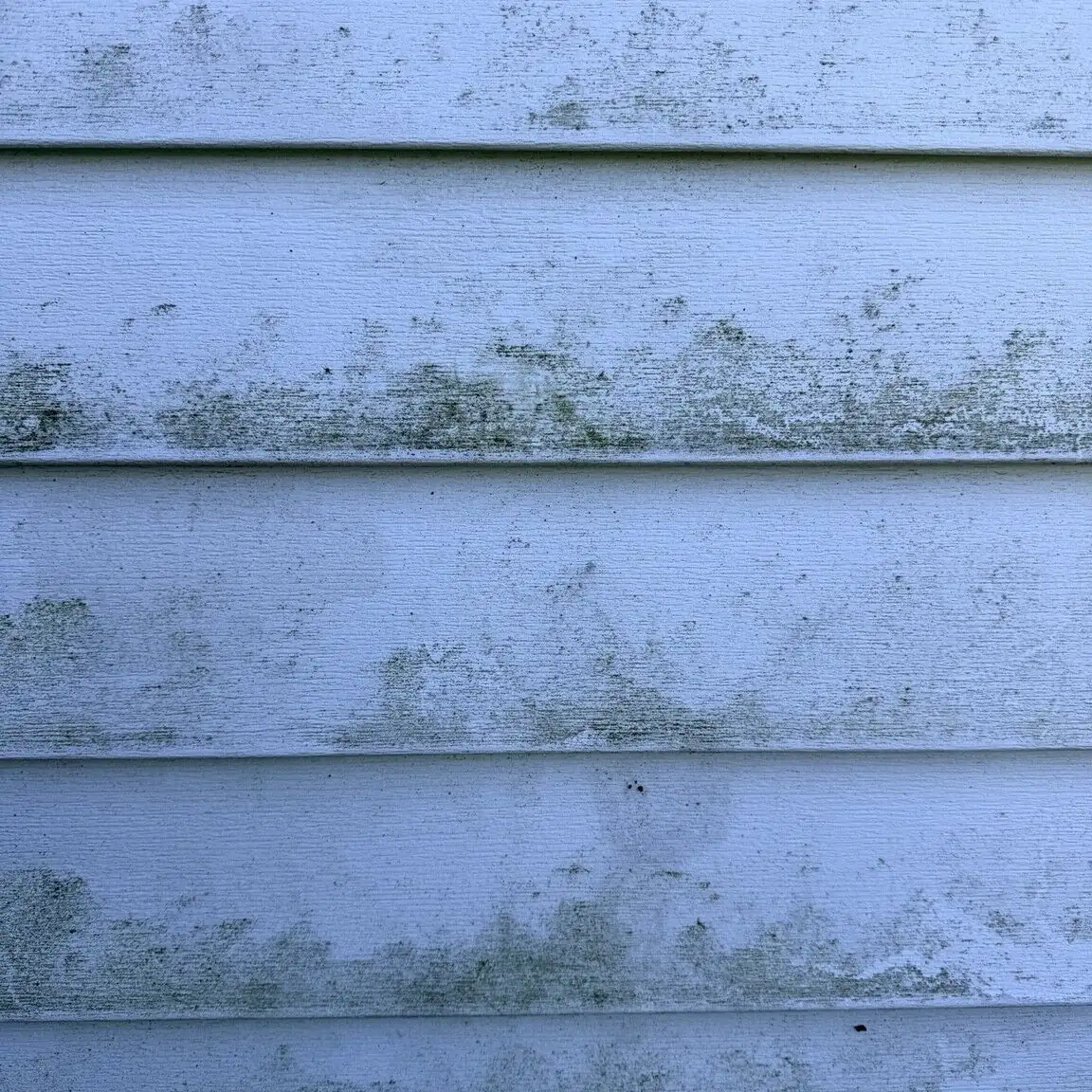
If a house in Whatcom or Skagit County was built or re-clad after about 1975, there is a good chance it is wearing vinyl. It is the default residential siding in both counties, it is the most common surface we soft wash, and it is straightforward — provided two questions get answered before anyone turns a hose on it.
How the material is built, and why it matters
Vinyl siding is extruded PVC hung on the wall rather than fastened tight to it. Panels lock into the course below, are nailed through elongated slots, and are deliberately left free to slide. That looseness is not sloppy installation; it is the design. Vinyl moves substantially with temperature, and a panel nailed tight buckles in July and pulls in January.
Two consequences follow, and both shape how the surface is cleaned.
The wall behind it is not sealed. Vinyl is a rain screen. Water gets behind it routinely and by design, and the drainage plane and flashings underneath are what actually keep the house dry. The panels shed the bulk of the weather downward, course over course, exactly like shingles.
The colour is the material, not a coating. There is no paint film on standard vinyl — pigment runs through the extrusion. That is why vinyl does not peel, and it is also why a faded wall cannot be washed back to colour: the surface layer itself has degraded.
What actually grows on it
Green algae is the common case and the reason most people call. An even film, worst on the north elevation and on anything under a canopy, heaviest at the lower courses where splash keeps things damp.
Mildew and mould show up as black speckling and blotching rather than an even film, concentrated in the dampest, most sheltered places — behind shrubs pressed against the wall, under eaves, in corners.
Lichen turns up on older walls on the shaded side, and on the lower courses.
Dirt splash on the bottom two or three courses, thrown up off beds and paths during heavy rain, often mixed with soil.
Artillery fungus, which is the one genuinely difficult problem. It lives in hardwood bark mulch and fires spores several feet, and they bond to siding hard enough that removal is partial at best. The remedy is mostly upstream: change the mulch.
All of the above except the last sits on the surface. None of it is eating the vinyl.
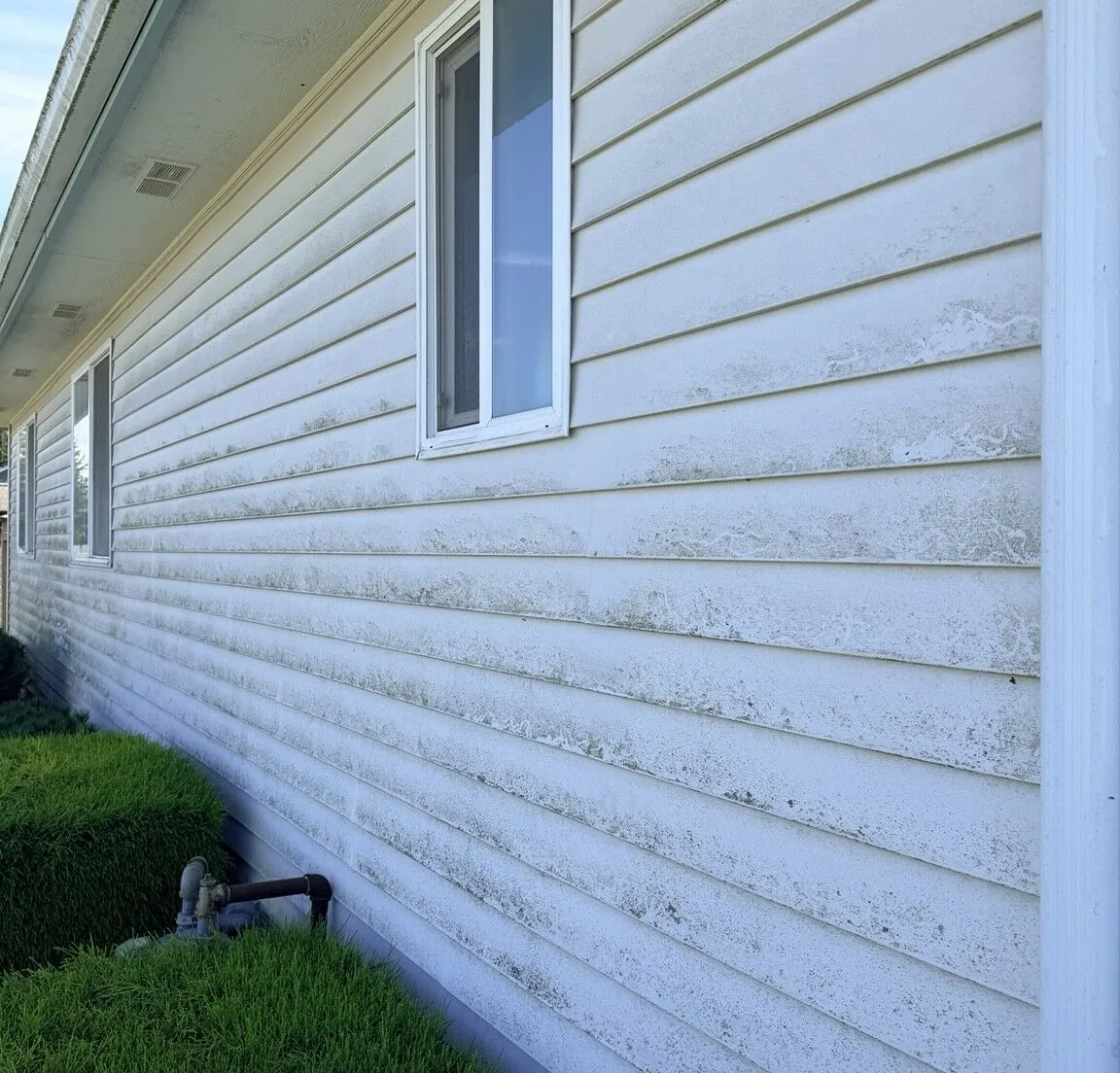 Before
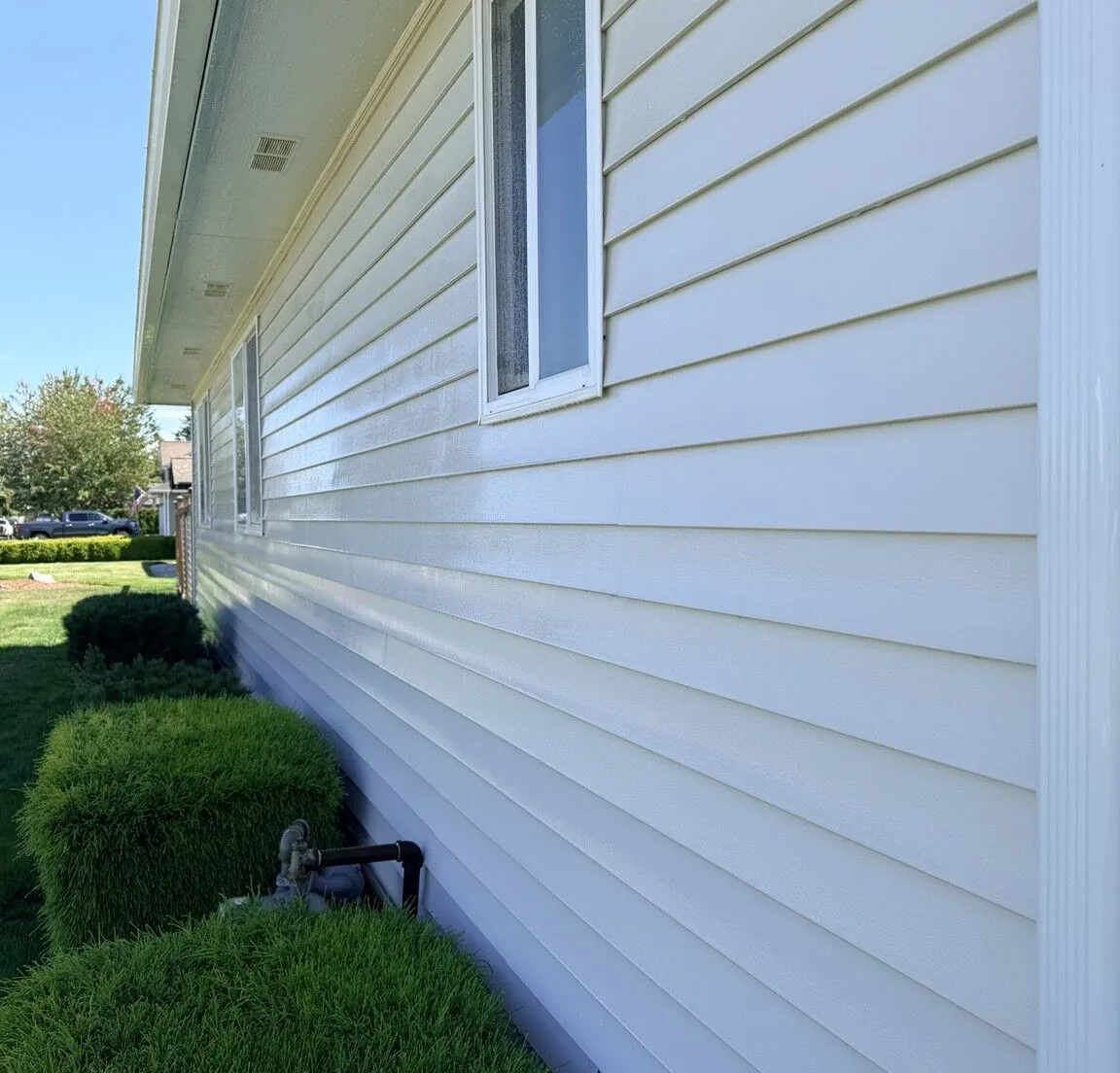 After
What is not growth
Two things get called dirt and are not.
Oxidation and chalking. UV degrades the surface layer of the extrusion over years, leaving a chalky film that rubs off on your hand and a colour that reads washed out. Cleaning removes the loose chalk and usually improves appearance considerably. It does not restore the finish, because there is no finish to restore — a wall that has faded is not dirty.
Staining from something running down the wall. Rust from a fixing, tannin from an overhanging conifer, run-off from a gutter joint, mineral spotting from sprinkler overspray on hard water. Each of these is a different treatment, and each is worth identifying at the quote rather than discovering mid-wash.
Method, and why it is not pressure
Vinyl gets soft washed: low pressure, roughly garden-hose level, with a cleaning solution matched to the growth, given time to dwell, then rinsed thoroughly. The work is chemical. The water is a delivery and rinse mechanism.
The temptation with vinyl specifically is that it tolerates pressure better than cedar, fiber cement or stucco do — the panel usually survives. What does not survive is the wall behind it. Force drives water upward behind the laps, into the assembly, past flashings detailed for gravity-driven water. In a climate this wet a wall cavity does not dry out quickly, and the consequences arrive years later as soft sheathing and rot at the sill rather than as a visible mark on the siding.
Old vinyl adds a second reason. Panels embrittled by decades of UV crack under force that newer panels absorb, and a cracked course is a replacement rather than a repair, because matching twenty-year-old vinyl colour is largely a matter of luck.
Planting below the work area is pre-wetted before anything is applied, sensitive planting is covered, and everything is rinsed at the end.
How vinyl compares to the other sidings here
Fiber cement — HardiePlank and similar, standard on newer construction. Durable and washes well. The vulnerable parts are cut ends and anywhere the factory coating is compromised. Low pressure only; it erodes under a jet.
Cedar shingle and cedar lap — common on older housing and around Chuckanut, Edgemoor and the lake. Absorbent, so saturation has to be controlled. Silvered cedar cleans up but does not return to fresh cedar colour.
Painted wood — throughout both counties on older stock. Sound paint washes fine; failing paint comes off, and that is a conversation at the quote.
Engineered wood (LP SmartSide and similar), increasingly common on newer builds. Cleans well, but the substrate is wood-based, so anywhere the coating is breached is a place water should not be driven.
Stucco and EIFS — a smaller share of the stock here. Porous, and cracking is common in older applications. Water behind stucco is a far more serious problem than growth on it.
Brick — durable, but older lime mortar joints erode under pressure.
Reading the age of a wall before washing it
Vinyl from the 1970s and 1980s and vinyl from the last decade are meaningfully different materials, and the wall will tell you which you have.
Panel thickness and rigidity. Press a panel between the nail line and the butt edge. Early vinyl is thin and flexes easily; modern panel is noticeably stiffer, and insulated vinyl — foam-backed, increasingly common on newer builds and re-clads — barely moves at all because there is rigid foam behind it.
Sound. Old thin vinyl rattles in wind and clicks with temperature change.
The colour on a sheltered face. Compare a section under a deep eave with the same elevation in the open. A large difference means the exposed surface has oxidised substantially, which sets expectations for how much washing will change.
Whether it has already been damaged. Look at the courses nearest a driveway, a mower line or a heat source. Warping near a barbecue or a reflective window is heat distortion, not dirt, and it is permanent.
None of this changes whether the wall can be washed. It changes how hard, and it is the difference between a quote made from the ground and one made after actually touching the building.
When in the year to do it
Late spring through early autumn, for a practical reason rather than a seasonal-marketing one: the wall needs to dry afterwards, and a solution needs reasonable temperatures to work as intended.
Washing in the depth of winter is possible and it is rarely the best use of the money — the growth will be back through the wet months regardless, and the result never quite looks like it does in June. Late spring, after the pollen has mostly finished, is the sweet spot on most houses here.
At a glance
| Property | Vinyl |
|---|---|
| Typical era here | Anything built or re-clad from about 1975 |
| How it is fixed | Hung loose on elongated nail slots so it can move with temperature |
| Where the colour lives | Through the extrusion — no paint film, so it cannot peel |
| Main failure mode | UV embrittlement and surface oxidation (chalking) |
| Cleaning method | Soft wash only; low pressure, solution, dwell, rinse |
| What will not come off | Faded colour, chalked surface, artillery-fungus specks |
| Typical interval | Two to four years; less on a heavily shaded elevation |
How to tell what you are looking at, from the ground:
- Even green film across a whole elevation — algae, comes off cleanly
- Black speckling in corners and behind shrubs — mildew, also surface-level
- Chalk on your hand after rubbing a sunny wall — oxidation, will not wash back
- Small dark specks that resist everything — artillery fungus from bark mulch
- A dirty band on the lowest two or three courses only — splash, not growth
Slowing the return
Removing the growth is the easy half.
Cut planting back from the wall — a foot of clearance makes a measurable difference and two is better, because airflow is what dries siding. Trim what overhangs. Fix sprinkler heads that hit the house. Keep the gutters clear so overflow staining stops recurring every wet season. And if there is hardwood bark mulch within a few feet of a wall that has black specks on it, that is the cause rather than a coincidence.
Full method and scheduling is on the house washing page. If the problem is confined to one elevation, which it usually is, start with mildew on north-facing walls.
Questions about this surface
- Why does vinyl grow algae so readily?
- Nothing about vinyl feeds algae — it is not organic and there is nothing in it to eat. What vinyl offers is a stable, slightly textured surface that stays damp on a shaded elevation. Algae needs moisture, a surface and a little light, and a north wall in this climate supplies all three for most of the year.
- How do I tell dirty from faded?
- Run a wet finger down the wall. If it comes away green or grey, it is coming off. If the wall looks the same colour wet as dry, that is the material. A second test: rub a dry hand across a sunny elevation — if it comes back chalky, the surface has oxidised, and washing removes the loose chalk but does not restore the colour.
- Can vinyl be pressure washed?
- It survives it more often than other sidings do, which is exactly why it gets pressure washed and exactly why so many walls here have water in them. Lap siding sheds water downward; force drives it upward behind the laps and into the wall assembly, past flashings detailed for gravity. The failures show up years later as soft sheathing, not as a mark on the panel.
- My siding cracked during a wash. Why?
- Age, almost certainly. Vinyl embrittles with UV exposure over decades, and old panels crack under impact or flex that new ones shrug off. It is one of the reasons an older wall gets a gentler approach and a conversation at the quote rather than a surprise on the day.
- What are the black spots that will not come off?
- Usually artillery fungus, and it is the one genuinely stubborn problem on vinyl. It grows in hardwood bark mulch and shoots spores that stick hard to the siding above it, leaving small dark specks that resist washing. Removing the mulch source matters more than any cleaning method.
- Will washing damage the caulking or the seals?
- Soft washing, no. What damages them is pressure and time — the same force that gets behind laps also works at sealant joints and at the perimeter of openings. That is part of why growth is worth removing rather than living with: what it does is hold moisture against those joints permanently.
- How often does vinyl need washing here?
- Two to four years on most walls, less on a heavily shaded elevation under trees. Cutting the planting back from the wall extends that interval more than any product does, because airflow is what dries siding.
Last updated