Whatcom County
Exterior Cleaning in Lynden, WA
The short answer
We wash siding, clear gutters, clean roofs and do windows on houses across Lynden, fifteen miles north of Bellingham and five from the border. Most homes here are fairly young, city storm drains run to Fishtrap Creek, and Lynden's code only tolerates building wash-down that carries no detergent, so every job is planned around all three.

Randy Fee — Owner, King of Kings Window Cleaning
Washington business licence, UBI 605476674 · L&I insured · BBB rated A
Randy runs the company himself, so you are dealing with the owner, not a call centre — and every technician here is personally trained by him. Working Whatcom and Skagit County since 2024.
We run the Lynden route on a regular rotation.
Lynden sits about fifteen miles north of Bellingham and five miles short of the Canadian border, and it asks for a slightly different kind of exterior work than the city this company started in. Its houses are younger on average. Its rainwater, once it leaves your downspouts and reaches the street, heads for Fishtrap Creek. And its municipal code has something specific to say about what may go down a storm drain along with that rain.
What follows is what those three facts mean for the siding, gutters, roof and glass on a Lynden house, with a link to each service page where you want more.
What are Lynden’s houses like?
Mostly newer than a first look at Front Street suggests. The Dutch storefronts and the windmill there are the product of a 1980s remodel, so even the most photographed buildings in town are younger than they appear.
The Census Bureau’s latest five-year estimate puts the median year built for Lynden housing at 1997. Of 6,210 housing units, about 2,773 went up in 2000 or later, which is roughly 45 percent of the town, and 325 of those date from 2020 onward. HistoryLink records that the population grew by nearly 60 percent during the 1990s alone, and the housing count carries the mark of it.
There is an older layer as well. The same estimate counts 483 units built in 1939 or earlier and another 410 from the 1950s. On those houses we slow down and look closely at what the siding, trim and glass are made of before choosing a method, because an old surface forgives far less than a factory finish does.
Detached single-family homes account for 4,082 units, about two-thirds of the stock, with 347 attached single units and 146 mobile homes alongside them. Around two-thirds of occupied homes, 3,984 of 6,018, are lived in by their owners. An owner-occupied house tends to be looked after on a cycle rather than cleaned once for a sale, and a cycle is how we would suggest planning it.
Why this page names no neighbourhoods
We could find no official list of named Lynden neighbourhoods, and we would rather leave a gap than invent one. The only named area we could find in the code is Pepin Creek, a planning sub-area with its own zoning chapter (LMC 19.18) created by Ordinance No. 1574 in 2019. That is a zoning designation, not a neighbourhood name, and we will not dress it up as one.
What does the weather here do to a house?
It keeps the shaded side wet for half the year. The long-record weather station nearest Lynden is the Western Regional Climate Center’s cooperative station at Clearbrook, which averages 46.71 inches of precipitation a year over a record running from 1903 to 2016. It sits in the area rather than in town, so treat its figures as the local pattern rather than a gauge on your roof.
The shape of that pattern matters more than the total. November averages 6.17 inches and December 6.22, while July manages only 1.47. The same station averages 16 inches of snow a year, most of it in December and January.
On a house, that calendar shows up in predictable places:
- The lower courses of siding, where rain splashes back off beds and paths and the boards stay damp long after the wall above has dried
- Any wall that gets little sun, which can go green within a couple of wet seasons even on siding that is nearly new
- Gutters and downspouts, which have to carry the heaviest months of rain and then sit under snow and ice through the coldest ones
- The roof’s shaded slope, where moss and algae get the longest run of damp days to establish
- Glass and frames, where splash, pollen and organic film build in the corners faster than on the open pane
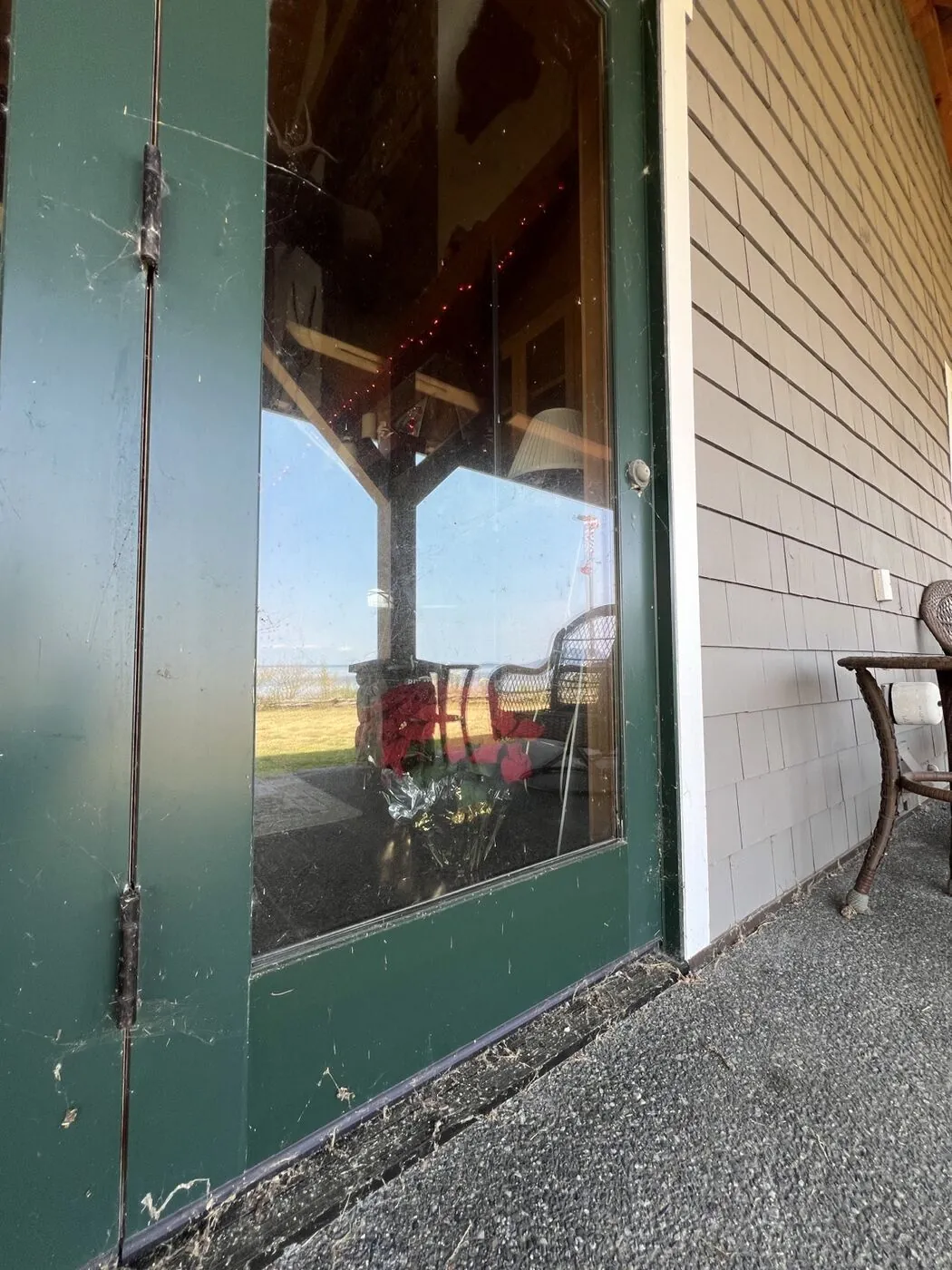 Before
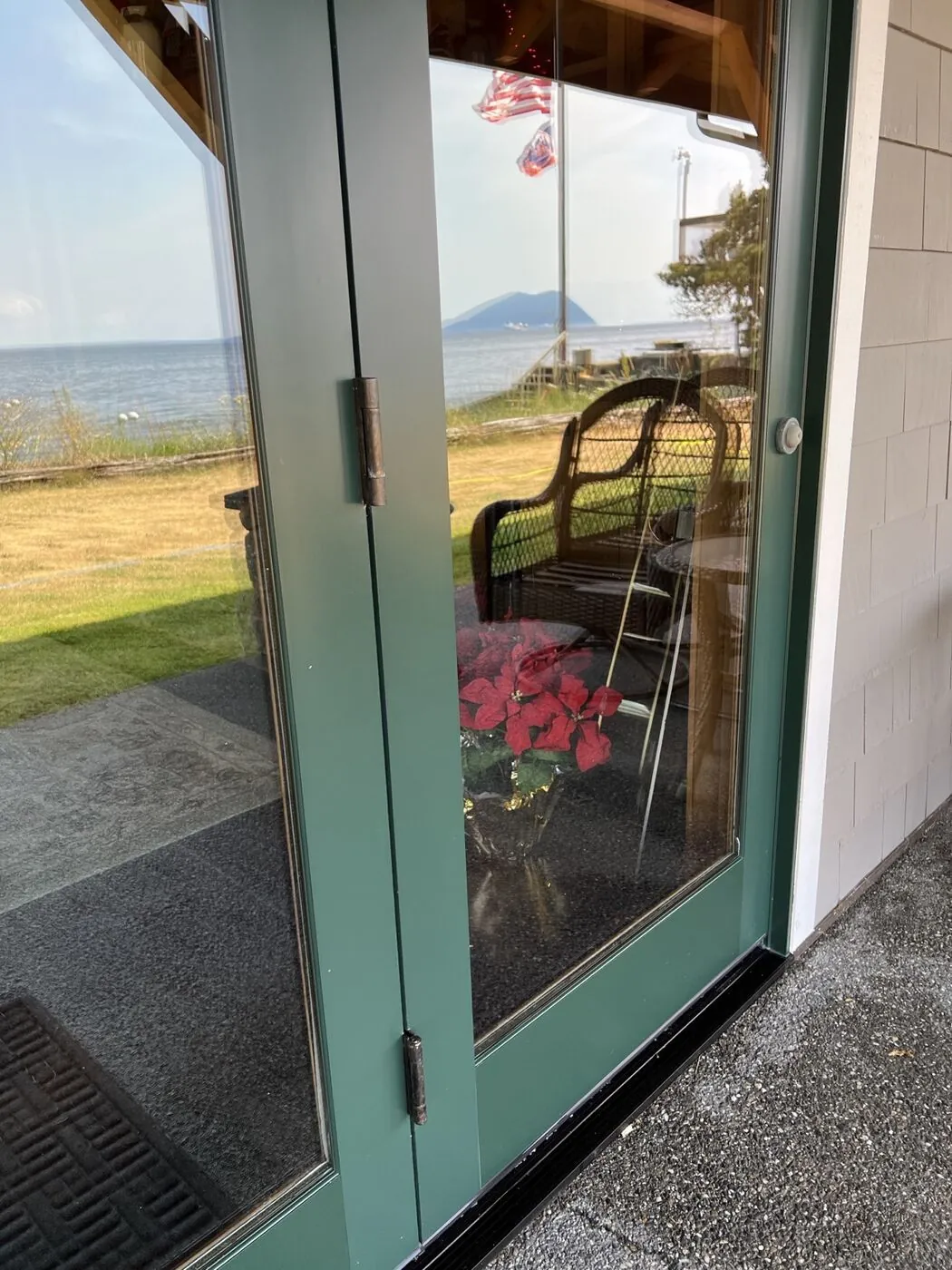 After
What else lands on a Lynden exterior?
Farming is part of the answer. Lynden’s economy turned from logging to agriculture around the turn of the twentieth century, dairy and berry farms above all, and the county’s berry output is still remarkable: the Whatcom Conservation District credits Whatcom County with nearly 85 percent of the nation’s red raspberries, close to 48 million pounds a year. A house that faces working land can collect a finer, drier film on its windows and siding than one set among other houses, and when we can see that on the day, we plan for it.
Trees are the other part, and the town has more of them than a drive past the fields suggests. Lynden City Park sits among tall conifers on Fishtrap Creek, and Berthusen Park, whose 236 acres the Berthusen family left to the city, includes old-growth forest. Whether your own lot carries real needle and leaf pressure depends on what stands near it, which is one more reason we look before we price.
How do you wash siding on a Lynden house?
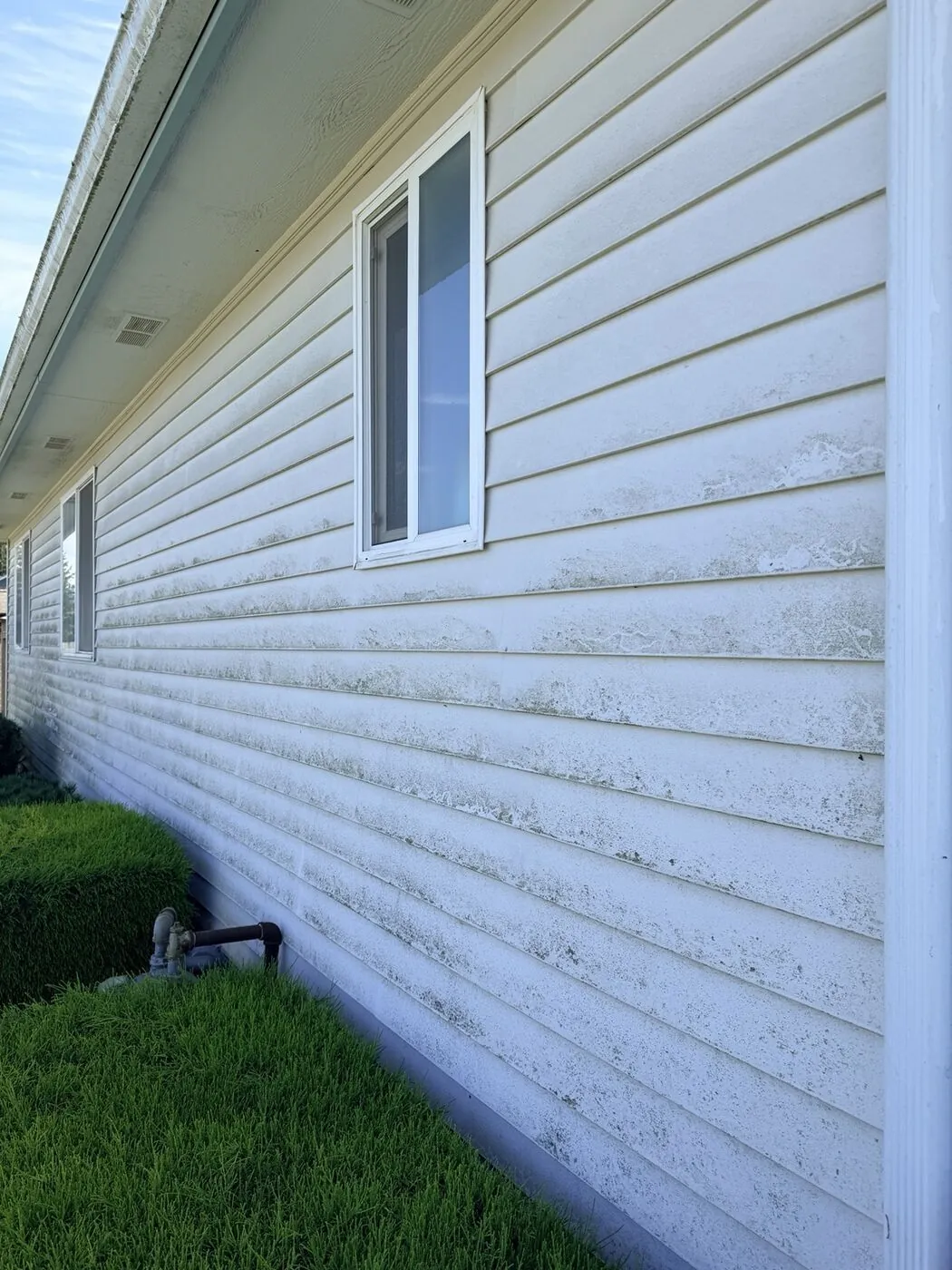
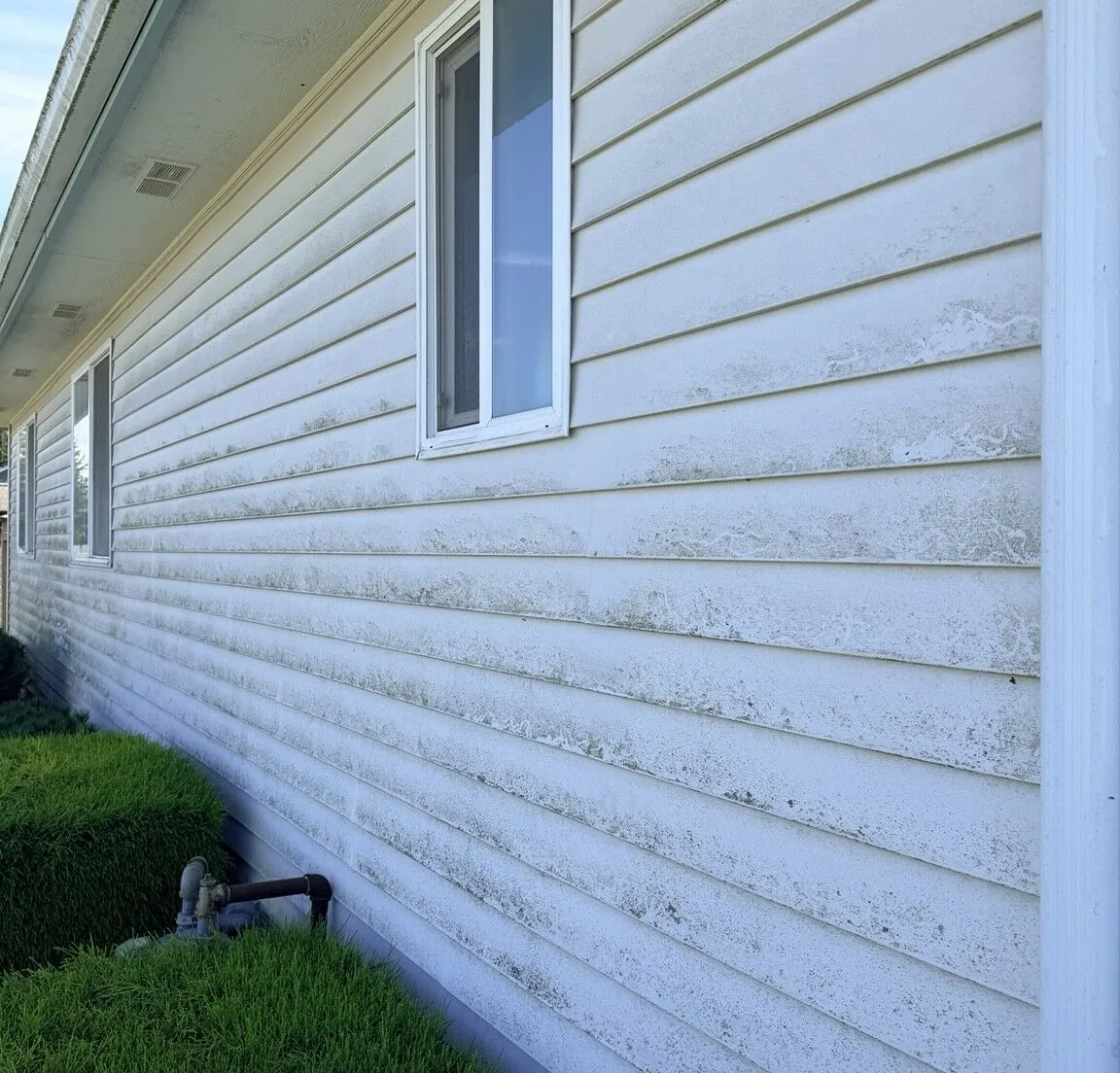
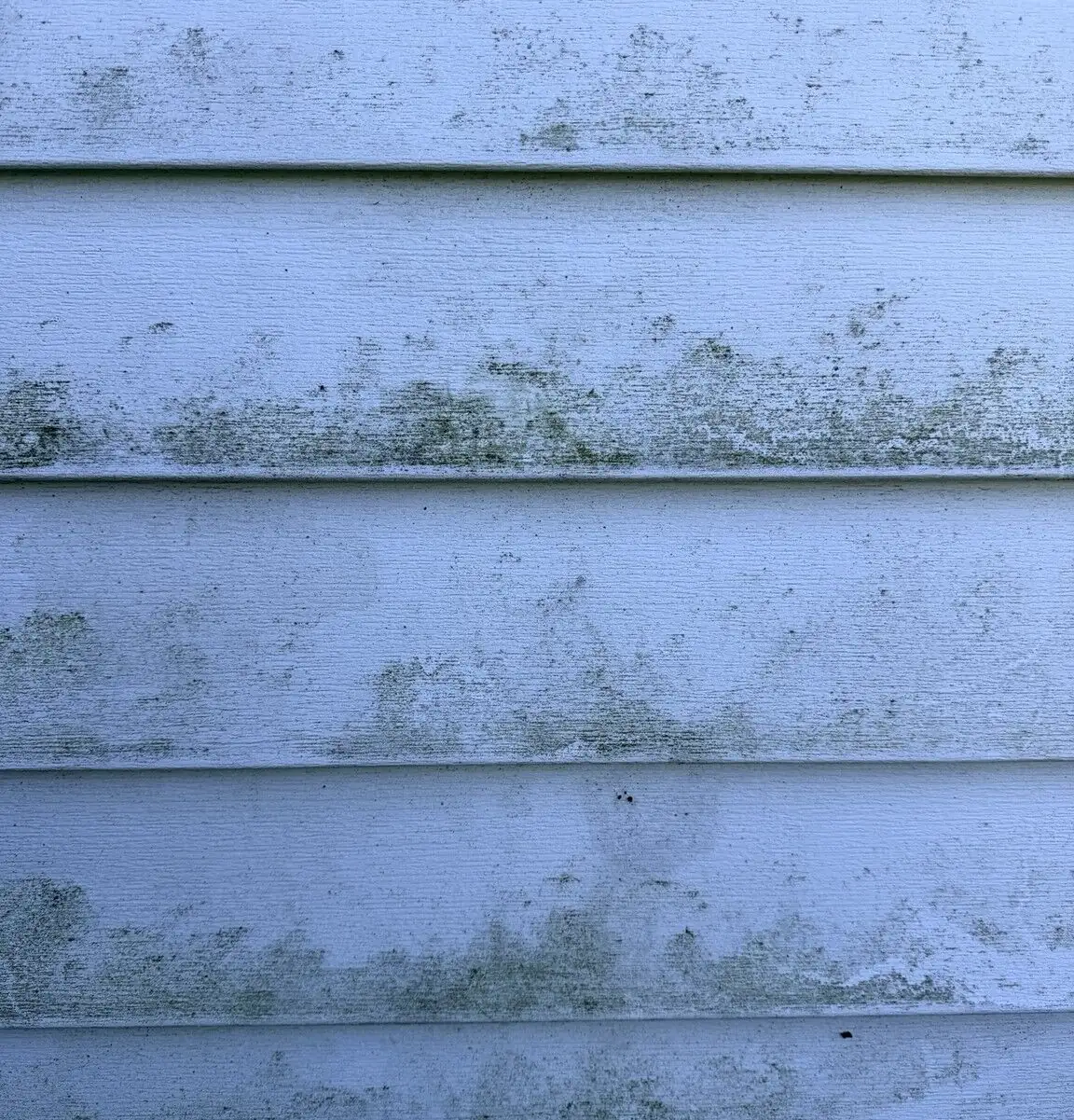
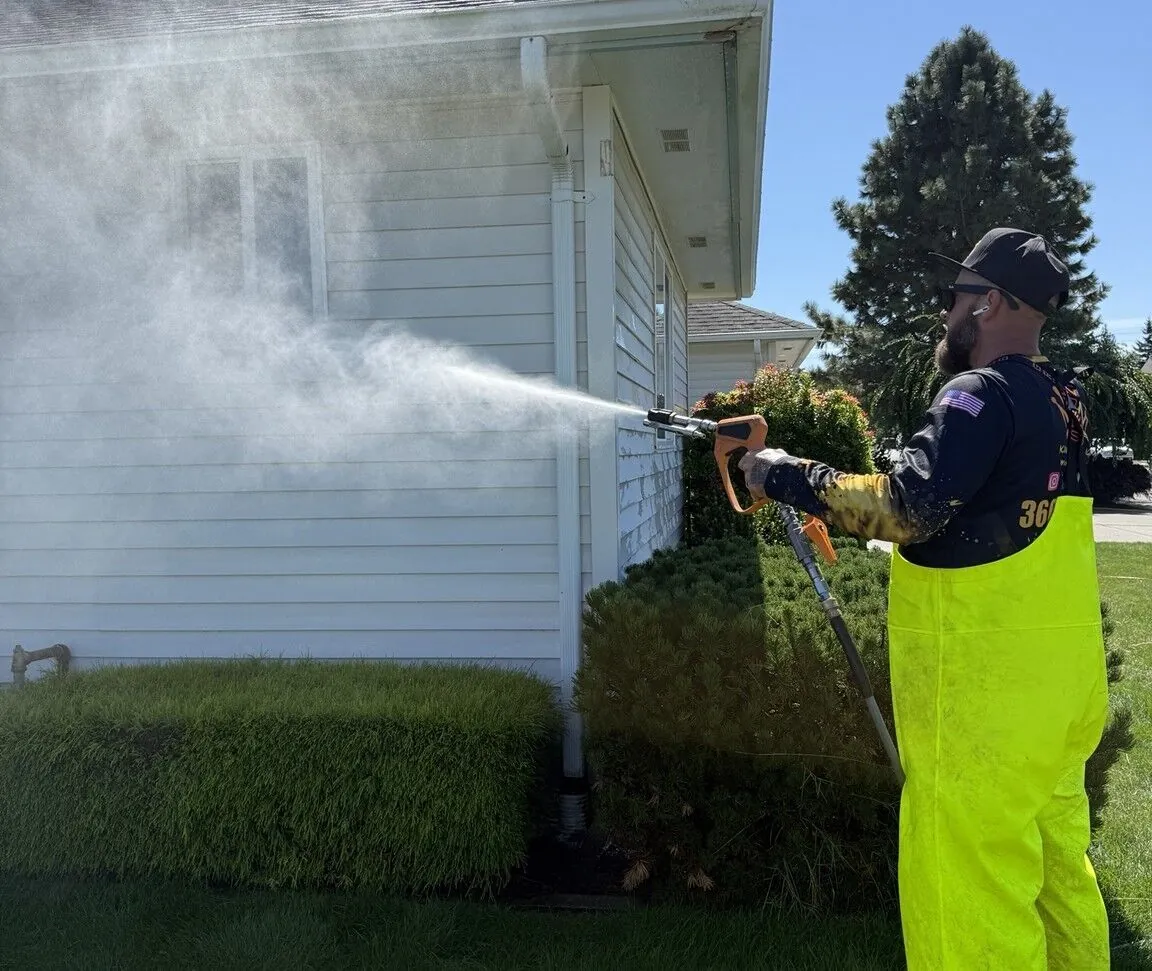
With low pressure and a cleaning solution that does the work, not a narrow jet that forces water behind the boards. That is how the one Lynden job we have documented was done: in August 2026, white lap siding with green growth on the lower courses and along a shaded side wall was soft washed back to clean, with before and after photos taken on the day and now in the gallery.
The pattern on that house is the one this climate produces, growth low down and growth on the side that sees least sun. Our Lynden house washing page covers method, rinse handling and timing in full.
What does gutter clearing involve here?
Hand clearing, bagging and removal, followed by a flush of each downspout to confirm the water actually leaves the run. The job matters most before November, when the heaviest rain of the year arrives, and again after any stretch of snow and ice has sat in the troughs. There is a local rule involved as well: Lynden’s code counts collected leaves and branches as an illicit discharge to the storm system, so debris goes in a bag, never down the street drain. The detail is on the Lynden gutter page.
Can you clean a Lynden roof?
Yes, using a soft wash rather than a pressure washer, which on shingles strips granules and shortens the roof’s life. Moss and algae get treated, the heavier growth is removed by hand, and the rest breaks down and rinses off over the following weeks of weather. Treatment goes on in the drier part of the year so it has time to work before the wet months return. We are cleaners, not roof inspectors, and if we see something that looks like damage we will point it out and suggest you have a roofer look at it. Read more on the Lynden roof cleaning page.
What about the windows?
Interior and exterior, screens and tracks, with purified water on a pole for upper storeys and squeegee work on glass we can reach by hand. Lynden’s drinking water is treated Nooksack River water, and the city’s water quality report publishes no hardness figure, so we make no hard-water claims about the town. We carry our own purified water regardless. The Lynden window page goes into access, larger modern panes and older sashes.
What does Lynden’s stormwater code ask of us?
More than people assume, and it is specific. Chapter 13.24 of the Lynden Municipal Code lists illicit discharges to the city storm system, and three items on that list touch exterior cleaning directly:
- Steam-cleaning wastes (item 14)
- Soaps, detergents or ammonia (item 15)
- Collected leaves or branches (item 24)
A separate provision, 13.24.160(C)(4), treats routine external building wash-down as a conditional discharge, allowed only when no detergents are used. The city’s own stormwater page adds plain advice to clean up debris before and after pressure washing.
The reason is downstream. Most of what enters a Lynden storm drain ends up in Fishtrap Creek and then the Nooksack River, the same river the city treats for its drinking water. In practice we decide on the quote where rinse water will go, keep detergent-bearing water on lawn and beds rather than hard surfaces that slope to the street, and leave the pavement swept. Our wash water and storm drain page sets out the wider approach.
Where else do you work near Lynden?
Two neighbouring towns have pages of their own: Everson and Ferndale. Nooksack and Sumas are on the same run without separate pages, and so are the rural roads that link them. Bellingham, fifteen miles south, is where the company is based.
Running this corner of the county on a regular rotation means a Lynden booking does not wait for a special trip, and if something needs a second look afterwards, a crew is rarely far away.
Can everything be done in one visit?
Usually, and it is generally the cheaper way to do it. A full exterior visit runs from the top down: roof, then gutters, then the walls, then the glass. Done in that order, nothing loosened from the roof or the troughs lands on siding or windows that have just been cleaned, and one setup covers the lot.
If you only want one service this year, that is fine too. We will tell you what we saw elsewhere on the house and leave the decision with you.
How do I get a price?
Call (360) 303-6806 or send a request online. Someone comes out, walks the house with you, and prices each part of the job separately so you can choose. Every technician on a Lynden job has been trained by the owner, and nothing starts until you have agreed exactly what is included.
What we do in Lynden
Nearby
Lynden questions
- Do you actually come out to Lynden?
- Yes. Lynden is on our Whatcom County route, and we quote and work there the same way we do in Bellingham: someone comes to the house, walks it with you, and prices the work in front of them rather than guessing from an address.
- Which services can I book for a Lynden house?
- Siding washes, gutter clearing, roof cleaning and window cleaning each have their own Lynden page with the detail. Moss work, pressure washing of paths and driveways, and solar panel cleaning are also available and can be added to the same visit.
- Can I have the siding washed with soap in Lynden?
- Detergent-based wash water has to be kept out of the storm system. Lynden's code lists soaps and detergents as illicit discharges and only allows routine building wash-down into the system when no detergent is used, so we plan where the rinse goes before we start rather than letting it run to the street.
- My house is only a few years old. Does it really need cleaning?
- Often, yes. New siding and new glass still collect organic growth and film on the shaded sides within a few wet seasons, and a newer house is the cheapest one to keep ahead of because nothing has had time to stain or etch.
- What order should the work be done in?
- Top down. Roof first, then gutters, then the walls, then the glass last, so nothing we loosen higher up lands on a surface that has just been cleaned. Booking it as one visit also saves a second setup.
- Do you cover the towns around Lynden?
- Everson and Ferndale have their own pages, and we also work Nooksack, Sumas and the rural roads between them. If you are unsure whether your address is in range, ring and ask; a straight answer takes a minute.
- Are you licensed and insured?
- King of Kings Window Cleaning LLC holds a Washington State business licence and Labor & Industries coverage. If you want to see the paperwork before anyone sets a ladder against your house, ask and it will be provided.