
Whatcom County
Gutter Cleaning in Lynden, WA
The short answer
We clear Lynden gutters by hand, bag the debris and take it away, then flush every downspout to prove the water leaves the run. Timing matters here: the nearest long-record station logs its wettest months in November and December, and Lynden's code treats collected leaves washed into a storm drain as an illicit discharge.

Randy Fee — Owner, King of Kings Window Cleaning
Washington business licence, UBI 605476674 · L&I insured · BBB rated A
Randy runs the company himself, so you are dealing with the owner, not a call centre — and every technician here is personally trained by him. Working Whatcom and Skagit County since 2024.
I run the Lynden route personally.
A gutter in Lynden has one job that matters above the rest: get the November and December rain off the roof and away from the house without spilling it down the wall. Whether it manages that depends almost entirely on what is sitting in the trough when the heavy weather arrives.
We clear the troughs by hand, bag what comes out, flush each downspout, and leave nothing behind that the next rain could carry to a street drain. The reason for that last part is local, and it is written into the city code.
What fills gutters on a Lynden house?
It depends on what stands near the house, and Lynden has real trees in places: Lynden City Park sits among tall conifers on Fishtrap Creek, and a lot next to a stand of mature trees collects needles and cones year round. A house on open ground still fills its gutters, just with different material.
What we typically pull from a trough, in roughly the order it builds up:
- Shingle grit, the fine mineral granules that wash off composition roofing and settle into a sludge at the low end of each run
- Moss fragments that break off the roof in wet weather and root again in the silt, sometimes growing right in the trough
- Leaves, needles and seed, wherever trees stand within reach of the eaves, including trees in a neighbour’s yard
- Windblown material such as dust, pollen and plant litter that sticks to the damp silt and thickens it
- Nests and the odd lost ball, usually at a corner or right above a downspout
Once a layer of that silt forms, it holds water between storms, and a trough that stays damp becomes a planter. If moss on the roof is shedding into the gutters, the lasting fix starts above them, on the Lynden roof cleaning page.
Why does the rain calendar set the gutter calendar?
Because the heaviest water arrives all at once. The Clearbrook cooperative station, the long-record weather station nearest Lynden, averages 6.17 inches of precipitation in November and 6.22 in December, set against 1.47 in July. It sits in the area rather than inside the town, so read it as the regional pattern, but the pattern is clear enough to plan around.
A gutter that is half blocked copes with a July shower and fails the first sustained November storm. That is why an autumn clearing, finished before the turn into November, does far more good than the same clearing in spring. Spring still has a place when trees overhang the roof, because material that fell over the winter has usually packed down by then.
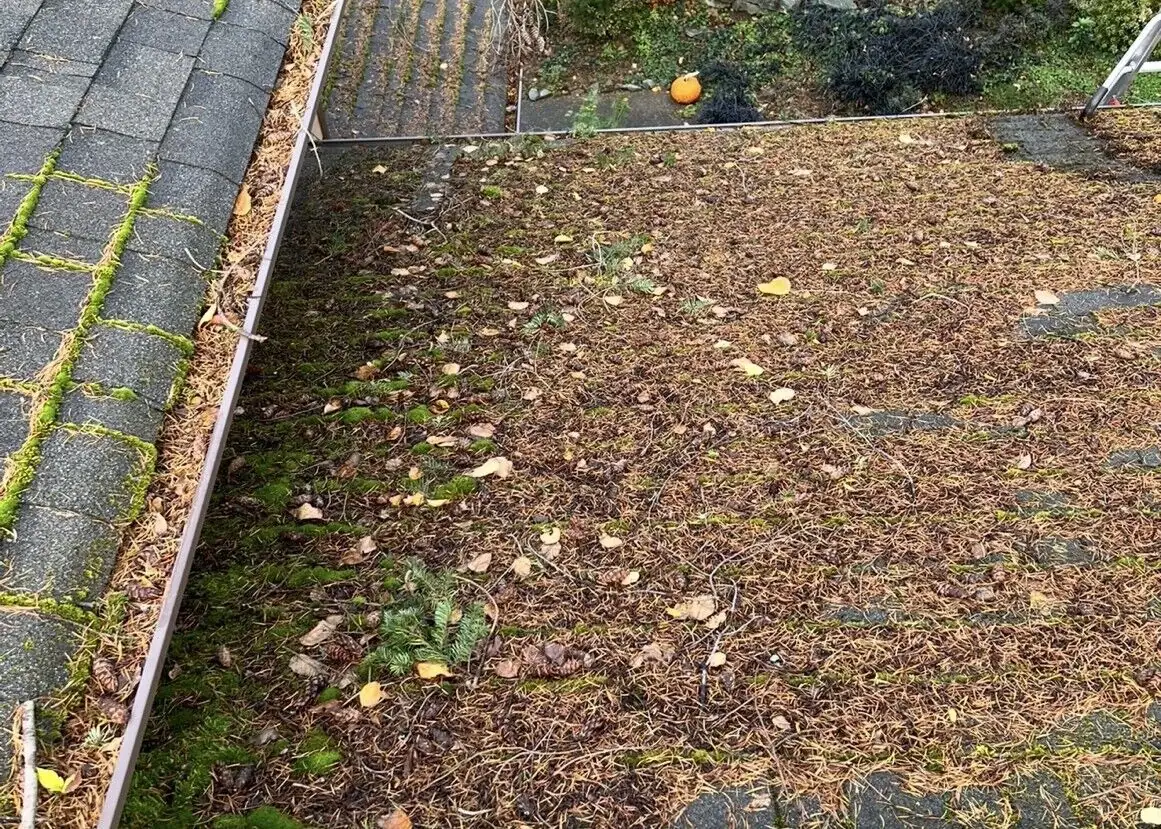 Before
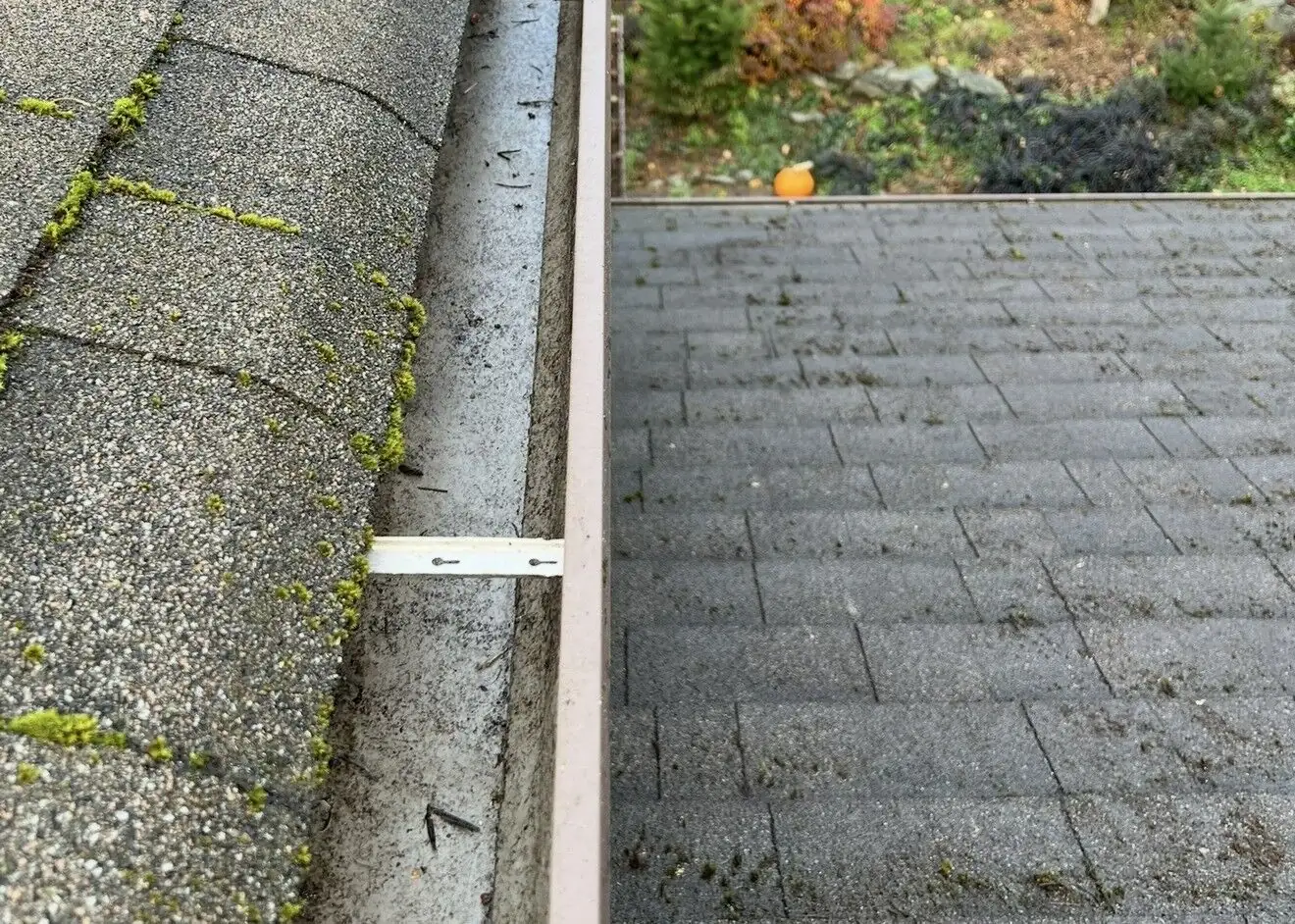 After
What does a gutter clean include?
Every accessible run on the house, done the same way each time:
- Debris taken out of the troughs by hand and scoop, not blown off the roof onto your lawn, beds or car
- Everything bagged and removed from the property
- Each downspout flushed from the top until water runs clear out of the bottom
- Troughs rinsed so the fall of each run can be seen and checked
- A walk round with you afterward, pointing out anything that needs a repairer
Detached garages and outbuildings are included when you ask for them on the quote. Gutter guards, where a house already has them, change the job considerably, so mention them when you book and we will price accordingly.
How is the work actually done?
From ladders set with care, standing clear of the trough itself, which bends and lets go of its hangers if anyone leans a ladder on it. On single-storey runs we work along the eave from the ground up; on two-storey runs, the reach and the ladder footing on soft lawn decide the approach, and some sections are handled from the roof where the pitch allows it safely.
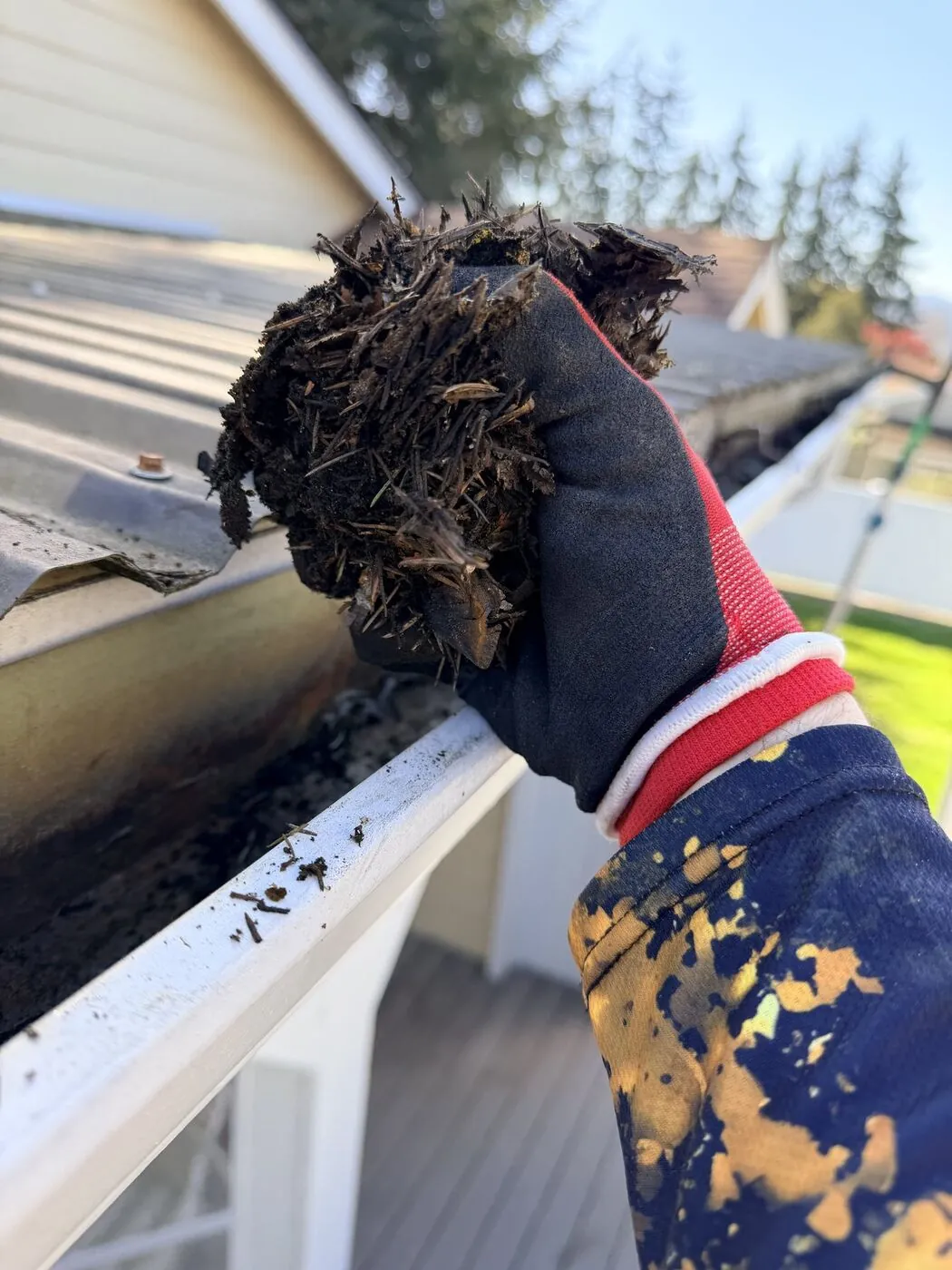
Hand clearing is slower than blowing a gutter out, and slower is the point. A blower throws the wet silt across the siding, the windows and the lawn, and the fine part of it ends up where the next rain rinses it toward a drain. Taking it out by hand keeps it in a bag.
The downspout flush is where the job is actually proven. We run water in at the top of each one and watch it leave at the bottom. If it backs up, we clear the blockage from above where we can reach it. If a drop runs into buried pipe we cannot clear, we say so plainly rather than call the job done.
Where does the debris go, and why does it matter here?
It goes into a bag and leaves with us, because Lynden’s municipal code does not let it go anywhere else. Chapter 13.24 lists illicit discharges to the city storm system, and item 24 on that list is collected leaves or branches. Rinsing gutter sludge down the driveway, or sweeping it to the kerb for the rain to take, puts exactly that material into the system.
The city’s stormwater page explains where it would end up: most of what enters Lynden’s storm drains flows into Fishtrap Creek and then the Nooksack River. The same list names soaps and detergents too, which is why the water we use to flush downspouts carries no additive at all. Our wash water and storm drain page covers how we handle runoff on every kind of job.
What drives the price on a Lynden house?
There is no flat rate, because houses differ too much for one. The quote comes down to:
- Length of run, measured along the eaves, including any garage or shop
- Height, since a two-storey eave takes longer and needs more ladder work than a single-storey one
- Access, meaning soft lawn, steep slopes, decks and planting under the eaves
- Condition, where a gutter cleared last autumn is quick and one left for several years may hold packed silt and live moss
- Downspout count, and whether any drop runs underground
- Extras such as brightening the outer faces or clearing an outbuilding
A second visit usually costs less than the first, because we are maintaining rather than excavating.
What problems start in a blocked gutter?
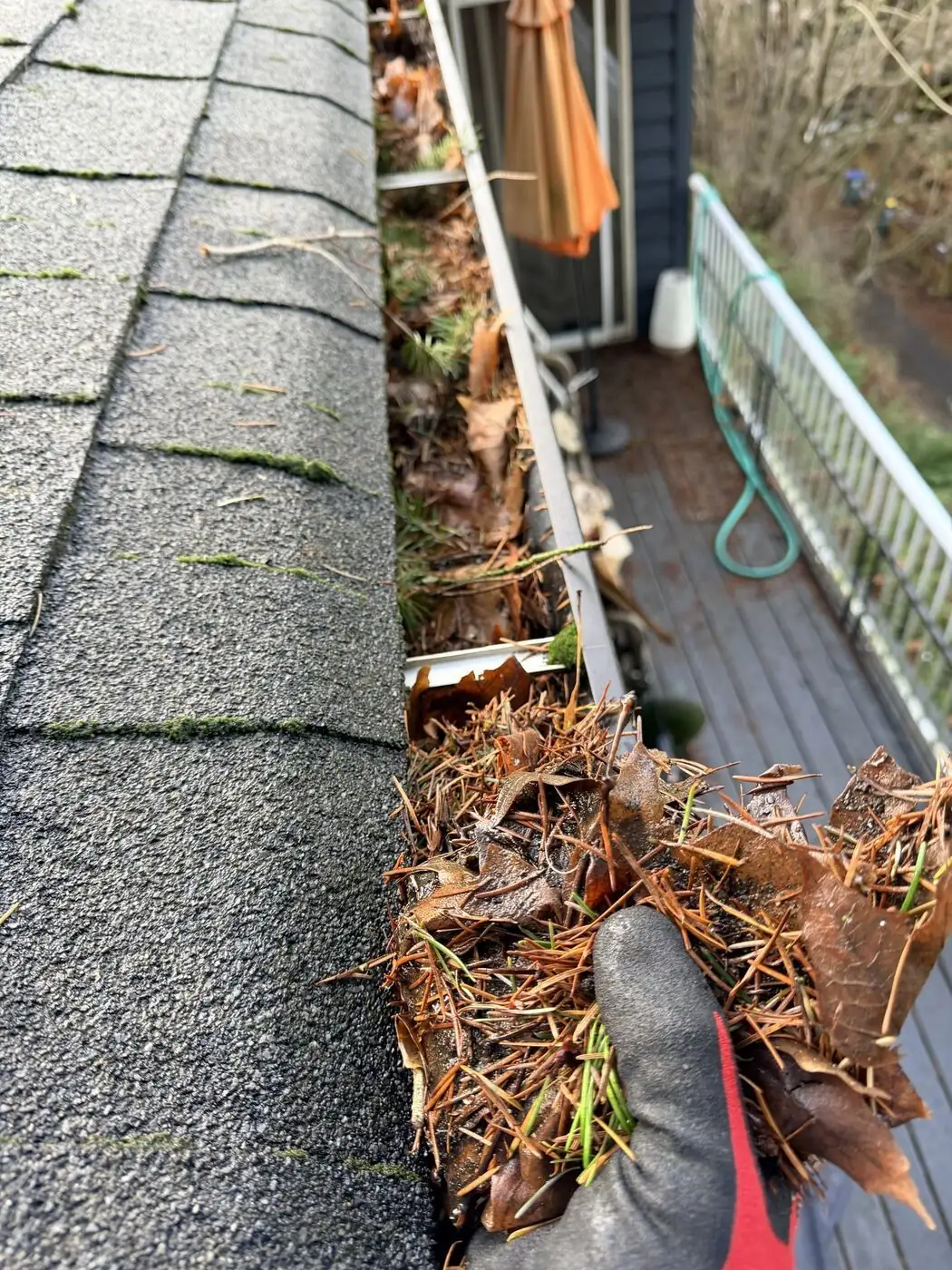
Most of them show up somewhere other than the gutter. Water that cannot get down the downspout spills over the front edge and falls straight onto the ground at the foundation, or runs behind the trough and down the fascia. Over a season or two that means rot in the fascia board, staining on the siding, soil washed out of beds and water pooling where it should never collect. The signs and causes are laid out on the overflowing gutters page.
The black vertical streaks that appear on the outer face of many troughs are a different issue, a film that clearing the inside will not touch. That is dealt with by gutter brightening, which we quote separately.
What do snow and ice do to Lynden gutters?
They add weight at the worst moment. The Clearbrook station averages 16 inches of snow a year, mostly in December and January, which puts the heaviest snow load on the gutters straight after the wettest months. A trough still holding wet silt freezes solid, and meltwater backed up behind that ice has nowhere to go but over the edge or under the first course of shingles.
We do not work on eaves carrying snow or ice, since the footing is unsafe and the trough is at its most fragile. Once it has cleared, a late-winter check is worthwhile on any house where the gutters were full going into December, because that is when sagging runs and pulled hangers tend to show.
How often should a Lynden gutter be cleared?
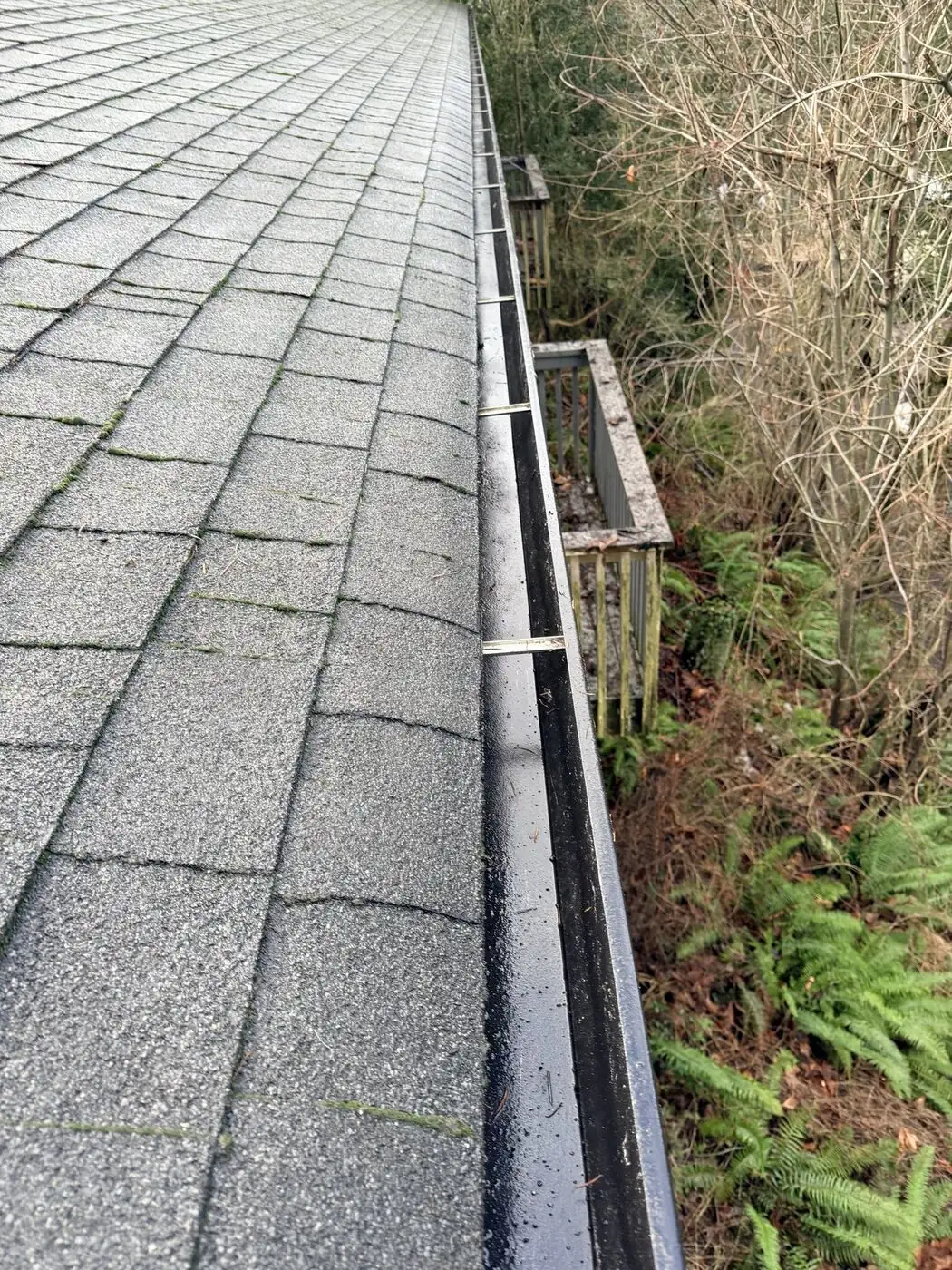
Once a year for a house with open sky above it, timed for October or the first days of November. Twice a year where trees stand near the roof, with the second visit in spring. Houses with moss on the roof sometimes need more until the roof itself is dealt with, because the moss keeps feeding the troughs. The general background on frequency and method sits on our main gutter cleaning service page.
What can I check from the ground between visits?
Quite a lot, and none of it needs a ladder. The most useful time to look is during a proper downpour, standing somewhere dry with a view of the eaves.
Water sheeting over the front lip of a trough, especially at a corner or midway along a long run, means a blockage or a run that has lost its fall. A downspout that stays dry while the gutter above it is overflowing is packed somewhere along its length. Plants sprouting along the roof edge tell you there is soil in the trough, and soil means it has been a while. Splash marks, fresh staining or washed-out mulch directly below the eaves show where water has been landing instead of being carried away.
After a cold snap, look along the line of each gutter from the end of the house. A run that dips between hangers has usually carried ice or wet silt heavier than it was built for. None of these signs means you need us tomorrow, but each one is worth mentioning when you ring, because it tells us where to look first.
How do I book?
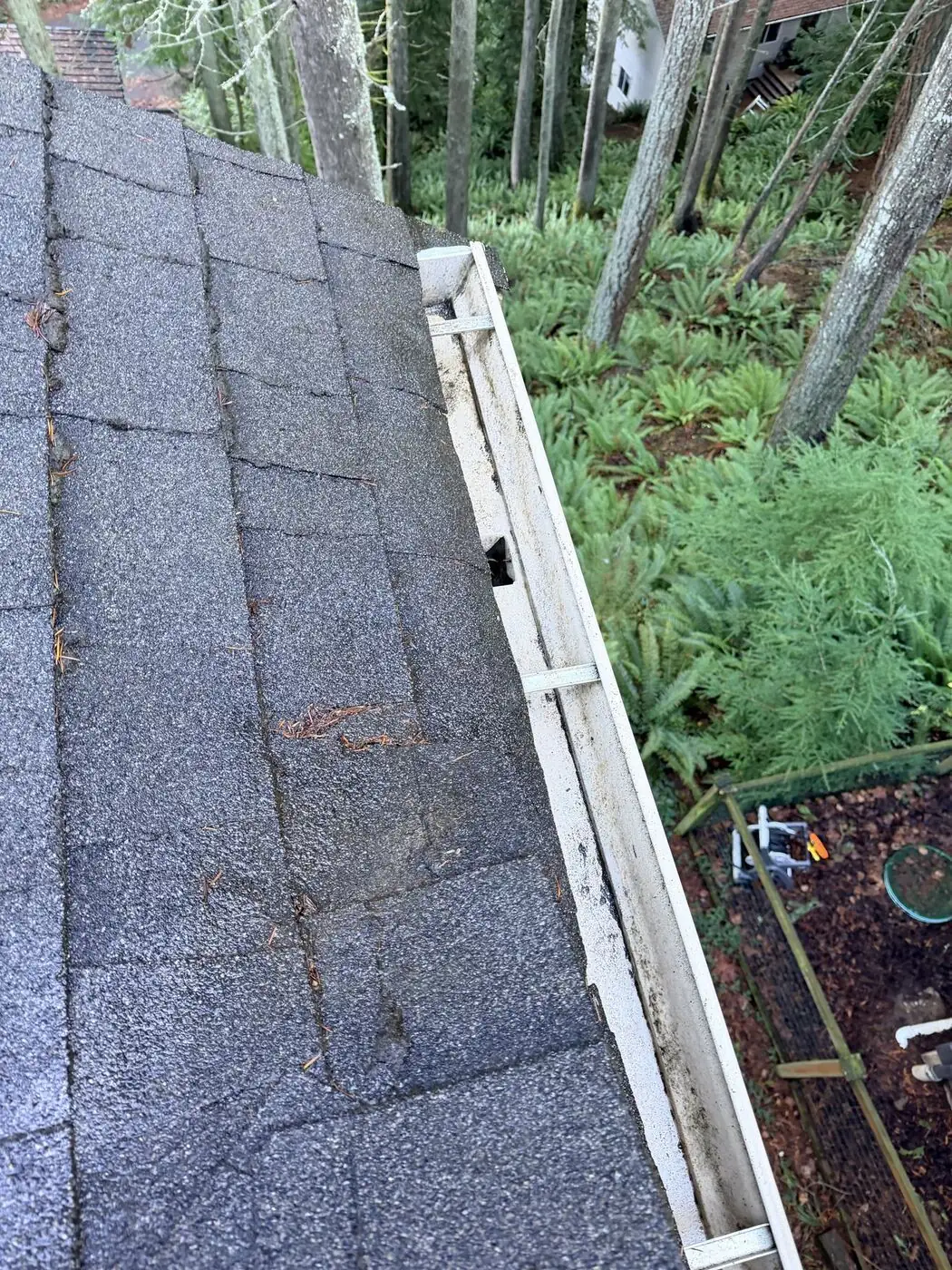
Ring (360) 303-6806 or send a request online. We come to the house, look at the runs and the downspouts, and give you a price for that house on that day. The crew who turns up has been trained by the owner in how this work is done, from ladder placement to the downspout flush, and you will get a walk round at the end before anyone packs up.
If the roof, siding or glass are due at the same time, the Lynden overview page shows how the whole house fits into a single visit.
Gutters questions from Lynden homeowners
- How often do Lynden gutters need clearing?
- Once a year, in autumn, suits a house with nothing overhanging it. Add a spring visit if trees stand near the roof or if the troughs held water through the winter. The right number is set by what actually lands on your roof, which is why we look before recommending one.
- What month should I book?
- October into early November, so the gutters are open before the two wettest months of the year arrive. If trees near the house drop late, a second pass after they are bare is worth more than an early first one.
- Where does the debris go?
- Into bags and off your property. Lynden's code lists collected leaves and branches as an illicit discharge to the storm system, so we never rinse or sweep gutter material into a street drain or leave it piled where rain can carry it there.
- Do you check the downspouts?
- Every one. A trough can be spotless and still overflow if the downspout below it is packed, so each drop gets flushed until water runs freely out of the bottom, and anything we cannot clear from above we tell you about.
- My gutters have black streaks on the outside. Is that part of the job?
- Those stripes on the outer face are a separate cleaning called gutter brightening. It is quoted as an add-on because it uses a different method from clearing the inside of the trough, and it pairs well with a siding wash.
- Can you work on the gutters when there is snow on the roof?
- Not safely while snow or ice is on the eaves. We wait for it to clear, then check whether ice has pulled hangers loose or left the trough sagging, and let you know what we find.
- Do you repair or install gutters?
- No. We clean them and report what we see, such as a loose hanger, a split seam or a run that falls the wrong way. Repairs and new gutters are a job for a gutter installer, and we would rather say so than improvise.