Whatcom County
Roof Cleaning & Debris Removal in Lynden, WA
The short answer
We clean Lynden roofs with a low-pressure soft wash, never a pressure washer, and lift heavy moss by hand before treating the rest. Timing follows the local rain: the nearest long-record station averages over six inches in each of November and December but under an inch and a half in July, so treatment goes on in the dry months.

Randy Fee — Owner, King of Kings Window Cleaning
Washington business licence, UBI 605476674 · L&I insured · BBB rated A
Randy runs the company himself, so you are dealing with the owner, not a call centre — and every technician here is personally trained by him. Working Whatcom and Skagit County since 2024.
I run the Lynden route personally.
A roof in Lynden spends most of the year wet and a short part of it dry, and that split is the whole story of what grows on it. Moss, algae and lichen settle in through the long damp season, hold water against the roofing through the coldest months, and look their worst by early spring.
The fix is not force. We treat the roof with a low-pressure soft wash, take heavy moss off by hand, and let the weather finish the rinse over the weeks that follow. The timing of all that is set by the local rainfall, which has a very clear shape.
What grows on a Lynden roof?
Three things, usually in combination. Moss forms the green cushions that sit in the gaps between shingles and along the lower edge of each course. Algae shows up as dark streaks running down the slope, often mistaken for dirt or ageing. Lichen appears as crusty grey-green spots that grip the surface harder than either of the others.
All three want the same conditions: a surface that stays damp for long spells and does not get much sun. That makes the shaded slope of any roof the first to go, followed by the areas under overhanging branches, along valleys where water concentrates, and on the lower courses where runoff from the whole slope passes over. An open slope in full sun can go years with little growth, while the other side of the same ridge carries a thick coat.
Heavy moss does more than look untidy. Its roots work into the joints between shingles and lift the edges, which lets wind-driven rain in. The mechanics of that are laid out on our moss under shingles page.
How does the Lynden rain calendar affect the roof?
It decides when treatment will actually work. The long-record station nearest Lynden is the Western Regional Climate Center’s cooperative station at Clearbrook, with a record running from 1903 to 2016 and an annual average of 46.71 inches of precipitation. It is in the area rather than in town, so take its figures as the local pattern rather than a reading from your street.
Month by month, the contrast is stark. November averages 6.17 inches and December 6.22, while July averages only 1.47. The same station records an average of 16 inches of snow a year, most of it falling in December and January.
For a roof, that sequence means a treatment applied in the dry part of summer gets a long run of dry days to work, and then the autumn rain does the rinsing. Growth left untreated goes into November already established, spends the wettest two months of the year soaking up water, and then sits under snow and ice through the coldest ones.
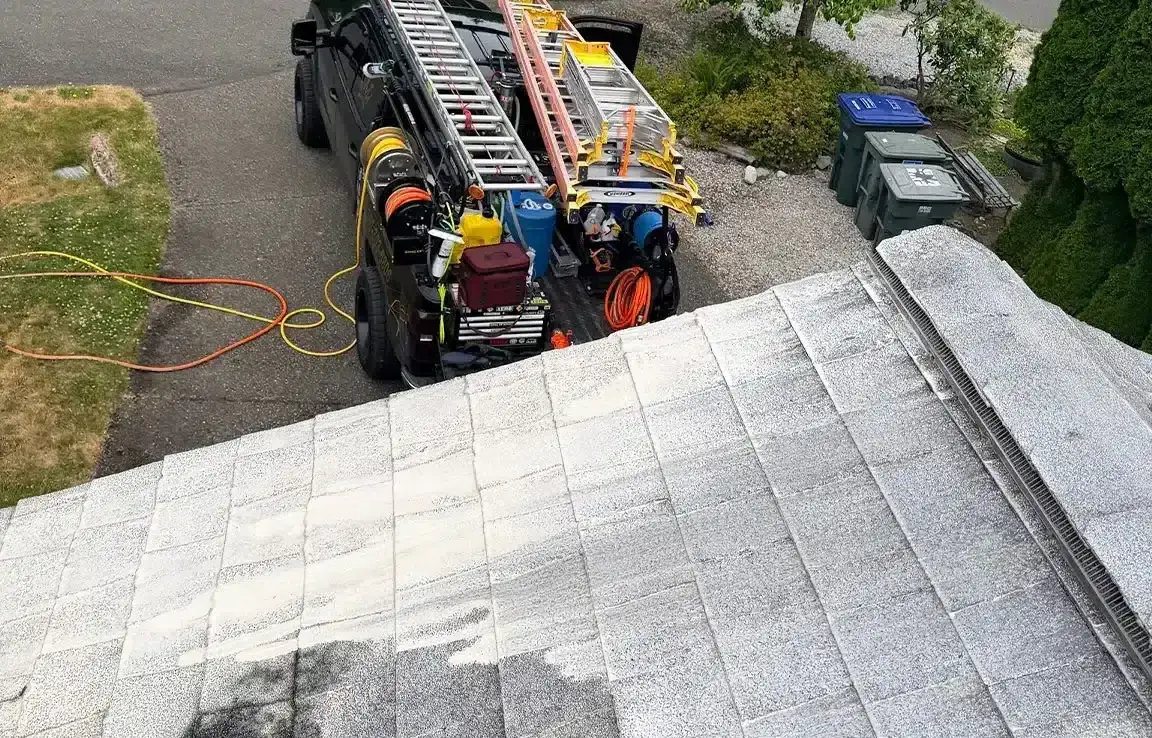
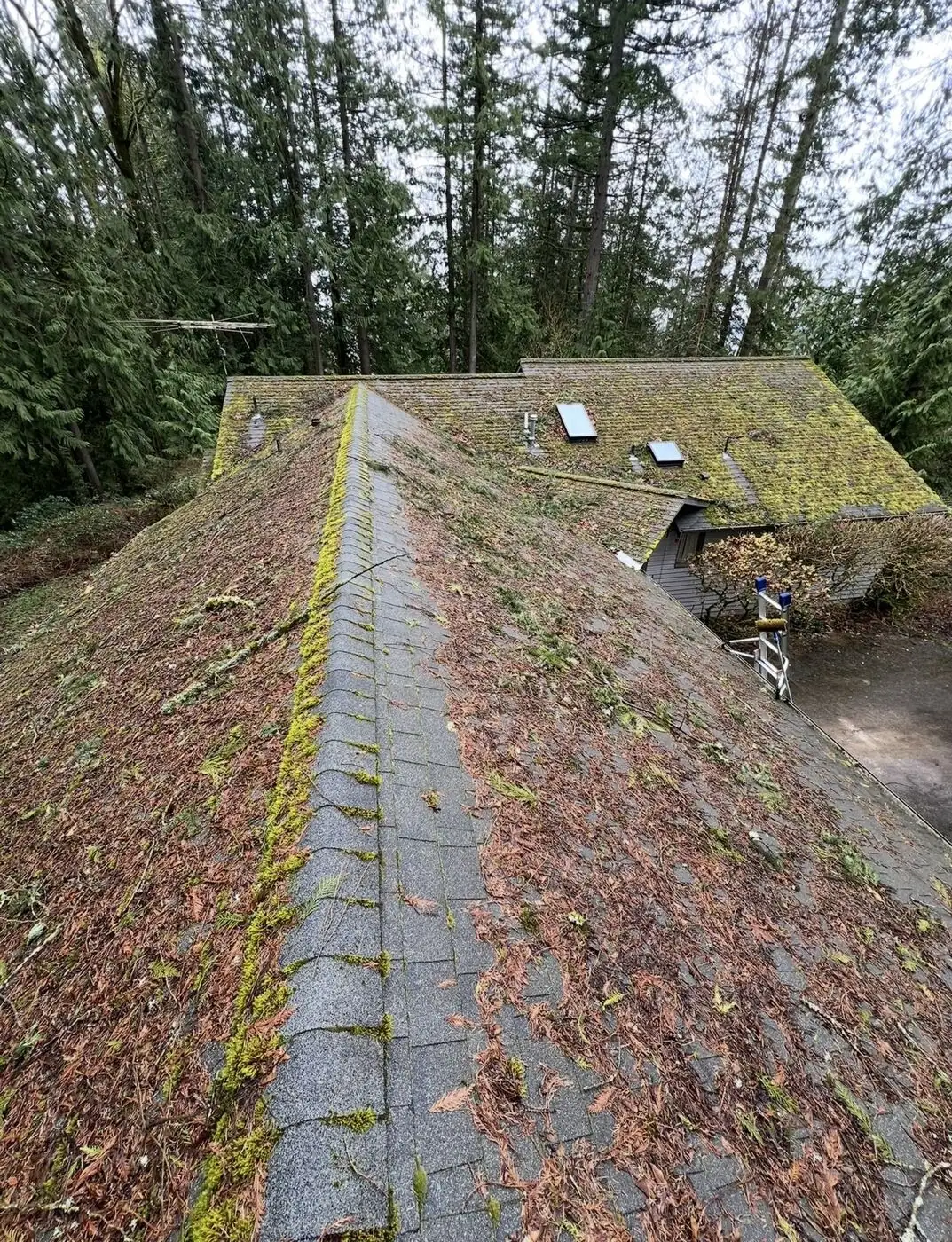 Before
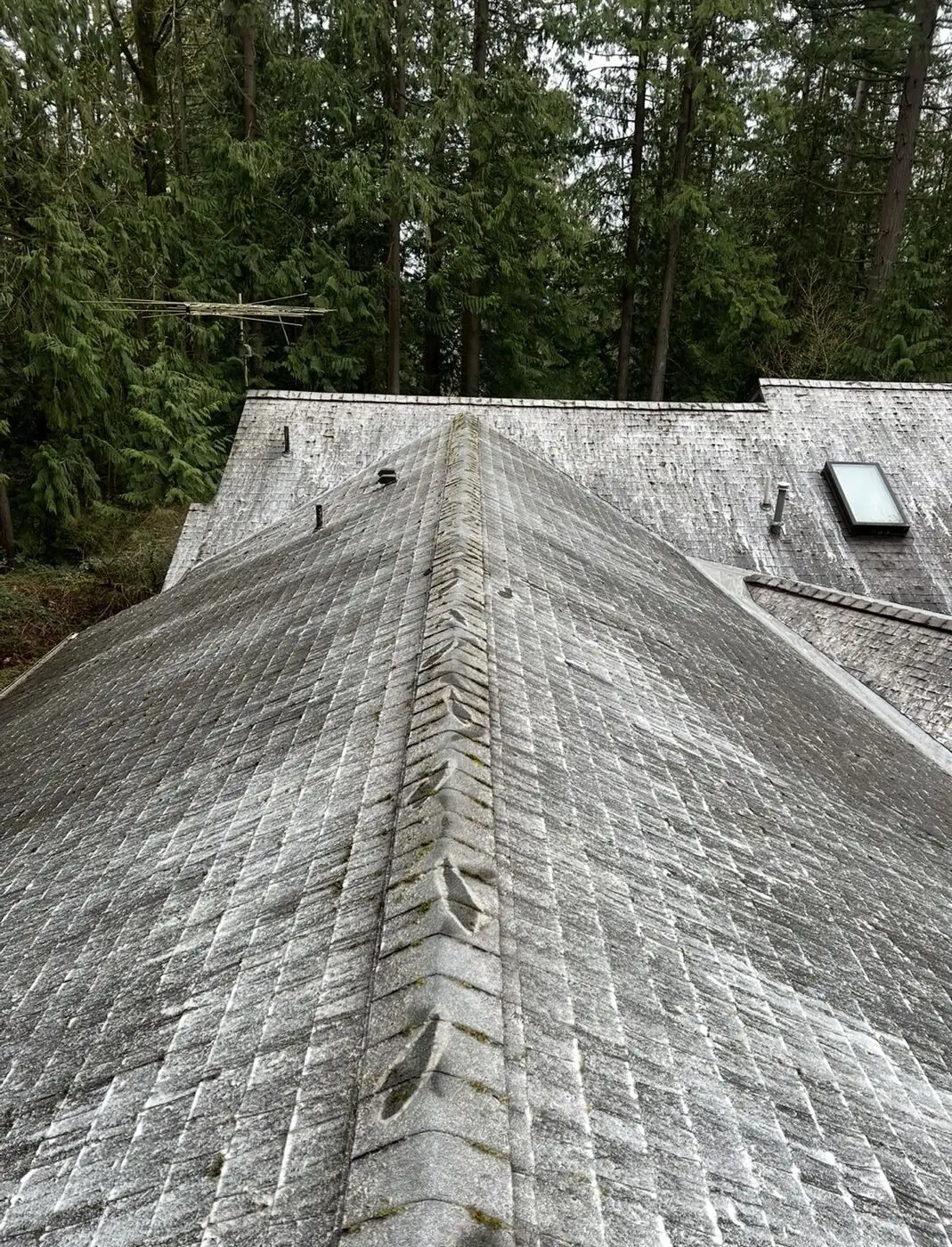 After
How do you clean a roof without damaging it?
By using chemistry and patience instead of pressure. The steps, on a typical Lynden roof, run like this:
- Planting below the eaves pre-wetted and, where needed, covered
- Downspouts checked so we know where the runoff will go
- Thick moss removed by hand, working down the slope with the grain of the roofing so nothing is lifted or scraped
- A cleaning solution applied at low pressure across the affected areas
- Planting rinsed again once the application is finished
- Loose material cleared from the gutters at the end of the visit
The solution kills the remaining growth and loosens the staining, and the rain over the following weeks carries it away. That is why a soft-washed roof looks better a month after the visit than on the afternoon itself.
What we do not do is put a pressure washer on a roof. On composition shingle it strips the mineral granules that protect the asphalt from sunlight, and those granules do not grow back. On cedar it can split and fray the wood. On any roof it drives water up under the laps. Our library pages go into how each surface behaves: composition asphalt shingle, cedar shake and standing seam metal.
Does the age of the roof change the approach?
It changes how carefully we work, more than what we use. Lynden’s housing is young by regional standards, with a median year built of 1997, so many roofs in town are on their first or second covering. A newer roof with a light coat of algae is a quick, straightforward treatment.
An older or heavily grown roof takes more time on the hand removal and more caution on the footing. Brittle shingles and weathered cedar get lighter handling, and anywhere the roof feels soft or looks lifted we stop walking it. Where a roof is simply at the end of its life, cleaning will make it look tidier, but it will not add years, and we would rather tell you that than take the job.

What does Lynden’s code say about roof runoff?
It says cleaning chemistry must not reach the storm system. Chapter 13.24 of the Lynden Municipal Code lists soaps, detergents or ammonia as illicit discharges to the city storm system (item 15), and the only building wash-down it tolerates is the kind that uses no detergent at all. The city’s stormwater page notes that most of what enters its drains ends up in Fishtrap Creek and then the Nooksack River.
A roof sheds everything into its gutters and downspouts, so the question is where each downspout goes. Where a drop discharges onto lawn or into a bed, runoff is taken up by the ground. Where it runs into a pipe that ties to the street system, we plan around it before we start, and apply only what the growth needs rather than drenching the slope. If a downspout’s destination cannot be managed, it goes on the quote as something to discuss.
What sets the price of a Lynden roof clean?
It is quoted on site after looking at the roof, and it depends on:
- Roof area, and how much of it actually has growth
- Pitch, since a steep roof needs more rigging and slower movement
- Height, especially on two-storey houses and those with dormers
- Roofing material, with cedar and older shingle taking the most care
- Amount of moss, since thick mats take far longer to remove by hand than a film of algae takes to treat
- Access around the house, including decks, conservatories and planting
- What else is booked, as gutters and windows cost less added to the same trip

What should I expect after the visit?
A roof that is clearly better on the day and noticeably better a few weeks later. Heavy moss will be gone by the time we pack up. Dark algae streaks fade over the following weeks as rain rinses the loosened growth away. Lichen is the slowest to shift and sometimes leaves a pale mark where it gripped the surface.
For a while, bits of dead moss will wash down into the gutters. That is expected, and it is one reason we suggest having the troughs cleared at the end of the job or after the first autumn rains. The Lynden gutter page covers timing for that.
What can I do to keep the roof clean longer?
Most of it comes down to sun and air. Branches that shade the roof or rest on it keep the surface damp and drop debris that holds water, so cutting them back buys years between treatments. Keeping gutters clear stops water backing up under the lowest course, where moss often starts. And looking up once a year, ideally in early spring when growth is most visible, catches a problem while it is still a light treatment rather than a heavy removal.
Is a snowy winter hard on a mossy roof?
Harder than on a clean one. Moss behaves like a sponge, so a roof carrying a thick coat goes into December holding water in every cushion. When the temperature drops, that water freezes in place against the shingles and in the joints between them, and a freeze-thaw cycle repeated through a winter works those joints open a little further each time.
Snow adds to it. With 16 inches a year on average at Clearbrook, much of it in December and January, a Lynden roof can spend stretches of midwinter under a blanket that melts from underneath. Meltwater running down under the snow meets moss dams along the lower courses and at the gutter line, backs up, and looks for the nearest gap. A clean roof sheds that water; a mossy one holds it.
None of that means a mossy roof is about to fail. It means the case for treating growth in summer, before the wet and the cold, is stronger here than a look from the driveway suggests. The general picture of how and why we clean roofs this way is on our main roof cleaning service page.
What we will not claim
We clean roofs; we do not certify them. Nobody on our crew is a roof inspector or an engineer, and a clean is not an assessment of the roof’s condition. If we see something that worries us, we tell you what it was and where, and suggest a roofer. We will not tell you a roof is sound, and we will not sell you a cleaning as a substitute for a repair.
How do I book a roof clean?
Phone (360) 303-6806 or send a request online. We come out, look at the roof from the ground and from a ladder where it helps, and give you a price that reflects what is actually growing on it. Everyone who works on a Lynden roof for us has been trained by the owner in this method, including where not to step. Other work in town, and how it fits a single visit, is on the Lynden overview page.
Roof cleaning questions from Lynden homeowners
- Will you pressure wash my roof?
- No. A pressure washer strips the protective granules from composition shingles, can split or fray cedar, and pushes water up under the laps. We use a low-pressure soft wash and remove heavy moss by hand, which takes longer to show its full result but leaves the roof intact.
- When is the right time of year for a Lynden roof?
- Late spring through early autumn. July is by far the driest month in the local record, and a treatment that goes on during a dry spell gets time to work before the November and December rain. We avoid applying anything with heavy rain forecast in the next day or so.
- Why is the roof not spotless the day you leave?
- Because the treatment keeps working after we go. The heavy moss comes off by hand on the day, but the remaining growth and staining break down and rinse away with the following weeks of weather, so the roof looks noticeably better a month later than it did at the end of the visit.
- How long before the moss comes back?
- On an open roof in full sun, several years. On a shaded slope under trees, sooner. The single biggest factor is how long the roof stays wet after rain, so trimming back overhanging branches does as much as any product.
- Can you tell me if my roof needs replacing?
- No, and we will not pretend otherwise. We are cleaners, not roof inspectors. If we see lifted or missing shingles, soft spots or damaged flashing while we work, we tell you what we saw and suggest a roofer takes a proper look.
- What happens to the runoff?
- It comes down the roof into the gutters and downspouts, so we protect planting below the eaves, think about where each downspout discharges, and keep cleaning solution from reaching a street drain. Lynden's code lists soaps and detergents as illicit discharges to the storm system.
- Should the gutters be cleaned at the same time?
- Yes, and after the roof rather than before. Hand removal of moss and the weeks of rinsing that follow both send material into the troughs, so clearing them last is the sensible order.