Whatcom County
Roof Cleaning & Debris Removal in Everson, WA
The short answer
Roofs in Everson fight moss and algae through a long wet season in the Nooksack valley, and many sit on houses from the 1970s and 1980s. We soft wash at low pressure with a mix suited to the roofing, never a pressure washer, so the growth dies and weathers off without stripping granules or forcing water under the shingles.

Randy Fee — Owner, King of Kings Window Cleaning
Washington business licence, UBI 605476674 · L&I insured · BBB rated A
Randy runs the company himself, so you are dealing with the owner, not a call centre — and every technician here is personally trained by him. Working Whatcom and Skagit County since 2024.
I run the Everson route personally.
An Everson roof spends most of the year damp, and a damp roof grows things. Moss takes hold along the lower edge and in the shade of trees, black algae streaks down from the ridge, and lichen settles into little crusty patches that grip tighter every year.
None of that is a failure of the roof. It is what happens to exposed surfaces in a wet valley. The job is to clear it without damaging what the roof is there to do, which is keep water out.
Why do Everson roofs grow so much moss?
Moisture, shade and time. The WRCC’s Clearbrook cooperative station is a regional record rather than one in Everson itself, but it gives a fair picture of the wetness around here: an average of 46.71 inches of precipitation a year, with November and December each above six inches.
A roof in those conditions is wet for weeks at a stretch through the dark months. Moss spores land, find grit and moisture in the joints between shingles, and root in. North-facing slopes, sections under trees and the shade of a taller neighbour stay wet the longest and grow the most.
Everson sits in the Nooksack River valley, about 15 miles northeast of Bellingham, and a roof there dries on the valley’s schedule, not the calendar’s. The growth pattern shows it: the sunny side of a ridge can look almost clean while the shaded side carries a thick green mat.
What is actually growing up there?
Three things, and they need slightly different handling.
- Moss is the soft green growth that soaks up and holds rain. It collects in the gaps and along the eaves, and left alone it lifts shingle edges and feeds debris into the gutters.
- Algae shows as dark streaks, usually running downslope. It is mostly cosmetic but holds moisture and makes a roof look older than it is.
- Lichen forms flat, pale, crusty patches. It anchors firmly into the surface and is the slowest of the three to release.
When moss has worked its way under the edges of the courses, the problem is harder to see and more important to deal with. Our page on moss under shingles explains what that looks like and why it matters.
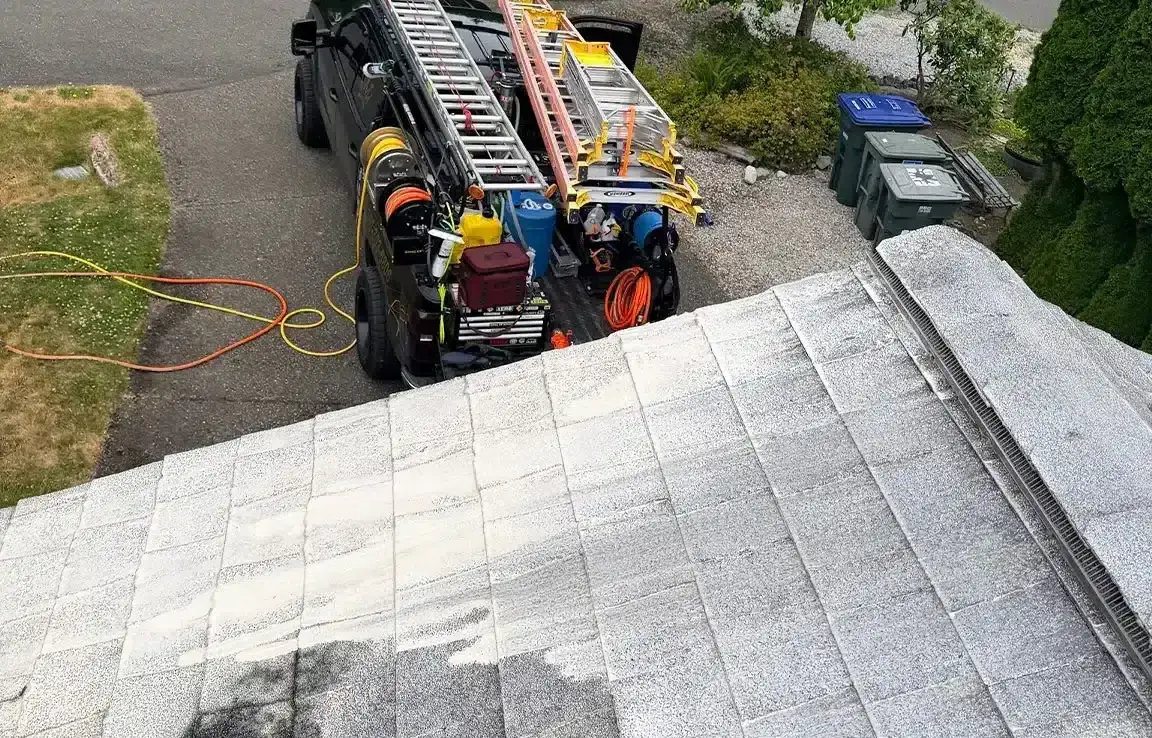
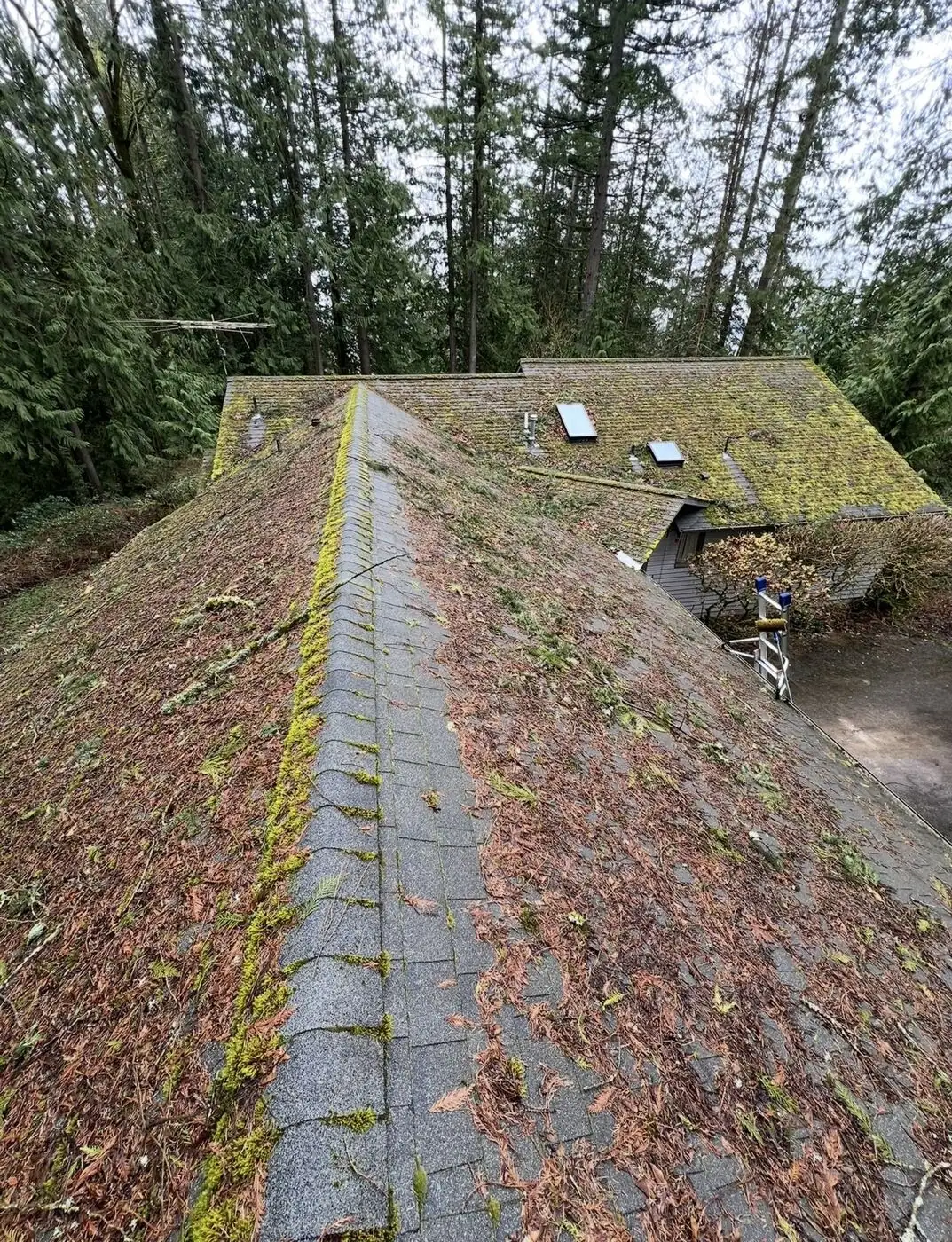 Before
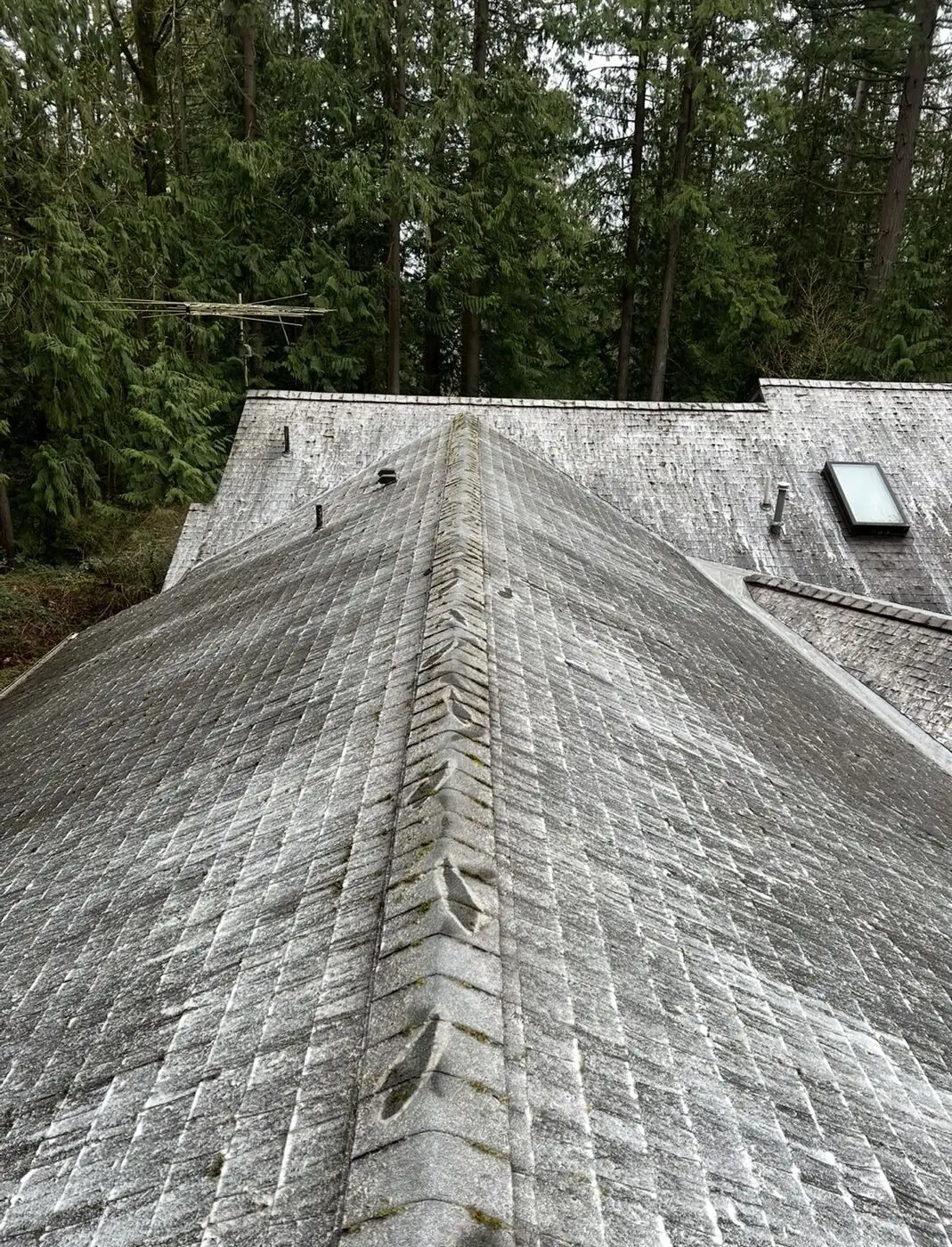 After
How old are Everson roofs, and why does it matter?
Older than people often assume. The median Everson home was built in 1987, and the town’s two biggest building decades were the 1970s and the 1980s, with 237 and 219 units respectively out of 1,074.
A house from those decades may be wearing its original roof, or a replacement fitted somewhere along the way. Either way, a lot of the roofing in town is past its first flush of youth. An older composition shingle has already shed some of its granules, the mineral layer on top that shields the asphalt from sun. It cannot afford to lose more to a heavy-handed clean.
That is the practical reason our method is gentle by design. On a roof that has some years behind it, the difference between a soft wash and a pressure wash is the difference between a cleaner roof and a shorter-lived one.
How do we clean a roof without damaging it?
With a soft wash: low pressure, a treatment suited to the roofing material, and time for it to work.
- Protect the ground first. We pre-wet planting under the eaves and move or cover anything sensitive.
- Clear loose debris from valleys and the roof edge by hand or soft brush.
- Apply the treatment at low pressure, roughly garden-hose force, working from the bottom up so it is not running onto dry sections.
- Let it dwell so it kills the moss, algae and lichen down to the roots.
- Rinse the planting and the walls beneath so nothing is left to dry on them.
Algae streaks usually brighten the same day. Moss dies and browns, then loosens and washes off with the rain over the following weeks, so the roof keeps looking better after we have gone. Anyone who removes every trace of thick moss on the day is scraping or blasting it, and both cost the roof life. For more on why we avoid pressure, see the main roof cleaning page.

Which roof types do we handle?
Composition asphalt shingle is the roofing we clean most often. Its specifics, including why granule loss is the thing to avoid, are on the composition asphalt shingle profile.
We also clean:
- Cedar shake and shingle roofs, which need an even gentler touch because the wood softens and splinters under force. The cedar shake roof profile explains the risks.
- Metal roofs, where the aim is lifting algae and grime without scratching the coating. Our metal roof soft washing page covers that work in detail.
- Outbuildings, garages and shop roofs, which often grow more moss than the house because they sit lower and in more shade.
If we are not sure what a roof is made of, we look closely before choosing a treatment. Getting that wrong is not an option.
What drives the cost of an Everson roof clean?
Every roof is quoted on site. The price depends on:
- Roof area and pitch, since steep roofs need more setup and care
- Height, with two-storey eaves taking longer than a single-storey ranch
- Roofing material, as cedar and older shingle take more time
- Amount and type of growth, with thick moss and lichen being the slowest
- Access around the house, including trees, fences and outbuildings
- Whether gutters are cleaned on the same visit, which is usually worth it
A roof that has been kept on a regular cycle is quicker, and cheaper, to clean than one with a decade of moss. The first treatment does the heavy lifting.

What time of year suits an Everson roof clean?
Spring through early autumn, in a spell of dry weather. The treatment needs a few dry hours to work, and it should not be washed off by rain before it has done its job.
Late spring is popular, because moss has done most of its growing over winter and the roof has time to clear before the wet season returns. Early autumn is the other good window, especially if you want to pair a roof clean with a gutter clean before November. We do not treat roofs in freezing conditions or when heavy rain is forecast within the day.
Where does the runoff go?
Down the gutters and downspouts, like any rain, and then into lawn and planting where possible. We manage the amount of treatment we use, rinse the plants and the ground beneath, and avoid sending anything toward a street drain.
We have not been able to verify Everson’s stormwater rules for this page, so we are not stating what they require. Rules do vary by jurisdiction across the county. Our wash water and storm drains page covers our general approach and the codes we have checked elsewhere. It is also worth knowing that Everson’s backup wells draw on a shallow sand-and-gravel aquifer, which is part of why we use only as much treatment as a roof needs.
What else should be done with a roof clean?
The gutters, most of the time. Once the treatment has killed the moss, the debris washes down into the channel over the following weeks. If the gutters are already partly full, that extra load is often what tips them into overflowing. Booking an Everson gutter clean for a few weeks after the roof, or at your usual autumn visit, keeps the system flowing.
We will also mention anything we notice that is outside our job: a lifted flashing, a cracked vent boot, missing shingles. We are not roofers and do not inspect roofs for structural problems, but we would rather tell you what we saw than keep quiet.
How can you keep a roof cleaner for longer?
A clean roof in a wet valley will eventually re-green; the aim is to push that day further out. A few habits make a real difference, and none of them cost much:
- Let the light in. Trimming branches that overhang the roof is the single biggest thing you can do, because shade is what keeps a slope wet.
- Keep the roof clear of debris. Needles and leaves piled in a valley or behind a chimney hold moisture and give moss a seedbed.
- Keep the gutters flowing, so water is not backing up under the bottom course of shingles.
- Look up after big storms, especially in November and December, for branches or debris that have landed and stayed.
- Do not wait for a thick mat. Light regrowth treated early comes off more easily and with less risk to the shingle than a roof left for many years.
What we would steer you away from is climbing up with a stiff broom or a garden pressure washer to deal with the first patches yourself. It is a fall risk, and scrubbing a wet composition roof loosens the granules that are protecting it. If you notice regrowth and are not sure whether it needs attention yet, send us a photo from the ground and we will give you an honest view on timing.
How do I book a roof clean in Everson?
Call (360) 303-6806 or ask for a quote online. We will look at the roof with you, identify what is growing and what the roofing is, and tell you honestly what a soft wash can and cannot do for it.
You can see the rest of what we do in town on the Everson page. The quote is the start of the conversation, not a commitment.
Roof cleaning questions from Everson homeowners
- Will you walk on my roof?
- Only where the pitch, surface and weather make it safe, and only as much as the job needs. Much of a soft wash can be applied from a ladder or the eave. Where we do step up, we keep weight on the strongest parts of the roof and avoid brittle ridge caps.
- Why is the moss still there after you leave?
- Because we killed it rather than tore it off. Dead moss browns, dries and loosens over the following weeks, and rain carries most of it away. Scraping it off on the day would take shingle granules with it, and granules are what protect the roof.
- Is the treatment safe for my garden?
- We treat the planting as part of the job. Beds and shrubs under the eaves are pre-wetted and rinsed again after, delicate plants can be covered, and we keep the mix on the roof rather than drifting it across the yard.
- Can you clean an old roof that is near the end of its life?
- Often, and it can buy some time and tidy the house up, but it will not make a worn roof new again. If shingles are curling, cracking or bare of granules, we will say so on the quote so you can talk to a roofer before spending money on cleaning.
- How often does an Everson roof need cleaning?
- Most roofs in the valley do well on a cycle of a few years, shorter under trees or on slopes that face north. We can tell you after the first clean how fast yours is likely to re-green, based on shade and how much growth came off.
- Do you clean the gutters at the same time?
- We recommend it. Treated moss that washes off in the following weeks ends up in the gutters, so a gutter clean after the roof has settled, or at the next autumn visit, keeps the downspouts from plugging.
- Are you a roofer or a roof inspector?
- Neither. We clean roofs, and we tell you plainly what we saw while we were up there. For a structural question or a leak, we will suggest you get a qualified roofing contractor to look at it.