
Composition Asphalt Shingle
What it is
Composition shingle covers the large majority of roofs in Whatcom and Skagit County. It is a fibreglass mat, saturated in asphalt, surfaced with ceramic-coated granules that carry the colour and block UV. Those granules are the service life, which is why every cleaning decision on this roof comes down to not removing them.
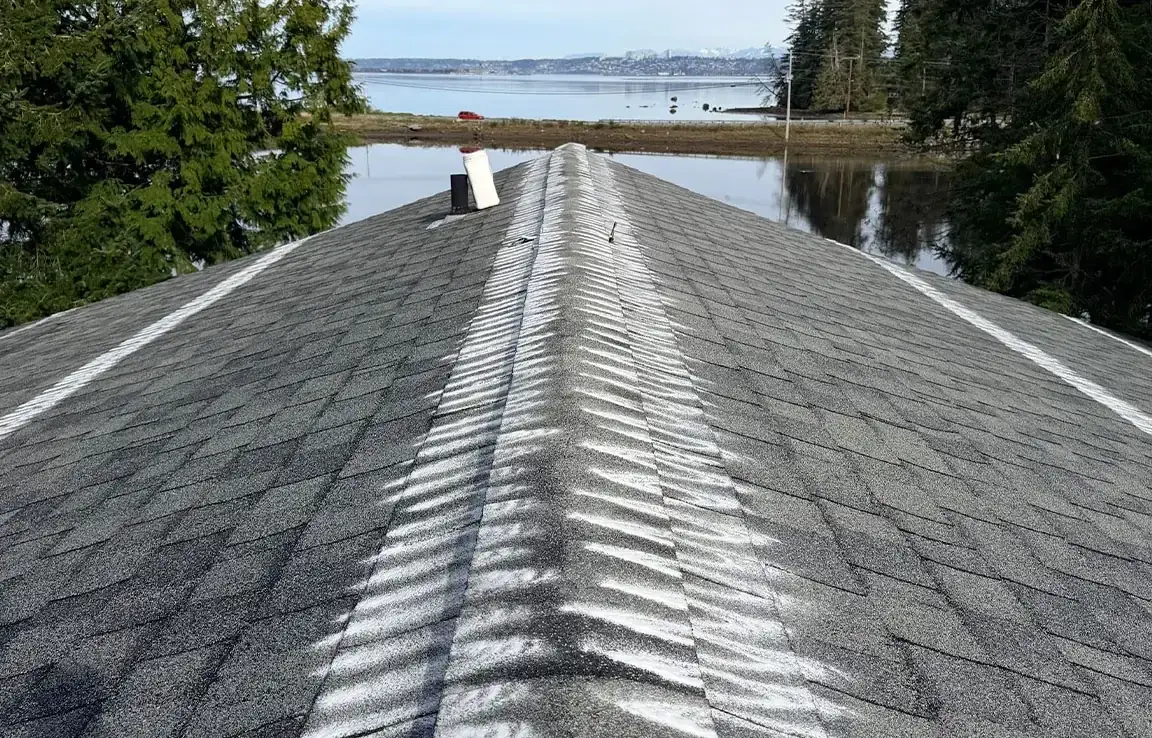
Composition shingle — asphalt shingle, comp roof, three-tab or architectural — is what most of this region is roofed in. It is inexpensive, it is fast to install, it handles a complicated roof shape without difficulty, and it has one vulnerability that determines every decision about cleaning it.
What a shingle is actually made of
Modern composition shingle is a layered product, and the layers are worth knowing because they explain everything that follows.
At the core is a fibreglass mat, which provides the tear strength and dimensional stability. That mat is saturated and coated in asphalt, which is the waterproofing. On top, pressed into the asphalt while it is hot, is a layer of ceramic-coated mineral granules.
The granules are not decoration. They block UV from reaching the asphalt, they provide fire resistance, and they carry the colour — the material underneath is black whatever the roof looks like from the street. When asphalt is exposed to sunlight it dries, loses its volatiles, becomes brittle and cracks. The granule layer is the only thing standing between the binder and that process.
So the shingle’s service life is, functionally, the life of its granule coverage. Everything below follows from that one sentence.
Three-tab shingles are a single flat layer with cutouts that make three tabs per strip — the older, thinner, cheaper product, common on housing stock here from the 1980s and 1990s. Architectural or dimensional shingles are laminated from two or more layers, which makes them heavier, thicker, longer-lived and visually textured. Most re-roofs here are architectural now.
How the roof keeps water out
Nothing on a composition roof is sealed. The waterproofing is geometry.
Each course overlaps the one below, so water arriving from above runs down the surface and off the eave without reaching a joint. Adhesive strips bond each course to the next once the sun has warmed them, which is what stops wind lifting tabs — but the adhesive is a wind detail, not a water detail.
This matters for two reasons. Anything that lifts a course breaks the geometry and lets wind-driven rain past it. And anything that pushes water upward — a pressure washer, a hose held wrong, a brush worked uphill — is sending water in the one direction the entire system was designed not to handle.
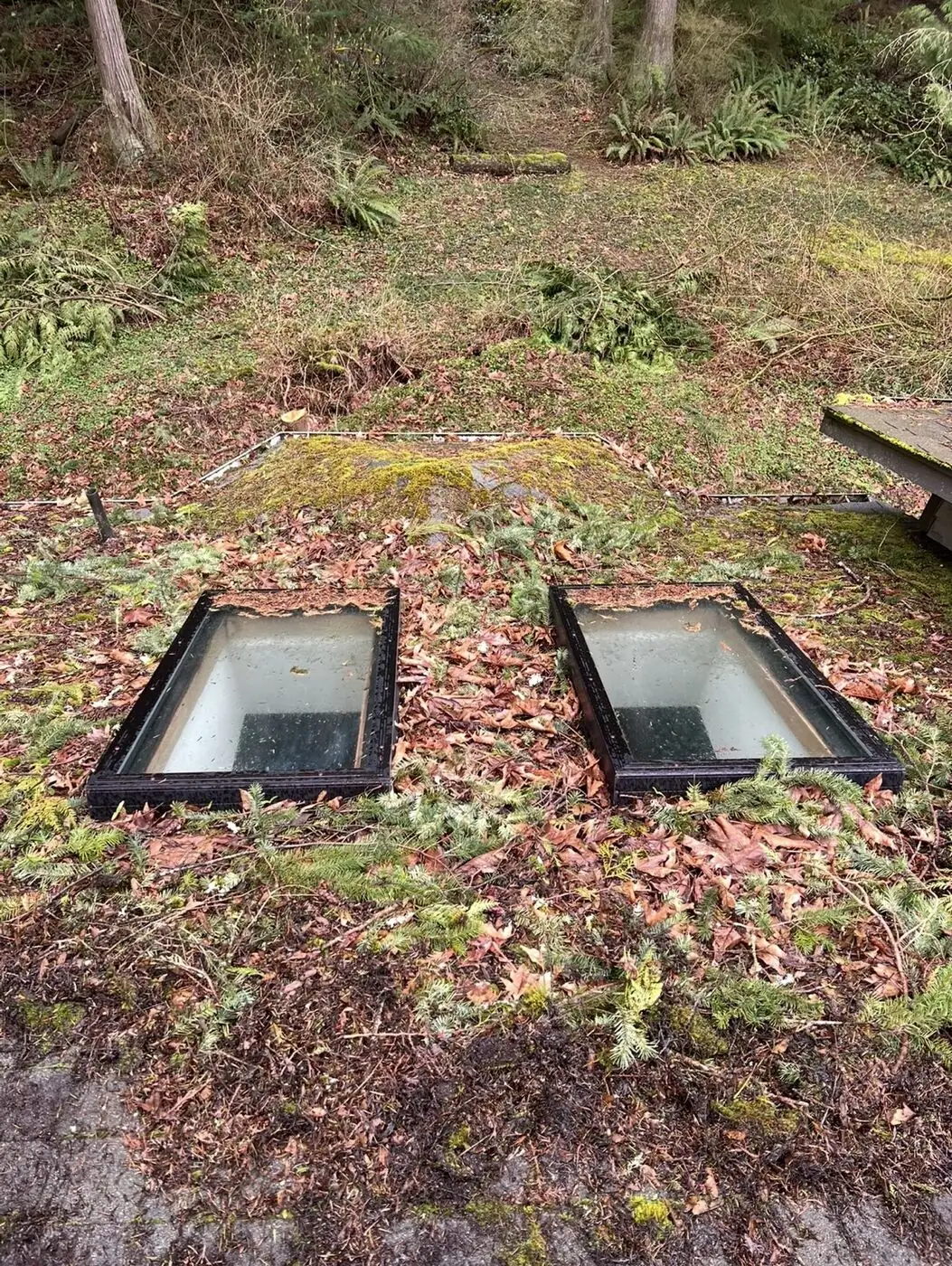 Before
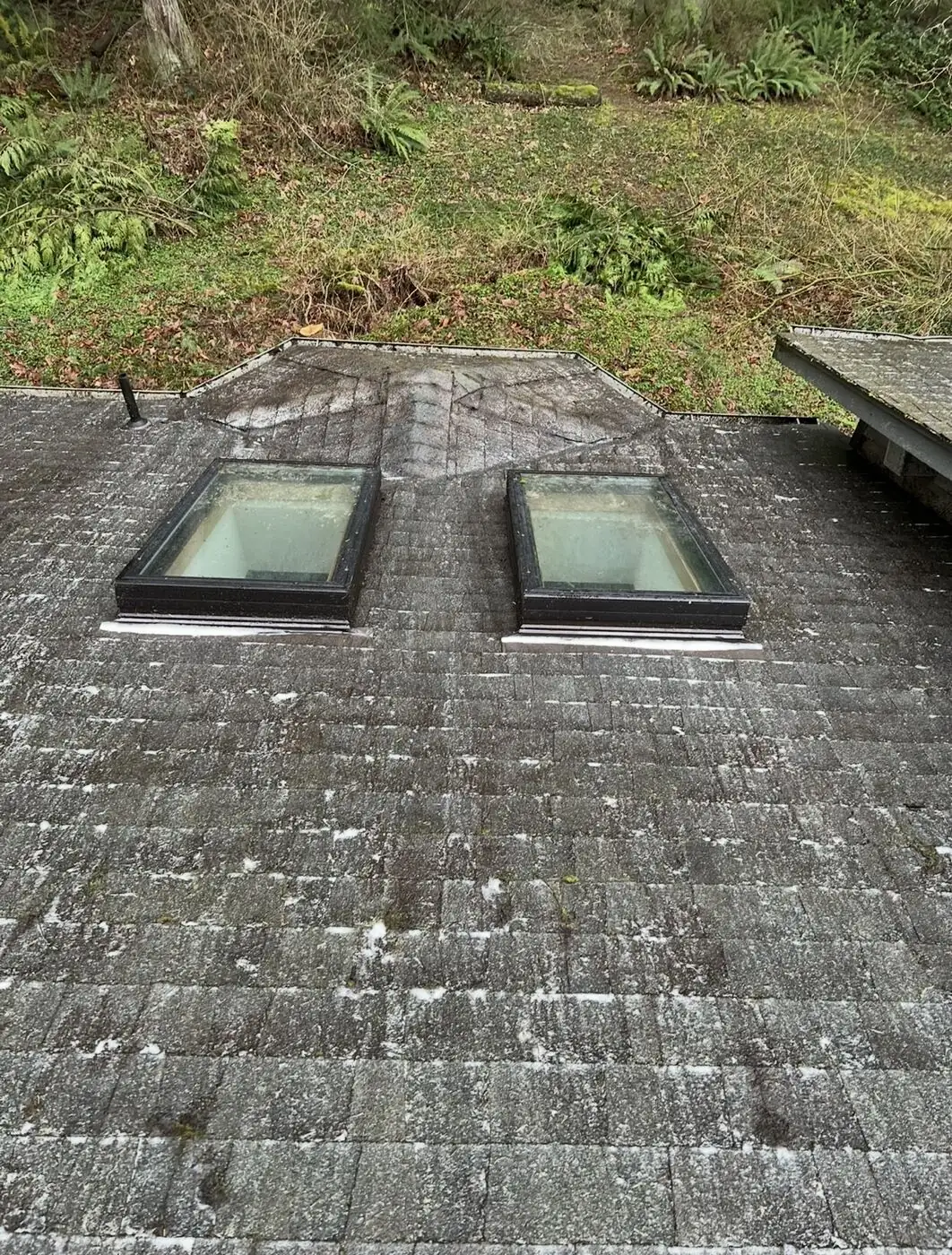 After
What grows on it here
Algae, most often Gloeocapsa magma, is the dark vertical streaking almost every older comp roof in this region carries on its shaded slopes. It is a cyanobacterium, not dirt and not mould; part of what sustains it is limestone filler within the shingle itself, and it spreads downward with the water, which is why the streaks start high and run to the eave. It is a surface organism and it responds to chemistry.
Moss is the more serious one, because it does not stay on the surface. It establishes at the lower edge of a course where debris collects, grows into the lap and lifts the shingle above it. That lifting is the damage.
Lichen bonds tightly to the granule surface and is the most stubborn of the three, because removing it aggressively removes granules with it.
Organic debris — conifer needles above all — is upstream of all of this. It holds moisture against the surface, collects in valleys and at flashings, and gives moss the damp organic bed it needs to start.
Why north slopes fail first
The same rule that governs walls governs roofs, and on a roof it is starker because the two planes are identical in every other respect.
At this latitude a north-facing slope receives effectively no direct sun for months. Through a wet season running October into May it does not dry between rains. The south slope on the same house, laid the same day from the same bundles, is frequently clear.
Add shade from conifers and the effect compounds — less light, more debris, and needles that mat and hold water. A roof under mature Douglas fir on a north aspect is working in the hardest conditions this region offers.
What cleaning can and cannot do
Comes off: algae streaking, moss, lichen to a large degree, needle and leaf debris, and general atmospheric film.
Improves: the colour reads truer once the darkening film is gone, and a roof often looks years newer than it did.
Does not change: granule loss, bare patches, curling or cupping tabs, cracked or brittle shingles, failed flashings, or a roof at the end of its life. None of those are dirt, and a clean will make them more visible rather than less — which is uncomfortable but useful, because it is a truer picture of the roof.
The method is chemistry and patience: the growth is killed, it dies, dries, loosens and weathers off over the following weeks. The roof does not finish looking clean on the day. That slow release is the point — it is what lets the material leave without anything mechanical crossing the granule surface.
When a roof should not be cleaned
There are roofs we decline, and it is worth knowing what they look like, because the alternative is paying for a clean that shortens the roof.
Visible bare patches. Where the granule layer is already gone in areas, the asphalt underneath is exposed and brittle. Treating it will not restore anything and walking it will make the bare areas larger.
Curling, cupping or clawing tabs. Edges lifting away from the plane mean the mat has shrunk and the shingle has lost flexibility. Those edges break underfoot and they break under water pressure.
Widespread cracking. Fine map-cracking across the surface is the binder telling you it has lost its volatiles. That roof is near the end, and the useful spend is a roofer’s opinion rather than a wash.
A roof somebody has already pressure washed. It is usually identifiable — an unnaturally uniform light patch, or fan-shaped striping where a wand was swung. There is nothing left to clean off; what remains is the mat.
In each case the honest recommendation is to clear the debris, keep the gutters running and spend the money on getting a roofer up there instead.
The part of the roof nobody sees
One thing that materially shortens a shingle roof here has nothing to do with what is growing on top of it.
A composition shingle sheds heat upward and downward. If the attic below is poorly ventilated, heat builds under the deck and cooks the shingle from underneath, ageing the binder from the side nobody inspects. Blocked soffit vents — often blocked by insulation pushed into them — and an inadequate ridge vent are common, and the symptom on the roof surface is premature brittleness across a whole plane rather than in the wet, shaded places you would expect.
It is outside what a cleaning visit addresses, and it is worth mentioning when a roof looks older than its age, because cleaning a roof that is failing from below solves the wrong problem.
At a glance
| Property | Composition asphalt shingle |
|---|---|
| Construction | Fibreglass mat, asphalt saturant and coating, ceramic-coated granules |
| What the granules do | Block UV, provide fire resistance, carry the colour |
| Three-tab vs architectural | Single flat layer with cutouts, vs two or more laminated layers |
| How it sheds water | Overlap geometry — nothing is sealed |
| Main failure modes | Granule loss, curling and cupping, map-cracking, lifted courses |
| Cleaning method | Chemistry and patience; pressure is never appropriate |
| What will not come off | Granule loss, bare patches, curling, cracking, failed flashings |
Signs worth acting on:
- Dark vertical streaking on the shaded slope — algae, treatable
- Raised green growth at course edges — moss, and it is lifting the shingle
- Coarse grit accumulating in the gutter year after year on a roof that is not new
- Tab edges lifting away from the plane
- One slope visibly worse than the other on the same house — aspect, not neglect
The two cheap things that extend it
Keep the debris off. Needles in valleys and at flashings are where the damp starts and where moss establishes. Clearing them is a blower-and-hands job, not a cleaning job, and it is the highest-return maintenance on a shingle roof in this climate.
Keep the gutters clear, especially after any roof treatment — everything killed up there comes down over the following two months, and a treatment followed by no gutter clearing produces a blocked system going into winter.
Method, chemistry and access is on the roof cleaning page. If the growth is raised and green rather than flat and dark, the relevant page is moss growing under shingles.
Questions about this surface
- What are the granules actually for?
- Three jobs. They block UV, which is what otherwise degrades the asphalt binder; they provide fire resistance; and they carry the colour, because the mat underneath is black regardless of what the roof looks like. Losing them is not cosmetic — it exposes the binder to the thing that ages it fastest.
- How do I know if I am losing granules?
- Look in the gutter. A handful of granules in a gutter after a new roof settles in is normal. A steady accumulation of coarse grit, year after year, from a roof that is not new, is the roof telling you where its surface is going. Bare dark patches visible from the ground are the late-stage version of the same thing.
- What are the dark streaks running down the slope?
- Algae — most often Gloeocapsa magma — not dirt and not mould. It feeds partly on limestone filler in the shingle and it spreads downward with the water, which is why the streaks run vertically and start under the ridge. It is a surface organism and it comes off with the right chemistry.
- Is the streaking damaging the roof?
- Less than moss is, and it is not nothing. Algae darkens the surface and holds moisture, and a permanently damp shingle ages faster than a dry one. The structural damage on a shingle roof comes from moss lifting courses; algae is mostly an appearance and longevity question.
- Why is it always the north slope?
- Because it does not dry. At this latitude a north-facing plane gets effectively no direct sun for months, so it stays damp after every rain through a wet season that runs October into May. The south slope on the same house is often completely clear, on identical shingles, laid the same day.
- Can a composition roof be pressure washed?
- No. It is the one roof type where the answer has no qualifications. Pressure strips granules and drives water up under courses in the direction the overlap was built not to handle. It looks excellent for a season and takes years off the roof, and nothing about that is reversible.
- How long should one last here?
- The wet, shaded half of this climate is harder on a shingle roof than the manufacturer's rating assumes, and shaded north slopes routinely fail before sunny south ones on the same building. What extends it is keeping organic growth off and keeping the gutters and valleys clear, neither of which is glamorous and both of which are cheap relative to a re-roof.
Last updated