Standing Seam Metal Roof
What it is
A standing seam roof joins its panels with raised vertical seams and hides its fasteners underneath, which is why it outlasts every other residential roof type. For cleaning, that geometry is the whole story: the panel face is nearly self-clearing, and everything that needs attention collects in the seams, the flashings and the transitions.
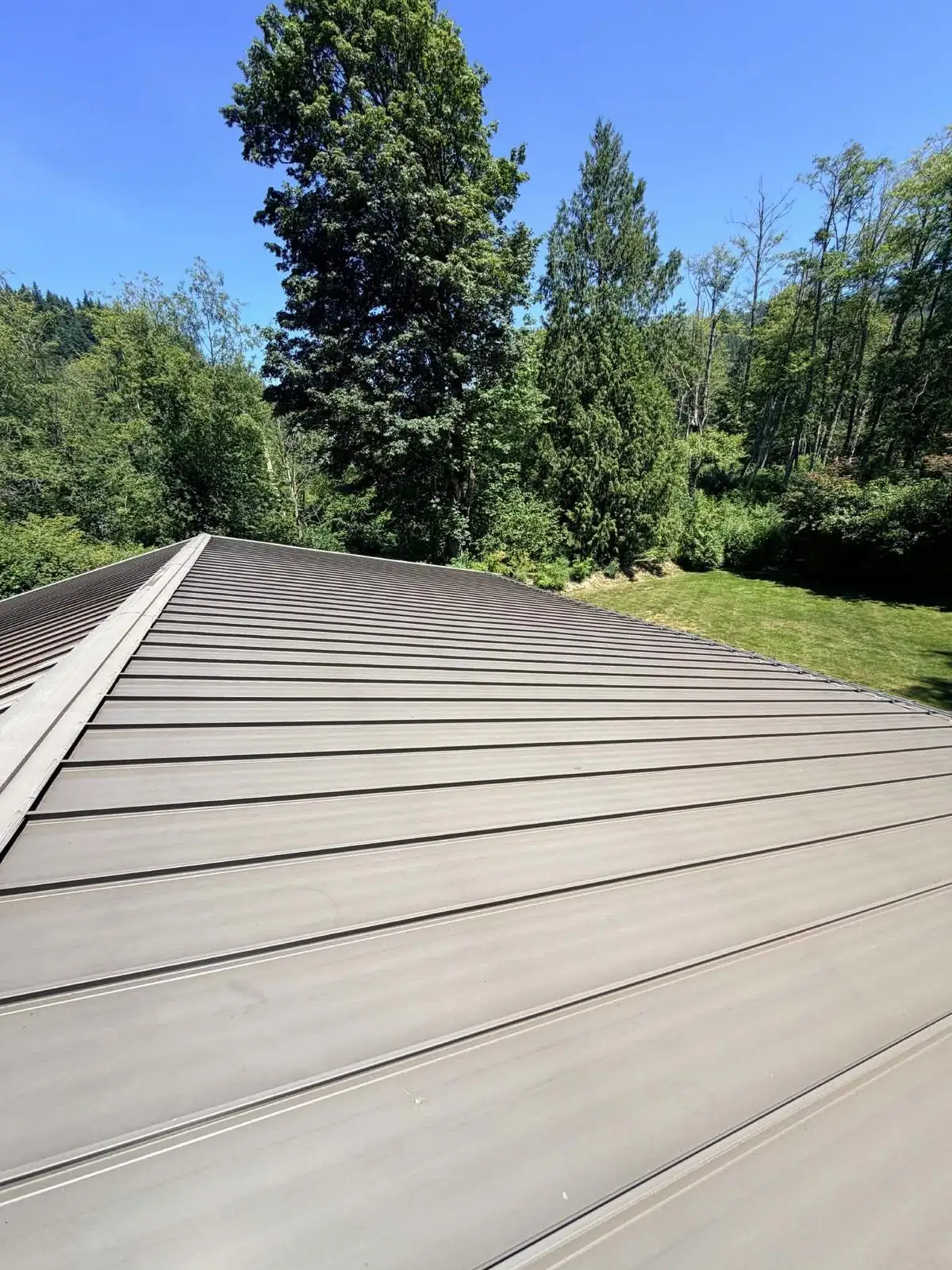
Standing seam is the premium residential metal system and the one most likely to be misunderstood by whoever is quoting to clean it. It is quiet, long-lived and almost maintenance-free across the panel face — which leads people to assume it needs nothing, right up until the details prove otherwise.
How the system works
Panels run vertically from ridge to eave. Adjacent panels are joined by a raised seam standing proud of the panel face, either mechanically folded on site or snapped together, depending on the system.
The fasteners live underneath. Clips attach the panel to the deck and the seam closes over them, so no screw penetrates the weather surface anywhere on the field of the roof. That single decision is why the system lasts: on an exposed-fastener roof, several hundred rubber washers are the service life, and here there are none in the weather.
The panels are also free to move. Metal expands and contracts substantially across a temperature range, and a standing seam system is detailed to let it, which is why the panel face stays flat-ish and the seams do not tear.
For cleaning purposes, the consequence of all this is simple and it shapes every decision: the panel face is nearly self-clearing, and everything that matters happens at the seams, the flashings and the transitions.
What collects where
Seam bases. The junction where a raised seam meets the panel face is a continuous, shallow, upward-facing ledge running the length of the roof. Needles, fine organic debris and grit pack into it and stay. This is where moss on a metal roof actually lives — not on the metal, but in the organic matter lodged beside it.
Flashings and penetrations. Ridge, hip, valley, chimney, skylight and vent flashings are where debris concentrates and where water is being managed rather than simply shed. They are also where a small amount of trapped organic material holds moisture against a detail for months at a time.
Low-slope transitions. Where the pitch flattens — over a porch, a dormer return, a bay — panels shed far less readily, and everything that would run off a steeper section stops there.
The north elevation. Same rule as every other surface here: the side that does not dry between rains carries the film.
Anywhere near salt water. Salt deposit is not a visual problem in the short term and it is a corrosion problem in the long one, particularly at cut edges, fixings and any point where two different metals meet.
 Before
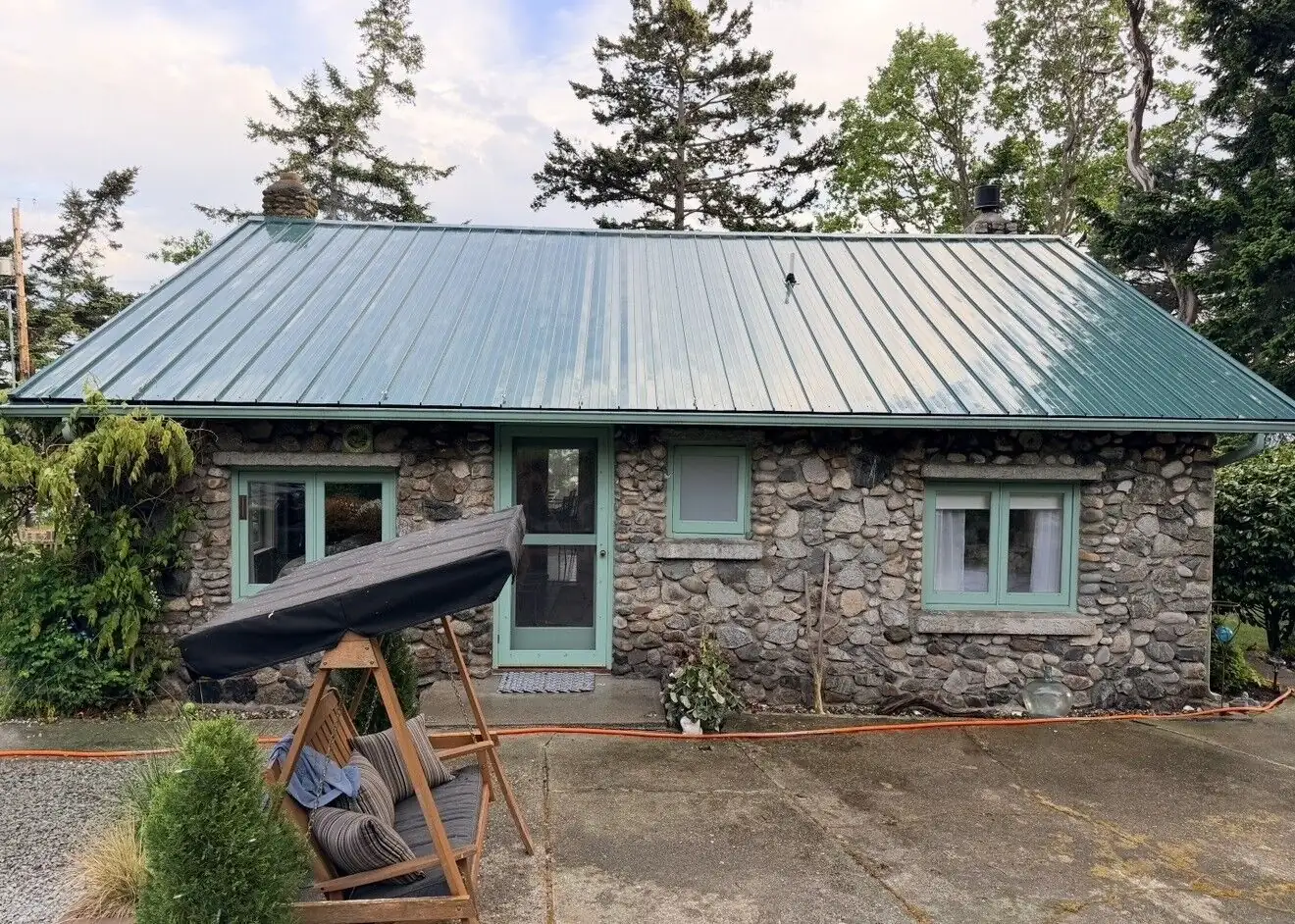 After
The rest of the metal family, for comparison
Knowing which roof you have changes the quote and the method, and most people are not sure which they have.
Exposed-fastener corrugated and ribbed — the classic agricultural profile, also common on outbuildings, shops and budget-conscious residential builds. Screws pass through the panel face into the structure, each with a sealing washer. Cheaper to install, shorter service life, and the washers are the maintenance item: they harden, crack and shrink with UV and thermal cycling over fifteen to twenty years. Cleaning these roofs means working around several hundred small ledges, and it is the roof type where a look at the fasteners has the most value.
Metal shingle and tile profiles, stamped to imitate slate, shake or tile. Used on higher-end residential work. More surface detail means more places for debris to sit and a slower clean.
Stone-coated steel is its own case and worth flagging: a steel panel with a granular stone chip surface bonded to it. It looks like tile and behaves, for cleaning purposes, more like asphalt shingle than like metal — the granules can be dislodged by pressure just as shingle granules can. Anyone treating a stone-coated roof as ordinary metal is likely to damage it.
Aluminium panels, common near salt water for obvious reasons. Softer than steel, dents more easily, does not rust but does corrode galvanically against dissimilar metals.
Copper and zinc, on a small number of higher-end and heritage properties. These patina by design, and the patina is the finish. Aggressive cleaning takes it off unevenly and the result is worse than what you started with. Cleaned very conservatively, and we will say plainly what we are not going to attempt.
What cleaning will and will not change
Comes off: organic growth in seams and around fasteners, moss and lichen, needle and leaf debris, streaking, general atmospheric film, salt deposit, pollen, and most tannin staining.
Improves: a chalked surface loses its loose powder and looks considerably better, and the colour reads truer.
Does not change: fading, chalking already in the coating, scratches, dents, oil-canning, existing rust, or a coating that has failed. None of those are dirt.
The honest framing is that cleaning a metal roof is preservation as much as appearance. Removing organic material and salt from the details is what stops small problems becoming corrosion, and it is why a roof cleaned on a sensible cycle reaches the service life the manufacturer had in mind.
Metal on agricultural and outbuildings
A large share of the metal roofing in Whatcom and Skagit County is not on houses. Barns, machine sheds, riding arenas, shops and pole buildings across the valleys are overwhelmingly exposed-fastener corrugated or ribbed steel, often on large, simple, shallow-pitched planes.
Those roofs are simpler to clean and have their own concerns. Fastener count is high, so washer condition matters more. Spans are long, so foot traffic is more constrained. Agricultural exposure — dust, ammonia in livestock buildings, fertiliser and chemical drift — is harder on coatings than residential exposure. And the roofs are frequently large enough that condition monitoring has real value, because a small fastener problem found early on a barn roof is a very different number from the same problem found late.
The coating is the roof
It is worth saying plainly, because it governs every cleaning decision that follows: on a metal roof, the steel or aluminium underneath is not what wears out. The coating is. Everything else — the seam design, the concealed clips, the thermal movement detailing — exists to keep water and fasteners away from a thin cured film that is doing the actual work.
Two families dominate residential work here.
PVDF finishes (sold under names like Kynar 500 and Hylar 5000) are the premium option. They hold colour and resist chalking markedly better over decades, which is why they carry the longer finish warranties and why they are specified on standing seam more often than on budget panel.
SMP finishes — silicone-modified polyester — are the common choice on exposed-fastener agricultural and outbuilding panel. Tougher against abrasion, cheaper, and noticeably more prone to fading and chalking in UV.
You usually cannot tell them apart by eye on a new roof, and you can tell them apart very easily on a twenty-year-old one. The practical consequence for cleaning is that chemistry is chosen conservatively unless the finish is known, and anything aggressive enough to strip a tired SMP finish has no business on a roof at all.
At a glance
| Property | Standing seam metal roof |
|---|---|
| How panels join | Raised vertical seams, mechanically folded or snapped |
| Where the fasteners are | Concealed clips under the seam — none in the weather |
| Why it lasts | No rubber washers exposed; panels free to move with temperature |
| Coating families | PVDF (premium, holds colour) and SMP (tougher, chalks sooner) |
| Where debris collects | Seam bases, flashings, penetrations, low-slope transitions |
| Cleaning method | Chemistry at low pressure; foot traffic minimised |
| What will not come off | Fading, chalking in the film, scratches, dents, oil-canning, rust |
What to check before booking:
- What overhangs the roof — conifers make this a debris job on a cycle
- Visible green at seams or flashings, which is a debris report, not a metal one
- Whether the surface rubs off chalky on your hand at an accessible edge
- Whether you can see screw heads across the panel face — that is a different profile
- Any distorted seam, which affects how the roof sheds and is a repair
What to look at before booking
Three things tell you most of what a quote needs to know, and you can check two of them from the ground.
What is overhanging it. Conifers above a metal roof mean the job is debris clearing on a cycle, not washing on a whim.
Whether there is visible green at the seams or flashings. Green on a metal roof is a debris report, not a metal report.
Whether the surface rubs off on your hand at an accessible edge. That is chalking, and it sets expectations about what the finish will look like afterwards.
Method, access and scheduling is on the metal roof soft washing page. If what you have is exposed-fastener panel on an outbuilding rather than standing seam on a house, the same page covers it — the method is the same and the fastener inspection is the part that earns its keep.
Questions about this surface
- Can a standing seam roof be pressure washed?
- It can be, and it should not be. The panel will survive the water; the coating may not. A factory finish is a thin cured film, and pressure at the seam edges and around flashings drives water into places detailed for gravity rather than force. The roof is cleaned with chemistry and low pressure, which is slower and does not trade service life for speed.
- Why does moss grow on a metal roof at all?
- Not on the panel — on what collects beside it. Needles and organic debris pack into the seam bases, the flashing junctions and the low-slope transitions, and once there is organic matter holding moisture, moss establishes in that rather than on the metal. Clear the debris and the moss has nowhere to live.
- How do I tell standing seam from a snap-together panel?
- Look at the seam and the eave. A mechanically seamed roof has a folded, often double-folded seam; a snap-lock panel has a cleaner rolled profile. Either way, if you cannot see screw heads across the panel face, it is a concealed-fastener system and it is in this family. Visible screws in rows means exposed-fastener corrugated or ribbed, which is a different profile and a different maintenance item.
- Will cleaning fix the chalky look?
- It improves it, and it does not reverse it. Chalking is the coating's binder degrading under UV and releasing pigment as loose powder. Washing removes the loose layer, so the colour reads truer immediately afterwards. The chalking already in the film stays, because it is the finish rather than something on it.
- What about oil-canning — the waviness across the panels?
- That is inherent to flat metal in wide panels and it is not damage and not dirt. It comes from the material, the substrate flatness and thermal movement, and it changes with the light and the viewing angle. Nothing in a cleaning process affects it in either direction.
- Is it safe to walk on?
- Less than people assume. The seams are the structural and weatherproofing detail, and a distorted seam changes how the roof sheds water — that is a repair, not a blemish. Work is planned to minimise foot traffic, weight goes where the manufacturer says it can, and on a steep or slick roof the honest answer is sometimes that access needs equipment rather than boots.
- How often does one need cleaning here?
- Driven by what overhangs it rather than by the metal. A roof clear of trees near the water may want attention every few years for salt and film. A roof under conifers is a debris-clearing job on a much shorter cycle, because it is the debris in the seams, not the metal, that starts the problems.
Last updated