Whatcom & Skagit County
Metal Roof Soft Washing in Whatcom & Skagit County
The short answer
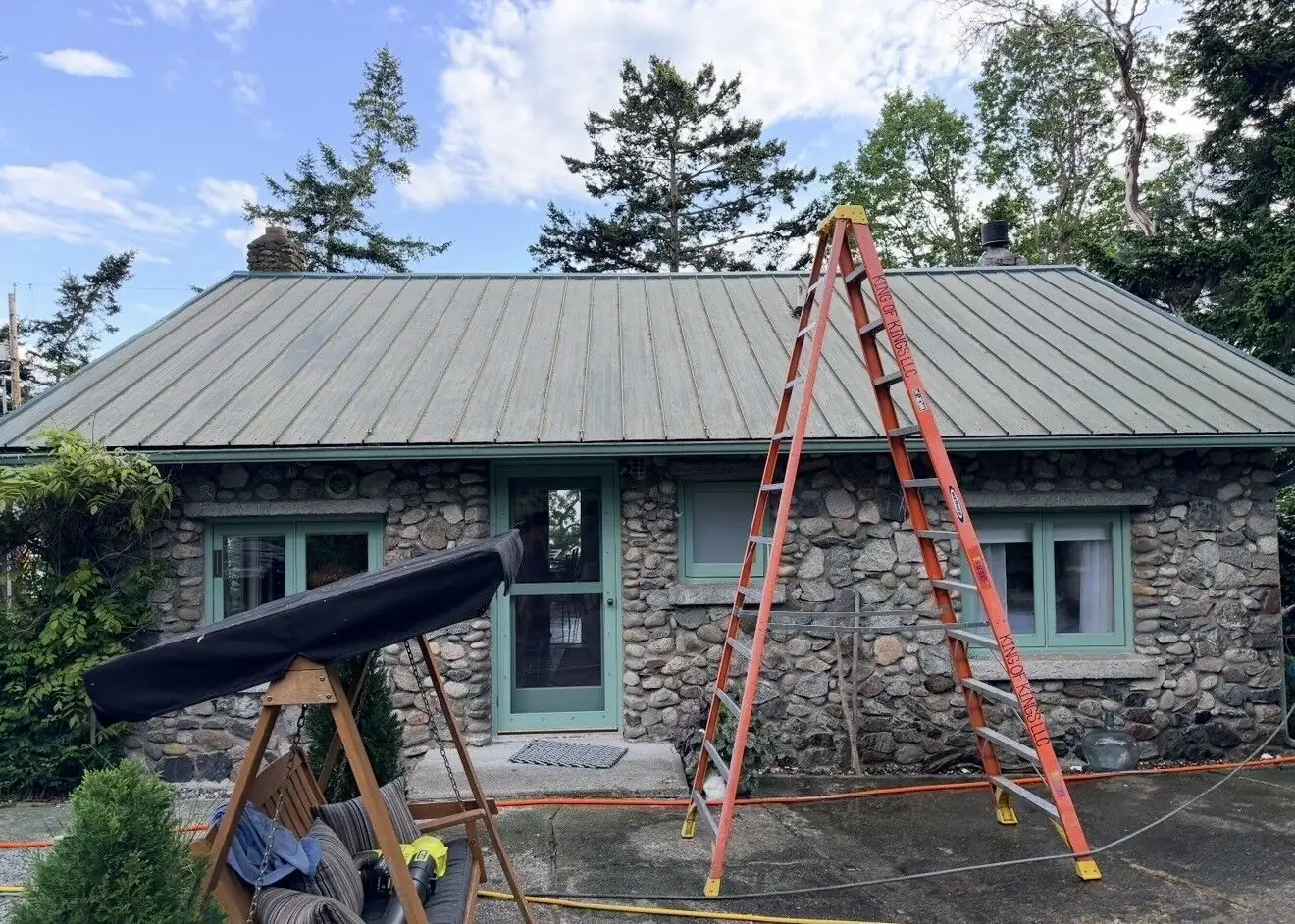
King of Kings soft washes metal roofs across Whatcom and Skagit County — standing seam, corrugated and painted panels. The factory coating is what makes a metal roof last thirty years, so the method is chosen to protect it: low pressure, mild chemistry, no abrasives, no pressure washer.

Randy Fee — Owner, King of Kings Window Cleaning
Washington business licence, UBI 605476674 · L&I insured · BBB rated A
Randy runs the company himself, so you are dealing with the owner, not a call centre — and every technician here is personally trained by him. Working Whatcom and Skagit County since 2024.
Metal roofing has taken a large share of new construction in Whatcom and Skagit County, and it turns up on everything from architect-designed homes on the water to barns, shops and outbuildings across the valleys. It is chosen for longevity, and it delivers on that — a properly installed metal roof can outlast two or three asphalt roofs.
That longevity depends almost entirely on one thing: the factory coating. Which means the entire question of how to clean a metal roof reduces to how to remove what is on it without harming what is under it.
The coating is the roof
A metal roof panel is not really a metal roof. It is a thin steel or aluminium substrate carrying a multi-layer factory finish, and that finish is doing all the work that matters.
On steel panels there is usually a metallic coating first — galvanised zinc, or a zinc-aluminium alloy — bonded to the steel to stop it corroding. Over that goes a primer, and then the visible paint system. On premium roofs that top layer is typically a Kynar-type fluoropolymer, which is what carries the long colour and chalk warranties; on more economical panels it is a polyester system, which performs well but weathers faster.
Every one of those layers is applied under factory conditions and cannot be recreated on a roof. The steel underneath is entirely ordinary steel: expose it and it does what ordinary steel does in a climate with this much rain.
So the working rule for cleaning is simple. Anything that dulls, scratches, strips or chemically etches that finish has taken life off the roof, regardless of how clean the panel looks afterwards.
This is also why aggressive cleaning of metal is more tempting and more damaging than aggressive cleaning of shingle. Metal feels robust underfoot and under a jet. It does not flake or shed granules to warn you. The damage is to a coating measured in fractions of a millimetre, and it shows up years later as chalking, fading and edge corrosion.
What actually grows and collects on metal
The panel faces stay comparatively clean, and that is genuine — a smooth, coated, well-pitched metal surface sheds water fast and gives moss very little to hold onto. The work is at the details.
The seams. On standing seam roofs the raised ribs create channels that trap needles, leaves and grit. Organic material sits in them, holds moisture, and moss and lichen establish along the seam line. This is the classic metal roof appearance problem: clean panels with green or black lines between them.
The fasteners. On exposed-fastener corrugated and ribbed roofs — very common on agricultural and outbuilding roofs here — every screw head is a small ledge with a rubber washer under it. Debris collects at each one, and each one is a place where growth establishes and where water can eventually get in as the washer ages.
The flashings and transitions. Valleys, ridges, hips, sidewall and headwall flashings, chimney and vent penetrations, and anywhere a roof plane changes angle. These collect everything that moves down the roof, and they are where a metal roof is most likely to have a real problem hiding under the debris.
Low-slope sections. Porch roofs, dormer tops, and shallow additions where water does not run off briskly. Debris sits, and so does moisture.
Streaking. Dark lines running down from seams, fasteners and edges. A mix of organic residue and oxidised material carried in runoff, bonded to the coating. Plain water does nothing to it.
Tree sap and needle staining, on roofs under conifers — tannin marking that sets into a tea-coloured stain.
Salt film, at the marine edge in Blaine, Birch Bay, Semiahmoo, Anacortes and on the islands. Metal roofs near salt water need more attention than metal roofs inland, and cut edges and fasteners are the vulnerable points.
Chalking. Not growth. The gradual UV breakdown of the paint system’s surface into a fine powder. It rubs off on a hand and it is the coating aging. Washing removes the loose chalk and improves appearance; it does not restore the finish, and a heavily chalked roof is telling you something about where it is in its life.
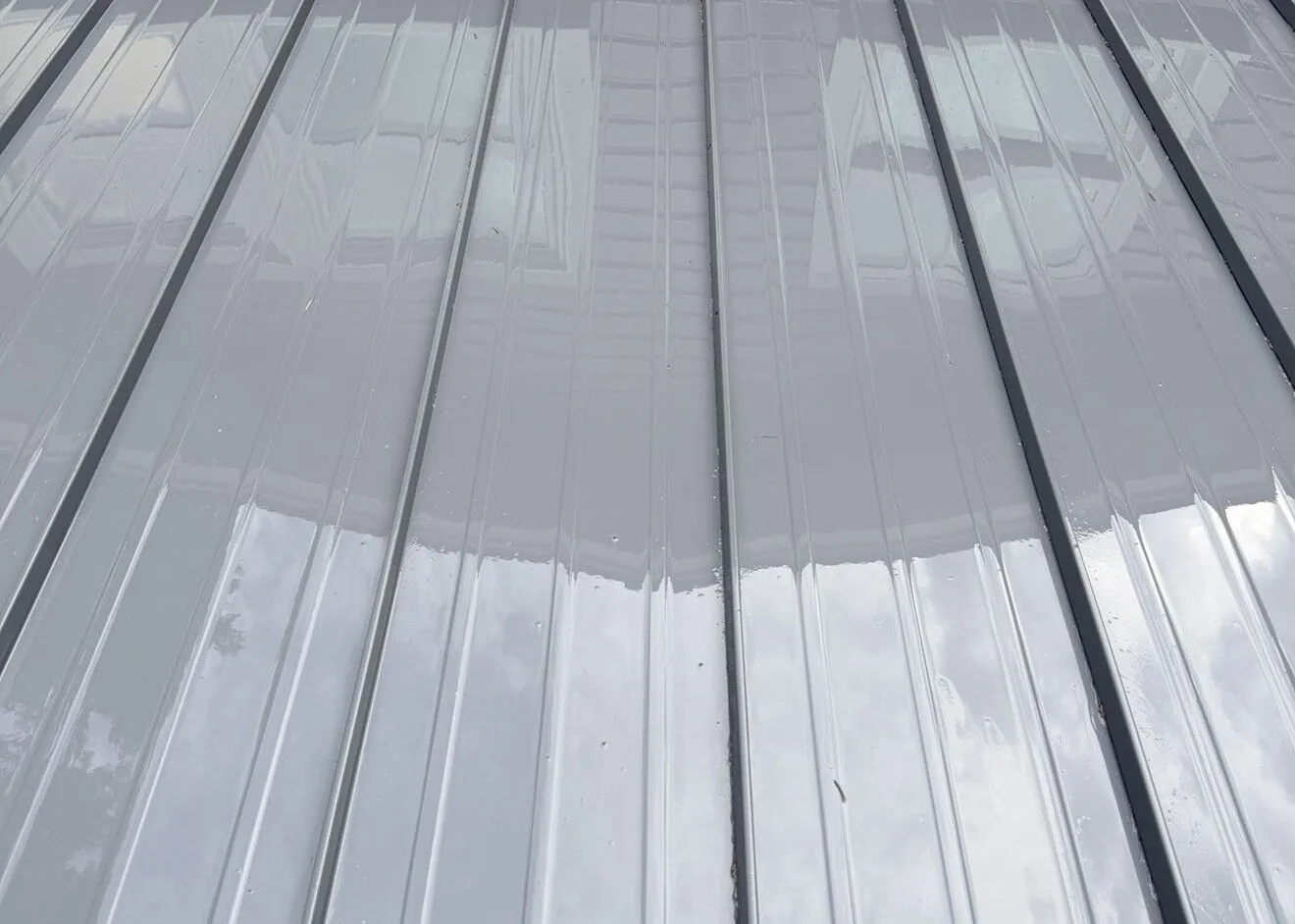
 Before
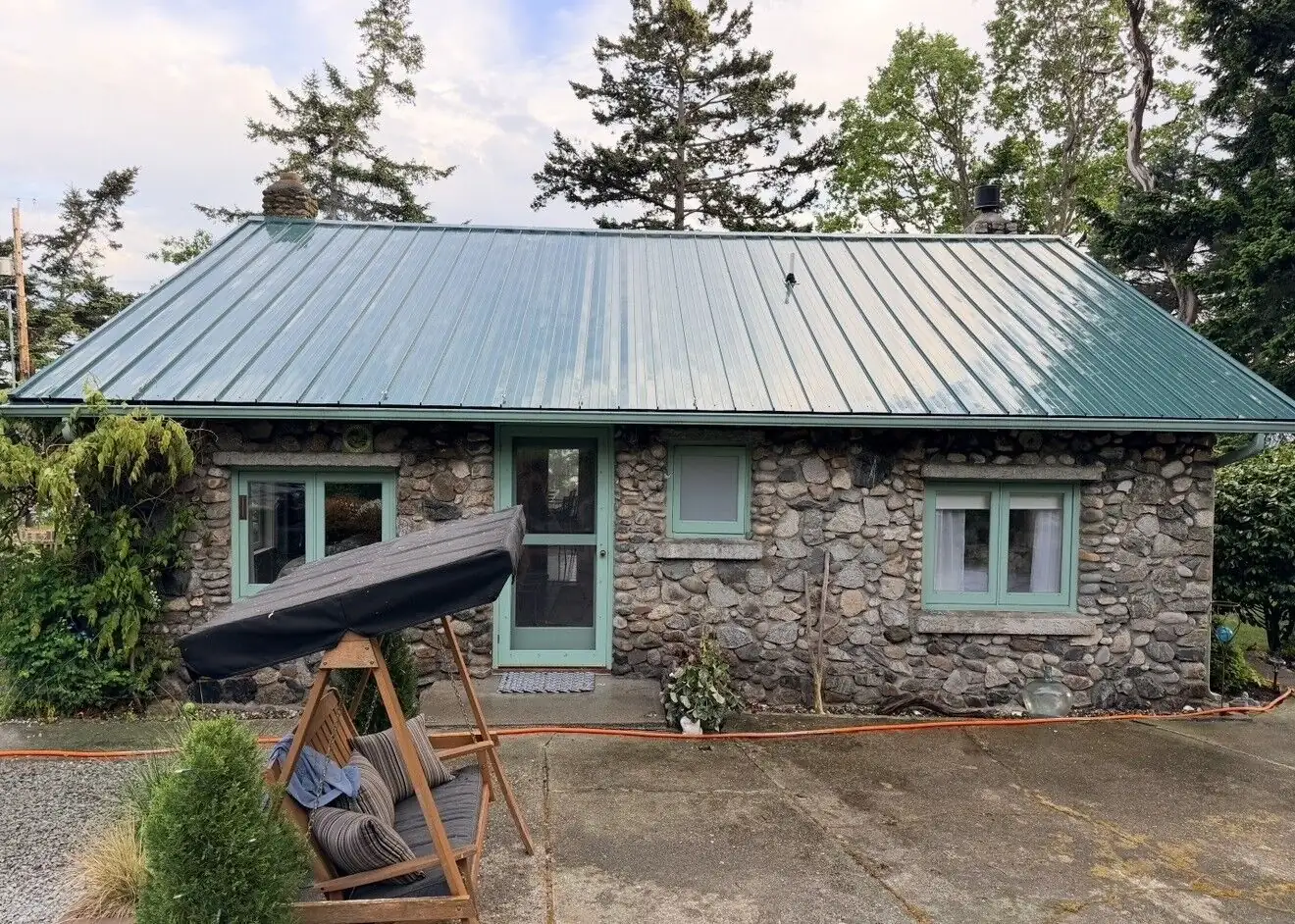 After
The method
Soft washing, and on metal the emphasis falls even harder on the “soft” than it does on shingle.
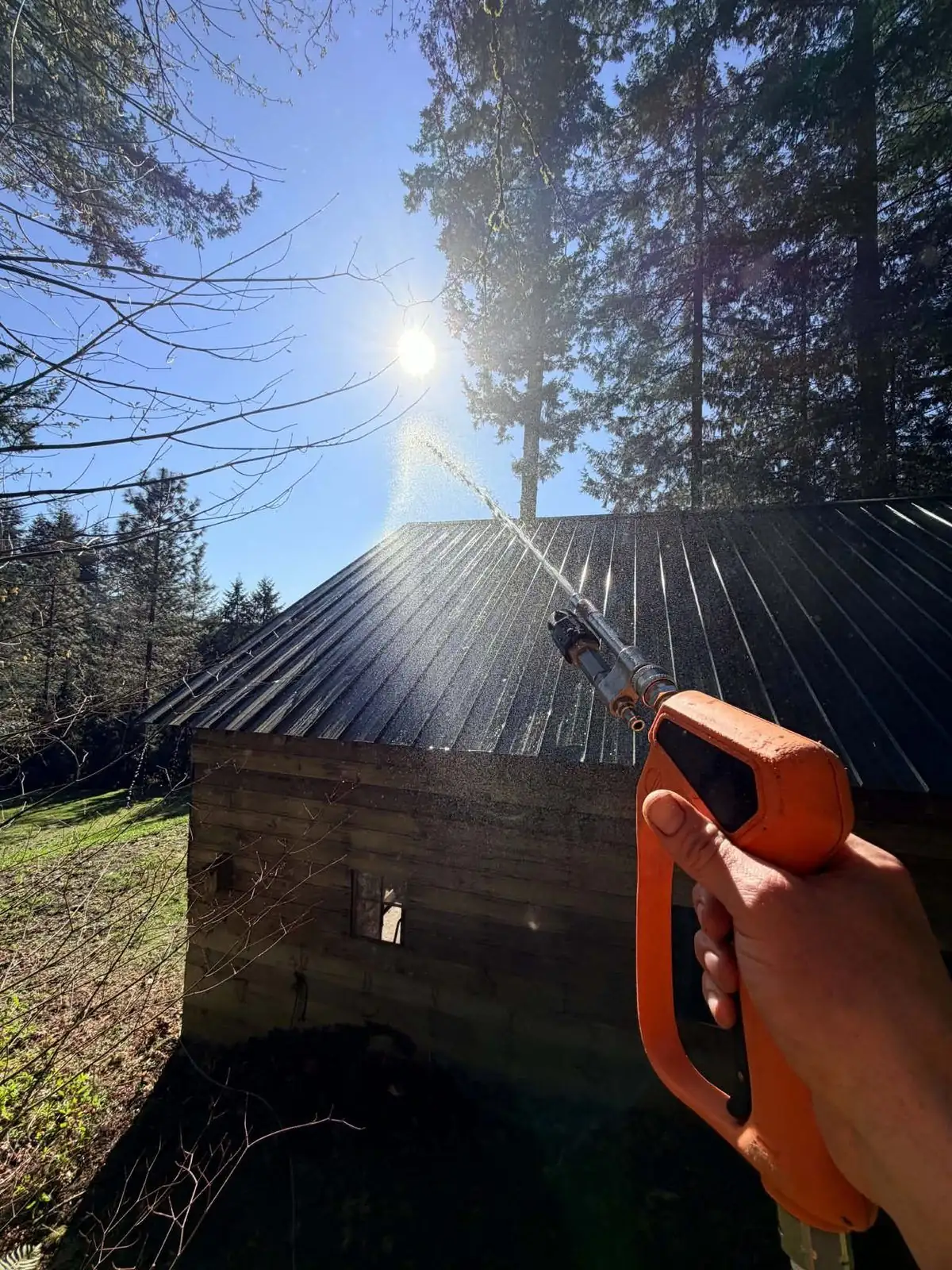
Low pressure — roughly garden-hose level. A mild cleaning solution chosen for the coating type rather than for speed, applied and given time to dwell so that the chemistry does the work. Gentle agitation only where it is needed, with soft bristle, never abrasive pads, wire brushes or anything that will mark a painted surface. Then a thorough rinse.
Two details specific to metal:
Direction matters. Metal panels lap, and the laps shed water downward. Work proceeds down the slope, and rinsing is directed down-slope, so that nothing is being pushed up under a lap or behind a flashing. A pressure washer aimed uphill at a metal roof is putting water exactly where the roof is designed to keep it out.
Dissimilar metals matter. Copper and steel do not get along: copper runoff onto a galvanised or steel panel causes galvanic corrosion. If there is copper anywhere above the panels — flashing, a vent, a decorative element — that is worth knowing before choosing a cleaning approach, and worth knowing generally.
Why we mostly stay off it
Metal roofs are more hazardous to walk than they look and easier to damage.
They are slippery, disproportionately so when wet, frosted, or carrying any organic film — which is precisely the condition of a roof that needs cleaning. The smooth coated surface offers very little grip and a metal roof does not forgive a slide the way a rough shingle does.
They also dent and oil-can. Standing between supports on a panel spanning purlins can leave a permanent deformation, and on a standing seam roof, weight in the wrong place can distort a seam and compromise the way it sheds water.
So the default is ladders, poles and extension equipment. Where the roof does have to be walked, it is walked over structure rather than mid-span, in the right footwear, in the right conditions, and by somebody who has looked at the panel profile first.
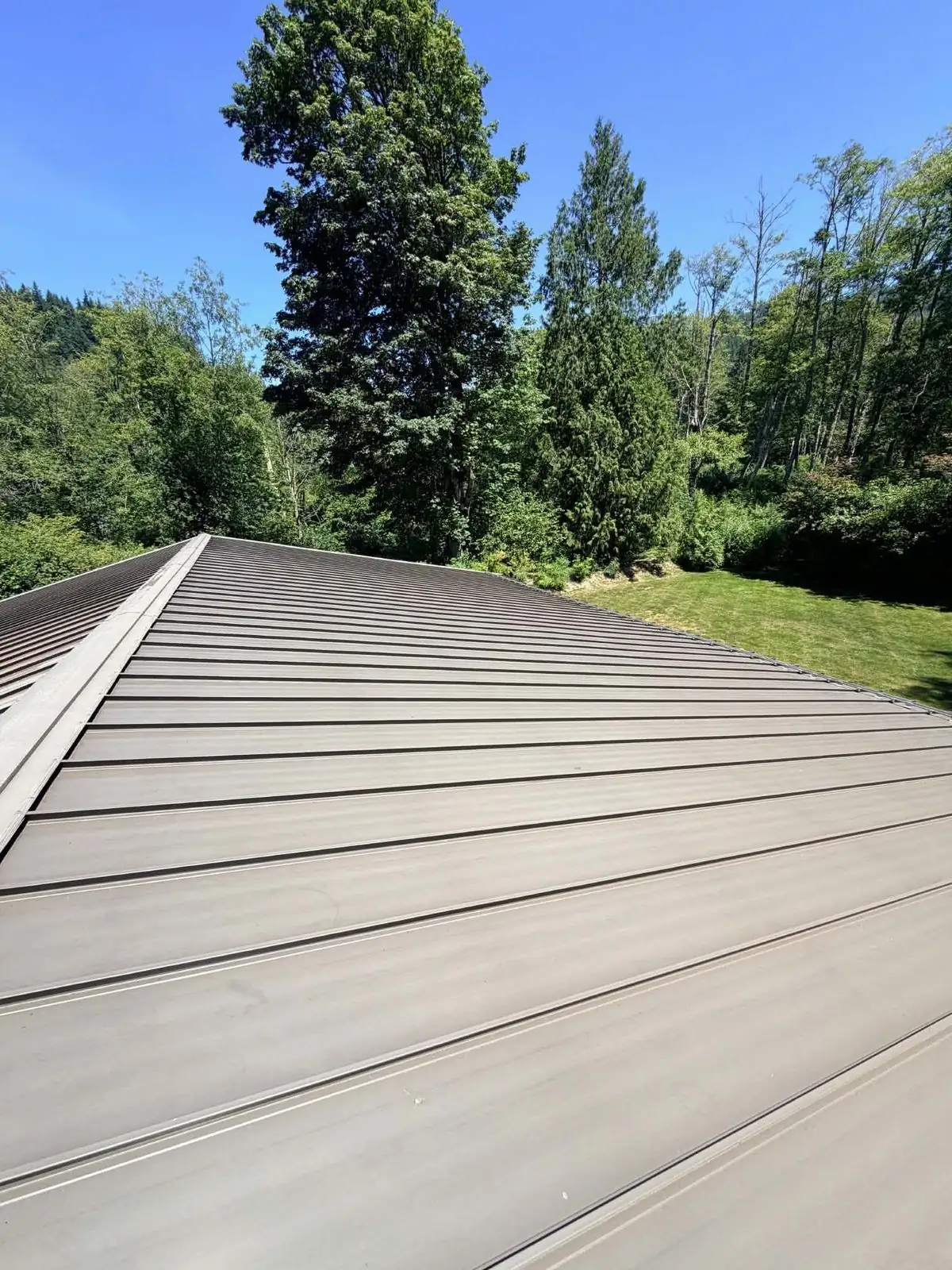
What we look at while we are there
Not an inspection — an observation from somebody at the roof, reported with photographs:
- Backed-out or missing fasteners, and aged or split washers on exposed- fastener roofs. These are the most common source of leaks on that roof type and they are visible.
- Surface rust at cut edges, panel ends, scratches and fastener penetrations.
- Sealant failure at flashings, penetrations and end laps.
- Panel movement — metal expands and contracts considerably with temperature, and fixings can work loose over years of it.
- Debris packed into valleys and behind flashings, which is cleared as part of the work.
- Coating condition — chalking, fading, or areas weathering differently.
We do not repair any of it. We do not replace fasteners, apply sealant, treat rust, or touch up coating. Those are roofing jobs, and the value of the visit is that somebody looked and told you.
When to book
Spring or early autumn, on a mild overcast day. Metal gets extremely hot in direct sun, which flash-dries solution before it can work and makes the surface unpleasant and more hazardous to work on. It also gets slick with frost early on cold mornings.
Every three to five years for most metal roofs here — longer on an exposed roof away from trees, shorter under conifers, at the marine edge, or where there is a low-slope section collecting debris.
Before the wet season, if there is heavy organic material in the seams, so it is not sitting wet all winter.
After a nearby construction project or a windstorm.
Metal roofs in this climate specifically
A few things about Whatcom and Skagit that shape how metal behaves here.
High rainfall is good for metal. A smooth coated surface at a decent pitch sheds water fast, and the frequent rinsing this region provides genuinely keeps the panel faces clean. Metal is a sensible choice here and this is a large part of why it has taken so much of the new-build market.
Conifer debris is the offsetting problem. Needles do not slide off a roof the way rain does — they lodge in seams, behind flashings and against any raised detail, and then they hold moisture in exactly the places the roof would otherwise stay dry.
Thermal cycling is moderate but constant. Metal expands and contracts with temperature, and the mild but variable weather here means a lot of small movements rather than a few large ones. Over decades that works fixings loose and fatigues sealant.
Freeze events at elevation. In the foothills — Deming, Acme, Kendall, Maple Falls, Glacier — water held in debris-packed seams and valleys freezes, and ice in a seam is a problem a clean seam does not have. Metal also sheds snow in sudden slides rather than gradually, which is worth knowing about what sits below the eaves.
Salt at the marine edge. Blaine, Birch Bay, Semiahmoo, Anacortes, Guemes and Samish Island. Salt aerosol is corrosive, it concentrates at cut edges and fastener penetrations where the coating is thinnest or breached, and it stays damp. Coastal metal roofs benefit from more frequent cleaning than inland ones, and rinsing salt off is doing real preservation work rather than cosmetic work.
Agricultural exposure through the valleys — dust, ammonia in livestock buildings, and chemical drift — is harder on coatings than residential exposure is.
What changes the price
- Roof area and the number of planes.
- Panel type — standing seam, exposed-fastener corrugated, ribbed, or architectural profile. Seam count and fastener count both drive time.
- Pitch and access, and how much can be reached without going onto the roof.
- Condition. Light film is quick; established growth in every seam is not.
- Detail count — flashings, valleys, penetrations, skylights, dormers.
- Coating type, since a more delicate finish means a gentler and slower method.
Why metal gets pressure washed more than it should
Worth naming the pattern directly, because it is the single most common way these roofs get damaged.
Shingle roofs deter people. They look fragile, they shed granules visibly when mistreated, and most contractors have absorbed the message that pressure washing them is wrong. Metal has none of those warning signs. It is hard, it rings under a boot, it does not flake, and a jet of water bounces off it looking like it is doing a great job.
So metal is where the pressure washer comes out. It cleans fast, the result on the day is impressive, and nothing appears to have gone wrong.
What has gone wrong is invisible for years. The finish has been micro-abraded and partially stripped, so it chalks earlier and fades unevenly. Water has been driven up under panel laps and behind flashings, into an assembly detailed for downward flow. On an exposed-fastener roof, aged washers have been disturbed. And at cut edges and scratches where the substrate was already marginally exposed, the protective layer has been thinned further.
The result arrives as premature corrosion and a roof reaching maybe two thirds of the life it was sold with. By then nobody connects it to a cleaning done eight years earlier.
If you are getting quotes for a metal roof, the useful question is not what it costs. It is what pressure they intend to use and what they are putting on the coating. A contractor who answers that specifically has thought about the roof; a contractor who has not is going to treat it like a driveway.
Where this sits alongside the rest
Metal roofs sit above everything else on the building, so the same sequence applies as anywhere: roof first, then gutters, then siding, then glass, then hard surfaces.
If the roof carries solar, the array and the roof are worth doing in one visit — see solar panel cleaning, which uses the same pure-water discipline for the same reason: protecting a coating that cannot be replaced.
If what you actually have is asphalt shingle rather than metal, the method and the risks are different — roof cleaning covers that, and moss removal covers the moss specifically.
On the day
We look at the roof before quoting rather than pricing from a square-foot figure, because panel profile, coating type and detail count all change the job and none of them are visible from a phone call.
On the day: access is set up, the ground below is protected, planting is pre-wet and covered where needed, and downspout discharge points are considered so that runoff goes somewhere sensible. Then the work runs plane by plane, top to bottom, with the solution given real dwell time rather than being rushed off.
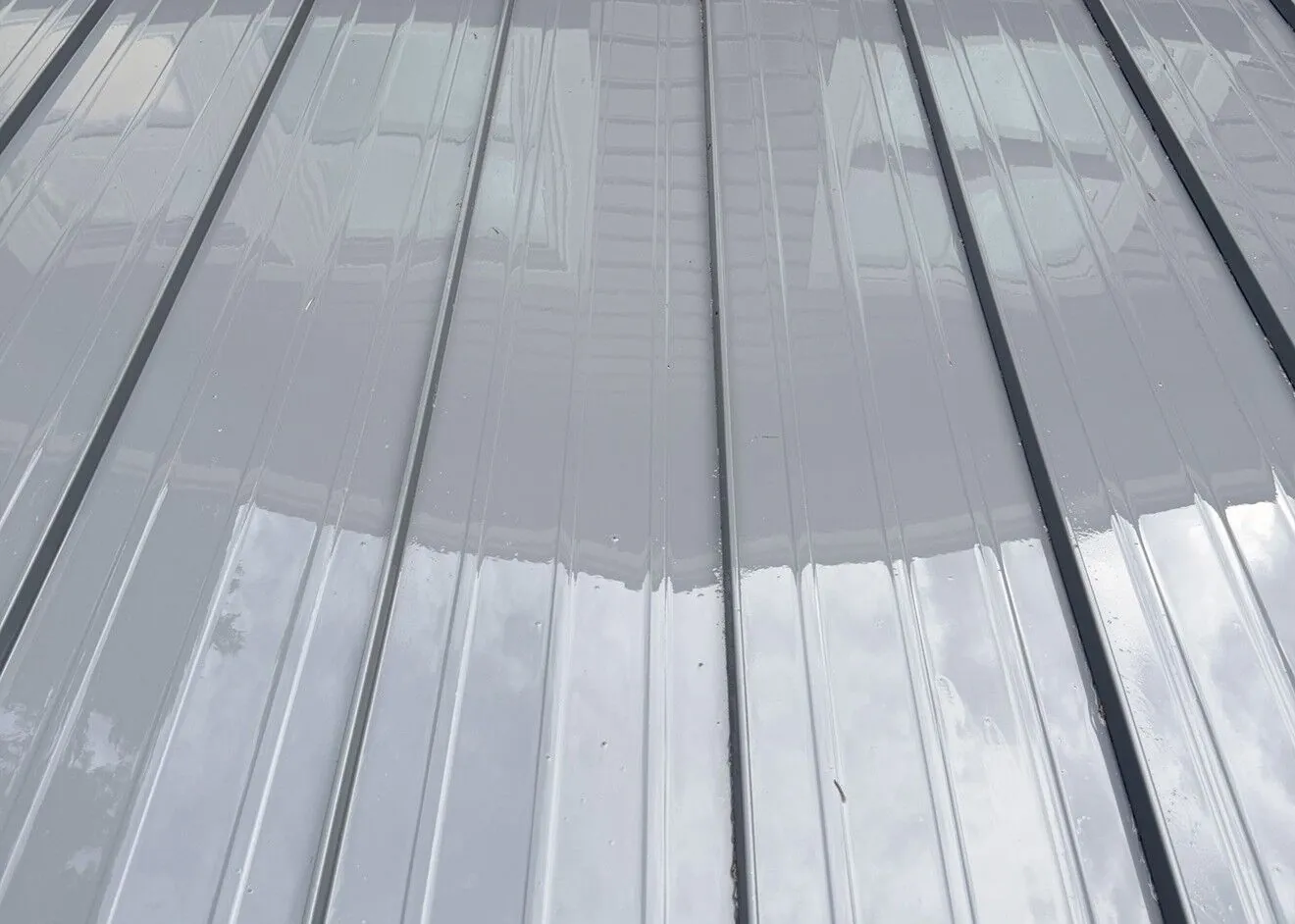
Metal rinses more completely than shingle does, which is one of the pleasant things about the job — there is no granular surface holding residue, so a thorough rinse genuinely leaves a clean panel. Seams, valleys and flashings get cleared by hand of whatever the wash loosens.
At the end we walk the property with you if you are there, and send photographs of anything worth seeing if you are not — particularly fastener condition, edge rust and sealant, since those are the things you would want to know about and cannot see from the ground.
A typical residential metal roof is a half day to a day. Agricultural buildings depend entirely on span and fastener count, and a large barn roof is realistically a full day or more of careful work rather than a quick pass.
What each profile needs
| Profile | Where attention goes | Note |
|---|---|---|
| Standing seam | Seam bases, flashings, low-slope transitions | Panel face is nearly self-clearing; the debris beside it is the job |
| Exposed-fastener corrugated or ribbed | Several hundred washers, plus the panel | Washer condition is the maintenance item and the reason to look |
| Metal shingle and tile profiles | Surface relief that holds debris | Slower clean, more places to check |
| Stone-coated steel | Treated like asphalt shingle, not like metal | Granules dislodge under pressure |
| Copper and zinc | Conservative or declined | The patina is the finish; uneven removal is worse than the soiling |
Cleaning a metal roof is preservation as much as appearance — it is the organic matter and salt in the details that turn into corrosion.
Where we do it
Metal roof soft washing is available across Whatcom and Skagit County. Bellingham and the surrounding area has the deepest existing coverage of this service — it is the subject of the most detailed page on the legacy site — and it applies equally to the agricultural buildings through the Nooksack and Skagit valleys and to waterfront properties where salt exposure is the driver.
If you are not certain which panel type you have, send a photograph taken from the ground. The profile is usually identifiable at a glance, and knowing it before we arrive means the quote reflects the roof rather than an assumption about it.
The surfaces this work touches
Metal Roof Soft Washing where you live
Whatcom County
Skagit County
We also cover Sedro-Woolley, Semiahmoo, Custer, Nooksack, Sumas, Deming, Acme, Maple Falls, Glacier, Kendall, Van Zandt, La Conner, Lyman, Edison, Bow, Alger, Clear Lake, Big Lake, Conway, Concrete, Hamilton, Bay View, Oak Harbor, Point Roberts, Lummi Island, Marietta, Geneva, Wickersham, Rockport, Samish Island and Guemes Island from these bases. Those areas do not have their own page — if you are not sure whether you are inside the area, call and ask.
Metal roofs questions
- Metal roofs don't grow moss — why do they need cleaning?
- The panel face largely does not, which is one of the reasons people choose metal. The seams, the fastener heads, the flashings and the low-slope transitions all collect organic debris, and moss and lichen establish in that. Add streaking, tree sap, pollen film and salt at the marine edge, and there is a real job there — it is just a different job from cleaning an asphalt roof.
- Can you pressure wash a metal roof?
- You can, and it is a bad idea. Metal seems tough enough to take it, which is exactly why it gets pressure washed more often than shingle does. High pressure dulls and can strip the factory coating, drives water up under the panel laps and behind flashings, and on older screw-down roofs it disturbs the fastener washers that keep the roof watertight.
- What is the risk to the coating?
- The coating is the roof. A metal panel is steel or aluminium with a factory-applied finish — usually a Kynar-type or polyester system — and that finish is what provides the corrosion protection and the colour warranty. Once it is dulled, scratched or chemically etched, the substrate underneath starts weathering and no amount of cleaning brings it back.
- What about the streaks running down from the seams?
- Very common on metal, and usually a mix of organic residue and oxidised material carried in runoff. It bonds to the coating and does not come off with plain water. It responds to the right mild chemistry with dwell time, which is the whole approach here.
- Will you walk on my metal roof?
- Only where the panel profile and the structure allow it, and only in the right places — over purlins or supports rather than mid-span. Metal panels oil-can and dent, and a standing seam roof in particular is easy to damage underfoot. Most of this work is done from ladders and poles.
- Do you clean the gutters and flashings too?
- The flashings, valleys and transitions are part of the roof and part of the job — they are where debris actually collects. Clearing the inside of the gutters is a separate service, and it is usually worth doing after the roof rather than before.
- What about rust?
- Surface rust at cut edges, fastener heads and scratches gets flagged. Cleaning does not repair it and we do not attempt rust treatment or touch-up — that is a roofer or a metal specialist. Catching it early is worth a great deal, which is one of the useful side effects of having somebody look at the roof.
- How often should a metal roof be cleaned?
- Less often than asphalt — typically every three to five years here, and longer on an exposed roof away from trees. Under conifers, at the marine edge, or where there is a low-slope section collecting debris, closer to every two or three.