
Whatcom & Skagit County
Solar Panel Cleaning in Whatcom & Skagit County
The short answer
King of Kings cleans solar panels across Whatcom and Skagit County with deionized water only — no detergents, no abrasives, nothing that touches the anti-reflective coating. Panels are cleaned from the ground where possible and never walked on. Licensed, L&I insured, free on-site quote.
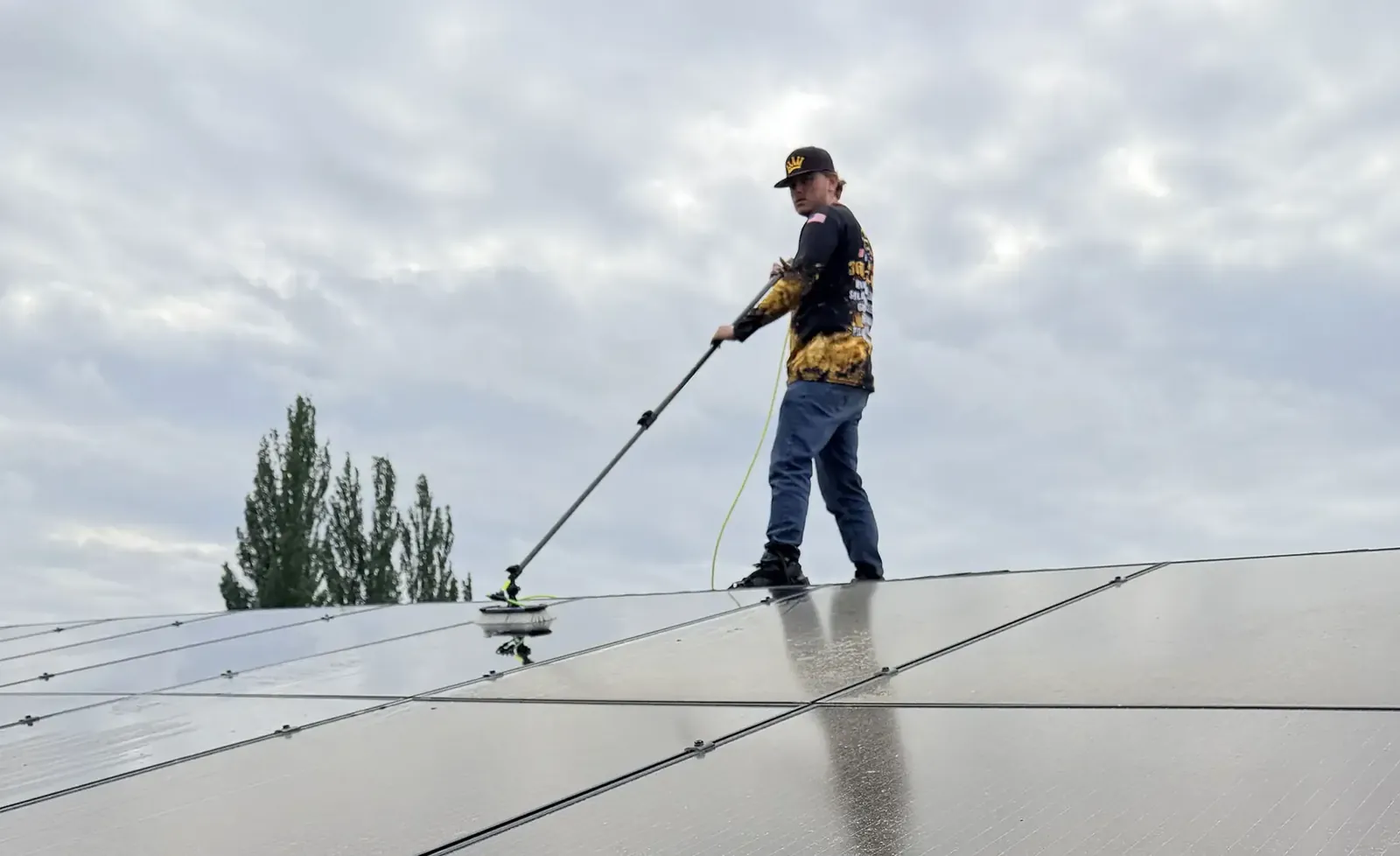

Randy Fee — Owner, King of Kings Window Cleaning
Washington business licence, UBI 605476674 · L&I insured · BBB rated A
Randy runs the company himself, so you are dealing with the owner, not a call centre — and every technician here is personally trained by him. Working Whatcom and Skagit County since 2024.
Solar in the Pacific Northwest is a longer game than solar in Arizona, and the cleaning conversation is different too. There is enough rain here to do part of the job for free, which means the honest answer to “do my panels need cleaning?” is sometimes no — and we would rather say so than sell an annual visit to somebody whose array is doing fine.
But rain is not a cleaner. It is a rinse, and there are specific things it does not remove. Those are what this service is for.
What rain does not wash off
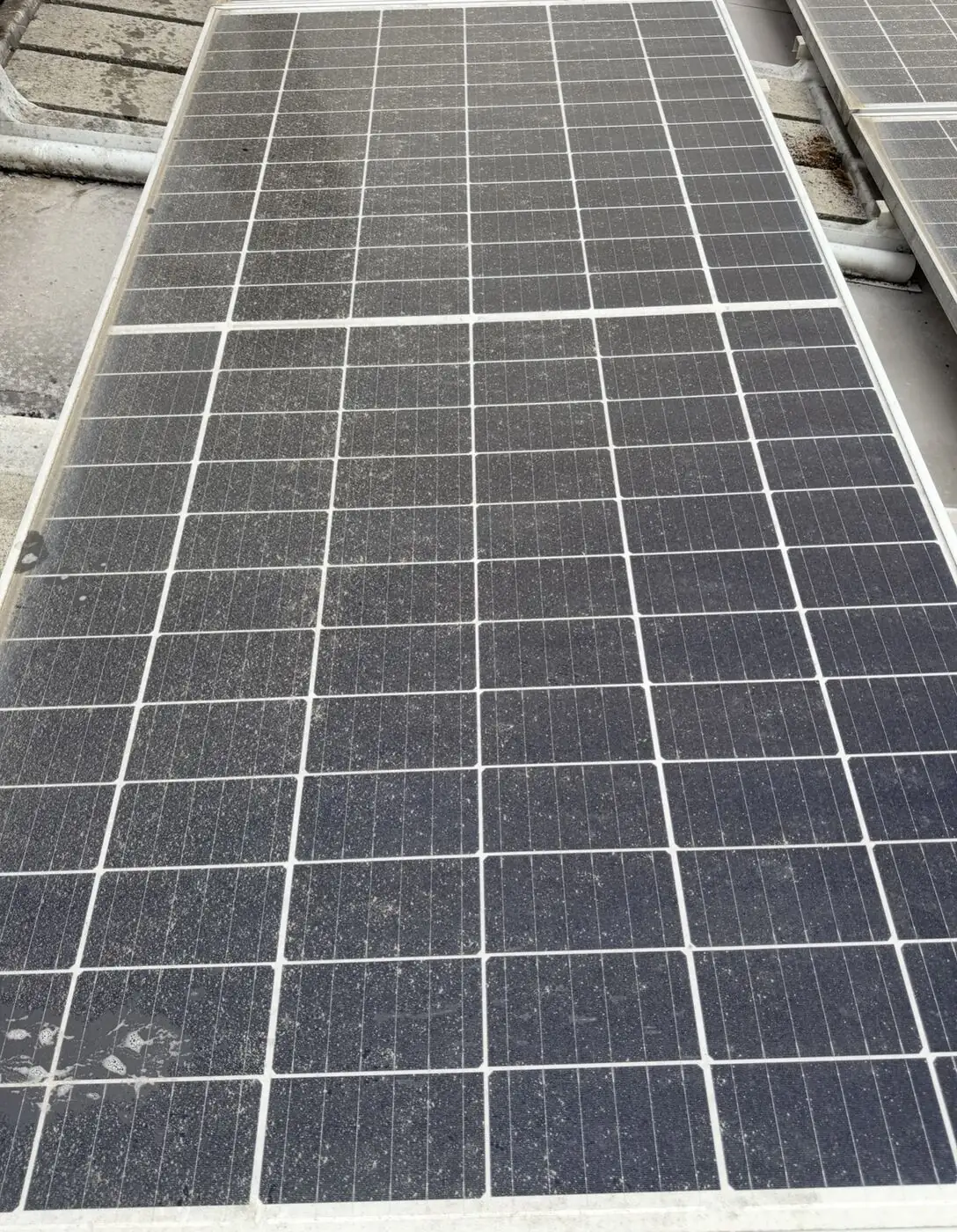
The edge band. This is the important one and it is the reason most arrays here benefit from cleaning at all. A framed panel has a raised aluminium lip around its perimeter. On a tilted panel, water running down the glass reaches that bottom lip and pools against it before it can escape. Silt, pollen and fine debris carried in the water settle out exactly there and dry into a band along the lower edge of every panel in the array.
It is easy to see once you know to look for it, and it does more damage to output than its size suggests, for a reason worth understanding: a solar panel’s cells are wired in series. Current through a series string is limited by its weakest element. Shade or soil across the bottom of the cells nearest the frame does not cost you the fraction of the surface it covers — it can hold back the whole string. This is why a thin dirty stripe can matter more than a large area of even haze.
Conifer pollen. Spring in this region delivers an enormous pollen load, predominantly from Douglas fir, and it arrives as a fine yellow-green film that sticks. Rain wets it and redeposits it rather than removing it, and it is at its worst in exactly the months when the array is starting to produce real output again.
Bird droppings. Opaque, adherent, and unaffected by rain. A single well-placed dropping over a cell can behave like the shading described above.
Moss, lichen and organic growth. Establishes at the frame edges and underneath the array, where it is permanently shaded and damp. This is a Whatcom County problem specifically, and the array is a good habitat for it.
Needle and leaf debris, particularly where it lodges between panels or under the array on a low-tilt mount, and stays there holding moisture.
Industrial and agricultural deposition. Near the Cherry Point corridor, and out on the farm ground through the Nooksack and Skagit valleys, the deposited layer is finer and more adherent than ordinary dust, and rain does not lift it.
Salt film. At the marine edge in Blaine, Birch Bay, Anacortes and on the islands, salt aerosol leaves a hygroscopic layer that stays slightly damp and collects everything else that lands on it.
Why deionized water, and nothing else
The method is not incidental. It is the whole service, and it is worth understanding why the obvious alternatives are wrong.
A modern solar panel is not simply a sheet of glass. The front surface carries an anti-reflective coating whose entire job is to get more light through the glass and into the cells rather than bouncing it back off. That coating is microscopically thin and it is the most valuable and most vulnerable surface on the panel.
Detergents leave residue. Any surfactant that helps a solution wet the glass also leaves a film when it dries, and that film is slightly tacky — it attracts and holds the next round of dust rather than shedding it, so the panel soils faster after cleaning than before. Some cleaning chemistries also attack anti-reflective coatings over repeated applications.
Abrasives — including scouring pads, stiff brushes, and any grit picked up and dragged across the surface — cause micro-scratching. Scratches scatter incoming light instead of transmitting it. The loss is small per scratch, permanent, and cumulative.
Ordinary tap or well water carries dissolved minerals. When it evaporates on the glass, those minerals stay behind as spotting — the same hard-water deposit described on the window cleaning page, on a surface where optical clarity is the entire point.
High pressure can force water past the panel’s edge seals and into the laminate, which is a failure mode that ends a panel’s life.
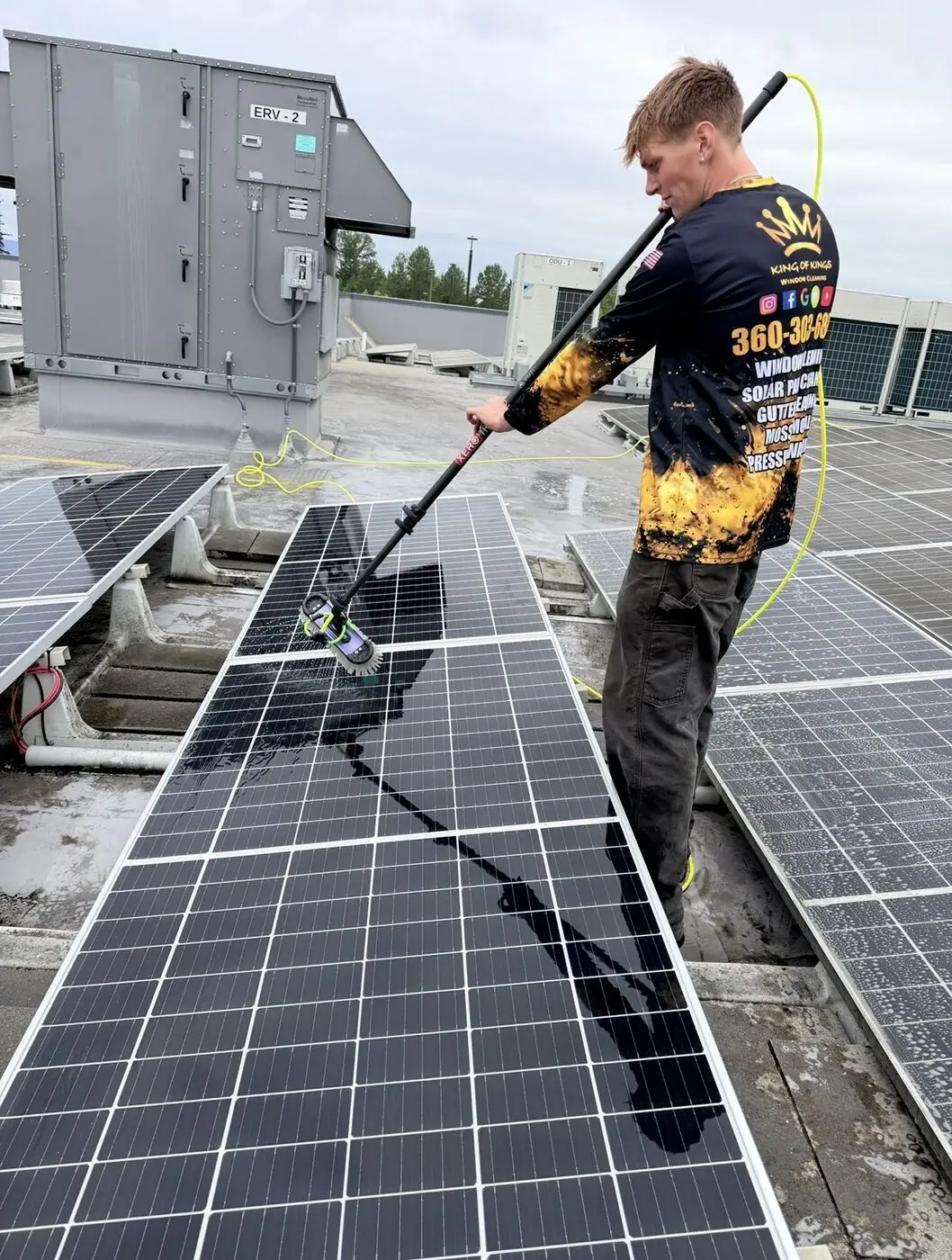
Deionized water solves all of it at once. With the minerals stripped out, water becomes an aggressive solvent in a mild way — it actively wants to pick up dissolved material and carry it off, and then it evaporates leaving nothing behind at all. No residue, no spotting, no film. Combined with a soft brush on a pole and no meaningful pressure, it cleans the glass without ever touching the coating with anything harder than water and bristle.
That is the method, and it is the same pure-water approach used on the upper glass of a house — applied to a surface where the stakes are higher.
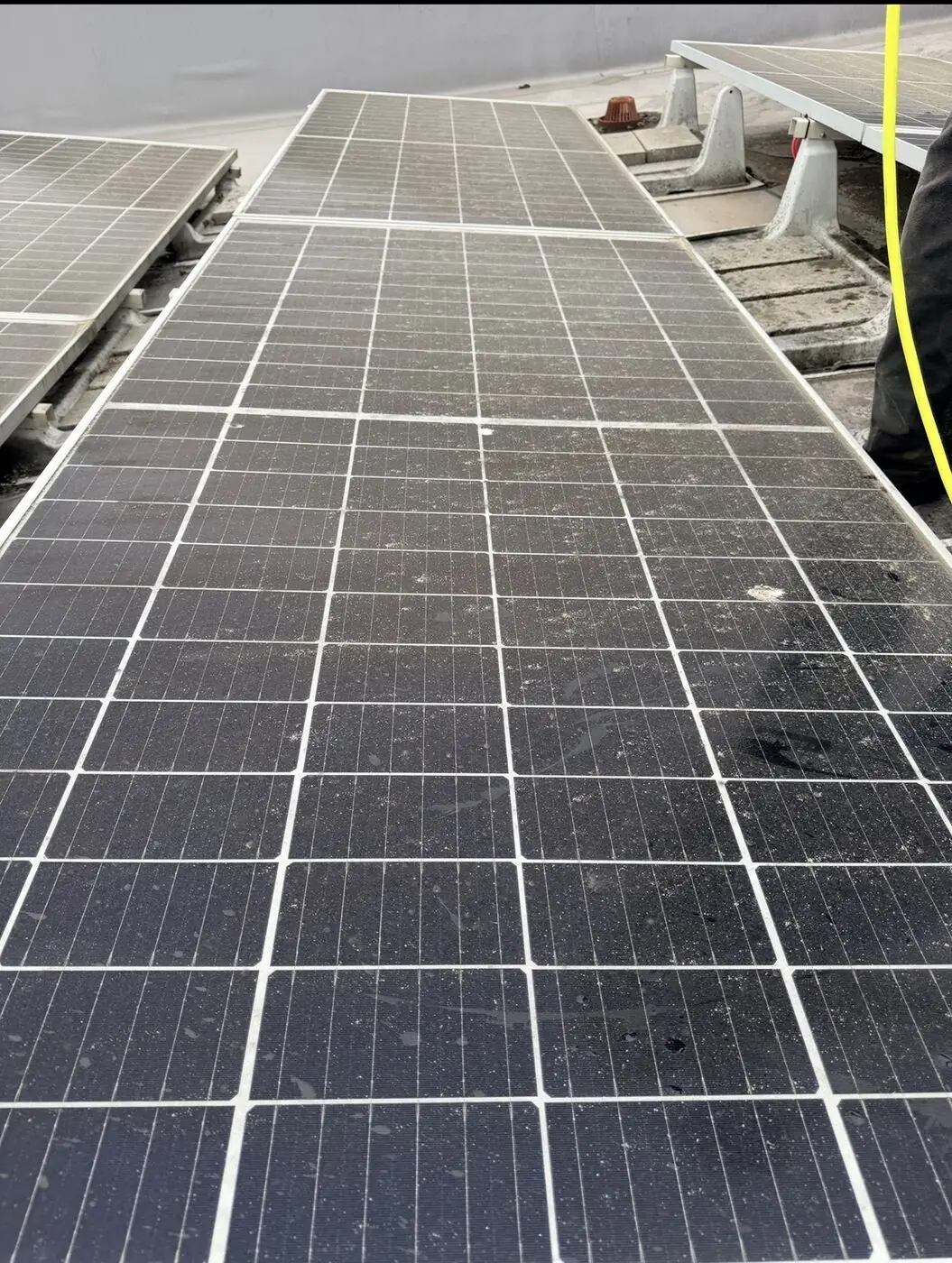 Before
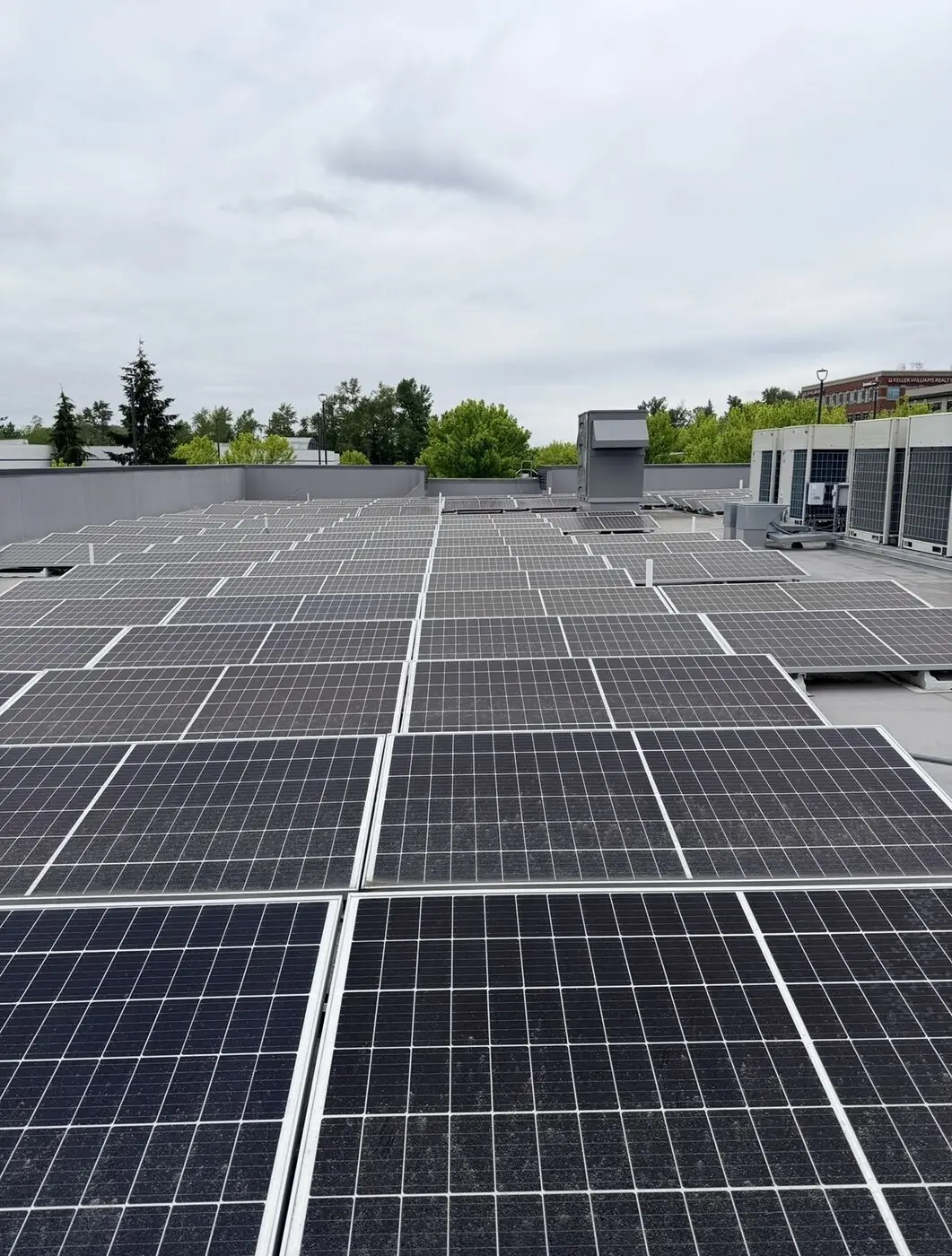 After
Why we never walk on panels
Standing on a solar panel is the single most damaging thing a person can do to one, and it is done routinely by people who do not know better.
The damage is invisible. Body weight on the glass flexes the laminate and causes micro-cracks in the silicon cells underneath. The panel looks unchanged. It continues producing. But the cracked cells degrade faster than they should, output falls progressively over the following years, and the failure is attributed to age rather than to whoever stood on it. Every major manufacturer treats foot traffic as abuse and excludes it from warranty coverage.
We clean from the ground with extension equipment on the majority of residential arrays. Where the roof has to be accessed, we work on the roof deck around the array rather than on it — which is also why array layout and roof access get looked at during the quote rather than discovered on the day.
The electrical reality
Worth being plain about, because it changes what we will and will not touch.
A solar array is a live direct-current electrical system, and it cannot be turned off by a switch. As long as daylight is falling on the panels, they are generating. The inverter can be shut down; the panels and the DC wiring between them remain energised. DC arcing is also less forgiving than AC.
Practically, that means we clean the glass and we do not go near anything electrical. Damaged or cracked panels, delamination, discoloured cells, scorching or browning at a junction box, chafed or sagging wiring, corroded connectors, loose mounting hardware — all of these get photographed and reported to you, and referred to your installer or a licensed electrician. We do not open, disconnect, adjust or repair any part of a solar system, and any contractor offering to is outside their lane.
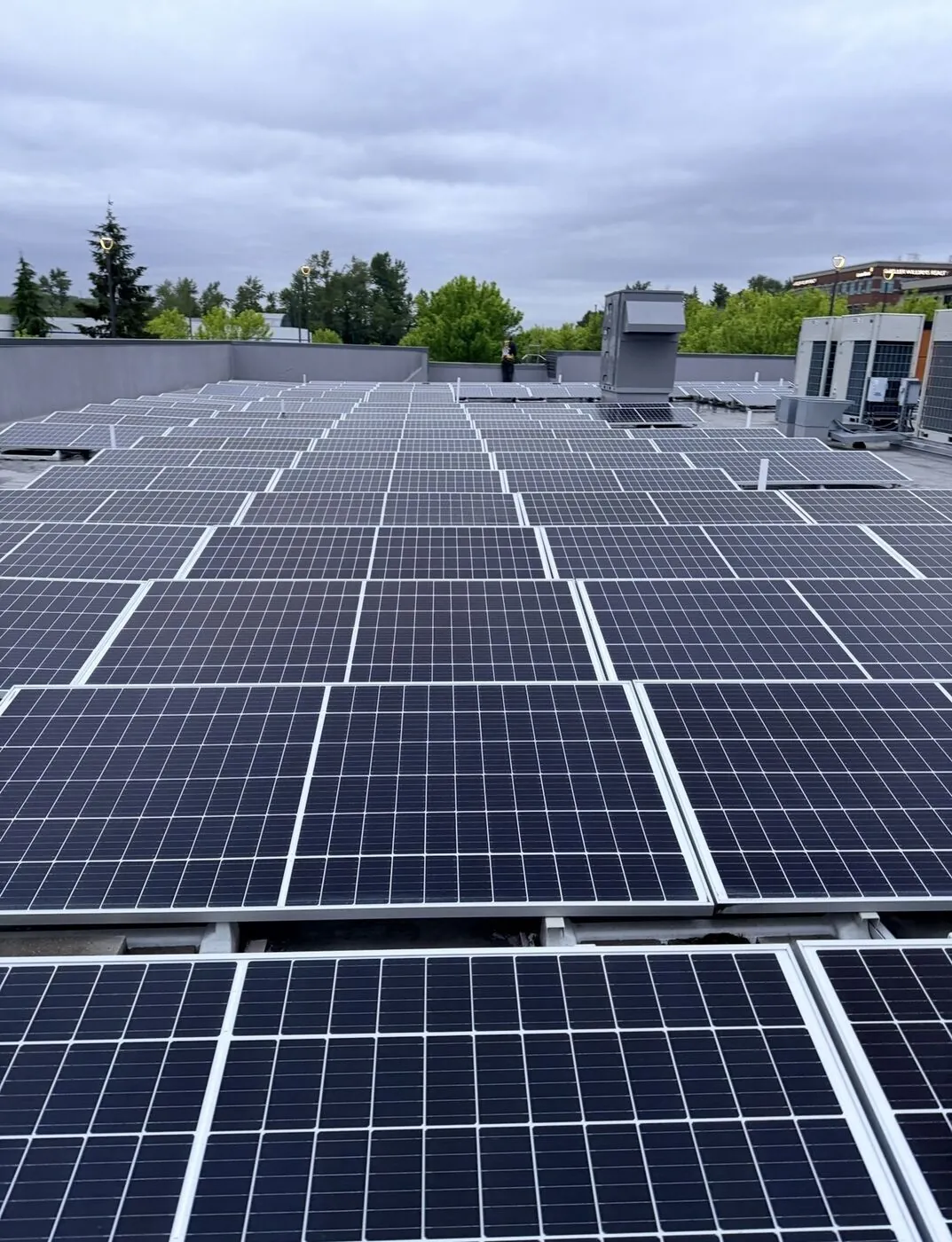
What the visit involves
- Assessment — array size, mounting, tilt, access, condition, and whether cleaning is actually warranted
- A pre-clean output note, where the system’s monitoring makes that available
- Deionized water clean with a soft brush on a pole, at low pressure
- Particular attention to the bottom edge band, for the reasons above
- Frames and the gaps between panels cleared of lodged debris
- Moss and growth cleared from around and beneath the array where reachable
- Condition report on anything visible, with photographs
- No foot traffic on the panels, ever
When to book
Late spring is the single best slot in this region, once the Douglas fir pollen has finished. Cleaning before the pollen has stopped falling means cleaning again.
Early autumn, particularly on the agricultural flats after harvest dust and before the array goes into the low-light months, when every percentage point of the little available production matters more.
After a construction project nearby, or after a windstorm that brought debris down onto the array.
When the numbers say so — see below.
Not on a hot panel in full sun. Cold water on hot glass is a thermal shock risk, and panels in direct summer sun get considerably hotter than the air. Morning, evening, or an overcast day is correct, which in this region is rarely a scheduling problem.
Let the monitoring tell you
This is the part that makes solar different from every other surface we clean: your array measures its own performance, and you can check whether cleaning is warranted rather than guessing.
Most systems installed here have monitoring — an app or a portal showing daily and monthly production. The useful comparison is the same month against previous years, not against last month, because seasonal variation swamps everything else. A clear-sky day in May this year against a clear-sky day in May last year tells you something. May against March tells you nothing.
If production on comparable days has drifted down a few percent and the panels look filmed or banded, cleaning will likely recover most of it. If production is holding steady year on year, your array is fine and we will say so.
A steep or sudden drop is a different matter and is usually not soiling. That is an inverter, a string, or a panel fault, and it needs your installer rather than a bucket.
Roof-mounted and ground-mounted
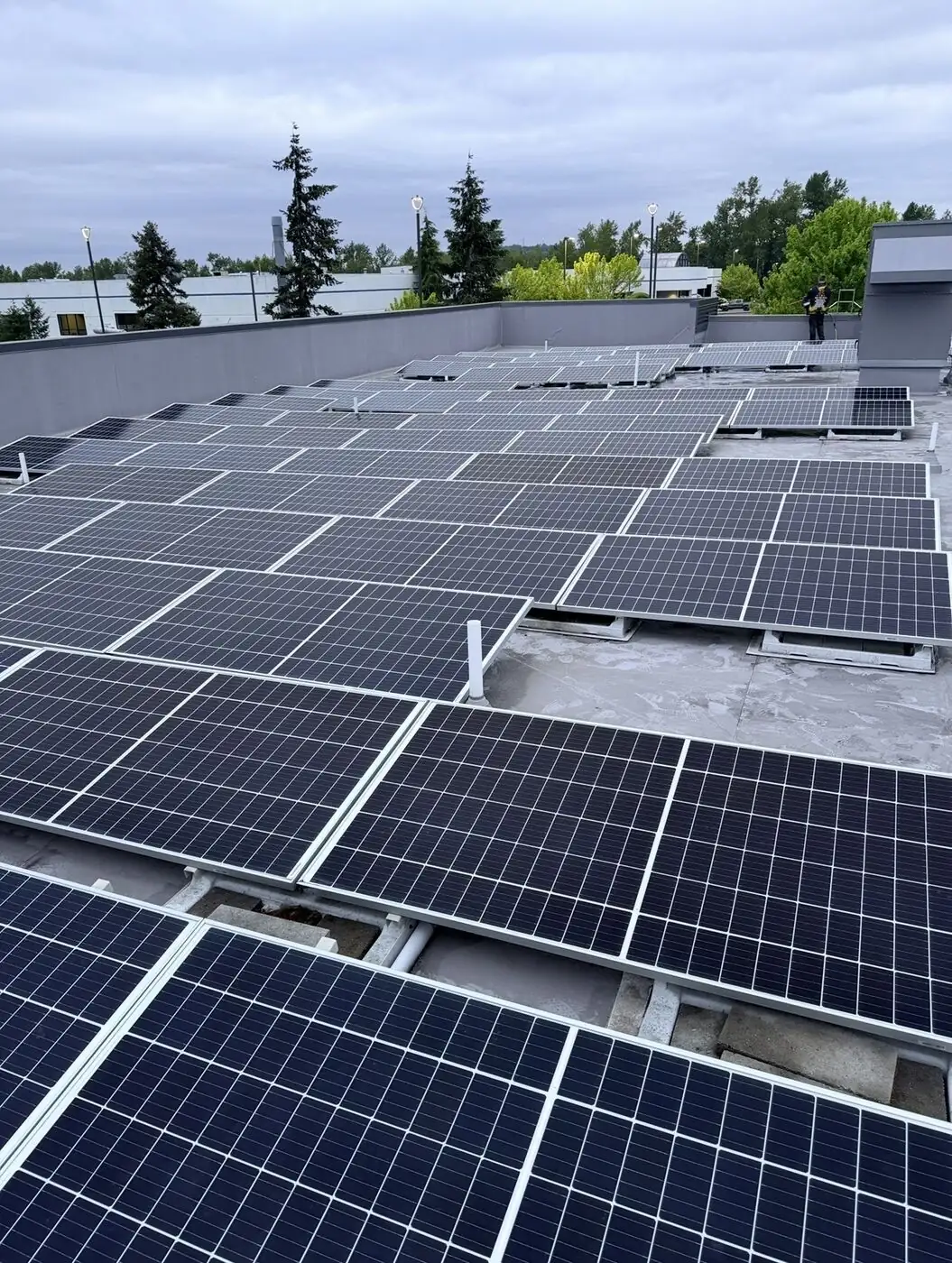
Roof-mounted is the majority here. The considerations are access, roof pitch, and the gap between the array and the roof surface — that gap is a shaded, sheltered, permanently damp space, which makes it excellent habitat for moss and a collection point for needles. It is also where rodents and birds nest if the perimeter is not screened.
Roof arrays interact with the rest of the roof, too: an array sitting above a mossy roof section will keep collecting what grows below it, which is a roof cleaning and moss removal question as much as a panel one.
Ground-mounted arrays are simpler, safer and cheaper to clean, and they have their own soiling profile: mud splash in heavy rain, grass clippings from mowing, dust from a nearby drive, and vegetation growing up into the lower edge. The bottom row is always the dirty one.
What changes the price
- Number of panels. The base figure.
- Roof or ground mount, and how the array is reached.
- Roof pitch and array position — a low-tilt array high on a steep roof is a different proposition from one at the eaves.
- Condition. A maintained array on an annual cycle is quick. An array that has never been cleaned, with moss established at the frames, is not.
- Growth under and around the array, if it needs clearing.
- Water access on site, since deionized water is produced from a supply.
Combining it with other work on the same visit is usually cheaper, because the access and set-up are shared.
The honest position on payback
We would rather set the expectation properly than oversell this.
In a high-dust, low-rain climate, panel cleaning has an obvious and rapid payback. Here, rain does a meaningful share of the work, so the return is real but more modest, and it is concentrated in the specific soiling types listed at the top of this page — the edge band, pollen film, growth and droppings — rather than in general dust.
Where cleaning clearly pays for itself: arrays under trees, arrays near the industrial or agricultural corridors, arrays at the marine edge, arrays with visible growth at the frames, and any array that has never been cleaned.
Where it may not, yet: a newer, well-sited, unshaded array on an exposed roof, two or three years old, with monitoring showing steady year-on-year production.
Send a photograph and a screenshot of your monitoring before booking and we will give you a straight answer, including “not this year” if that is the answer.
What we do not do
- We do not walk on panels, under any circumstances.
- We do not touch wiring, connectors, junction boxes, rapid shutdown devices, optimisers, inverters or any electrical component.
- We do not repair, replace, reposition or re-seat panels or mounting hardware.
- We do not inspect systems, test output, or issue performance reports. Observed problems are photographed and referred to your installer.
- We do not use detergents, solvents, abrasives or high pressure on panels.
Common mistakes worth avoiding
Four things people do to their own arrays that cost more than the cleaning would have.
Standing on them. Covered above, and it is worth repeating because it is the most common and the most expensive.
Using a pressure washer. Force at a panel edge can breach the seal between glass and frame and let moisture into the laminate. That ends a panel.
Cleaning with a hose and a household cleaner on a sunny afternoon. Three mistakes at once: mineral spotting from the tap water, residue from the cleaner, and thermal shock on hot glass.
Scraping something off with a blade. Bird droppings and tree sap tempt people towards a scraper. The anti-reflective coating does not survive it.
If you want to do it yourself, the safe version is: overcast day or early morning, cool panels, soft brush, and the purest water you can get, from the ground, never from on top of the array.
What each visit covers
| Array type | Method | Note |
|---|---|---|
| Framed residential, roof-mounted | Purified water, soft contact, no abrasives or solvents; edge band worked specifically | The band along the lower frame is where the output loss concentrates |
| Frameless or dual-glass | Same method, no perimeter lip to clear | Less to clean, more sensitive to point loads |
| Textured or patterned front glass | Longer dwell, more passes | Soiling sits in the texture |
| Ground-mount or tilt frame | Same method, better access | Sheds better between cleans |
| Solar hot-water collectors | Identified first, then treated as glazing or as evacuated tube | Not photovoltaic; a different thing entirely |
Nobody walks on an array. Late spring is the visit that earns its keep.
Where we do it
Solar panel cleaning is available across the Tier 1 and Tier 2 markets in Whatcom and Skagit County. Soiling profile varies a lot by location — pollen dominates in the treed neighbourhoods and the foothills, deposited film near Cherry Point, agricultural dust through the valleys, and salt at the marine edge. Your town’s page has the local picture, including whether an annual clean is likely to be worth it there, and what the array is most likely collecting where you live.
The surfaces this work touches
Solar Panel Cleaning where you live
Whatcom County
Skagit County
We also cover Sedro-Woolley, Semiahmoo, Custer, Nooksack, Sumas, Deming, Acme, Maple Falls, Glacier, Kendall, Van Zandt, La Conner, Lyman, Edison, Bow, Alger, Clear Lake, Big Lake, Conway, Concrete, Hamilton, Bay View, Oak Harbor, Point Roberts, Lummi Island, Marietta, Geneva, Wickersham, Rockport, Samish Island and Guemes Island from these bases. Those areas do not have their own page — if you are not sure whether you are inside the area, call and ask.
Solar panels questions
- Doesn't the rain clean them?
- Partly, and more here than in most of the country — which is why we will tell you honestly if your array does not need doing. What rain does not clear is the band of soiling that builds along the bottom edge of each panel where the frame traps water and silt, and it does nothing about pollen film, bird droppings, or moss establishing under the frame.
- Why deionized water and nothing else?
- Because it is the only thing that cleans a panel without leaving something behind. Deionized water has the dissolved minerals stripped out, so it dries without spotting — no residue, no film. Detergents leave a residue that attracts soiling and can degrade the anti-reflective coating over time. Abrasives scratch it permanently.
- How much output do dirty panels actually cost?
- It varies enormously with what the soiling is and where it sits. Even light uniform film costs a few percent. A soiling band across the bottom of a panel costs disproportionately more, because shading part of one cell can drag down an entire string. That is why the edge band matters more than the general surface.
- How often should they be cleaned?
- Most arrays here suit once a year, generally in late spring after the conifer pollen has finished. Twice a year makes sense near the Cherry Point corridor, out on the farm ground in the Nooksack and Skagit valleys, at the marine edge, or under overhanging trees.
- Do you walk on the panels?
- Never. Standing on a panel causes micro-cracks in the cells that do not show on the surface and permanently reduce output, and it voids the warranty. We clean from the ground with extension equipment wherever possible, and work from the roof deck around the array where it is not.
- Is it safe with the system running?
- The cleaning itself is, done correctly with pure water and no high pressure. A solar array is a live DC electrical system that cannot be switched off by daylight, so damaged panels, exposed wiring or compromised connectors are things we look for and do not touch — we flag them for your installer.
- Can you clean ground-mounted arrays?
- Yes, and they are usually simpler and cheaper than roof-mounted, because access is straightforward. Ground mounts sit lower, so they pick up splash, grass clippings, dust and vegetation growth along the bottom edge more readily than a roof array does.
- Will you tell me if something looks wrong?
- Yes — cracked or delaminating panels, discoloured cells, damaged frames, loose mounting hardware, chafed or sagging wiring, moss under the array. That is an observation from someone who was at the panels, not an inspection, and anything electrical goes to your installer rather than to us.