Whatcom County
Roof Cleaning & Debris Removal in Ferndale, WA
The short answer
Ferndale roofs are soft washed, never pressure washed: a low-pressure solution kills algae, moss and lichen, and the dead growth weathers off over the following weeks. With a census median build year of 1998, many roofs here are likely originals, the stage worth protecting. Runoff is contained, because Ferndale's allowance excludes detergents.

Randy Fee — Owner, King of Kings Window Cleaning
Washington business licence, UBI 605476674 · L&I insured · BBB rated A
Randy runs the company himself, so you are dealing with the owner, not a call centre — and every technician here is personally trained by him. Working Whatcom and Skagit County since 2024.
I run the Ferndale route personally.
A roof in Ferndale spends most of the cool half of the year wet, and whatever side of it faces away from the sun stays wet longest. That is where the growth starts: black streaks first, then moss in the gaps, then the crusty patches of lichen that are the hardest of the three to shift. The good news is that a lot of Ferndale roofs are young enough to catch it early.
This page covers how we clean roofs in Ferndale, why we never use pressure, and what drives the timing and the price.
What is growing on Ferndale roofs?
Three different organisms, which look similar from the driveway and behave very differently up close.
Algae shows as dark vertical streaks running down from the ridge, most visible on lighter shingles. It is the most cosmetic of the three and the quickest to disappear once treated.
Moss grows in the joints between shingles and along the lower edge, where water lingers longest. It holds moisture against the roof, lifts shingle edges as it thickens, and sheds debris into the gutters below.
Lichen forms flat, pale green or grey patches that grip the surface itself. Treated lichen dies quickly and lets go slowly, sometimes over a full year, and trying to remove it by force takes roof with it.
On a typical house the growth concentrates on the north-facing slope, under any overhanging tree, and along the bottom rows above a gutter that has been holding water. A roof on open ground with good sun on every face can go years with very little, while the same roof in shade can need attention every couple of years.
Why does a young Ferndale roof deserve care?
Because it has the most to lose.
The census puts the median year built for Ferndale’s housing at 1998, and 1,690 of the town’s roughly 6,200 homes went up in 2010 or later. A large share of the town’s roofs are therefore likely still on their first covering, and on a composition roof that means the granule layer is mostly intact.
Those granules are the shingle’s sun protection. Once they are gone, the asphalt underneath weathers much faster. A pressure washer can strip years of that protection in an afternoon, and nothing puts it back. Soft washing leaves the granules where they are. The composition asphalt shingle profile explains how that surface is built and how it ages.
On an older house with a roof that has already lost much of its granule layer, the same approach applies with even more care, because the shingle has less margin left.
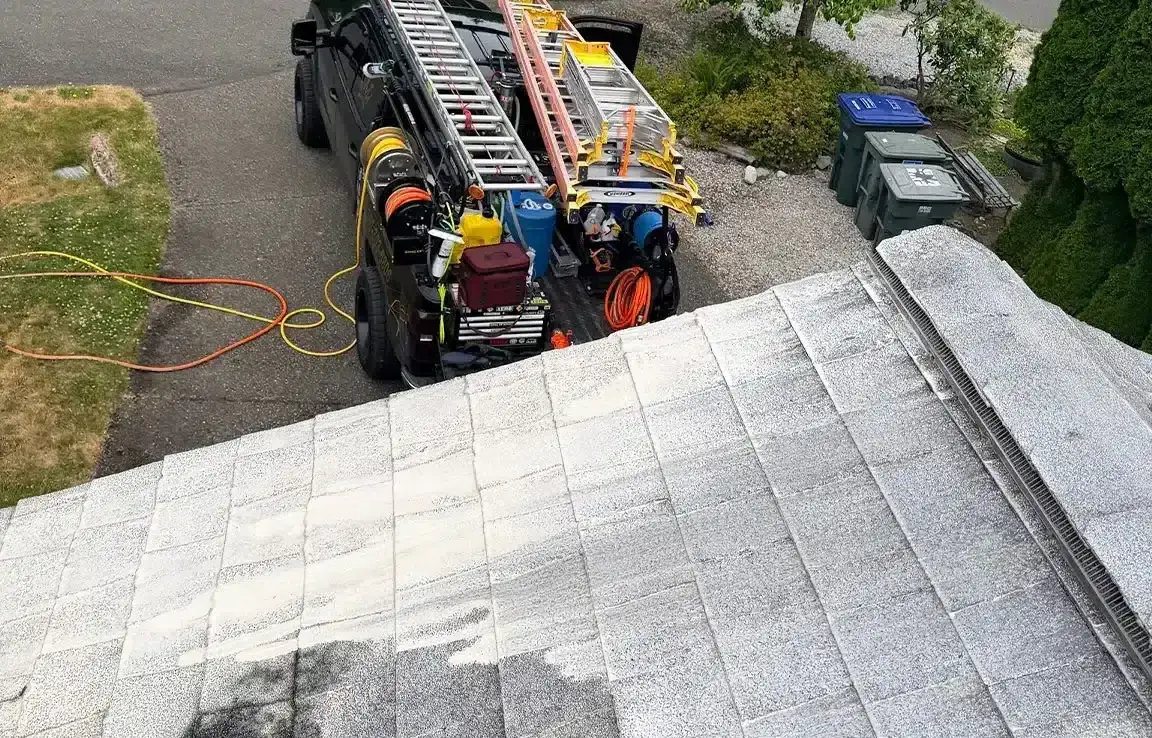
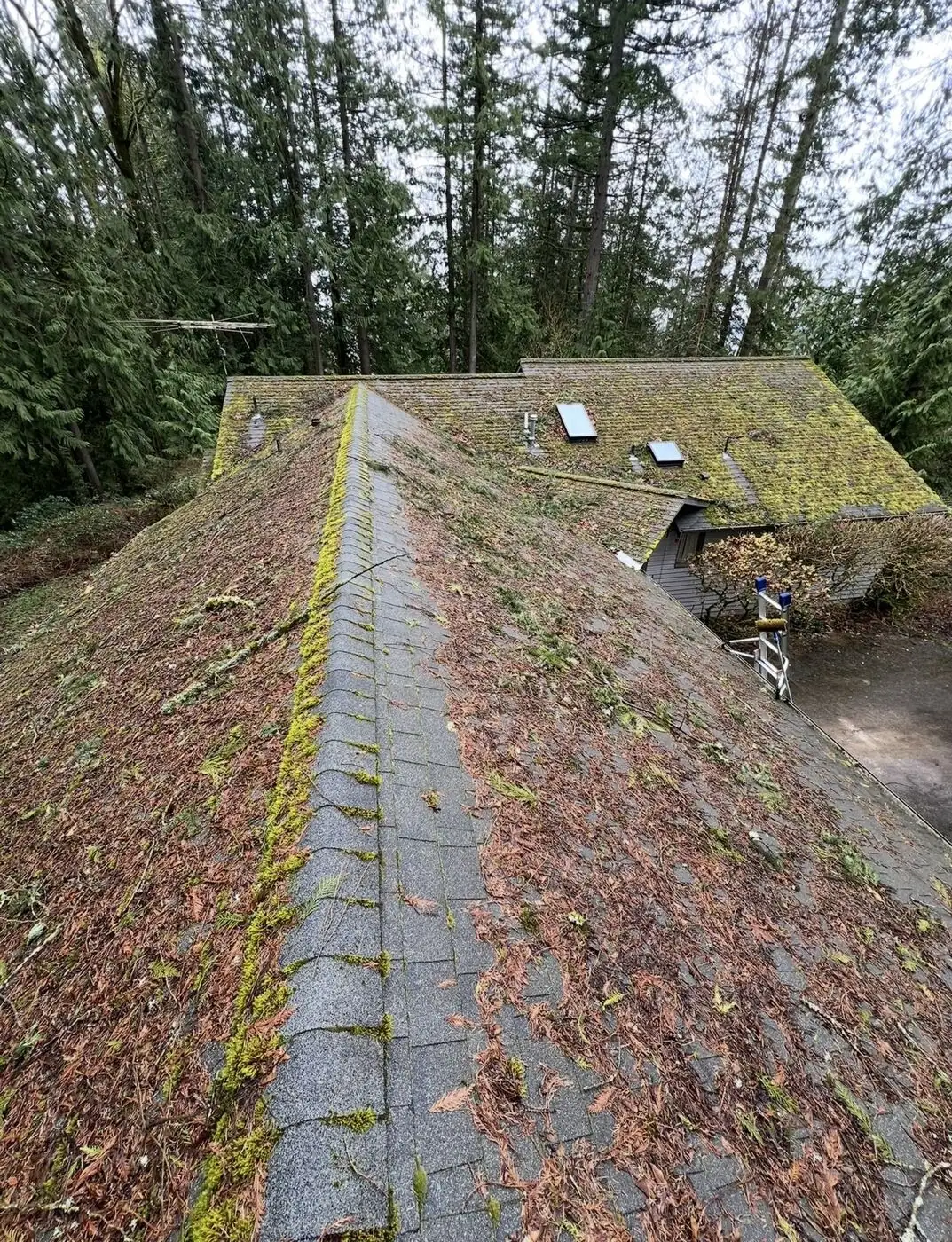 Before
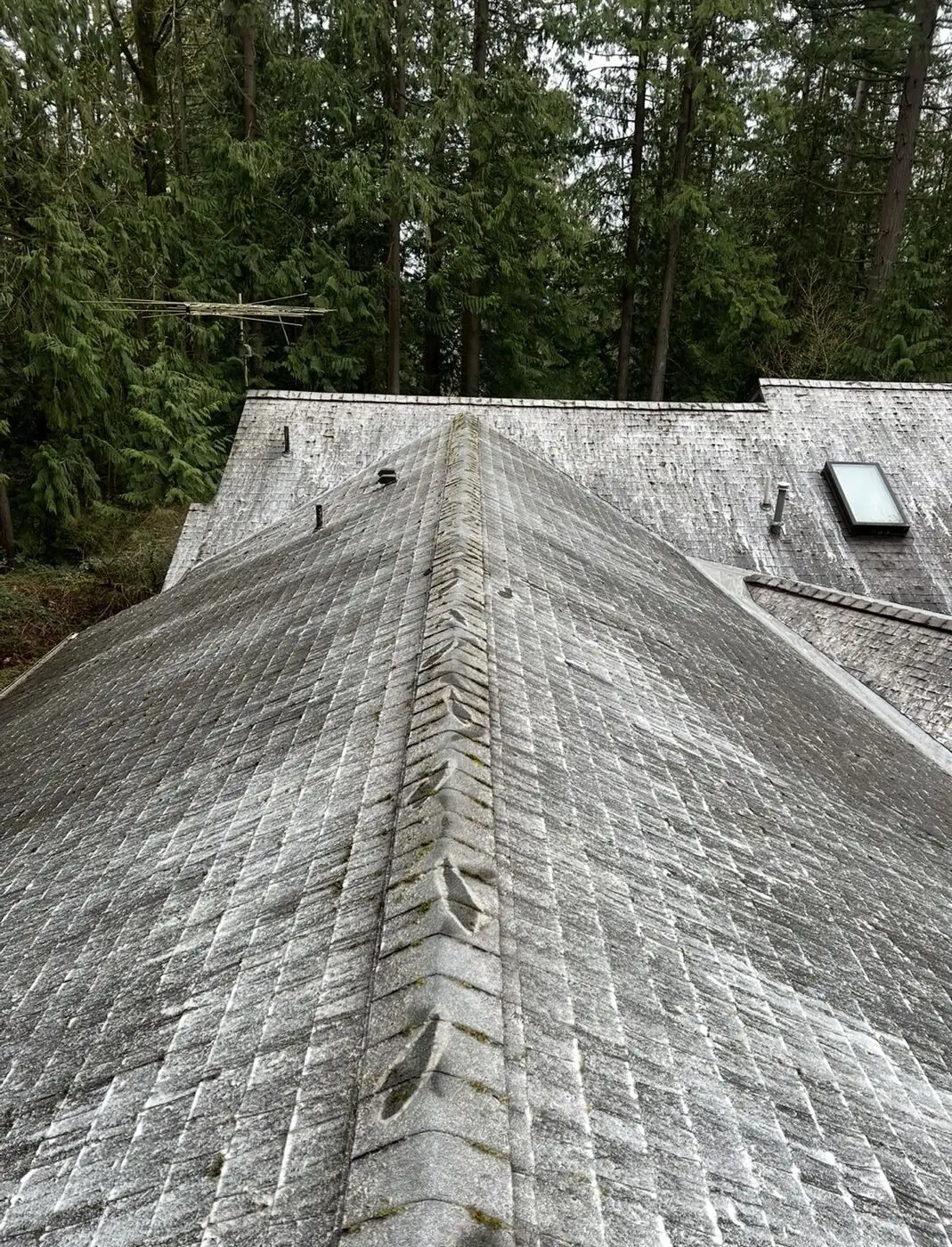 After
What about metal and manufactured-home roofs?
Ferndale counts 411 mobile homes in the census figures, and their roofs are a separate case. Many are low-pitched, some are metal, and not all of them are built to carry a person walking on them. Before quoting we look at how the roof is built and decide how it can be reached. Often that means working from ladders and the edge rather than from the roof itself.
Metal roofs, whether on a manufactured home, a barn or a newer house, are soft washed too. The coating on a metal panel is its protection in the same way granules are on a shingle, and it does not take kindly to force or to abrasive scrubbing. The standing seam metal roof profile goes into that surface in more detail.
What does a Ferndale roof clean include?
A standard roof visit covers:
- A look at the roof before anything goes on it, to identify the material, the growth and any obvious damage we should mention.
- Planting and surfaces below protected, with beds soaked in plain water and delicate items covered or moved.
- Soft-wash treatment of every affected face, at low pressure, with a solution matched to the roofing and the growth.
- Loose moss lifted by hand where it has built into thick mats, without scraping the shingle surface.
- A gentle rinse of the roof, the walls it drained down and the ground below.
- Gutters checked for anything the treatment has washed into them.
- A note on anything we noticed, such as lifted shingles or damaged flashing, for you to follow up with a roofer.

How does soft washing work on a Ferndale roof?
It swaps force for time. The solution goes on at roughly the pressure of a garden hose and stays on long enough to kill what is growing. After that, the job continues without us: over the next few weeks, rain and wind carry off the dead growth, and the roof keeps improving after the truck has left.
That delay is worth understanding before booking. Algae streaks usually fade within days. Moss turns brown and dry and lets go over several weeks. Lichen can take a season or more. Anyone who promises a spotless roof on the day is either scraping or blasting, and both take shingle with them.
We keep our weight off fragile roofing wherever we can, work from ladders or a walkable ridge where the roof allows it, and avoid treating in direct hot sun or ahead of heavy rain, when the solution would either dry too quickly or wash away before it has done its work. The general method, and why pressure never has a place on a roof, is laid out on the main roof cleaning page.
What if the moss has got under the shingles?
Then the roof needs more than a surface clean. Moss that has worked its way under the shingle edges lifts them, lets wind-driven rain in behind them and keeps the underside wet. You can often spot it from the ground as shingle edges that no longer sit flat along the lower rows.
The approach is still gentle: treat the moss so it dies, lift the loose material out from under the edges by hand, and let the rest weather away. The page on moss under shingles covers what to look for and why forcing it out does more harm than good. If lifted shingles have cracked or lost their seal, that is work for a roofer, and we will tell you so.

What drives the cost of roof cleaning in Ferndale?
The price is set on site after we have seen the roof, and it depends on:
- Roof area, the starting point of any quote.
- Pitch and height. A steep two-storey roof needs more setup and slower work than a low single-storey one.
- Material. Composition, metal and older or fragile roofing each need a slightly different approach.
- How established the growth is. Light algae on a young roof is a quick job. Thick moss and old lichen take more treatment and more hand work.
- Access and surroundings. Planting close to the eaves, conservatories, decks and tight side yards all add protection work.
- Runoff management, which depends on where the downspouts go and how close the nearest drain is.
Roof and gutters booked together share one visit, and the order is always roof first.
When should a Ferndale roof be cleaned?
Treatment works well from spring into early autumn, during a spell of mild, dry weather. The solution needs a few dry hours to work, and the dead growth comes off faster when it is followed by ordinary rain rather than a downpour.
The time to look at your roof, though, is the wet season. Moss is swollen and bright green in winter and shrunken and grey by late summer, so a roof judged in August almost always looks healthier than it is. If you have been meaning to get the roof seen to, a quote in winter and treatment in spring is a sensible rhythm.
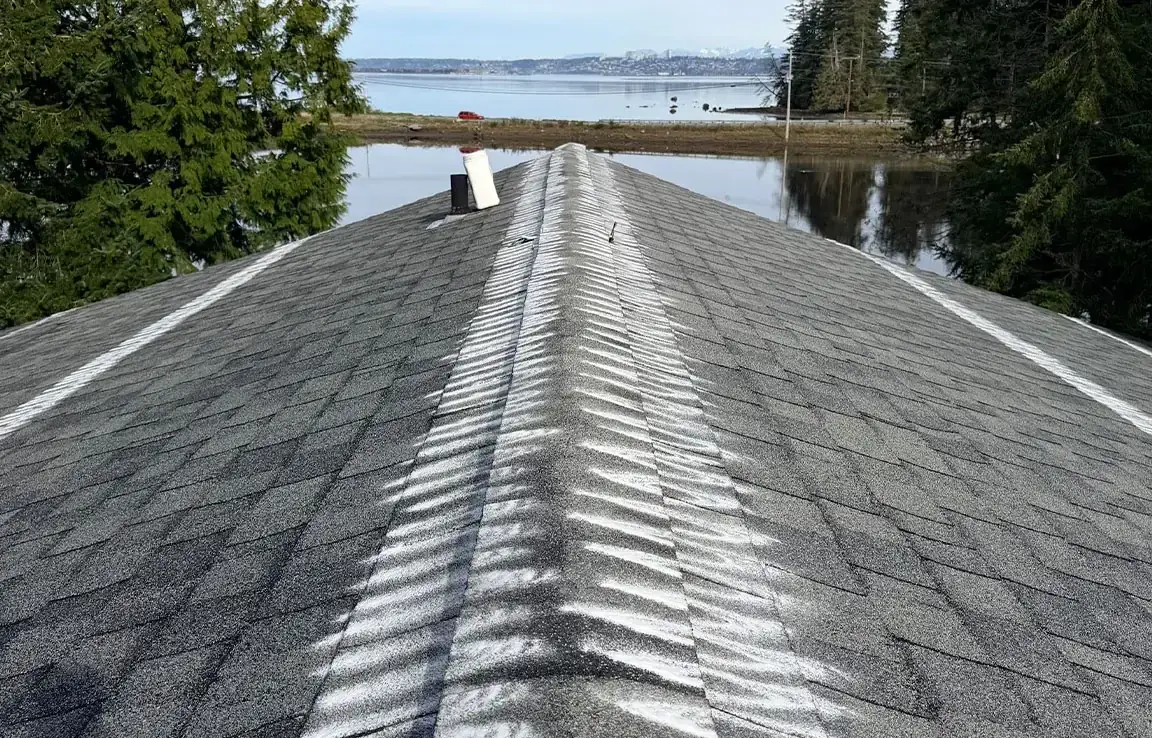
Where does the rinse go, and what do Ferndale’s rules say?
This is where roof work differs most from a plain rinse. Inside city limits, Ferndale Municipal Code 13.35.020(B)(4) allows “routine external building wash down that does not use detergents.” A roof soft wash uses a cleaning solution, so it sits outside that allowance and falls back under the code’s general prohibition on other discharges.
In practice that means planning around the gutters, because a roof drains straight into them. Where downspouts feed a storm connection, we manage them so the first runoff from the treatment does not go down that pipe. Nearby street inlets get covered, and the rinse is sent onto lawn and planting rather than into a drain.
In the unincorporated Ferndale Urban Growth Area, the county’s illicit-discharge rules under WCC chapter 16.36 apply instead, because Whatcom County’s 2025 Stormwater Management Program includes the UGA in its permit area. The wider comparison is on the wash water and storm drains page.
Should the gutters be done at the same time?
Almost always. A roof clean sends moss, granules and dead growth down into the gutters, and if the gutters were already part-full, that is enough to block an outlet. Clearing them straight after the roof means the next heavy rain has a clean path to the ground. How we handle that part of the job is on Ferndale gutter cleaning.
How do I book roof cleaning in Ferndale?
Call (360) 303-6806 or send a request online. We will come out, look at the roof with you, tell you what is growing where and whether it needs doing this year, and write down a price before any work starts.
King of Kings is owner-run, with every technician trained by the owner himself, and it carries a Washington State business licence and Labor & Industries coverage. More on what we do around town is on the Ferndale page.
Roof cleaning questions from Ferndale homeowners
- Do you pressure wash roofs in Ferndale?
- No, on any roof. High pressure strips the granules that protect a composition shingle and can force water up under the courses. We soft wash instead, letting a low-pressure solution kill the growth and the weather finish removing it.
- Why is there still moss on my roof a week after the clean?
- Because it is dead but still attached. Treated moss turns brown, dries out and lets go over the following weeks as rain and wind work on it. Scraping it all off on the day would take shingle surface with it, which is the trade we are trying to avoid.
- My roof is only ten years old. Is it too early to clean it?
- Not if something is growing on it. Early growth is the easiest to deal with and does the least harm before it is treated. If there is nothing there yet, we will say so and suggest you check the shaded faces again in a year or two.
- Can you clean a manufactured-home roof?
- Usually, yes. Many are low-pitched metal or composition roofs that cannot take much foot traffic, so we look at the structure and work from ladders or the edge wherever that is the safer option. If a roof cannot be reached safely, we will tell you before quoting.
- Will the roof treatment harm my plants or my lawn?
- We soak the planting under the eaves with plain water before starting, keep overspray off the beds, and rinse them again when we finish. Sensitive plants right under a downspout can be covered for the duration.
- Does the runoff go into the storm drain?
- Not if we can help it. A roof soft wash uses a cleaning solution, so it is outside Ferndale's allowance for detergent-free wash down. Downspouts that feed a storm connection get managed, nearby inlets get covered, and the rinse is directed onto vegetation.
- Can you tell me if my roof needs replacing?
- No, and we will not pretend to. We clean roofs; we are not roof inspectors. If we notice cracked, curling or missing shingles while we are up there, we will point them out and suggest a roofer takes a proper look.