Whatcom County
Roof Cleaning & Debris Removal in Bellingham, WA
The short answer
Bellingham roofs sit under a 40% tree canopy of fir, cedar and maple, and most of the year's rain lands between October and March, so moss, lichen and algae get a long damp season to take hold. We soft wash at low pressure, keep rinse water away from storm drains, and quote free on site.

Randy Fee — Owner, King of Kings Window Cleaning
Washington business licence, UBI 605476674 · L&I insured · BBB rated A
Randy runs the company himself, so you are dealing with the owner, not a call centre — and every technician here is personally trained by him. Working Whatcom and Skagit County since 2024.
I run the Bellingham route personally.
A Bellingham roof lives under someone’s trees. Four acres in ten across the city are canopy, and a lot of that canopy is conifer that never drops its shade in winter, which is exactly when the rain arrives. Put those two things over the same shingles and you get a roof that stays damp from October to spring and grows something on nearly every plane.
This page covers what that growth is, how we take it off without taking the roof with it, and the city rules that decide where the water goes afterwards.
What grows on roofs here, and why so much of it?
Shade plus a long wet season, and Bellingham has both in quantity. The City puts annual rainfall at about 36 inches, with roughly 80% of it falling between October and March. That rain comes during the short, dim days, so a roof plane under trees can go months without drying out fully.
The canopy is the other half. The City’s urban forest figures put tree cover at 40% of the city, some 7,252 acres, and the native mix is heavy with species that matter to a roof:
- Western redcedar and Douglas-fir, which shade year round and drop needles that collect in valleys and behind chimneys
- Big-leaf maple and vine maple, whose leaves mat down in autumn and hold water against the shingle
- Red alder and black cottonwood, fast growers that often end up overhanging a roof sooner than an owner expected
- Sitka spruce, one more evergreen on the list, and one more source of shade that does not lift in winter
That mix produces three kinds of growth. Black algae streaks run down from the ridge. Lichen sits in flat, crusty patches. Moss builds into cushions along the shaded eaves and in the valleys, and that is the one that does real harm. The service hub for roof cleaning explains the biology of each at length.
Is the shade getting better or worse?
Worse, from a roof’s point of view, and on purpose. The City’s draft urban forest plan sets a canopy target of 45% by 2050, up from the current 40%. That is good news for the city and a fair warning for anyone with shingles under a young tree: the shade line over your roof is more likely to grow in the next decade than to shrink.
It is also why we tell people not to plan their roof around how it looked when they bought the house. A lot that was open ten years ago may have a maple or an alder reaching over the ridge now, and a roof that used to go five years between treatments starts needing one every three.
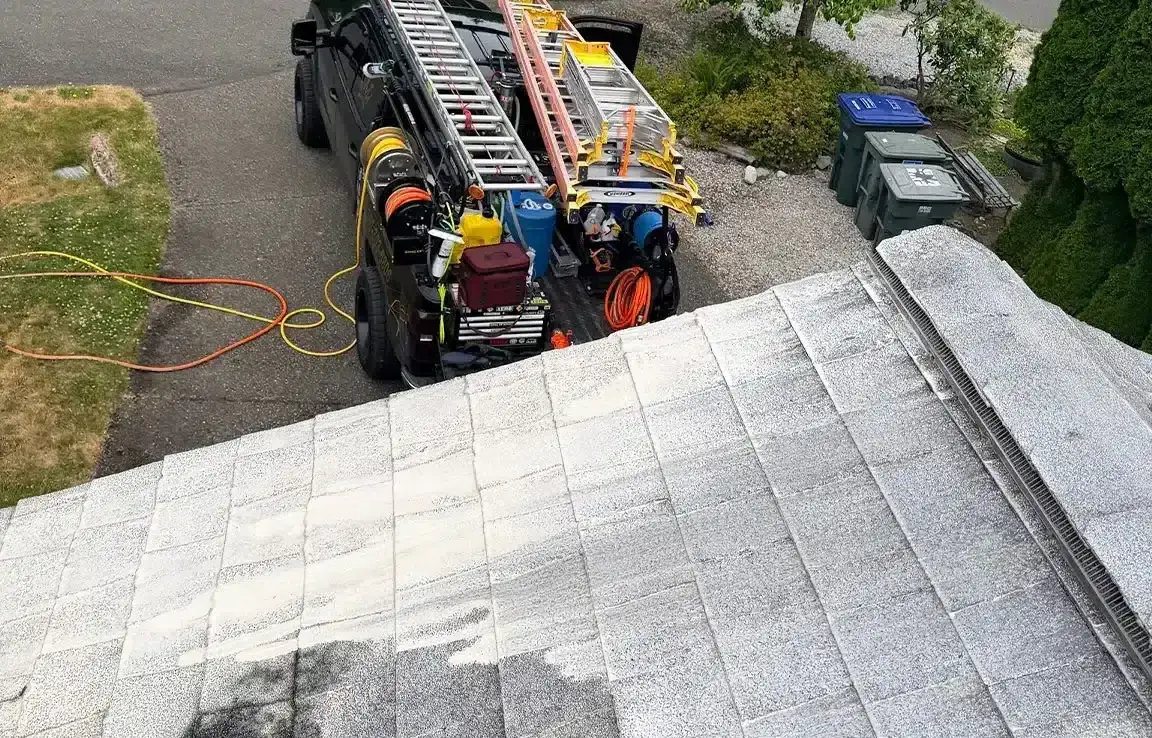
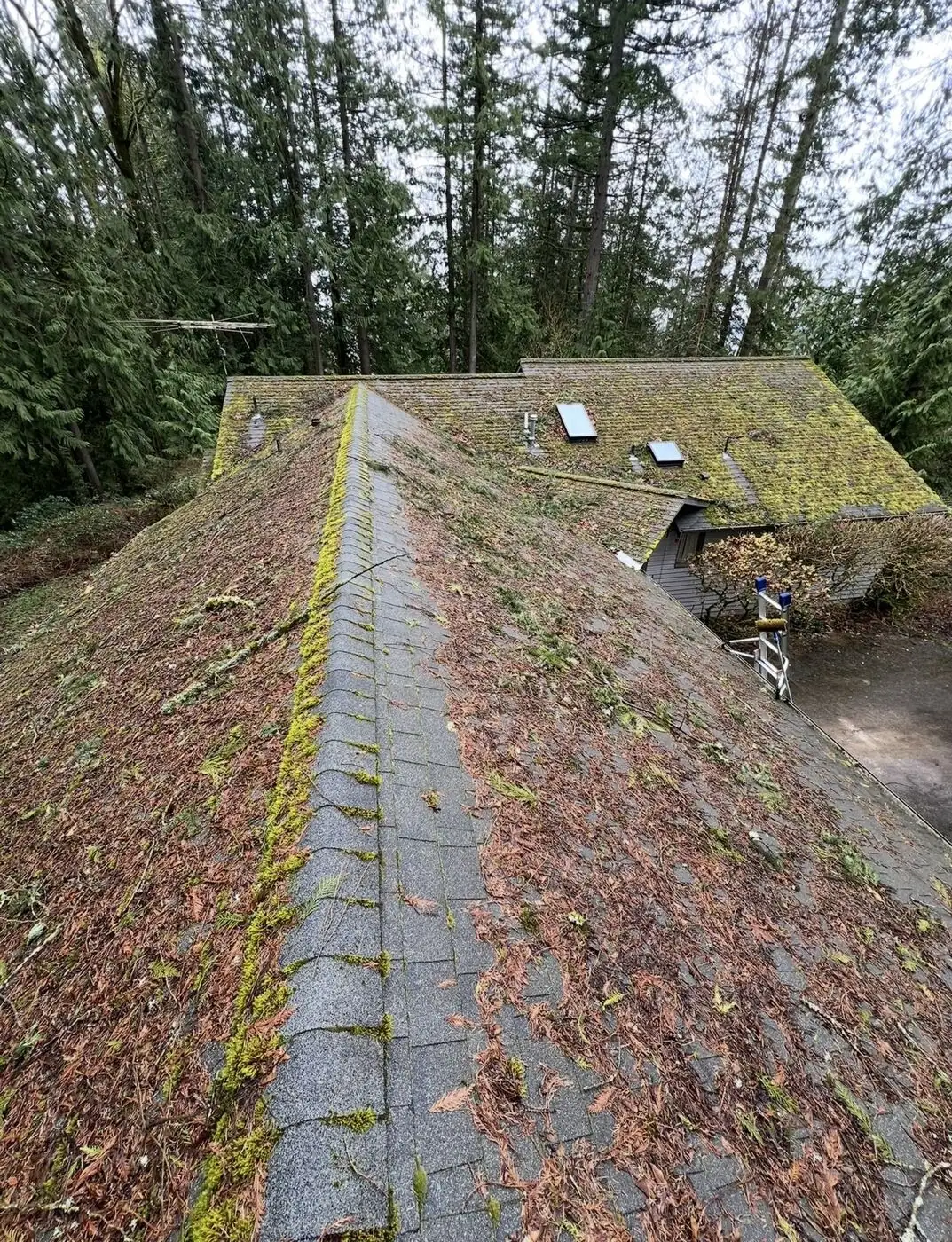 Before
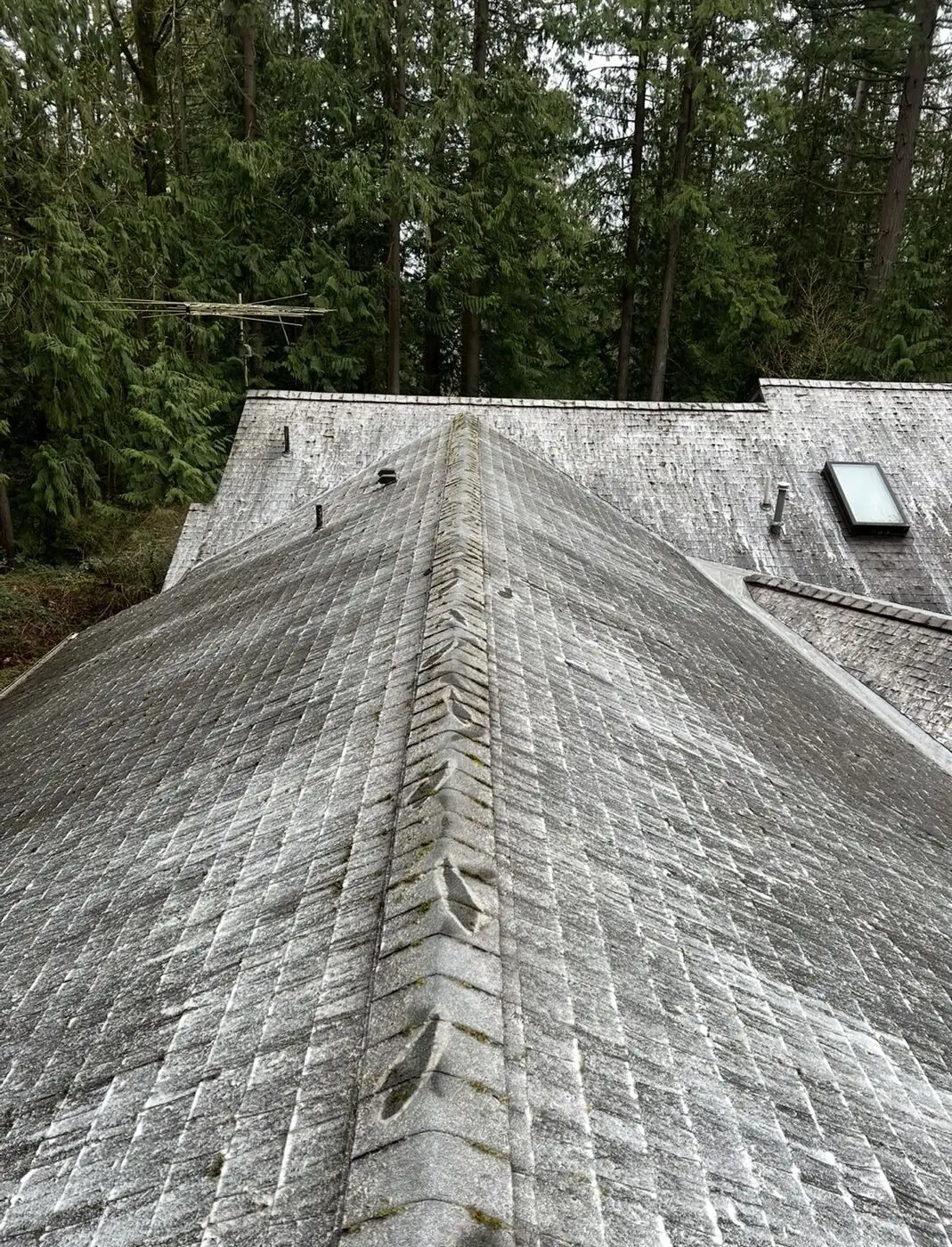 After
Which roofs in the city need the most care?
Material decides the method before the moss does.
Composition shingle is the bulk of what we treat. Its mineral granules are the shingle’s weather surface, and losing them shortens the roof. So everything we do on asphalt is designed around keeping granules where they are, which rules out pressure and rules out scraping. The composition asphalt shingle profile goes into how that surface ages.
Cedar shake and shingle concentrates in the wooded south end, around Edgemoor, Fairhaven, South Hill and out along Chuckanut Drive. Wood absorbs whatever is put on it, and moss roots into the checks and the joints between courses. Cedar gets a milder solution, careful control of how wet the wood gets, and no prying at the growth. The cedar shake roof profile has the longer version.
Metal, where we find it, does not host algae the way asphalt does, but needles pile in the seams and the finish is sensitive to the wrong chemistry.
Older districts deserve a note too. Bellingham has eight National Register historic districts, including Fairhaven, Sehome Hill, South Hill, Eldridge and York. The Cissna Cottages date from 1900 to 1904, and York was substantially built out by the Great Depression. Older roofs are worth a slower look at the quote before anything goes on them.
What does the job include?
A standard visit on a Bellingham roof covers:
- A walk around the property first, looking at the roof from every side and noting where planting, paths and drains sit below the drip line
- Covering or berming any storm inlet in the work zone, and pre-wetting beds underneath
- Clearing loose needles and leaf mats from valleys and from behind chimneys and skylights, by hand or blower
- Low-pressure application of a solution chosen for the roofing material and the growth on it, left to dwell
- A gentle rinse where the method calls for one, directed away from drains
- Rinsing down the planting and hard surfaces below
- A look at the result with you, and a straight account of what will keep changing over the next few months
Gutters, skylights and glass are separate lines on the quote but usually booked in the same visit, because the roof sends material into all of them.

How is a roof soft washed without damage?
With chemistry and patience instead of force.
The solution goes on at roughly garden-hose pressure. It kills the growth rather than blasting it off, and then the Bellingham weather does the removal. Algae lightens fast, often on the day. Moss browns over the following weeks and lets go as the rain works on it, which is why the roof keeps looking better for a month or two after we leave.
We keep foot traffic off the roof wherever the application can be done from ladders and poles. Shingles are brittle when cold and soft when hot, and every step costs granules either way. When a roof does have to be walked, the decision is made on the day, in the conditions on the day. A saturated, mossy north slope in January is one of the slickest surfaces in residential work, and we would rather come back than gamble on it.
Moss that has worked its way under the courses is its own problem, and lifting shingle tabs to reach it can crack them. If that is what we find, the moss under shingles page explains what can realistically be done.
What drives the price on a Bellingham roof?
We quote on site, because the factors vary street to street:
- Size and shape. A simple gable is quick; dormers, valleys, skylights and several levels add time.
- Pitch. A steep roof changes how the solution is delivered and how the crew is secured.
- Material. Asphalt, cedar and metal each take a different solution and a different pace.
- Growth. Light streaking is a short job. Thick moss in the valleys and old lichen take longer and sometimes a second pass.
- What sits below. Dense beds, a pond, a greenhouse or a neighbour’s fence at the drip line all mean more protection work.
- Watershed location. Inside the Lake Whatcom watershed the plan is tighter and slower.
There is no figure on this page because a number without seeing the roof is a guess. A roof treated on a regular cycle costs less each round than one being rescued from ten years of growth.

When is the right time of year?
Two windows work well here, and one is overlooked.
Late spring gives the solution dry spells long enough to dwell, and gets the roof clean before summer.
Early autumn is the one people skip. Treating in September or early October means the growth is dead before the wet half of the year starts, rather than thriving on it. With four-fifths of the year’s rain still to come, that timing buys the most.
Midwinter is the time to look, not to treat. Moss is green, swollen and easy to spot in December. In August it goes grey and flat and looks far less serious than it is, which is how a lot of roofs get left a year too long.
We avoid treating in a freeze and on hot, sun-baked shingles, where the solution dries before it has done anything.
Where does the wash water go in Bellingham?
Not down the storm drain. Bellingham Municipal Code 15.42 prohibits pressure wash water entering the storm system; it has to go to sanitary sewer or to a vegetated area where the soil can filter it. A storm grate is not a sewer connection, and the creeks that cross the city, Whatcom, Squalicum and Padden among them, are what a careless rinse ends up threatening.
So inlets near the work get covered before we start, and rinse is steered onto lawn and beds. The City also flags that buildings from 1950 to 1979 may contain PCBs, and wash water from those can need licensed hazardous disposal, which is worth raising at the quote on a house from that era.
On the east side the rules go further. The Lake Whatcom watershed is the city’s drinking water source, and Basin One carries a zero-phosphorus rule on fertilisers and soil amendments. We plan watershed roofs with that in mind and keep the products we choose there under closer scrutiny. The detail sits on our wash water and storm drains page, and the neighbouring Sudden Valley roof page covers the lakeside side of that catchment.
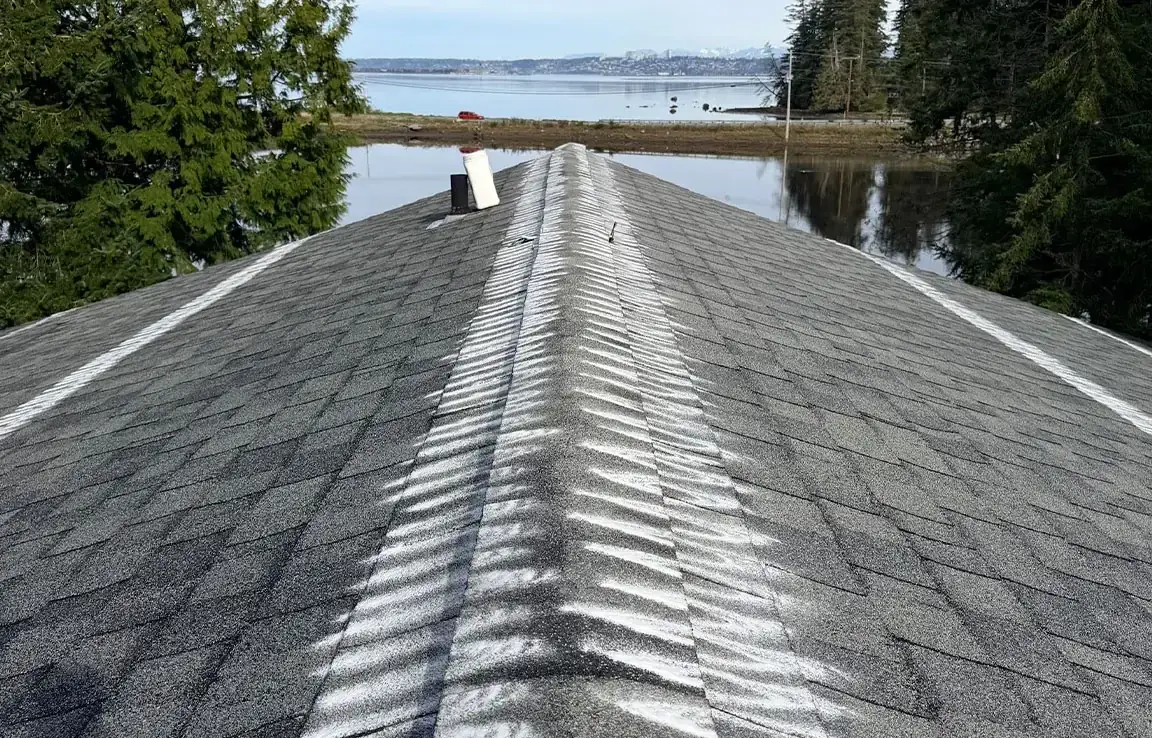
What have we done on Bellingham roofs recently?
Two jobs from September 2026, both posted to our Google Business Profile at the time.
In Roosevelt, a single-family home had its roof cleaned, gutters cleared, a moss preventative treatment applied and the exterior windows washed. Those four belong together on most houses, with the roof going first and everything it drops handled after.
In Edgemoor, one visit covered roof cleaning, gutter cleaning, solar panel cleaning, skylights, the exterior windows and a greenhouse. A combined visit like that is one setup instead of five, and it stops a clean surface lower down from being dirtied by work done above it later.
What else tends to come up with a mossy roof?
Rarely just the roof.
Gutters take everything the treatment kills. Dead moss rides the rain into the troughs for weeks, so we often clear them on the day and suggest a check after the shedding tapers off. Our Bellingham gutter page covers the needle load separately.
North walls under the same trees usually carry green film too, because they share the shade and the damp.
Solar arrays above a mossy roof collect needles and growth around the frames, and the roof beneath them is often the hardest part to reach.
We will also tell you if a roof is too far gone to be worth cleaning. Widespread granule loss, curling tabs or brittle shingles can be harmed by any method, and at that point the useful call is to a roofer rather than to us.
How do you book a roof clean here?
Ring (360) 303-6806 or send a request through the contact page. A photo of the worst roof plane helps us arrive with the right solution. After that we visit, look at the roof and what is under it, and give you a written figure, along with an honest idea of how long the result should last under your particular trees.
More on how we work across the city is on the Bellingham page.
Roof cleaning questions from Bellingham homeowners
- How often does a Bellingham roof need treating?
- Most roofs here run on a three-to-five-year cycle, and the canopy over the lot sets the pace more than the roof's age does. A house under Douglas-fir or western redcedar tends toward the short end; an open lot with full southern exposure can stretch toward five years between treatments.
- Will the moss be gone the day you finish?
- No, and we say that at the quote so nobody is disappointed. Algae streaks lighten quickly, but moss dies in place, turns brown and lets go over the following weeks as the rain works on it. Scraping it all off on the day would take shingle granules with it.
- Can you clean a cedar shake roof in the south end?
- Yes. Cedar is common around Edgemoor, Fairhaven, South Hill and the Chuckanut side, and it gets a gentler solution, controlled saturation and no scraping between courses. Weathered cedar brightens but does not go back to its original colour, and we tell you that before starting.
- Where does the rinse water go?
- Not into a storm drain. City code sends wash water to sanitary sewer or a vegetated area, so we cover inlets near the work before applying anything and steer rinse onto planting and lawn. On lots inside the Lake Whatcom watershed we plan that part of the job more tightly again.
- Do you walk on the roof?
- As little as possible. Low-pressure soft wash can usually be delivered from ladders and extension equipment. When a roof has to be walked, we judge it on the day, and a wet, mossy north slope in winter is a reason to reschedule rather than push on.
- Should gutters be cleaned at the same visit?
- Usually, but the timing matters. Dead moss keeps sliding off for weeks after treatment and ends up in the troughs, so many owners book the roof and gutters together and then have the gutters checked again once the shedding slows.
- Can you tell me whether my roof needs replacing?
- No. We clean roofs; we are not roofers or inspectors. If something catches our eye while we are up there, such as lifted tabs or bare patches, we point it out as an observation and suggest you have a roofer look at it.