
Whatcom County
Window Cleaning in Bellingham, WA
The short answer
Interior and exterior glass, screens and tracks, across all 25 Bellingham neighborhoods. Purified water on a pole for upper storeys so nothing is left behind as it dries, traditional squeegee work where hands can reach, and runoff managed because Bellingham's stormwater code has no exemption for wash water.
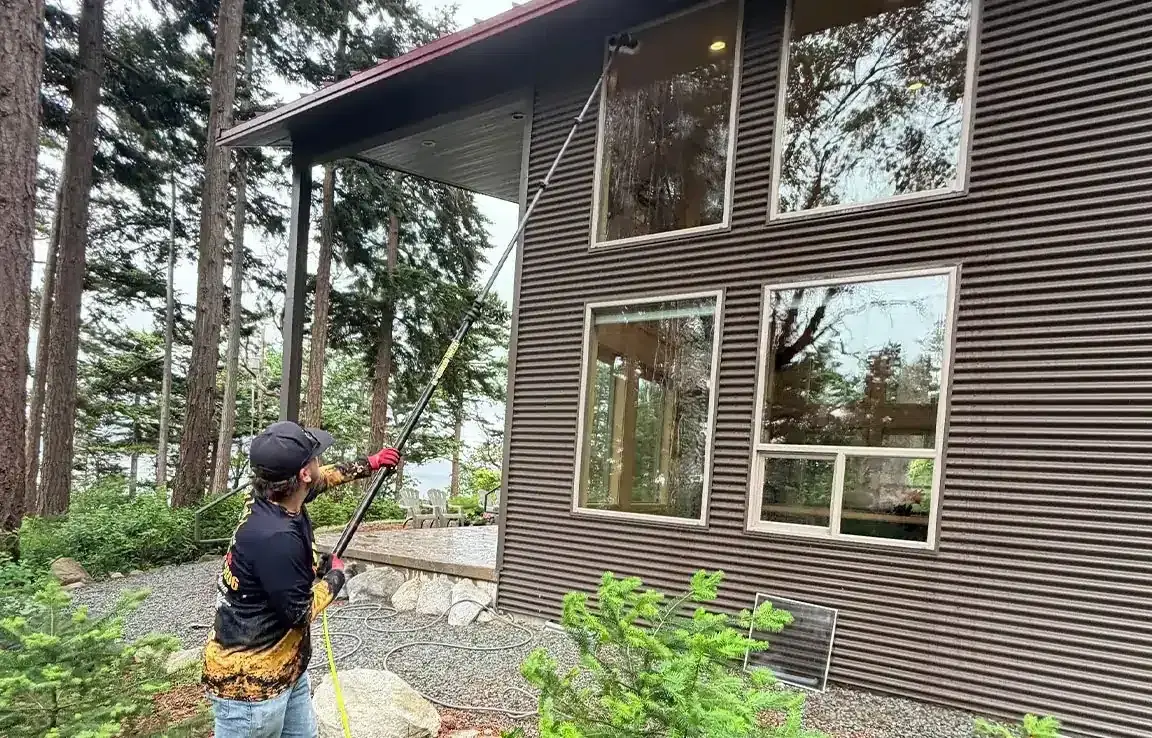

Randy Fee — Owner, King of Kings Window Cleaning
Washington business licence, UBI 605476674 · L&I insured · BBB rated A
Randy runs the company himself, so you are dealing with the owner, not a call centre — and every technician here is personally trained by him. Working Whatcom and Skagit County since 2024.
I run the Bellingham route personally.
More people search for window cleaning in Bellingham than for every other exterior-cleaning service in this city combined, and most of them are asking a narrower question than the phrase suggests: can someone get the north side and the upstairs done properly, and will the result last past the next front.
Why Bellingham glass behaves the way it does
The wet season here runs October into May and delivers roughly 80% of the year’s rain. That single fact drives most of what turns up on glass.
North and east elevations never dry. They get no direct sun for months, so organic film establishes in the frame corners and along the lower rail and stays there. This is the elevation people describe as “looking dirty again a week after it was cleaned,” and it is aspect rather than workmanship.
Interior condensation runs all winter. Warm indoor air meeting the coldest surface in the room leaves a film that builds cumulatively from November. It is why exterior-only is a false economy in this city specifically.
Tree cover does the rest. Bellingham is a wooded town. Conifer debris, sap and the fine organic matter that comes off a canopy in wind all land on glass, and under a mature fir they land continuously rather than seasonally.
What Bellingham largely does not have, compared to the valley, is heavy mineral spotting on municipal supply — that is more a well-water problem, and it turns up here mostly where a sprinkler head is hitting the glass daily.
Which side of the house gets dirtiest?
Both the north and the south, for opposite reasons. The north side collects growth because it never dries; the south side collects spatter because it takes the weather head-on. Prevailing wind in Bellingham is southerly in eleven months of the year, so fronts arrive from the south and throw rain straight at that face. Every squall leaves droplets carrying whatever was in the air, and when they dry on the pane you get the freckled look that shows worst in low winter sun.
Trees add their own layer. Street maples, cherries and oaks shed blossom, pollen and leaf fragments that stick to wet glass and set hard once the first warm week of spring dries them. Under conifers the load is steadier and finer, a grey dust of needle litter that turns to smear the moment it rains. The damp north walls that grow mildew on siding are the same walls where film builds fastest in the lower corners of the frames, so a house with one problem nearly always has the other.
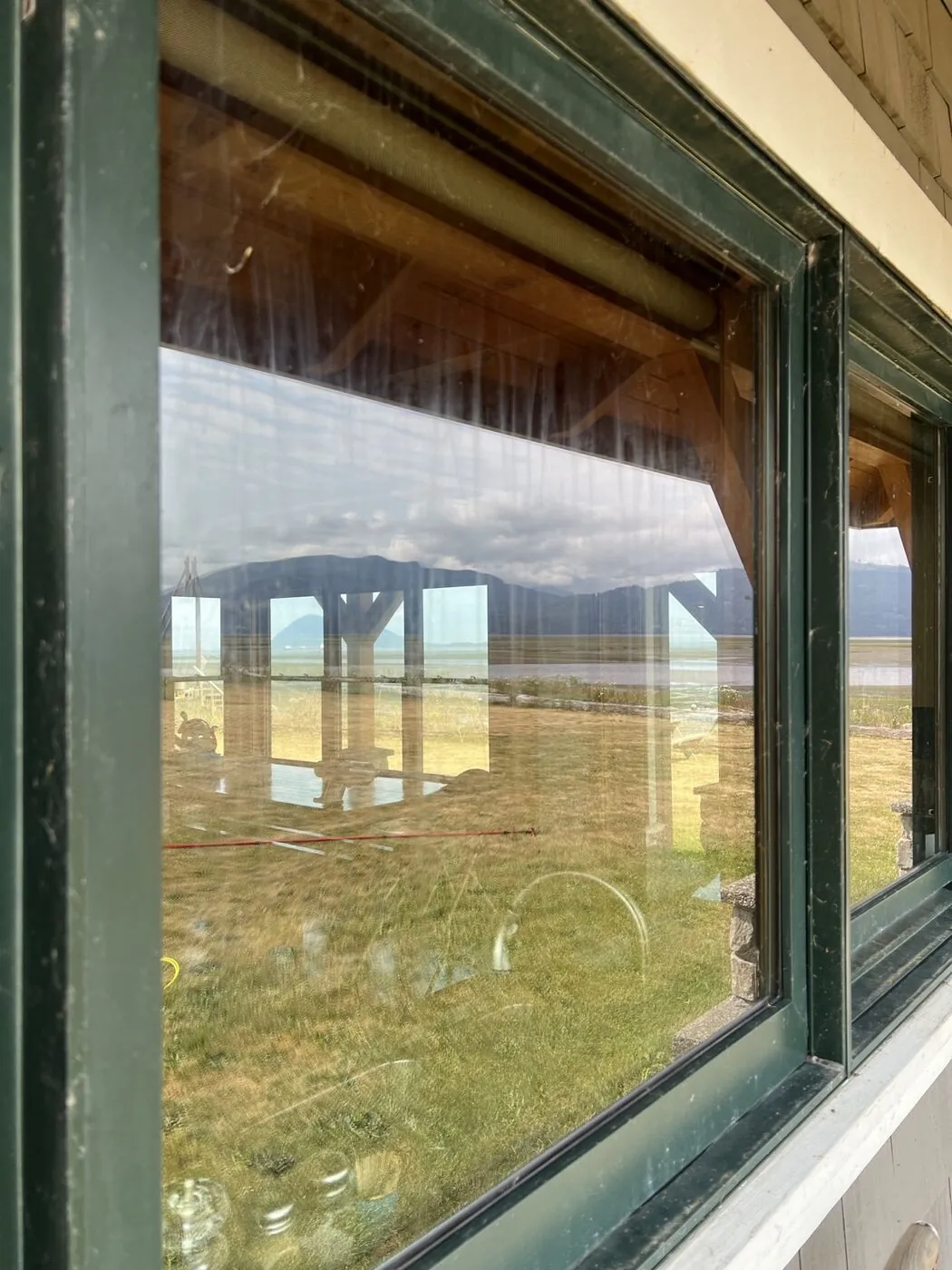 Before
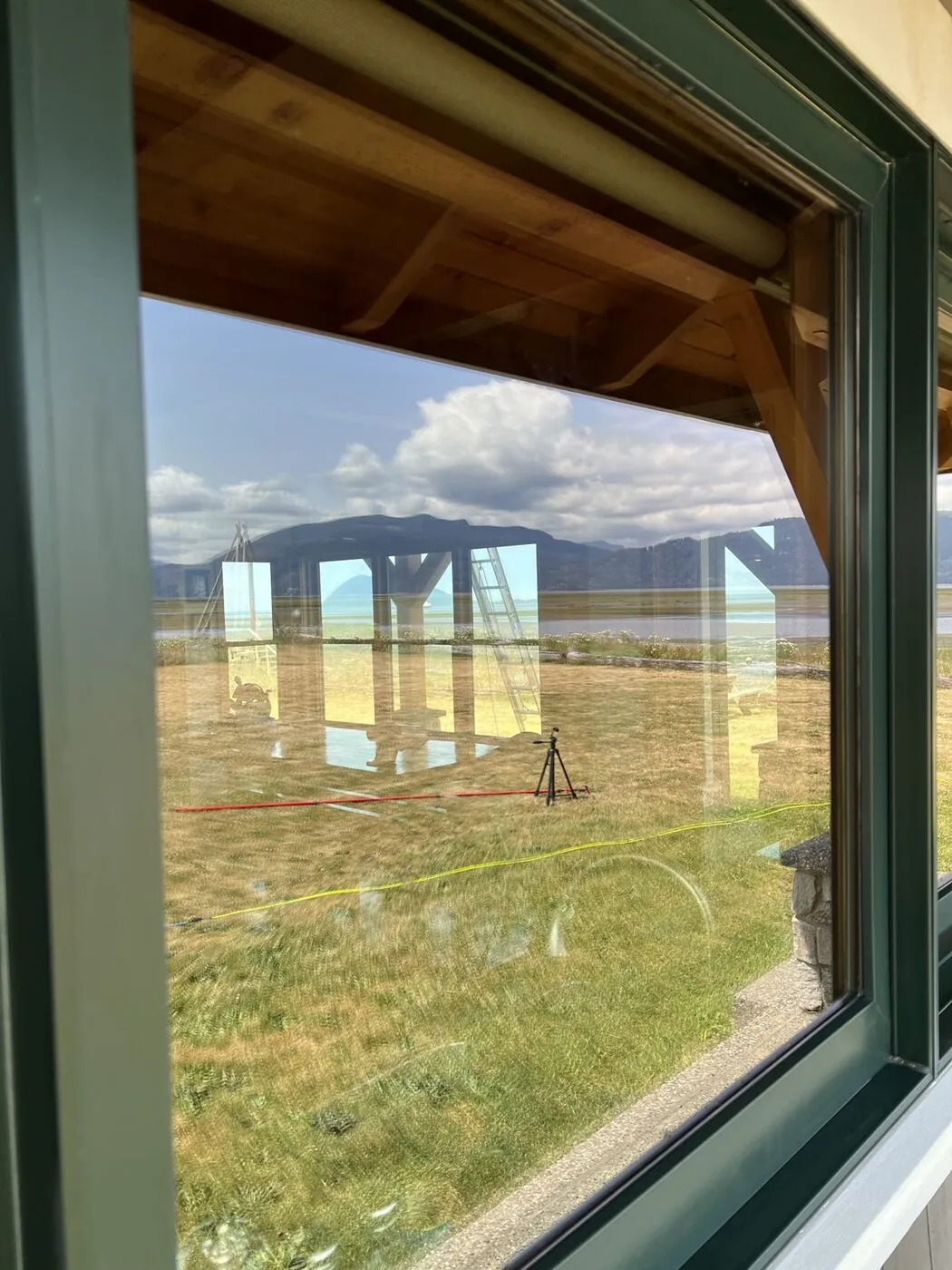 After
Two methods, chosen per window
Reachable glass gets the traditional treatment: a detergent solution, a scrubber to break the film, a squeegee to pull it off in one pass. There is no substitute for physical contact when the problem is bonded film, and on accessible glass it is still the fastest route to a genuinely clear pane.
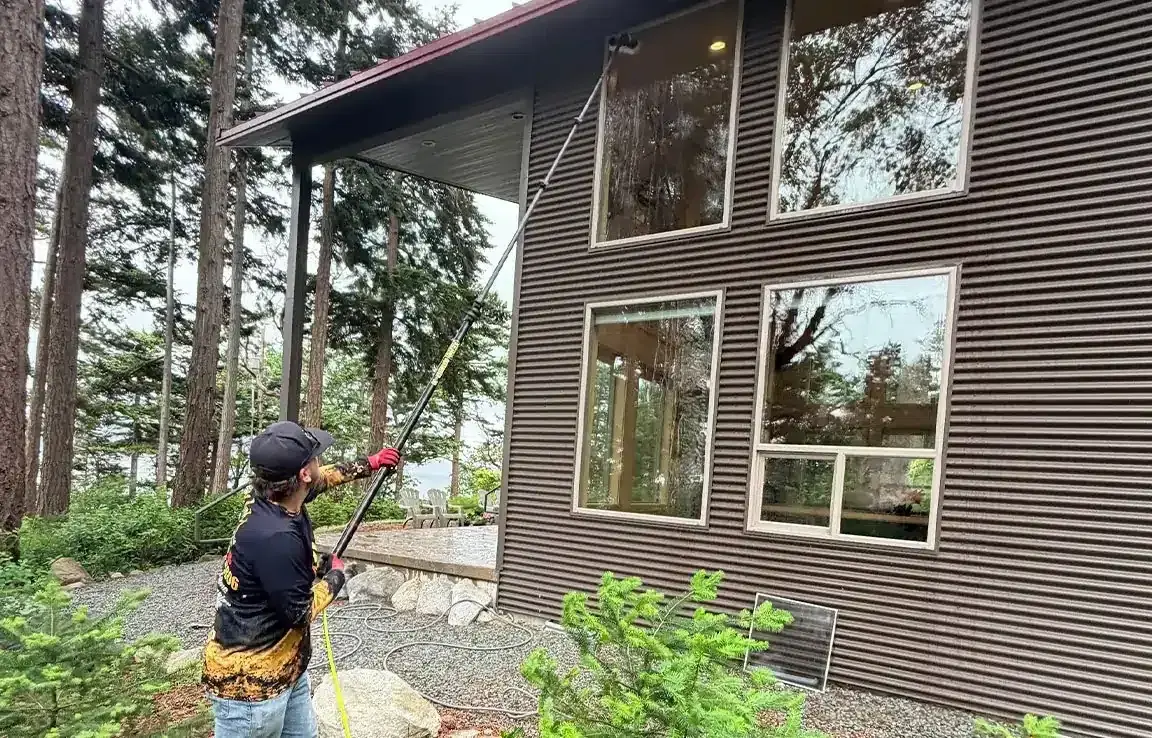
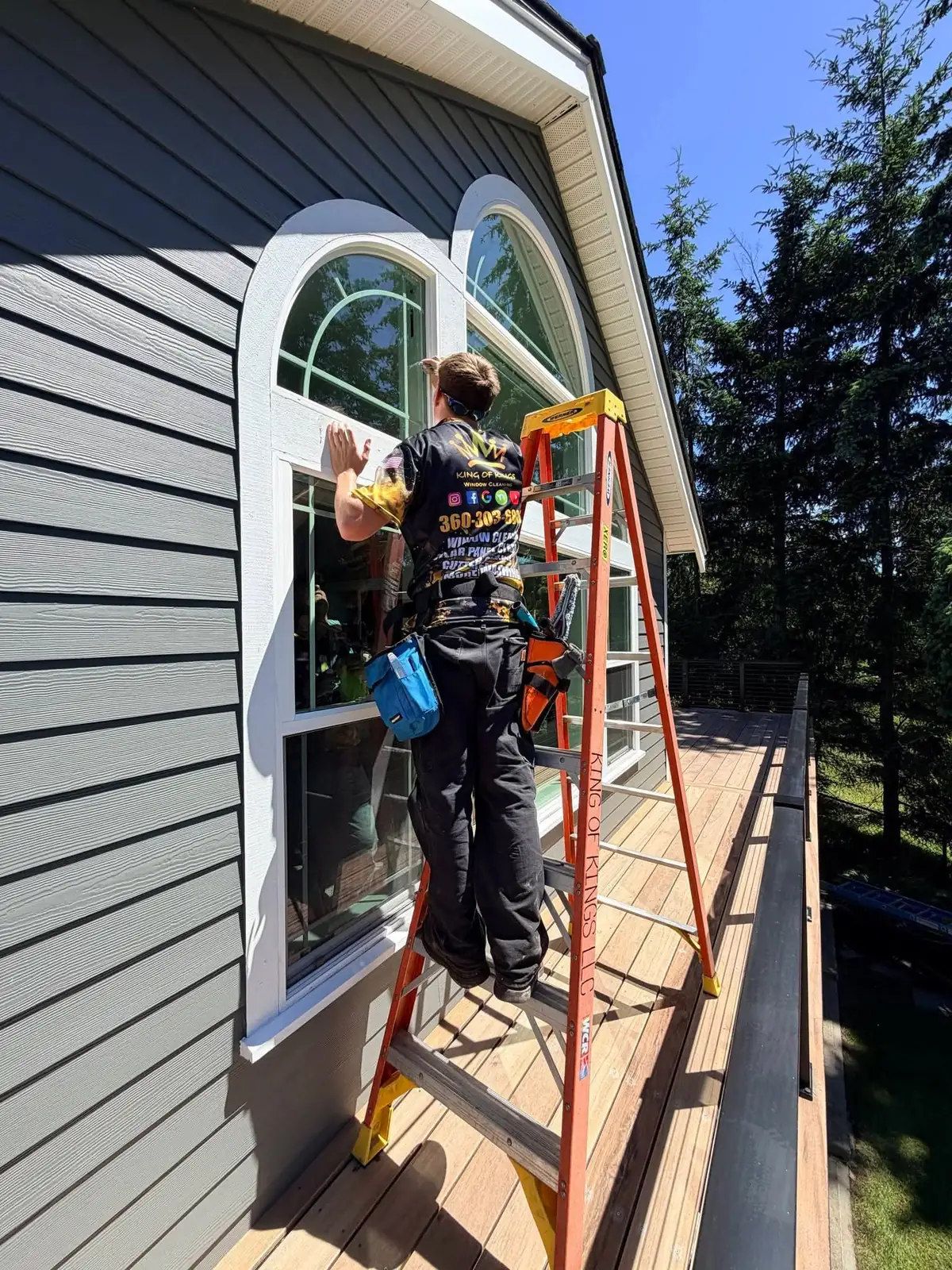
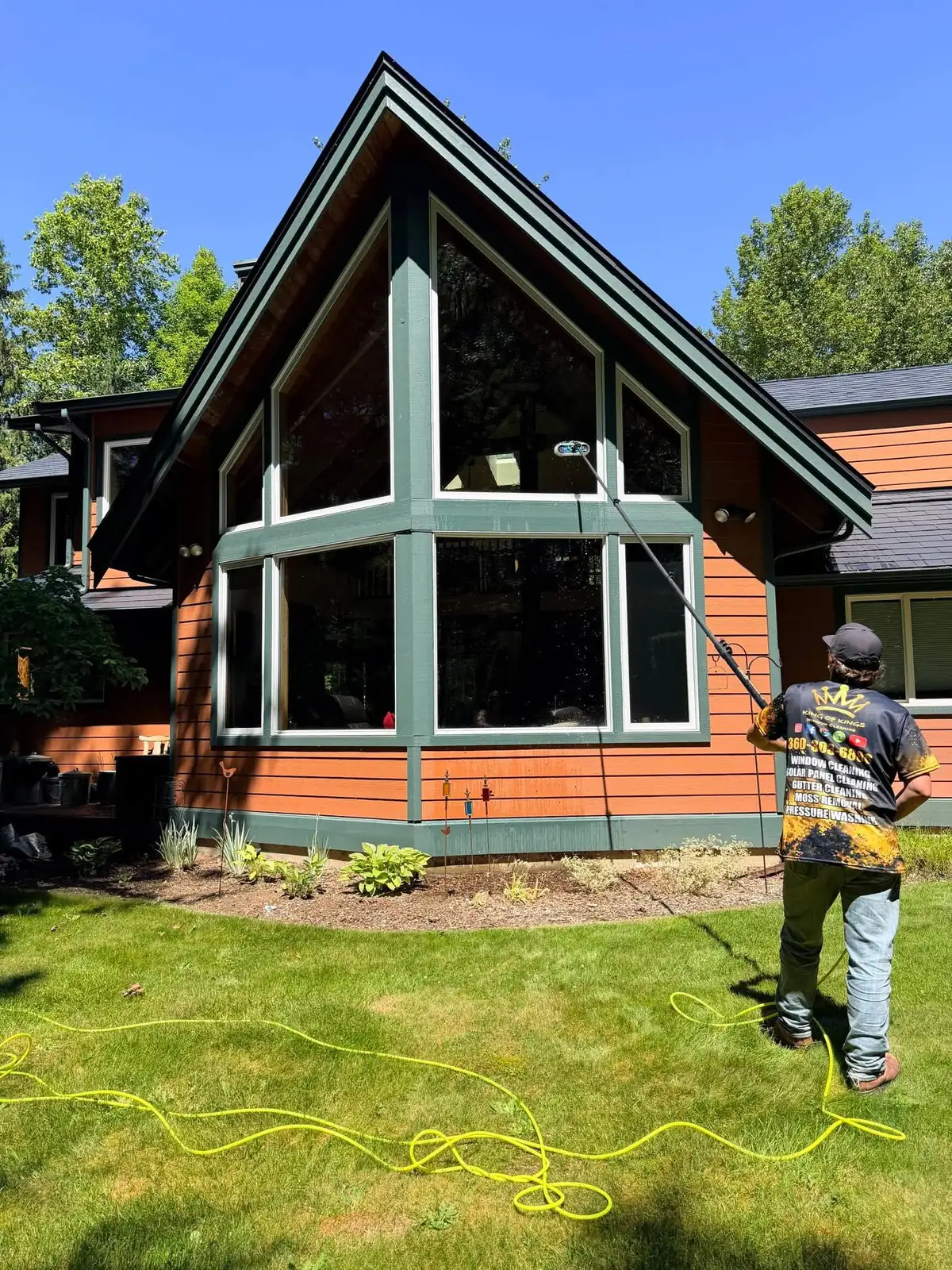
Upper storeys and anything above an obstruction get a water-fed pole running purified water. Strip the minerals out and water dries leaving nothing behind, so the glass can sheet dry untouched. It also means no ladder in your planting bed and no ladder feet on your decking.
We carry our own water and filtration on every job. That is partly about result and partly about access — a vacant property between tenants, a house with the water shut off, a job where the outside tap is behind a locked gate.
What is included
- Exterior and interior glass on every accessible opening
- Screens removed, washed, dried and returned to the opening they came from
- Tracks and sills vacuumed and wiped — grit here is what wears weatherstripping
- Frames wiped where they are washable
- Cobwebs cleared around openings and the eaves immediately above
- A walk-round with you at the end, in daylight, before we pack up
Skylights, glass balustrades, storm windows and conservatory glazing are quoted separately because access varies so much house to house. Post-construction glass is a genuinely different job — mortar splash, silicone, label adhesive and paint overspray on new glass, where doing it wrong scratches permanently.
Not included, so there are no surprises: fog between the panes of a sealed unit, which is a failed seal rather than dirt; paint and silicone removal as part of a standard clean; and any window we cannot reach safely, which we identify on the quote rather than discover on the day. Why a sealed unit fogs, and what can and cannot be done about it, is set out in the profile of insulated glass units.
Where the water goes
Worth a paragraph, because it is the part nobody else quotes on.
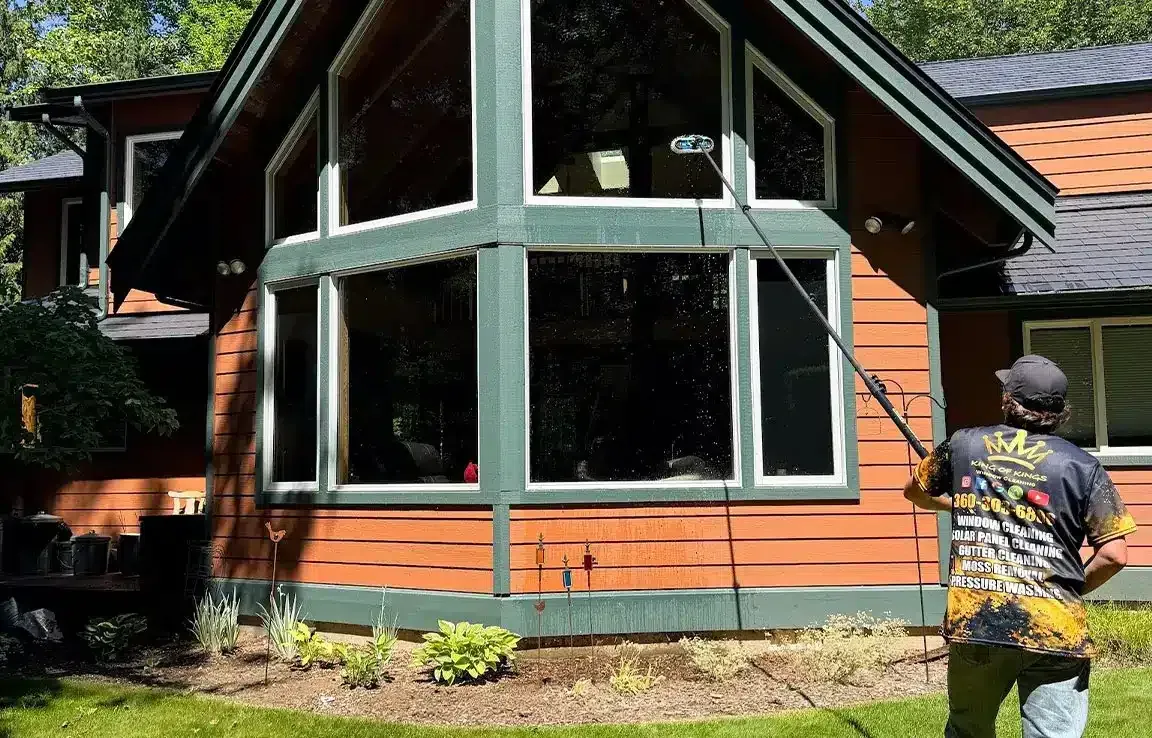
Bellingham’s stormwater chapter admits nothing but stormwater into the drainage system, and unlike Ferndale’s code there is no exemption for routine building wash down. Pole work produces runoff. So on a Bellingham job the rinse is directed to planting and lawn, where soil filters it, rather than to the gutter line and the nearest inlet — and on a Lake Whatcom watershed property, where reservoir-specific provisions apply on top, that planning is tighter again.
Full detail is on wash water and storm drains.
Glass varies more than people expect across this city
Worth knowing before a quote, because it changes the time and occasionally the answer.
The wooded south end — Edgemoor, Fairhaven, South Hill — runs to older stock: wood sashes, some original single glazing, divided lights with real muntins, and storm windows that come off and go back on. More openings, smaller panes, slower work, and sashes that want care rather than speed.
The north and east — Cordata, Barkley, Irongate, newer Meridian — is modern construction: large fixed picture units, low-E coated sealed glass, and fewer but much bigger panes. Faster per opening, harder to reach, and the low-E coating gives a faint sheen people sometimes mistake for a film that will not come off.
The lakeside and hillside lots add the access problem: glass over decking, over slopes, over mature planting, and stairwell windows nobody has cleaned since the house was built. That is pole work, and it is the reason the pole exists.
Waterfront and near-waterfront carries salt film on top of everything else, on the exposed elevations.
None of this changes the price list, because there isn’t one — it changes what we are actually looking at when we walk the property, which is why the quote happens on site.
How is glass handled in the historic districts?
Slowly, and with the expectation that some of it is older than the people living behind it. Bellingham has eight National Register historic districts, from Broadway Park and Eldridge to Sehome Hill and York. The Cissna Cottages date from 1900 to 1904, and York was substantially built out by the Great Depression, so on those streets a window can be a century-old sash with glazing putty that has dried and cracked.
Where original glass survives it is thinner than a modern pane and less forgiving of pressure. On those openings we use a light hand with the scrubber, keep blades off anything with visible ripple or seed in it, and do not force a sash that has been painted shut. Cracked panes, crumbling putty and loose glazing points get pointed out on the walk-round. We are cleaners, not window restorers, so the repair is yours to decide on, but at least you hear about it from someone who has just looked at every opening up close.
Do you clean apartment, condo and townhome glass?
Yes, and it is a growing share of what gets built here. Roughly three-quarters of the permits Bellingham issued over the past decade were for multi-family housing, which means a lot of three-storey townhome rows and small condo buildings with fixed upper glass and balconies.
Those jobs run differently from a detached house:
- Scheduling goes through a manager or an association, and residents need notice before anyone appears outside a bedroom window
- Balcony glass is often only reachable from inside the unit, so it needs a resident at home or a key arrangement agreed in advance
- Upper fixed glass over parking, entrances and landscaping is pole work, and we plan the rinse so it does not run across a shared walkway
- Ground-floor retail under residential floors is a different job again, and sits with our commercial window cleaning
What sets the price on a Bellingham window job?
There is no rate card, because the same opening count can mean very different work across this city. What the quote actually comes down to:
- Openings and pane size. A south-end house with divided lights has many small panes; a Cordata build has fewer, much larger ones.
- Storeys and what sits below the glass. Decks, slopes, conservatory roofs and planting beds all change how the glass is reached.
- Storm windows and old sashes, which take longer and want more care.
- How long since the last clean. A first visit on north-side glass after several wet seasons is restoration; the next one is maintenance.
- Extras such as skylights, balustrade glass and post-construction residue.
- Whether it rides with other work. Glass booked alongside roof or gutter work shares one setup and one trip.
When should Bellingham windows be booked?
For most houses, twice: once as the wet season lets go and once before it returns. With roughly 80% of the annual rain landing between October and March, glass cleaned in the first half of October is facing six months of weather, and shaded exterior panes will not look freshly done by February. That is not a reason to skip the autumn visit; it is a reason to book it for what it does, which is getting the interior clear before the condensation months.
The spring clean is the one that shows. By March or April the heaviest weather is behind the house, the light is coming back, and glass cleaned then stays right for months rather than weeks. If roof or gutter work is planned for the same year, put the glass after it, never before. And if the forecast shows a hard frost, we will move the date rather than work on frozen panes.
What does a recent Bellingham window job look like?
Two September 2026 visits, both posted to our Google profile on the day. In Roosevelt, exterior windows on a single-family home were cleaned as the last stage of a visit that also covered roof cleaning, gutter cleaning and a moss preventative treatment. In Edgemoor, exterior glass and the skylights were done in the same visit as the roof, the gutters and the solar panels, and the greenhouse glazing was cleaned too.
Both followed the same order for the same reason: everything above the glass first, the glass itself last. When the roof has just shed a winter of moss and the gutters have just been emptied, that is the point at which clean windows stay clean.
Booking
Call (360) 303-6806 or request a quote online. We walk the property with you, tell you which of the three problems your glass actually has — dirt, film or deposit — and price the work in front of us.
Other services in this city are on the Bellingham page, and the full method is on the window cleaning hub.
Windows questions from Bellingham homeowners
- How often should Bellingham windows be cleaned?
- Twice a year suits most houses — early spring to clear the winter's organic film and condensation residue, early autumn before the wet season starts again. Heavily treed lots and houses with a lot of north-facing glass usually want a third visit, because the shaded elevations never dry between weather systems here.
- Do you clean the inside as well?
- Yes. Interior and exterior together is the standard job, with screens and sills. Exterior-only is available and costs less, but it is a false economy on a Bellingham house — interior condensation film builds through the winter and it is the half you actually look through.
- How do you reach second-storey glass?
- A water-fed pole running purified water. The purification is the point rather than the pole: water with the minerals stripped out dries without leaving anything behind, so the glass sheet dries with no squeegee contact. It is the only sensible way to handle glass over a deck, a conservatory roof or a planting bed.
- Do you need to use my outside tap?
- No. We carry our own water and filtration, which means we can work on a vacant property or one with the water off — and it means we are not putting untreated water back onto glass we just cleaned.
- What about the storm drain?
- It matters more here than most people realise. Bellingham's code prohibits anything but stormwater entering the drainage system, and there is no carve-out for building wash down the way there is in Ferndale. On a pole job that means directing rinse to planting rather than to the gutter line, and it is part of how the work is planned rather than an afterthought.
- Will you get the hard water spots off?
- Usually, and we will tell you which before we start. Fresh mineral spotting lifts with a dedicated treatment. Spotting that has baked on for years can etch the glass itself, and no amount of cleaning removes an etch — that is a glass replacement question, and we would rather identify it on the quote than at the end of the job.
- There is fog inside the glass. Can you clear it?
- No, and nor can anyone else. That is a failed seal on an insulated unit and the haze is on the inner faces, inside a sealed cavity. We flag failed units on the walk-round and photograph them if you want a record, because many sealed units carry decades-long warranties people never claim.
- How long does a house take?
- A single-storey with twenty-odd openings is usually a morning. A two-storey with a lot of fixed glass or a stairwell window runs most of a day. Newer builds with large picture units take longer than the opening count suggests, because the panes are bigger and the reach is worse.