Whatcom County
Moss Removal in Bellingham, WA
The short answer
Bellingham roofs grow moss because the city sits under about 40% tree canopy and takes most of its 36 inches of rain between October and March. We lift the heavy growth by hand, treat what remains at low pressure, and let the weather shed the rest, with no pressure washing and runoff kept out of storm drains.

Randy Fee — Owner, King of Kings Window Cleaning
Washington business licence, UBI 605476674 · L&I insured · BBB rated A
Randy runs the company himself, so you are dealing with the owner, not a call centre — and every technician here is personally trained by him. Working Whatcom and Skagit County since 2024.
I run the Bellingham route personally.
Moss on a Bellingham roof is less a question of whether than of how much. The city grows trees the way other places grow lawns, and it takes its rain in one long, cool, grey stretch that suits moss perfectly. Leave a north-facing slope under a Douglas-fir alone for a few winters and the green cushions along the shingle edges will be thick enough to see from across the street.
The fix itself is straightforward, but it runs slower than most people expect, and the fast versions do lasting harm. What follows is how we handle it in this city in particular.
Why does moss take hold so readily in Bellingham?
Because what moss needs is the normal condition of a Bellingham roof for half the year. The city averages around 36 inches of rain annually, and roughly 80% of it falls between October and March, not in cloudbursts that sluice off and clear, but as a long run of damp days with little drying between them. Moss has no true roots and takes nothing from the shingle. All it asks for is water held against a surface and enough shade to stop it drying out.
The shade is where this city stands apart. The City counts about 40% of its area under tree canopy, some 7,252 acres, and its urban forest plan aims to push that to 45% by 2050. Whatever you think of that as a resident, for a roof it means the pressure is not going to ease off. Bellingham intends to get leafier, and roofs under that canopy will keep needing attention.
Which trees make it worse?
The conifers above all, and not only for their shade. The city’s forest species are western redcedar, Douglas-fir, big-leaf maple, vine maple, red alder, black cottonwood and Sitka spruce. Fir and cedar drop needles and fine litter all year round, and that debris packs into valleys, along the eaves and behind chimneys, where it soaks up water and gives moss a seedbed on a surface that would otherwise be hard to colonise.
The broadleaf trees do their damage in one burst. Maples and alders let go of a season’s leaves over a few weeks each autumn, and a wet mat of leaves lying on the shingles through November is a moss nursery. Street plantings here are mostly maples, cherries and oaks, so even a house with no big conifer in the yard often has a street tree reaching over the front slope.
A roof with nothing hanging over it goes far longer between treatments than one sitting under branches. Tree work is not our trade, but trimming back what overhangs the roof is the most useful single thing a homeowner can do to lengthen the interval.
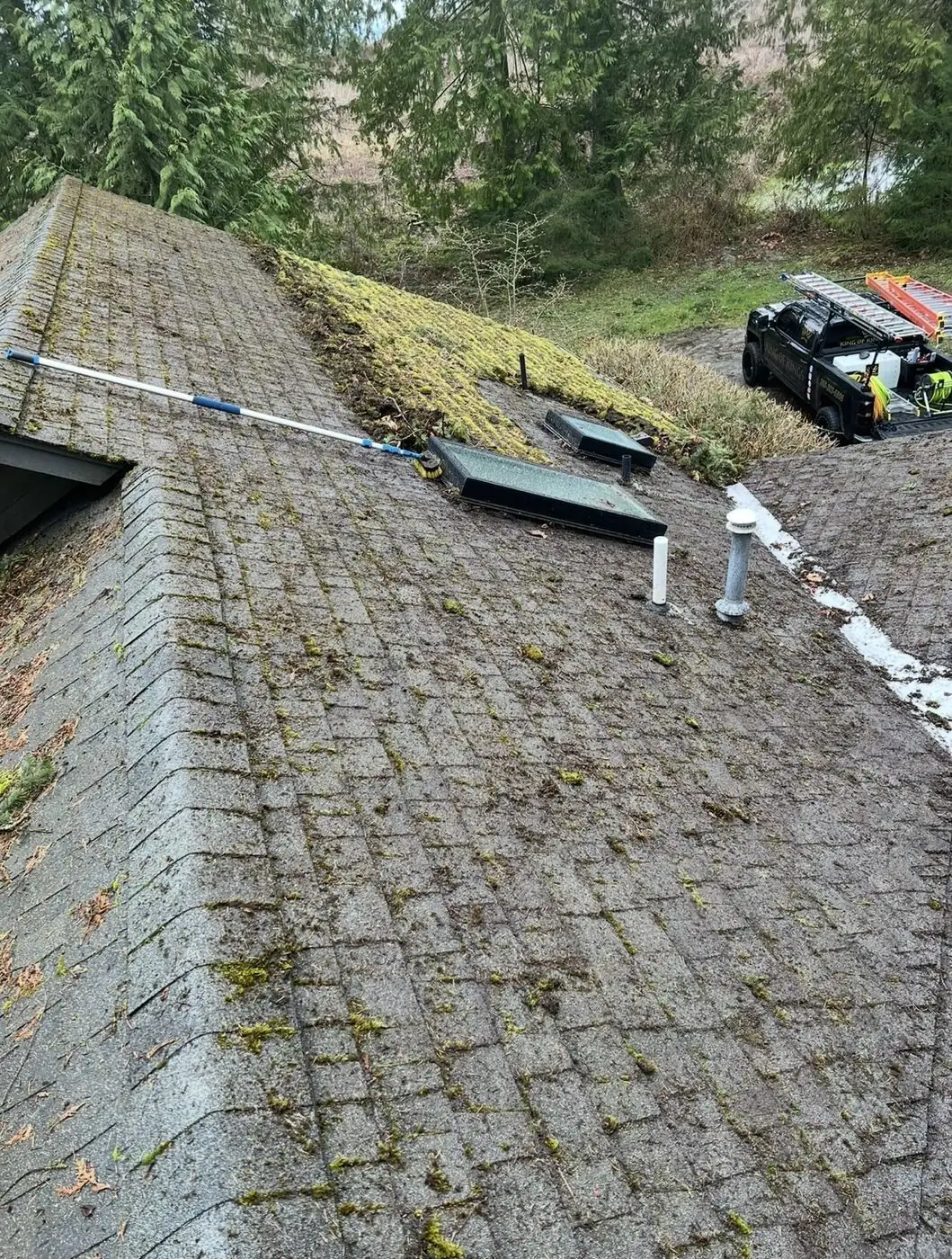
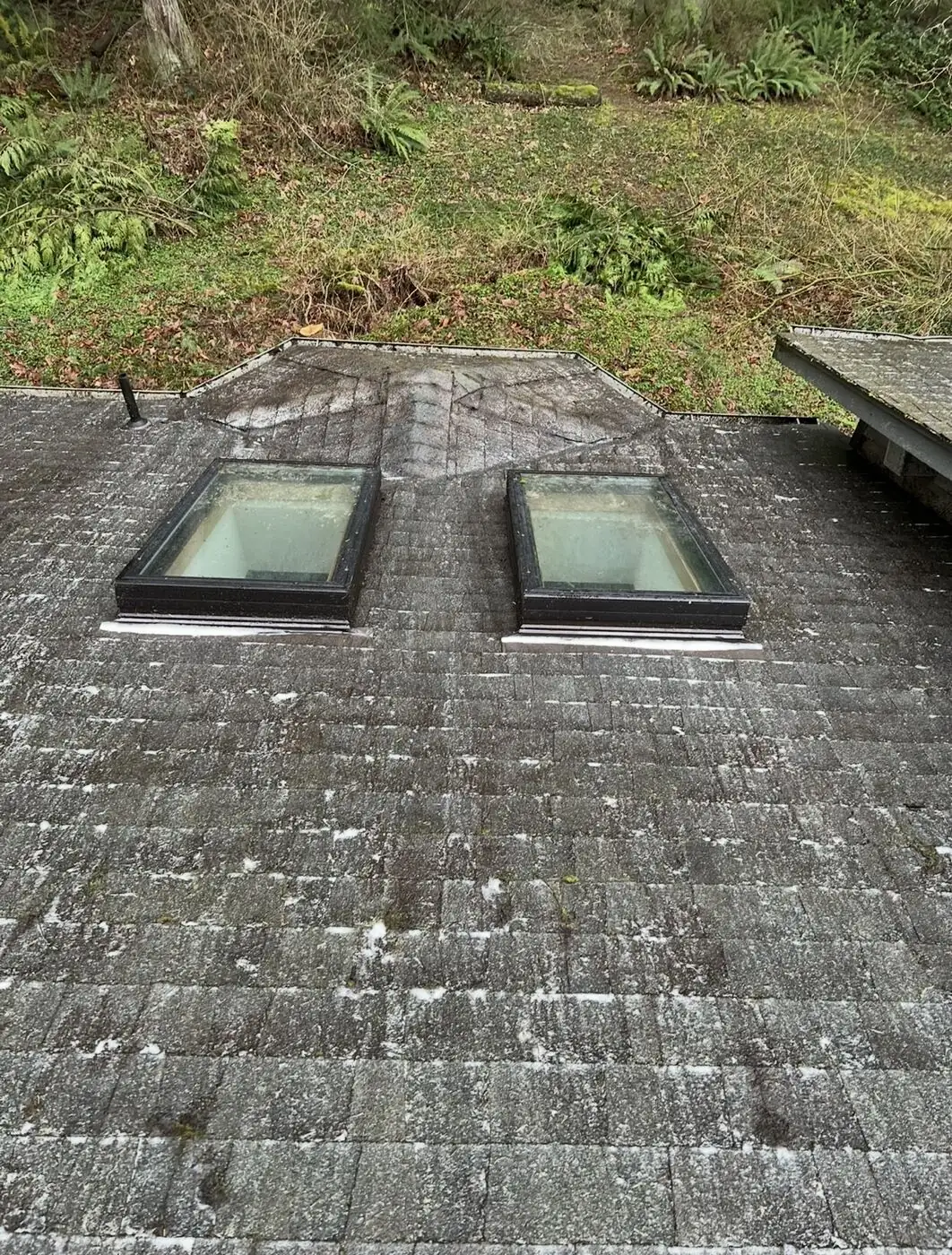
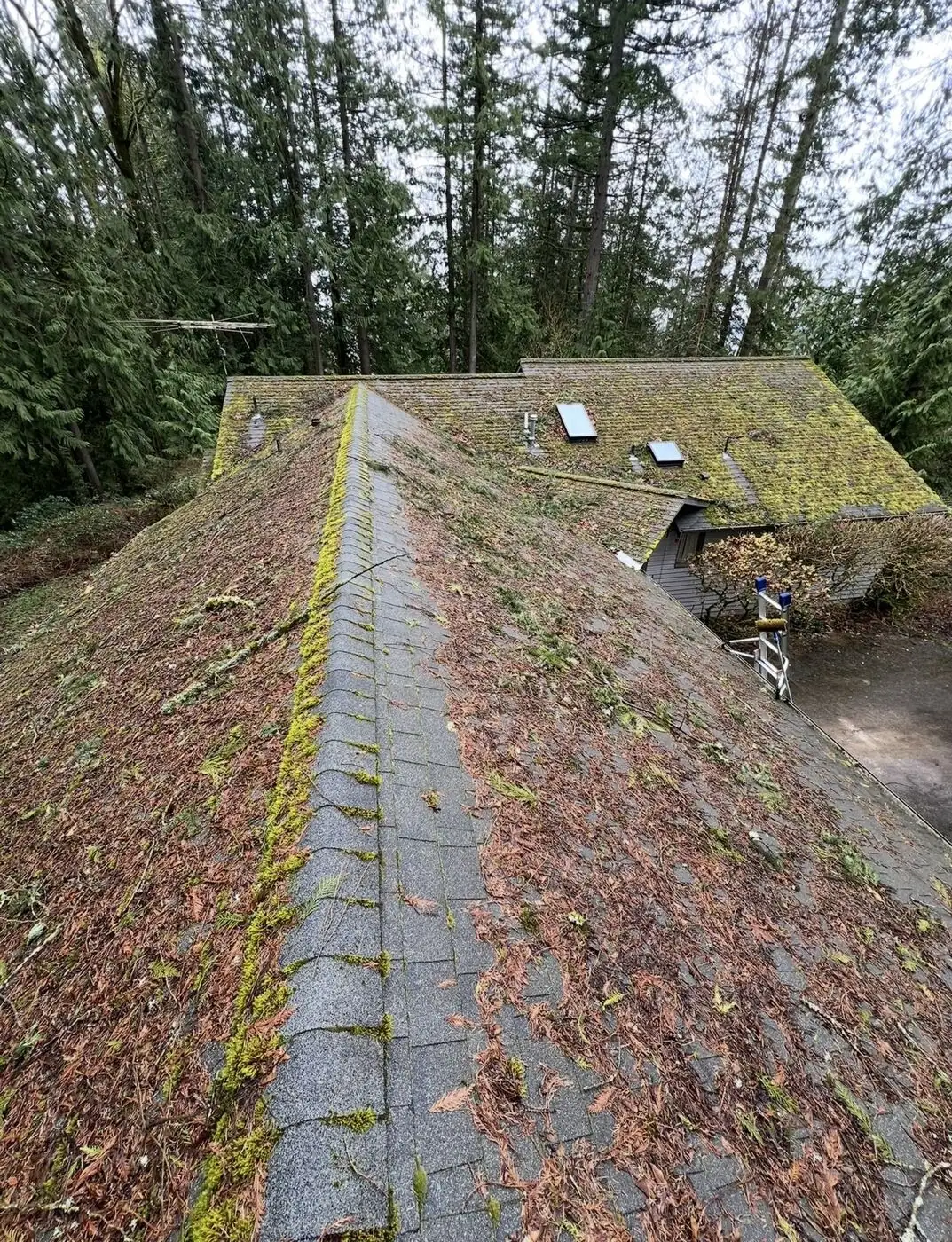 Before
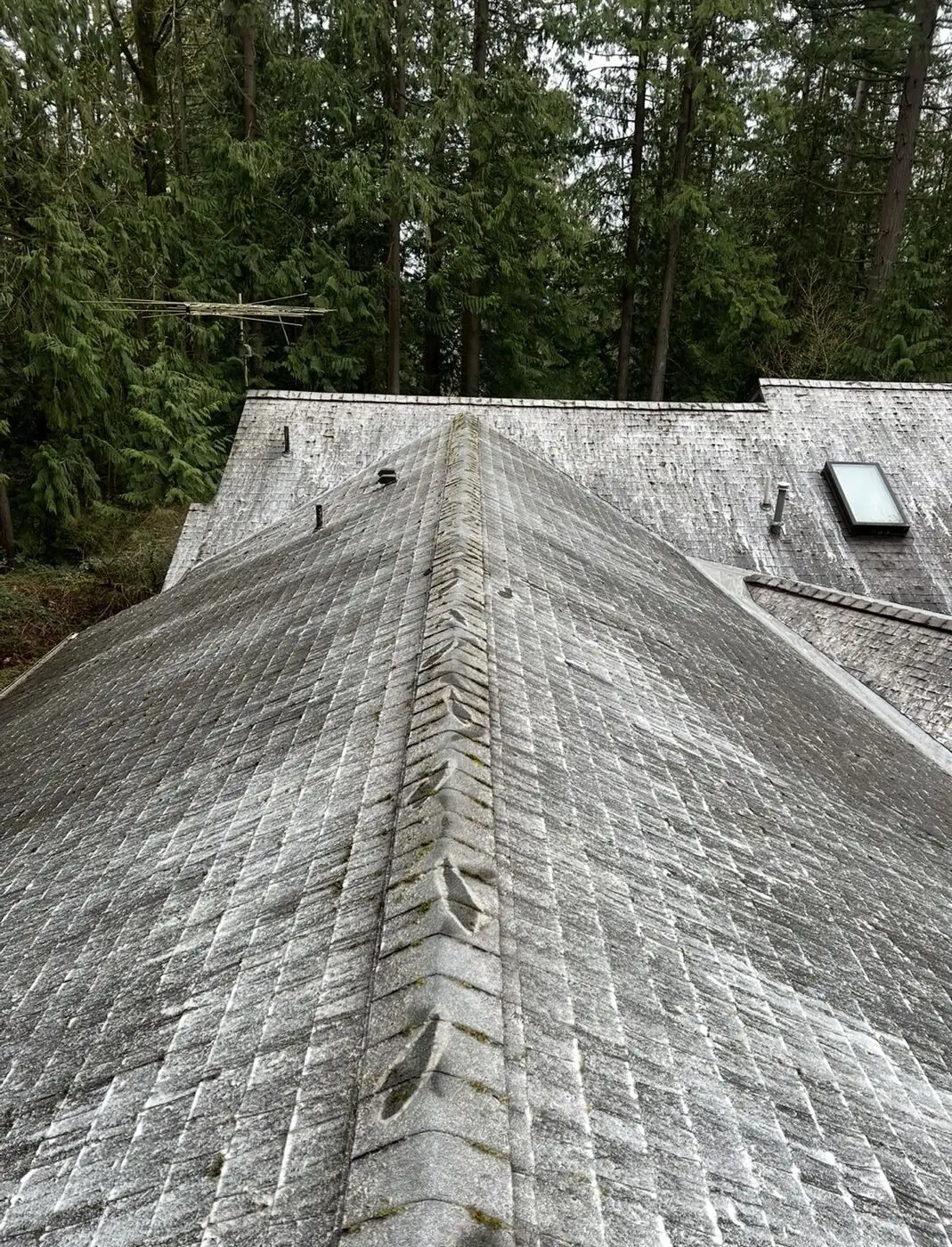 After
Where does moss start on a roof?
Wherever the roof stays wet longest:
- The north-facing slope, which gets the least direct sun all winter
- Along the eaves, the coldest part of the roof and the last to dry
- In the valleys, where water, needles and grit all collect
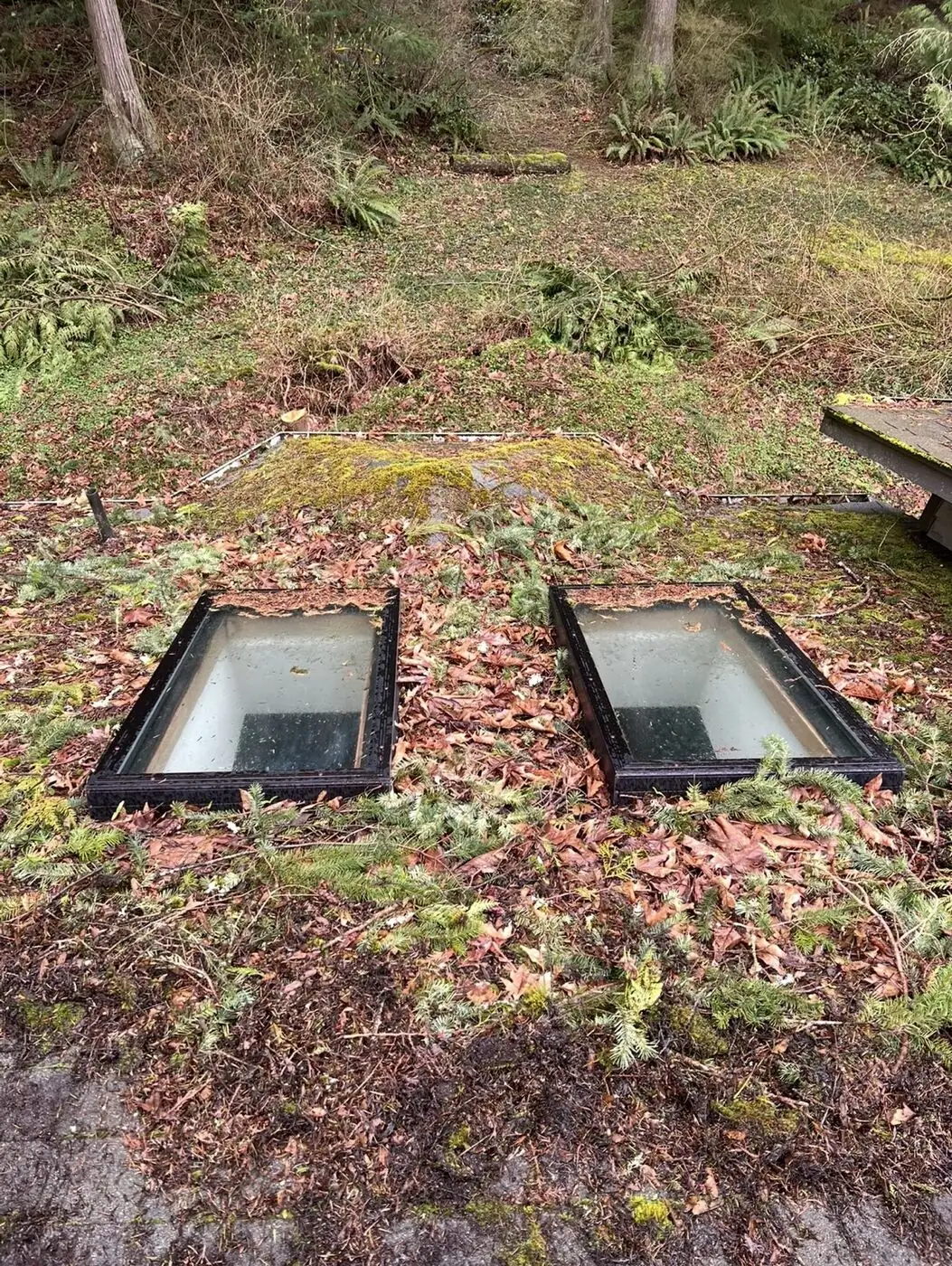
- Around chimneys, skylights and vents, where flashing forms ledges and shelter
- Beneath any branch that keeps dripping after the rain has stopped
Once it is established along a shingle edge, moss grows back beneath the course above and starts to lift it. That hidden growth under the laps is the part that actually damages a roof, and it is explained in detail on moss under shingles.
How does the moss come off without harming the roof?
In three stages, and none of them uses a pressure washer.
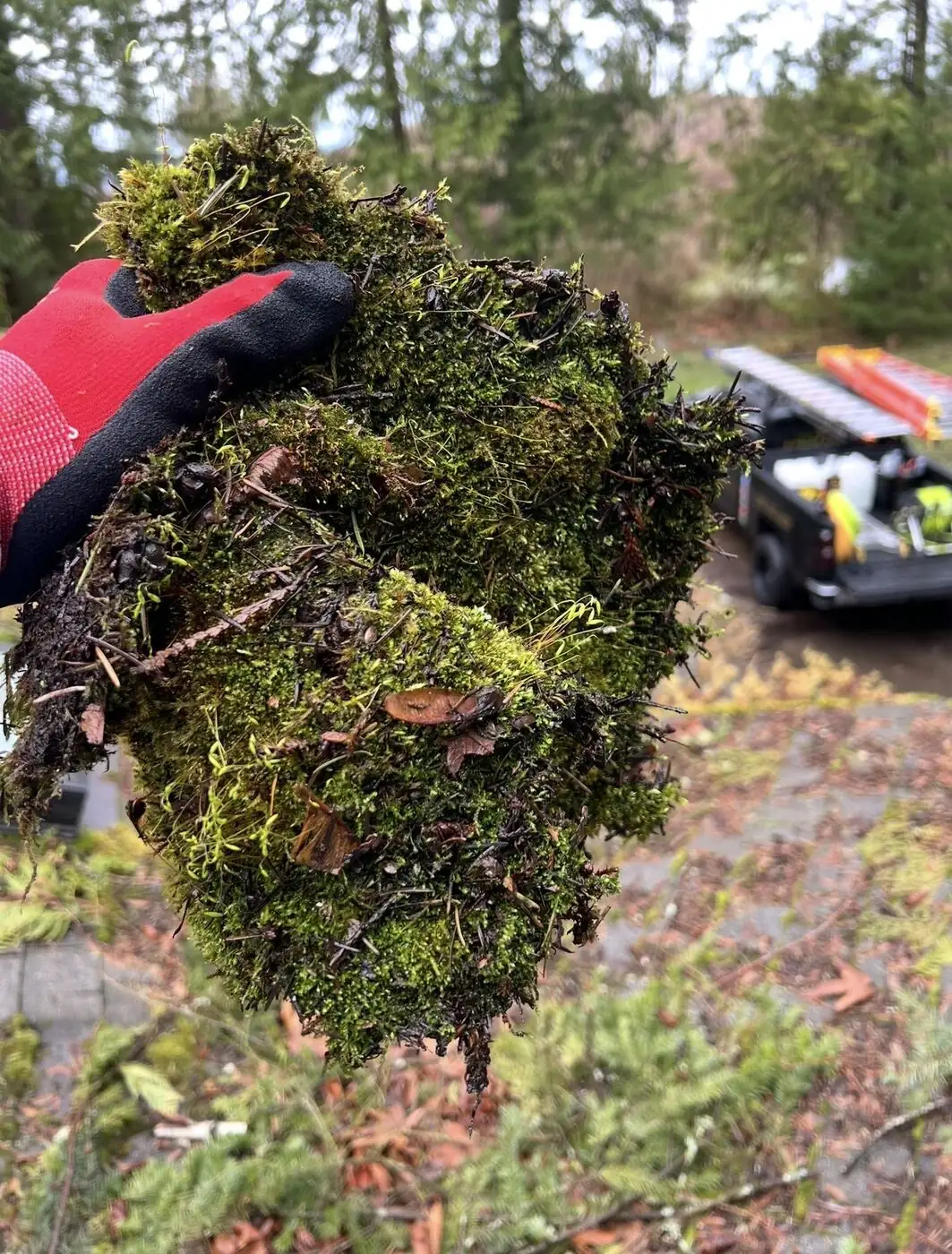
First, the heavy cushions are lifted away by hand, working down the slope with the courses rather than against them. Thick moss holds a great deal of water and weight, and there is no reason to leave it on the roof. Lifting that bulk is not the same as scraping: moss is not rooted into the shingle, so it comes away under light pressure and the granules stay where they are.
Second, what is left is treated at low pressure with a solution chosen for the roofing material. That reaches the thin mat still clinging to the surface and the growth tucked under the course edges, which no tool should be forced into.
Third, the weather finishes it. Over the following weeks and months the treated moss browns, dries, loses its grip and washes off. On a Bellingham roof, for once, the autumn rain is on your side.
The full method, and what we refuse to do (scraping, wire brushing, high pressure), is on the main moss removal page. How asphalt roofs age and shed granules is covered under composition asphalt shingle.
What about cedar roofs in the south end?
They need the gentlest handling of anything we work on. Cedar roofing and siding are concentrated in the wooded south of the city, in Edgemoor, Fairhaven, South Hill and out along Chuckanut Drive, and many of those roofs sit right under the fir and cedar canopy that feeds moss in the first place.
Shakes and cedar shingles cannot take force. High pressure shreds the soft surface fibres, and scraping splits the wood along the grain. On cedar the hand-lift is lighter, the solution milder and the timeline longer. It is also the material where a roof near the end of its life is most often better replaced than treated, and when that is the honest answer we say so before quoting. The material itself is profiled on cedar shake roof.
What did a recent Bellingham visit involve?
In September 2026 we worked on a single-family home in the Roosevelt neighborhood and posted the job to our Google Business Profile. The visit took in roof cleaning, gutter cleaning, a moss preventative treatment and exterior window cleaning, all together.
That combination is typical of how moss work runs here. The roof is cleaned and treated first, the gutters are cleared of what comes off it, and the glass is saved for last so nothing from above lands on it afterwards. Booking moss removal with roof cleaning also means one set of ladders, one round of bed protection and one visit instead of several.
What moves the price on a Bellingham roof?
Every moss job is priced on site, because the amount of growth is the biggest single variable and a photo does not show it. The main factors are these:
- How thick and widespread the moss is, and whether lichen is mixed in with it.
- The roof’s size and pitch, and how many planes, valleys and dormers it has.
- Whether it is composition, cedar or metal.
- Tree cover and access, since a slope above a steep drop or a conservatory takes longer to protect.
- Where the property sits, because a Lake Whatcom watershed address calls for tighter controls.
- Whether the gutters are cleared in the same visit or on the follow-up.
The first treatment on a roof that has been left for years is always the dearest one. After that the job becomes upkeep: thinner growth, less hand-lifting, a quicker treatment. A Bellingham roof kept on a regular cycle costs noticeably less per visit than one that waits until the moss can be seen from the car, and it keeps more of its granules along the way.
When is the right time to treat?
Early autumn, for most Bellingham roofs. Treating in September or early October sends the moss into the wet season already dead, and the rain that would normally feed it carries it off instead. Spring works as well, once there are enough dry days for the solution to sit on the growth rather than being rinsed away by the next shower.
Late summer is the worst moment to judge a roof. Moss dries to a grey crust in August and looks like far less than it is. Take a look in the wet months, when the cushions are swollen and bright green, and you will see the true extent.
For most houses here, treatment every three to five years keeps things in hand: nearer three under heavy conifer cover, nearer five on an open lot. Leave the gutters for a couple of months after a treatment, until the dead moss has come down; gutter cleaning is usually booked around that timing.
What happens to the runoff?
It stays out of the storm drains. Bellingham’s stormwater code, BMC 15.42, does not allow pressure wash water into the storm system; it has to go to sanitary sewer or a vegetated area, and we treat what rinses off a roof with the same care as what comes off a driveway. The complication on a roof is that the gutters gather everything and the downspouts decide where it goes, and on many houses a downspout vanishes into a pipe in the ground.
So before any treatment goes on, we check where each downspout discharges and plan the rinse around it, soak the planting below the eaves, and keep the application tight to the growth rather than flooding the whole slope.
On the east side, the Lake Whatcom watershed adds a further layer. The lake supplies Bellingham’s drinking water, and in Basin One of the watershed the City applies a zero-phosphorus rule to fertilisers and soil amendments. That rule is written for lawns and gardens rather than roofs, but it shows what the City is guarding, and it is why a watershed address gets its own category on our quotes. The detail is set out at wash water and storm drains.
Getting a quote
Call (360) 303-6806, or start from the Bellingham page. We will look at the roof from the ground and from the ladder, tell you what is growing and where, say plainly if the roof is past the point where treatment makes sense, and give you a price along with a realistic timeline for the moss to clear.
Moss removal questions from Bellingham homeowners
- Will the roof look clean on the day you treat it?
- Not completely. The heavy cushions come off during the visit, but the treated remnant takes weeks to months to dry out and wash away in the rain. Two to three months after treatment, most Bellingham roofs look markedly different from how they did on the day.
- Why not just pressure wash the moss off?
- Because it knocks the granules off asphalt shingles, tears the surface of cedar, and forces water up under the courses the moss has already loosened. A blasted roof can look spotless that afternoon and still have lost years of its life.
- How often will a Bellingham roof need treating?
- Every three to five years for most homes. Roofs under fir, cedar or big-leaf maple sit toward three; an open roof with nothing hanging over it sits toward five. Trimming back overhanging branches is the one thing that reliably stretches the gap.
- Do you walk on the roof?
- As little as we can. Much of the work is done from ladders and extension equipment, because boots on shingle cost granules and a mossy slope is slippery. Where a roof genuinely has to be walked, that decision is made on the day in the conditions on the day.
- Is the treatment a concern for Lake Whatcom?
- We plan for it rather than hope. Runoff is kept out of the storm drains, beds are soaked beforehand and rinsed afterwards, and watershed addresses get a tighter plan because the lake is the city's drinking water. Ask what is going on your roof and we will tell you.
- Should the gutters be cleared at the same time?
- Checked on the day, then cleared again a couple of months later. Dead moss sheds into the gutters as it weathers off, so a clearing booked after the treatment catches all of it rather than half.
- Can you tell me whether my roof needs replacing?
- We are not roof inspectors and do not write condition reports. We will tell you what we noticed from the ladder, such as curling, bare patches or lifted shingles, and suggest a roofer takes a look if treatment does not seem worth the money.