Whatcom County
House Washing (Soft Wash) in Bellingham, WA
The short answer
We soft wash Bellingham siding at low pressure with a solution matched to the cladding, then rinse it without sending anything into a storm drain, because BMC 15.42 forbids that. Shaded north walls under the city's heavy tree canopy are the usual reason people call, and houses built from 1950 to 1979 get one extra question first.

Randy Fee — Owner, King of Kings Window Cleaning
Washington business licence, UBI 605476674 · L&I insured · BBB rated A
Randy runs the company himself, so you are dealing with the owner, not a call centre — and every technician here is personally trained by him. Working Whatcom and Skagit County since 2024.
I run the Bellingham route personally.
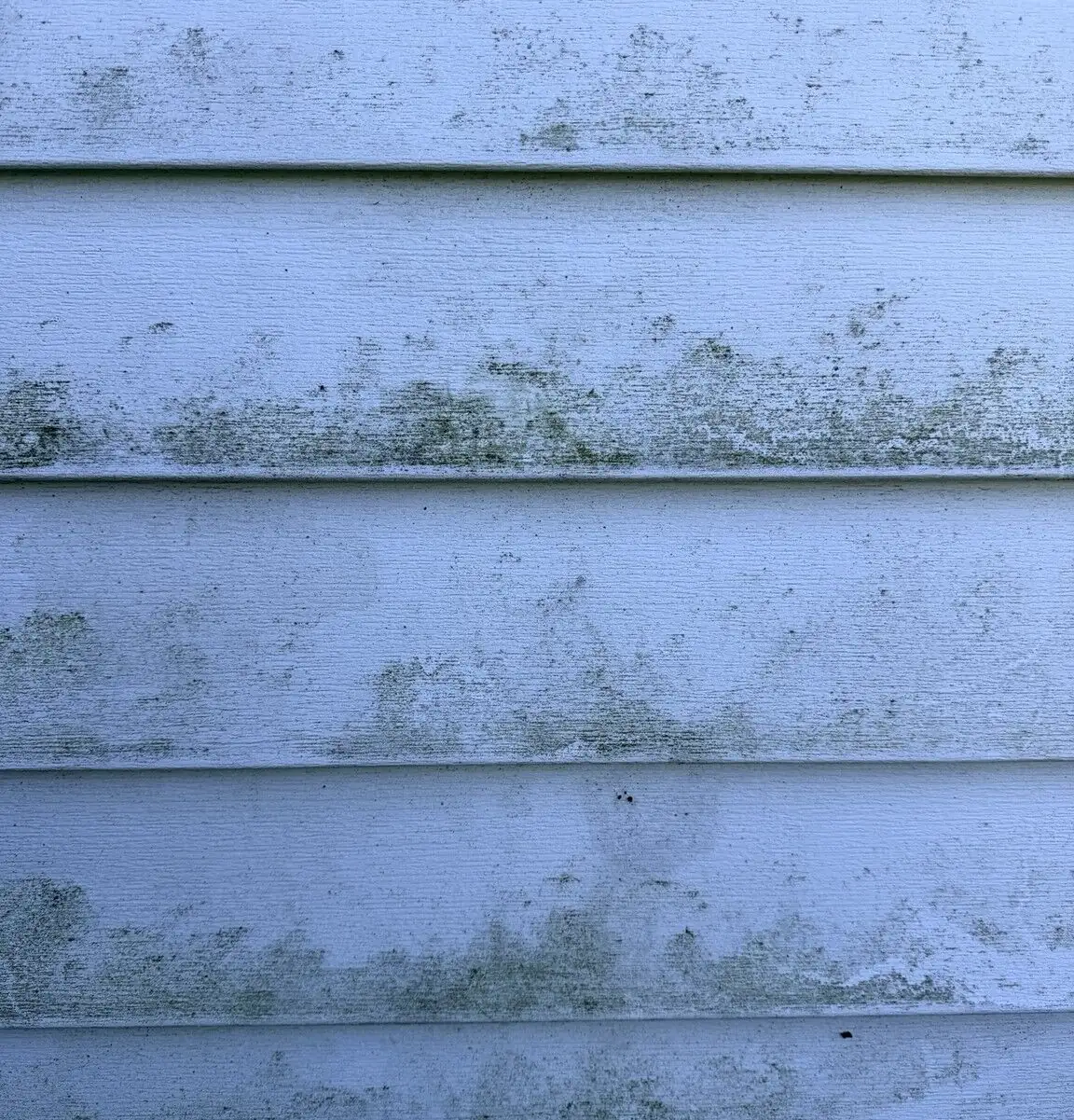
The walls of a Bellingham house show you exactly where the sun never reaches. A south face that catches the afternoon can stay presentable for years, while the north face, or the side wall eight feet from the neighbour’s fence, is green by the second winter and stays that way. What you are looking at is not grime in the ordinary sense. It is algae, mildew and moss, doing what they do in a wet and heavily treed city.
Getting it off is not hard. Getting it off without damaging the cladding, scorching the flower beds or sending a tank of solution down the street drain takes more thought, and that thought is most of what this page covers.
Why do Bellingham walls go green so quickly?
Water and shade, in amounts much of the country never deals with. The city averages about 36 inches of rain a year, and around four-fifths of it lands between October and March. For half the year a wall spends more time wet than dry, and any surface that holds a little moisture becomes somewhere for growth to begin.
Then there is the canopy. The City counts roughly 40% of Bellingham under tree cover, some 7,252 acres, and plans to lift that to 45% by 2050. The forest species are western redcedar, Douglas-fir, big-leaf maple, vine maple, red alder, black cottonwood and Sitka spruce, while the planted street trees are mostly maples, cherries and oaks. Every one of them sheds something, shades something, and holds the air beside a wall damp for longer after each shower.
Combine the two and a wall that might go a decade between washes in a drier town is due every few years here. That is not a verdict on how the house has been kept. It is simply what siding does in this climate.
Which side of the house usually needs it most?
The north side, nearly always, followed by whichever wall is boxed in by trees or a close neighbour.
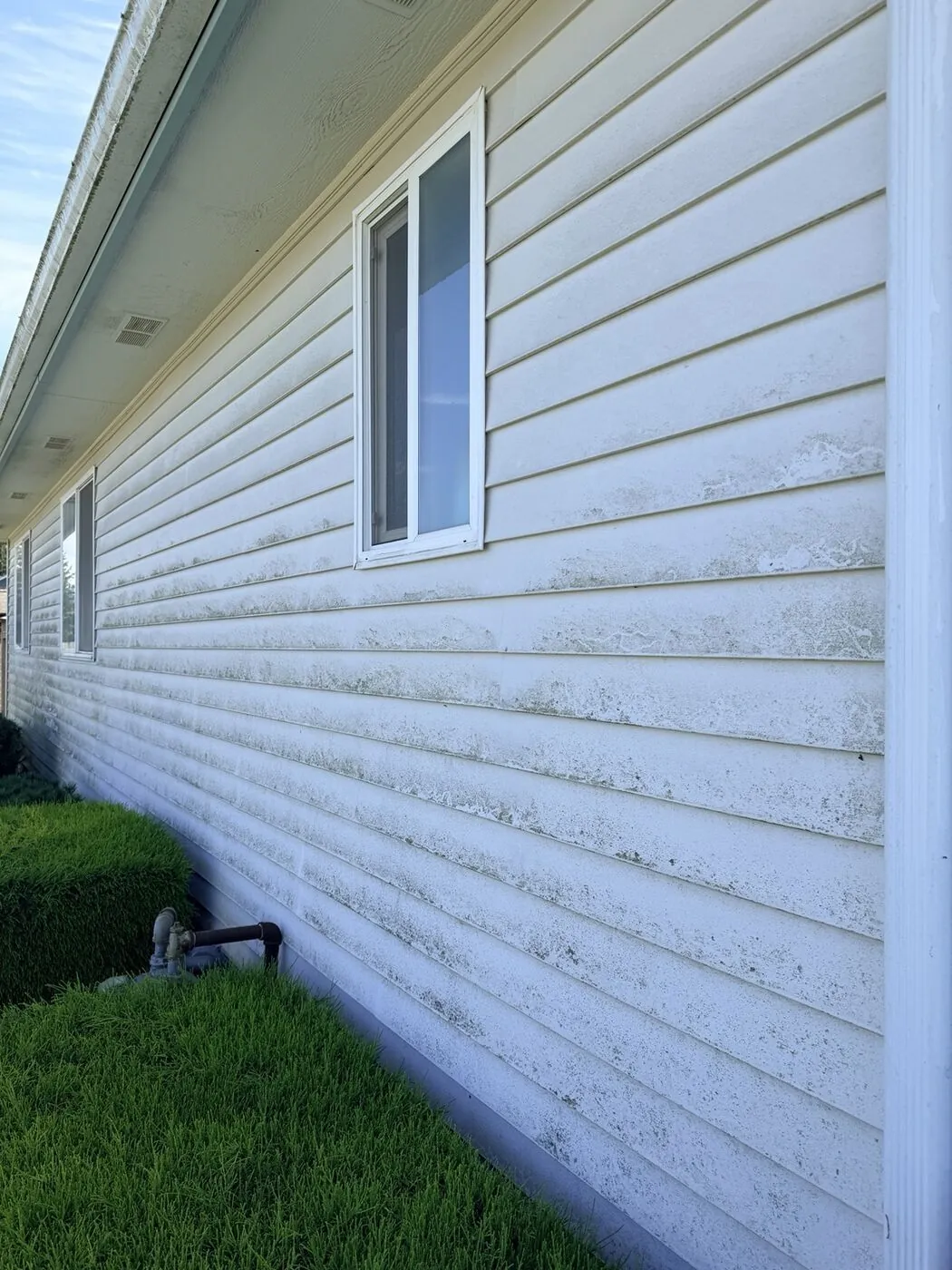
Bellingham’s prevailing wind comes from the south in eleven months of twelve, so southern elevations take most of the driven rain. They also get the sunshine that dries them out again. A north wall sees less of the rain and almost none of the drying, and that is the mix growth thrives on: constant moisture, no ultraviolet, little warmth. You see it as a green film across the lower courses and black freckling under the eaves, worst wherever a shrub has been planted tight against the siding.
That lopsided pattern is useful to know about. It makes a shaded-walls-only wash a real option on a lot of Bellingham houses, and we will price it that way when the sunny sides do not need touching. The north-face problem has its own explanation at north-facing wall mildew.
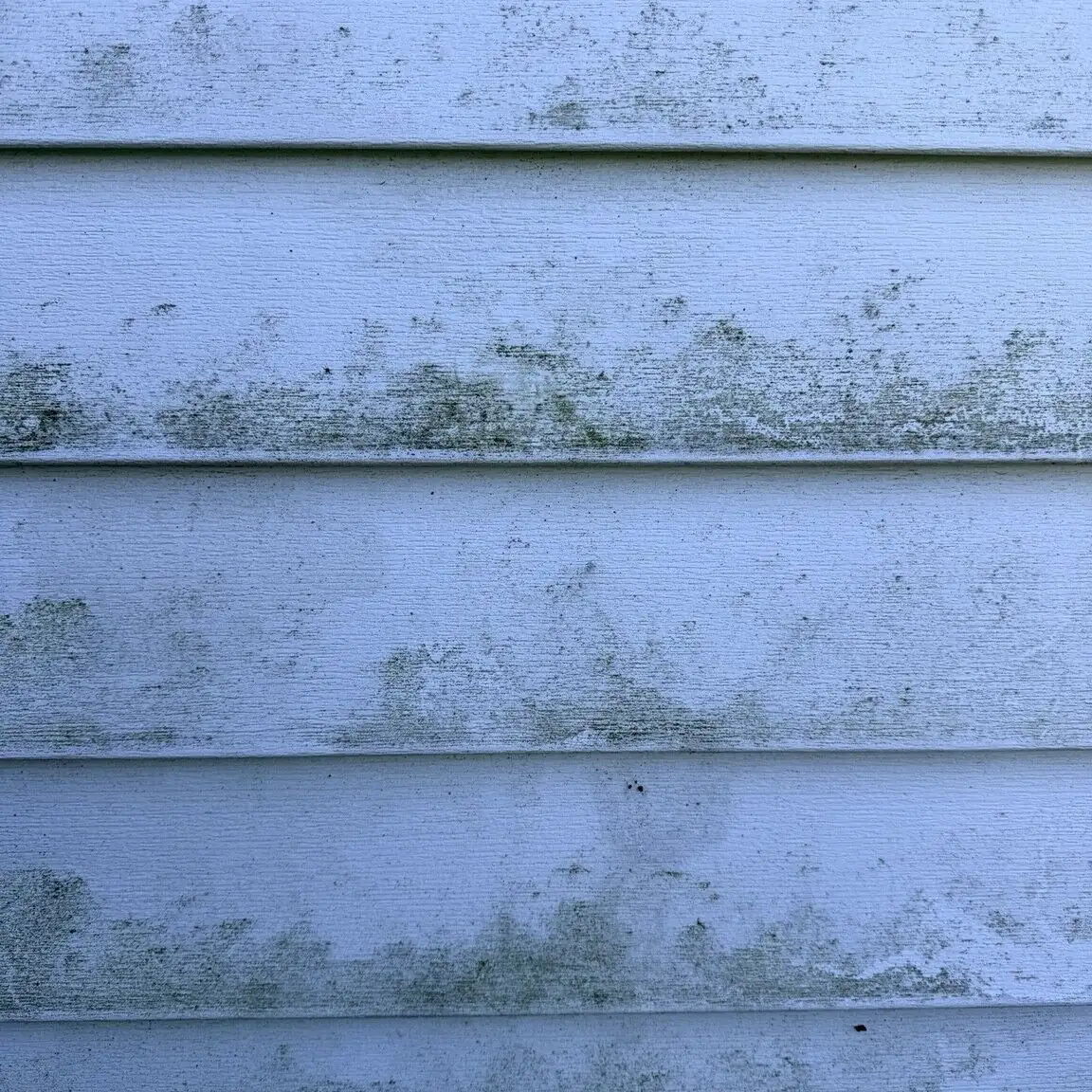 Before
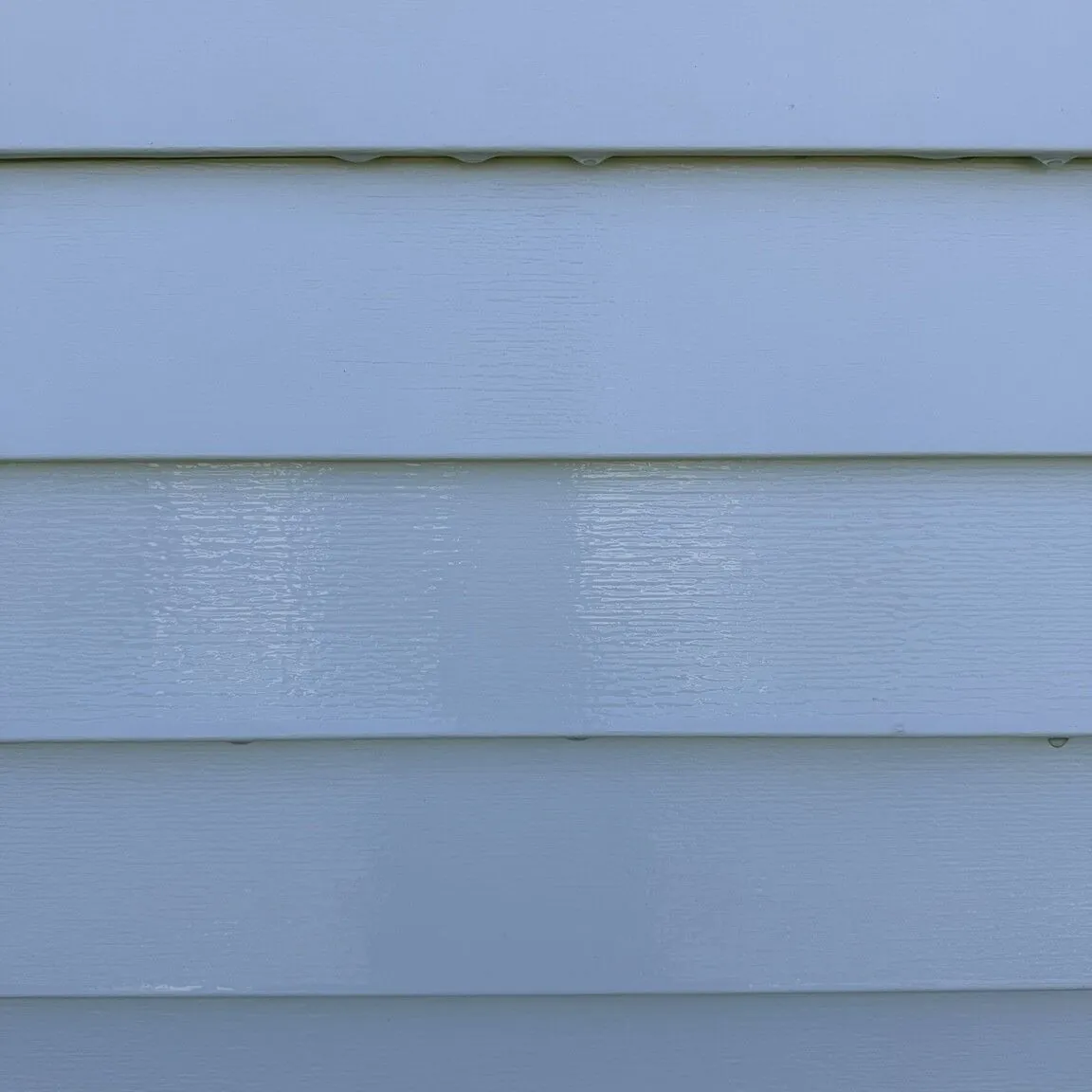 After
What does a wash include?
A standard exterior wash on a Bellingham home takes in:
- Every elevation of siding, soft washed from the foundation line up to the eaves
- Soffits and eave undersides, with cobwebs and wasp nests cleared away
- The outside faces of the gutters, where black streaks gather
- Fascia, trim, and the frames around windows and doors
- Entry doors, garage doors and any shutters
- Soaking the beds below each wall beforehand and rinsing them afterwards
- A final walk round with you, or photographs sent if you are out
The glass, the inside of the gutters and the driveway are separate jobs with their own methods. They combine easily with a wash, and the local detail for each sits on window cleaning in Bellingham, gutter cleaning and pressure washing.
How is the siding actually cleaned?
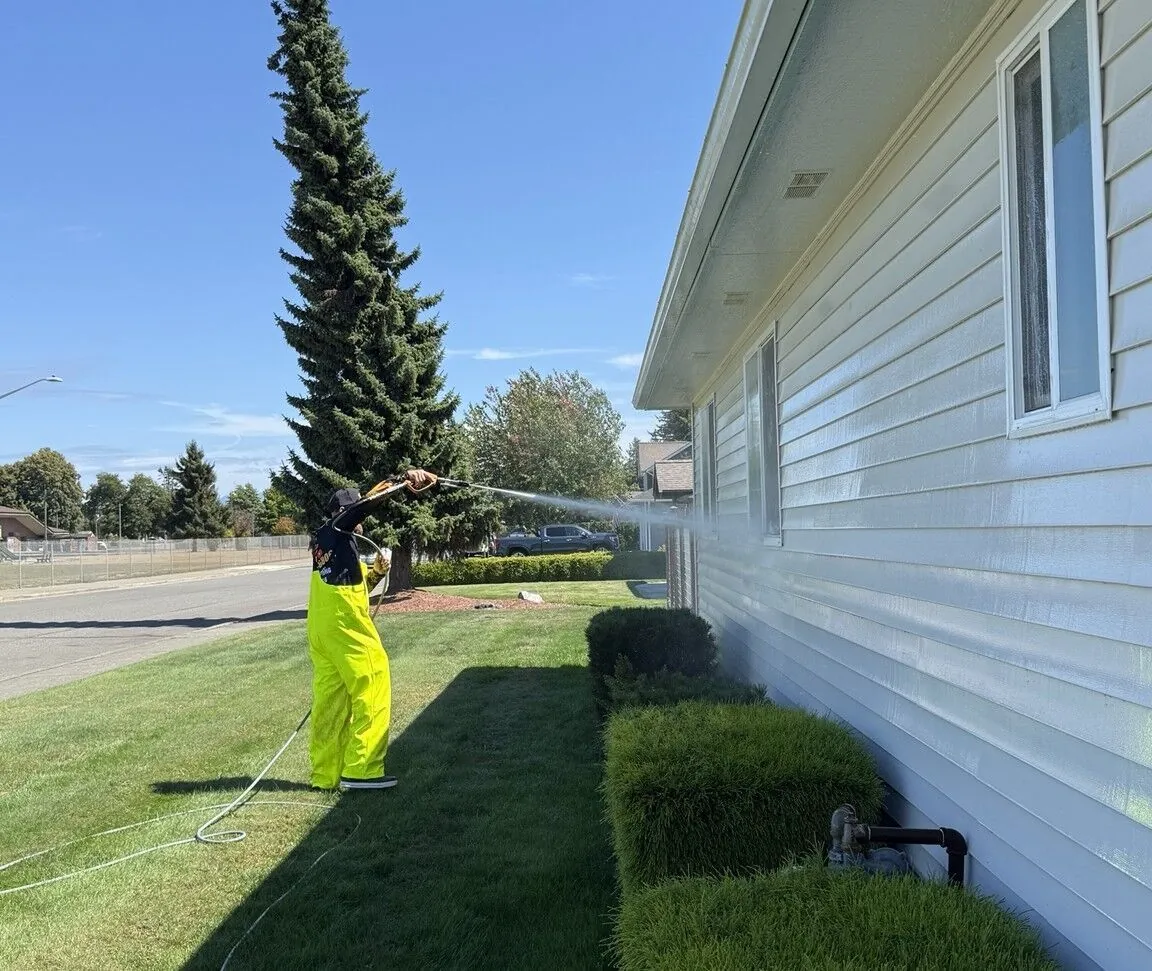
With a soft wash: low pressure, and a cleaning solution doing the work that force would otherwise do. The mix goes on, sits long enough to kill what is growing, and comes off with a rinse at roughly garden-hose strength.
The restraint comes from how siding is put together. Lap cladding, whether vinyl, fiber cement or wood, keeps water out by letting each course overlap the one beneath. That copes perfectly well with rain running down the face of a wall. It copes badly with a jet driven upward into the laps, which is what a pressure wand does, and water pushed behind the cladding in a climate this damp can linger in the wall for a long time.
The mix is decided at the wall, not poured from one tank for every house. Vinyl on a newer build toward the north end of town is forgiving. Cedar and old painted clapboard are not, and they get a milder approach and a slower rinse. The wider argument for the method, and the list of what we will not wash, is on the main house washing page, and the most common cladding on newer homes is profiled under vinyl siding.
What about Bellingham’s older houses?
They make up a real part of the work, and they want a lighter touch. Bellingham has eight districts on the National Register of Historic Places: Broadway Park, Cissna Cottages, Downtown, Eldridge, Fairhaven, Sehome Hill, South Hill and York. The Cissna Cottages were built between 1900 and 1904, and York was largely filled in by the time of the Great Depression.
Houses of that vintage are usually clad in painted wood that has been repainted many times. Sound paint washes without trouble. Paint that is already letting go, lifting at the joints or blistering on the sunny side, will shed a few flakes under even a gentle rinse, and we would rather point that out on the quote than have it arrive as a surprise. Nobody should find out halfway along a wall that the wash has turned into partial paint stripping.
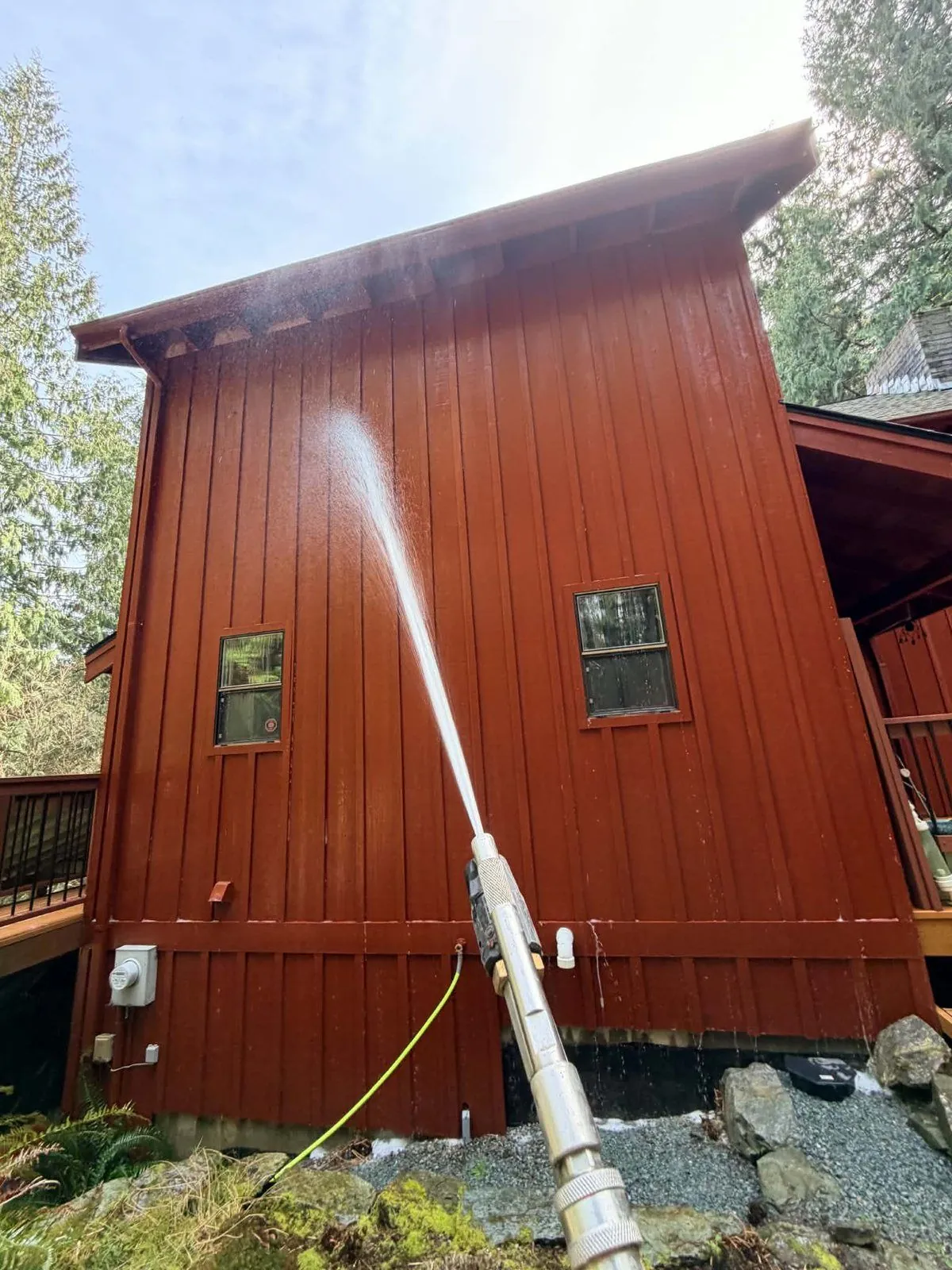
The wooded south end adds cedar to the picture. Edgemoor, Fairhaven, South Hill and the Chuckanut Drive side of town carry a good deal of cedar siding and shingle, and cedar is the least forgiving cladding there is: too much force raises the fibres and leaves the boards furred and blotchy. At low pressure with the right solution it cleans up well, and weathered silver cedar will still be silver afterwards, just without the green.
Why do we ask when the house was built?
Because the City’s own guidance raises it. Bellingham’s advice on pressure washing says that buildings constructed between 1950 and 1979 may contain PCBs, and that wash water coming off them may need disposal as hazardous waste by a licensed handler.
We do not test for PCBs, and we are not a hazardous-waste business. What we can do is put the question on the table at the start and, where the answer falls inside that window, work out with you what it means before anything is sprayed. Sometimes that is a test you arrange first, sometimes a narrower scope, and sometimes part of the job belongs with someone licensed to handle the water. It is a five-minute conversation at the quote, and a much longer one if it gets skipped.
Where does the rinse water go?
Not into a storm drain. Bellingham Municipal Code chapter 15.42 does not allow pressure wash water into the storm system; it has to go to the sanitary sewer or onto a vegetated area where the soil can deal with it. The City also gives businesses free pressure wash water reclaim kits, which says a lot about how firmly it means the rule.
On a house wash the practical answer is usually the lawn and the beds. Before any solution is mixed we check which way the ground falls, where the nearest street inlet is, and whether a driveway is going to carry rinse straight to the curb. Inlets in the path get covered. Planting is soaked with clean water first, so it absorbs as little as possible of what follows, and hosed down again when the walls are done.
Homes on the east side inside the Lake Whatcom watershed call for more care again, because the lake is the city’s drinking water. The code sections, and how they differ from the rules a few miles north in Ferndale, are laid out at wash water and storm drains.
What decides the price on a Bellingham house?
There is no flat rate, because the houses differ too much. The quote comes down to:
- How much wall there is, and how much sits above ground-floor reach.
- The cladding, since vinyl goes faster than cedar or old painted wood.
- How established the growth is, from a faint film to moss packed into the seams.
- Access: sloping lots, narrow side yards, decks, and planting hard against the wall.
- How much protection the beds and the drainage need.
- Trim and detail, such as dormers, shutters and decorative work on older homes.
Slopes matter more than people expect. A house built into a hillside can be a single storey at the street and two or three at the back, and the back is the part that sets the price.
When should a Bellingham house be washed?
Late spring into early summer suits most homes. The solution needs a few dry hours to work and the siding needs to dry afterwards, and the long wet stretch from October to March does not hand out many of those. By May the winter’s growth is at its most obvious, and washing then means the dry months are spent looking at a clean house.
Early autumn is the other good window, and it is less busy. Going into the rains with a clean wall means the growth starts again from nothing instead of from last year’s film.
Two conditions we avoid: freezing weather, and a wall baking in hard afternoon sun, where the solution dries before it has done anything useful. Most Bellingham houses are due every two to four years, with the shaded ones toward the shorter end.
Condos, townhomes and rentals
A lot of Bellingham’s newer housing is shared. Around three-quarters of the building permits issued in the city over the past decade were for multi-family homes, so a growing share of the siding in town belongs to an association or a landlord rather than to the people living behind it.
That changes how the job runs. An association generally wants the whole complex washed in one mobilisation so the buildings match, with notice to residents about cars, patio furniture and closed windows. A landlord generally wants the wash timed to a turnover, often with the glass done the same day. Both are routine for us, and both are far easier to schedule a season ahead than a week ahead.
Booking a wash
Ring (360) 303-6806, or send a request through the Bellingham page. We will walk the walls with you, show you which elevations actually need attention, ask when the house was built, and price the work in front of us. If only the north side is due this time round, that is what the quote will say.
House washing questions from Bellingham homeowners
- Will a soft wash hurt the plants along the house?
- Not if the beds are prepared properly. We soak the planting with clean water before any solution goes on, cover anything delicate or newly planted, and rinse it all again at the end. A plant that is already full of water takes up very little of what lands on it.
- Do you pressure wash siding?
- No. Siding is designed to shed water that runs down it, and a pressure jet drives water up behind the laps and into the wall. Vinyl, cedar and painted wood all get low pressure and a solution suited to the surface, followed by a gentle rinse.
- Why does my north wall go green when the rest of the house stays clean?
- It gets almost no direct sun and dries slowly after every shower. Bellingham's prevailing wind blows from the south for most of the year, so the south face takes the weather but dries out, while the north face stays damp, which is exactly what algae and mildew need.
- My house was built in the 1960s. Does that change anything?
- It can. City of Bellingham guidance says buildings from 1950 to 1979 may contain PCBs and that wash water from them may need licensed hazardous disposal. We raise it at the quote and talk through the options before any wall gets washed.
- Where does the wash water end up?
- On the lawn and in the planting beds, not in the street drain. Bellingham's stormwater code keeps pressure wash water out of the storm system and sends it to sanitary sewer or a vegetated area, so inlets near the work are covered and the rinse is steered onto soil.
- Can you wash just the shaded side of the house?
- Yes, and on plenty of Bellingham lots that is the sensible booking. If the south and west walls are clean, we quote the shaded elevations on their own and tell you so, rather than selling a whole-house wash you do not need.
- Will washing bring faded siding back to its original colour?
- No. Washing removes growth, grime and loose chalk, and chalky siding usually looks a great deal better for it. Fading is a change in the material itself, though, and no amount of washing puts the pigment back.