Whatcom County
Window Cleaning in Lynden, WA
The short answer
We clean Lynden windows inside and out, with screens, tracks and sills included, using squeegees on glass we can reach and a purified-water pole on upper storeys. Lynden's own water reports publish no hardness figure, so we make no hard-water claims about the town, and we bring our own filtered water to every job regardless.

Randy Fee — Owner, King of Kings Window Cleaning
Washington business licence, UBI 605476674 · L&I insured · BBB rated A
Randy runs the company himself, so you are dealing with the owner, not a call centre — and every technician here is personally trained by him. Working Whatcom and Skagit County since 2024.
I run the Lynden route personally.
Most window trouble in Lynden is not dramatic. It is a slow build of rain splash, pollen, film and cobweb that turns a clear pane grey over a season, plus the tracks and sills that quietly fill with grit. Clean glass changes how a room feels more than almost any other maintenance job, and it is one of the few that shows from the inside of the house as much as from the street.
We clean the inside and the outside, take the screens out and wash them, and clear the tracks and sills. The method depends on how high the window is and what is below it, and the water we use comes with us rather than out of your tap.
What makes Lynden windows dirty?
A mix of weather, setting and ordinary living. Rain is the biggest single contributor. The long-record weather station nearest town, at Clearbrook, averages 46.71 inches of precipitation a year, and every shower that hits a dusty pane dries into spots and runs. Splash from beds and paths spatters the lower panes of ground-floor windows, much as it does the bottom boards of the siding.
Setting adds its own layer. Lynden’s economy moved from logging to agriculture, dairy and berry farming especially, around the turn of the twentieth century, and glass that faces working land can pick up a fine dry film after dry spells that looks more like haze than dirt. Glass under trees gets pollen, sap mist and organic film in the frame corners.
Inside, the film comes from the house itself: cooking, heating, candles, pets and winter condensation. It builds slowly, which is why people are often surprised by how much of the grey was on the inside.
Does Lynden have hard water?
Nobody can honestly tell you from the published record. Lynden draws its drinking water from the Nooksack River and treats it at the city’s own plant. Neither the 2021 nor the 2024 water quality report gives a hardness figure, so there is no city number to point to, and we will not invent one to sell a treatment.
What is true everywhere is that tap water dried on glass leaves its dissolved content behind. Sprinkler overspray, a hose rinse left to dry in the sun, and runoff from a stained sill can all leave marks, whatever the water’s source. Where we find mineral spotting on a Lynden window, we treat it as what it is on that pane, not as a fact about the town. For our own rinse on upper storeys we use purified water we bring with us, so our work adds nothing to the glass as it dries.
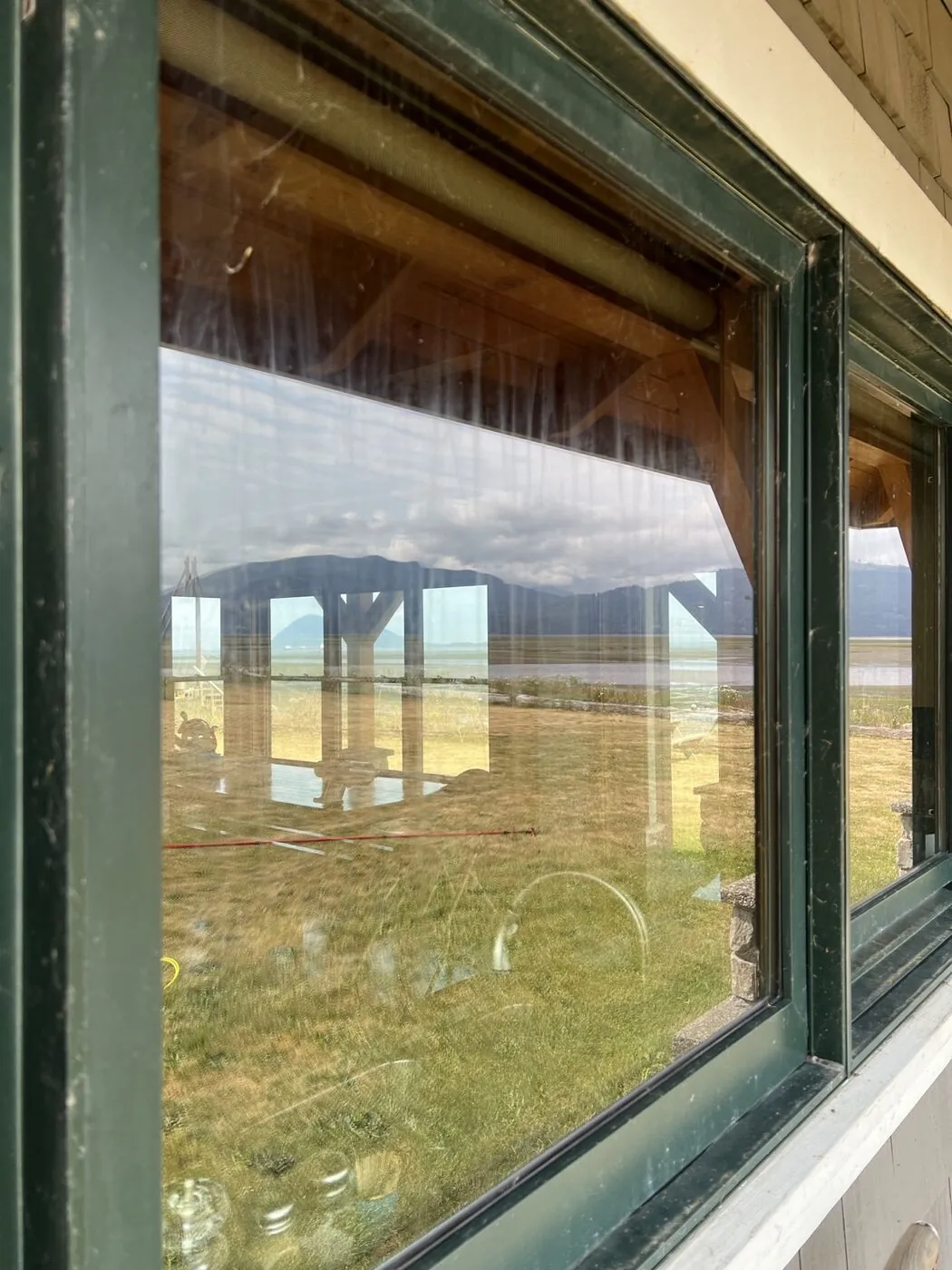 Before
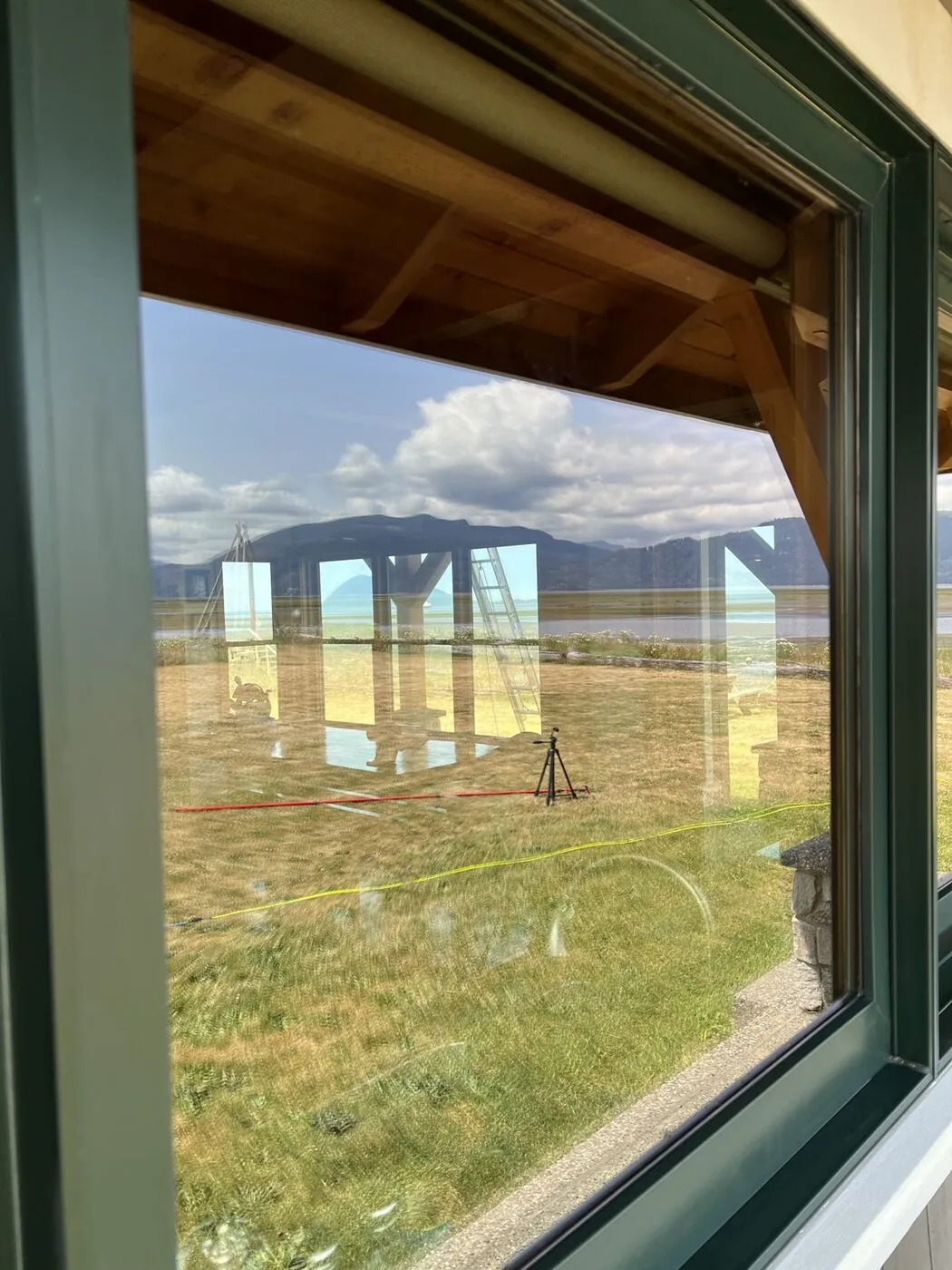 After
What is included in a window clean?
A standard residential booking covers:
- Outside and inside glass on every window we can safely reach
- Screens taken out, washed, dried and returned to the opening they came from
- Tracks vacuumed and wiped, with grit removed from the corners
- Sills and frames wiped where they are washable
- Cobwebs cleared from around each opening and the eave just above it
- A final look round with you before we leave, in daylight
Skylights, glass railings, storm windows and conservatory roofs are quoted separately because access varies so much from house to house. Paint, silicone and construction residue on glass is also its own job, since removing it without scratching the pane needs a different approach from a maintenance clean.
How is the glass actually cleaned?
Two ways, chosen window by window.
Glass we can reach from the ground or a short ladder gets washed by hand. A scrubber loosens the film with a mild cleaning solution, and a squeegee takes it off in a controlled pass, with the edges detailed by cloth. The solution is used sparingly and comes off on the squeegee and towel rather than being hosed down the wall.
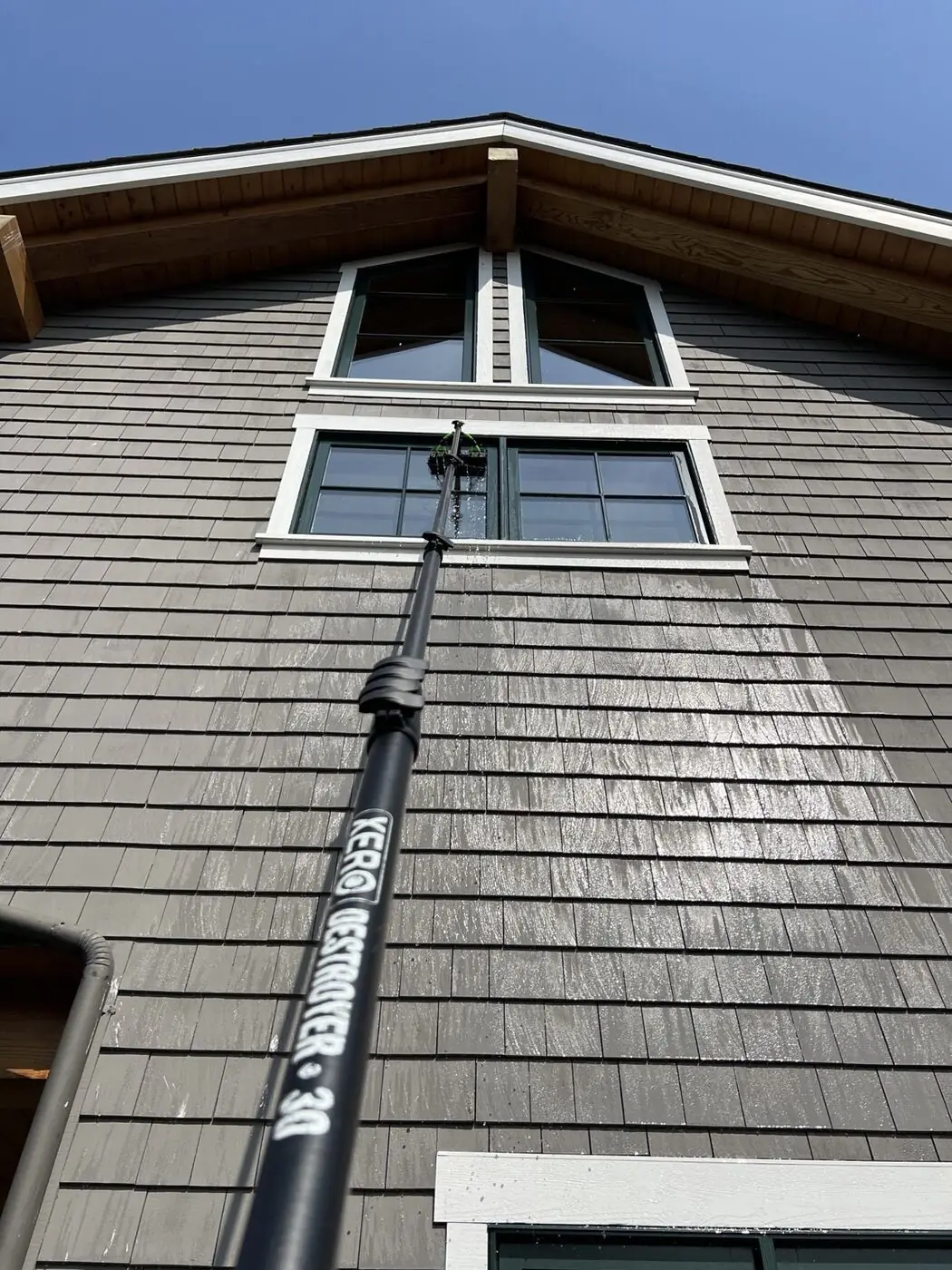
Upper storeys and anything above an obstacle get a water-fed pole. A brush on the end scrubs the glass while purified water flows through it, and because that water carries nothing dissolved in it, the pane is rinsed and left to dry on its own without spotting. It lets us clean a high gable window, or a pane above a deck or a conservatory, without a ladder touching the house.
Modern double-glazed units need a little care in both methods, mostly around the seals and any coatings, which is covered in our insulated glass units profile.
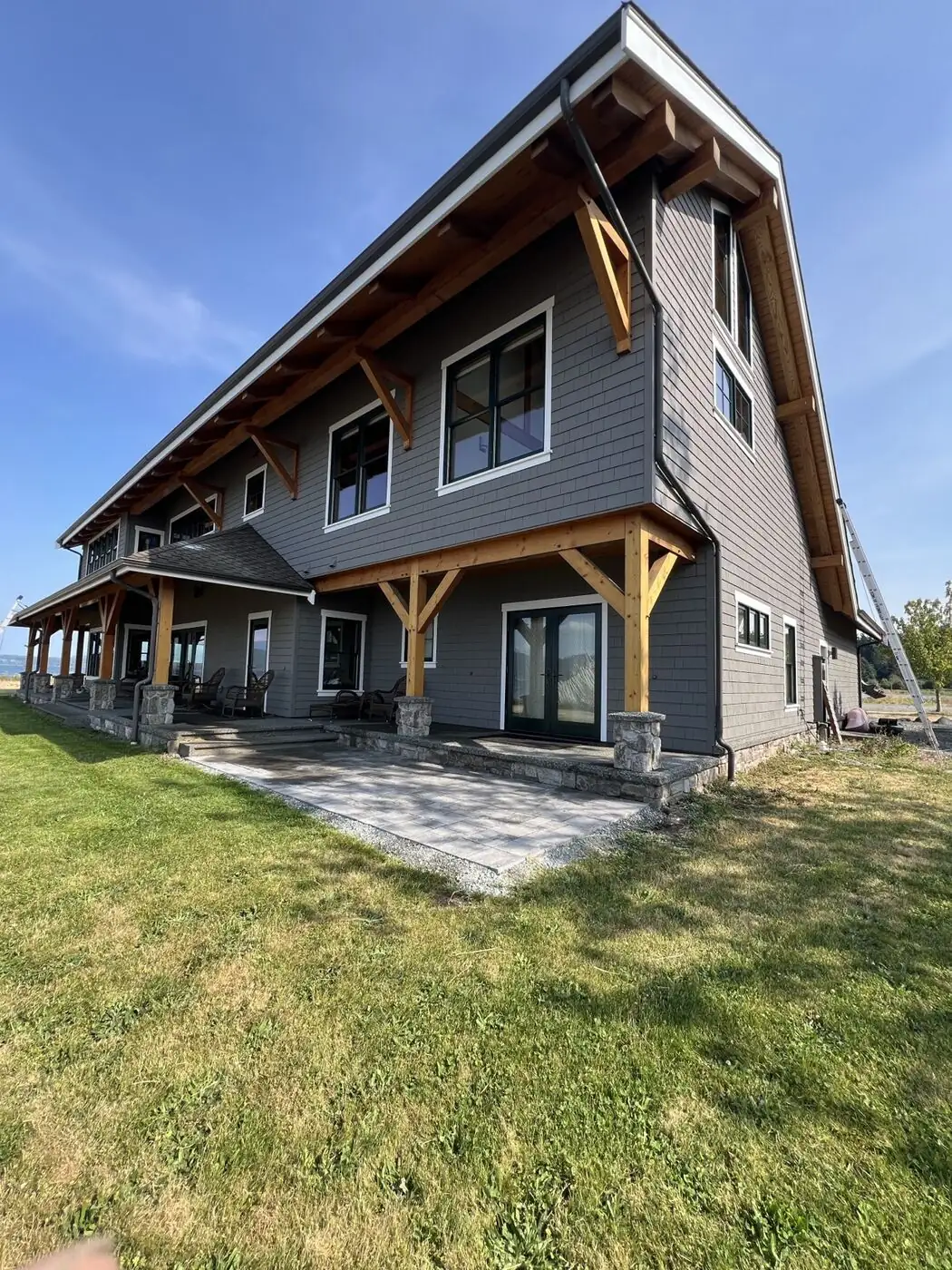
Do newer Lynden houses need anything different?
Often they have larger glass, and larger glass behaves differently. Lynden’s housing is young, with about 2,773 of its 6,210 units built in 2000 or later and 325 of those since 2020. Houses of that era tend to carry bigger fixed panes, taller gable windows and more glass on the upper floor than older designs did.
Big panes show every streak, so they take more time per window even if the window count is low. Tall gable and stairwell glass is exactly what the pole is for. And a house that is only a year or two old may still have builder’s residue on the glass, such as labels, paint flecks or mortar spatter. That is a post-construction clean, priced separately, because careless scraping can scratch new glass for good.
What about Lynden’s older homes?
They need a slower hand. The census counts 483 Lynden homes built in 1939 or earlier and 410 from the 1950s. Older houses are more likely to have wooden sashes, painted frames, putty-glazed panes and storm windows, and every one of those is less forgiving than a modern vinyl frame.
On an older window we check the putty and paint before scrubbing, keep water away from bare wood, and handle sashes and storms carefully. If a window will not open, or a frame is soft, we tell you rather than force it.
What drives the price here?
Each quote is built on site from a handful of things:
- The number of windows, which sets the starting point
- Pane size, since one big picture window can take longer than several small ones
- Height and access, including decks, slopes and planting under the glass
- Inside, outside or both, with inside work taking longer per window
- Condition, because a first clean after years of neglect takes more than a routine visit
- Extras, from skylights and storm windows to post-construction residue
A regular customer on a steady schedule usually pays less per visit than someone booking a one-off restoration clean, simply because there is less to remove.
When should I book?
Spring is the most popular time, clearing off the winter’s rain spotting and interior film once the days lengthen. Late summer or early autumn is the other natural window, after the dry months have left their dust and before the November and December rain begins. The local record shows those two months as the wettest of the year, averaging over six inches each at Clearbrook.
A clean before a house goes on the market is always worth it, because the listing photos are taken from the inside looking out. We avoid cleaning glass at or below freezing, since water left on the pane can ice and the finish suffers.
Where does the rinse water go?
Mostly onto the ground right under the window, and in very small volumes. Lynden’s code, at 13.24.160(C)(4), permits routine external building wash-down without detergent as a conditional discharge, and the purified water from a pole contains nothing at all. Hand-washed glass uses a small amount of solution that comes away on the squeegee and cloth.
On larger glass jobs over paving, we still watch where water runs, because the city’s storm drains feed Fishtrap Creek. How we approach runoff across all our services is on our wash water and storm drain page.
Can windows be combined with other work?
Yes, and they should go last. If the siding is being washed, it rinses down over the glass, so book the windows to follow on the same visit; the Lynden house washing page covers that side. The same goes for roof and gutter work, which can drop grit onto glass. The general detail behind our method sits on the main window cleaning service page, and the rest of our Lynden work is on the Lynden overview page.
How should I get the house ready?
Very little is needed, but a few minutes beforehand speeds the day up and keeps your things safe:
- Clear ornaments, plants and photos off the inside sills of the windows being cleaned
- Unlock any windows you want cleaned on both sides, and tell us about any that stick or should not be opened
- Move cars away from the walls if upper glass is directly above the driveway
- Let us know about pets, alarm sensors on frames, and gates that must stay shut
- Point out any window you already know has a cracked pane, failed seal or loose screen, so it is noted before anyone touches it
Interior work means we will be inside for part of the visit, so tell us about rooms that are off limits or floors you would like covered. Outside, nothing needs moving unless furniture sits directly against the glass.
Lynden is not the only town on this run. If you have family or a rental in Ferndale, the Ferndale window cleaning page covers the rather different conditions on that side of the valley.
How do I book?
Call (360) 303-6806 or request a quote online. We will look at the windows with you, agree on what is in the job, and give you a price before any work starts. The technicians who arrive have been trained by the owner in both methods, and the owner answers for the result.
Windows questions from Lynden homeowners
- Is Lynden's water hard enough to spot my windows?
- We cannot say, and neither can anyone quoting from the city's reports. Lynden's water is treated Nooksack River water, and its published water quality reports give no hardness figure. What we can say is that any tap water drying on glass leaves something behind, which is why we rinse with our own purified water.
- Do you clean the inside too?
- Yes, inside and outside is the standard booking, with screens, tracks and sills. Outside-only is available and costs less, but through the winter the inside of the glass picks up its own film from cooking, heating and condensation, and that half is the one you look through.
- How often should Lynden windows be done?
- Twice a year suits most houses, in spring and again in late summer or early autumn. Homes with a lot of shaded glass, or glass facing open land, often look for a third visit. If the house is going on the market, book a few days ahead of the listing photographs.
- Can you reach tall or awkward windows?
- Most of them. A water-fed pole reaches upper-storey and gable glass from the ground, including over decks and planting. Where a window genuinely cannot be reached safely, we say so on the quote rather than attempt it on the day.
- Do you wash the screens?
- Yes. Screens come out, get washed and dried, and go back into the same opening. Torn or bent screens are pointed out rather than repaired.
- There is fog between my panes. Can you clean that?
- No one can from the outside or the inside. Mist or droplets trapped between the panes of a double-glazed unit mean the seal has failed, and the fix is a new sealed unit from a glazier. We will point it out if we see it.
- Should I have the house washed before the windows?
- If both are on your list, yes. A siding wash rinses down over the glass, so the windows go last, ideally on the same visit, and you get clean walls and clear glass together.