
Skagit County
Gutter Cleaning in Burlington, WA
The short answer
Burlington gutters work hardest from autumn into winter: the nearest long-term station, in Mount Vernon, records November as its wettest month. We clear every run by hand, bag the debris, flush and test each downspout, and keep the muck out of street drains that feed Gages Slough. Rentals and multi-unit buildings are quoted on the actual runs.

Randy Fee — Owner, King of Kings Window Cleaning
Washington business licence, UBI 605476674 · L&I insured · BBB rated A
Randy runs the company himself, so you are dealing with the owner, not a call centre — and every technician here is personally trained by him. Working Whatcom and Skagit County since 2024.
I run the Burlington route personally.
A gutter in Burlington has an easy summer and a hard winter. For a few dry months it sits nearly idle. Then the autumn rain arrives, the leaves come down at the same time, and a run that looked fine in August is holding water and spilling over its front lip by the middle of November.
The job is to have it empty, flowing and pointed at the right place before that happens. Here is how we approach it in this town specifically.
Why do Burlington gutters overflow?
Mostly because of timing. The leaf fall and the start of the wet season overlap here, so a gutter that fills with leaves in October meets its heaviest rain only a few weeks later, while the debris is still wet and packed in the trough.
The ground plays a part as well. Burlington sits on the flat floodplain where the Skagit River turns southwest, and on level ground water that spills from a gutter does not run away downhill the way it might on a sloping lot in the hills. It pools against the wall, soaks the bed along the foundation, and splashes mud back up onto the lowest courses of siding.
Then there is what falls into the gutter besides leaves. On an open valley lot, wind-blown dust and fine soil settle in the trough through the dry months and turn to a dense sludge once it rains. Moss shed from the roof adds to it all year. None of these alone is dramatic, but together they are why a gutter here can block without a single tree anywhere near the house.
What does the local rainfall pattern mean for your gutters?
Burlington does not have a long-term weather station, so we use the one closest to it, Mt Vernon 3 WNW. Between 1956 and 2005 that station logged an average of 4.48 inches in November and just 1.16 inches in July. Its yearly average was 32.58 inches.
The figure that matters to a gutter is the gap between those two months. A system that coped perfectly well through summer can be overwhelmed in its first real autumn storm, and the first sign is usually water sheeting over the front edge at a corner or above a doorway. If you see that, the trough or the drop below it is already partly blocked.
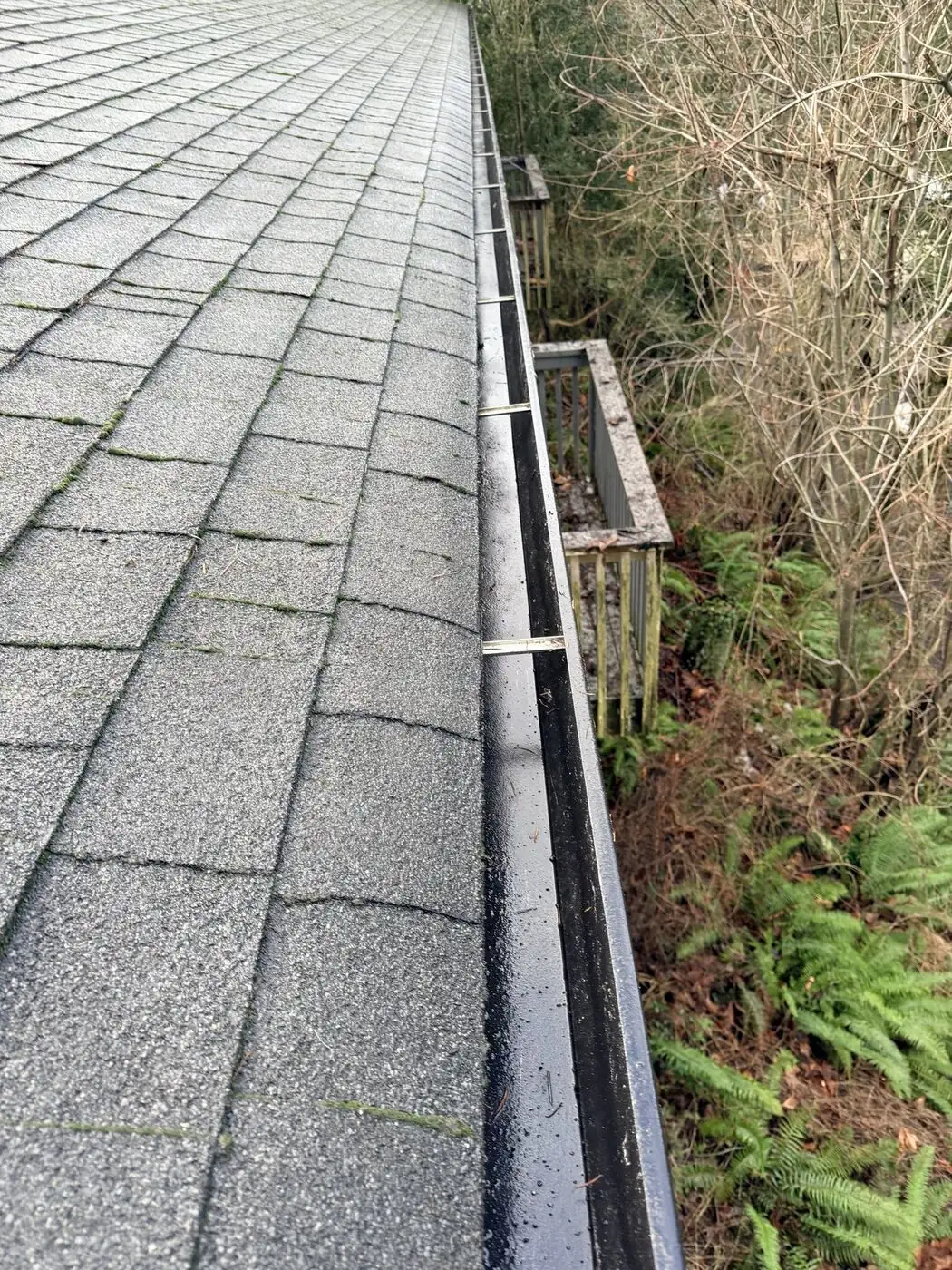
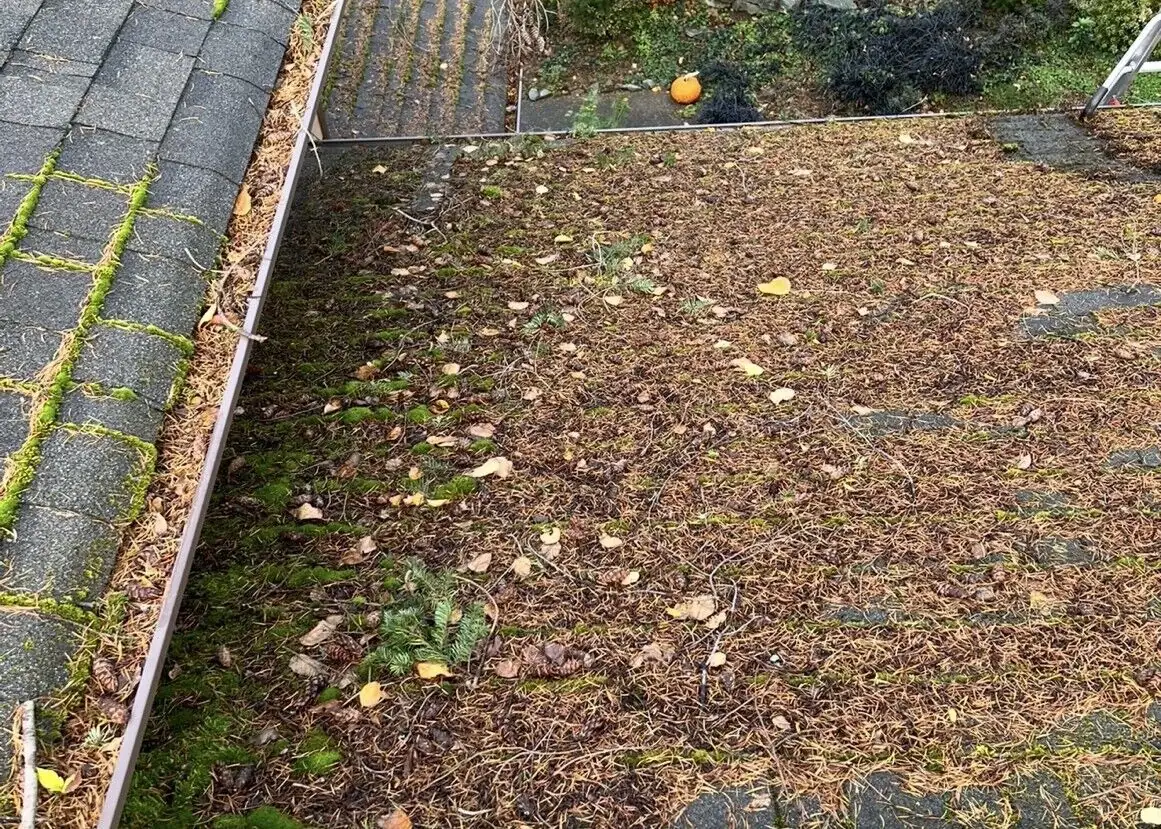 Before
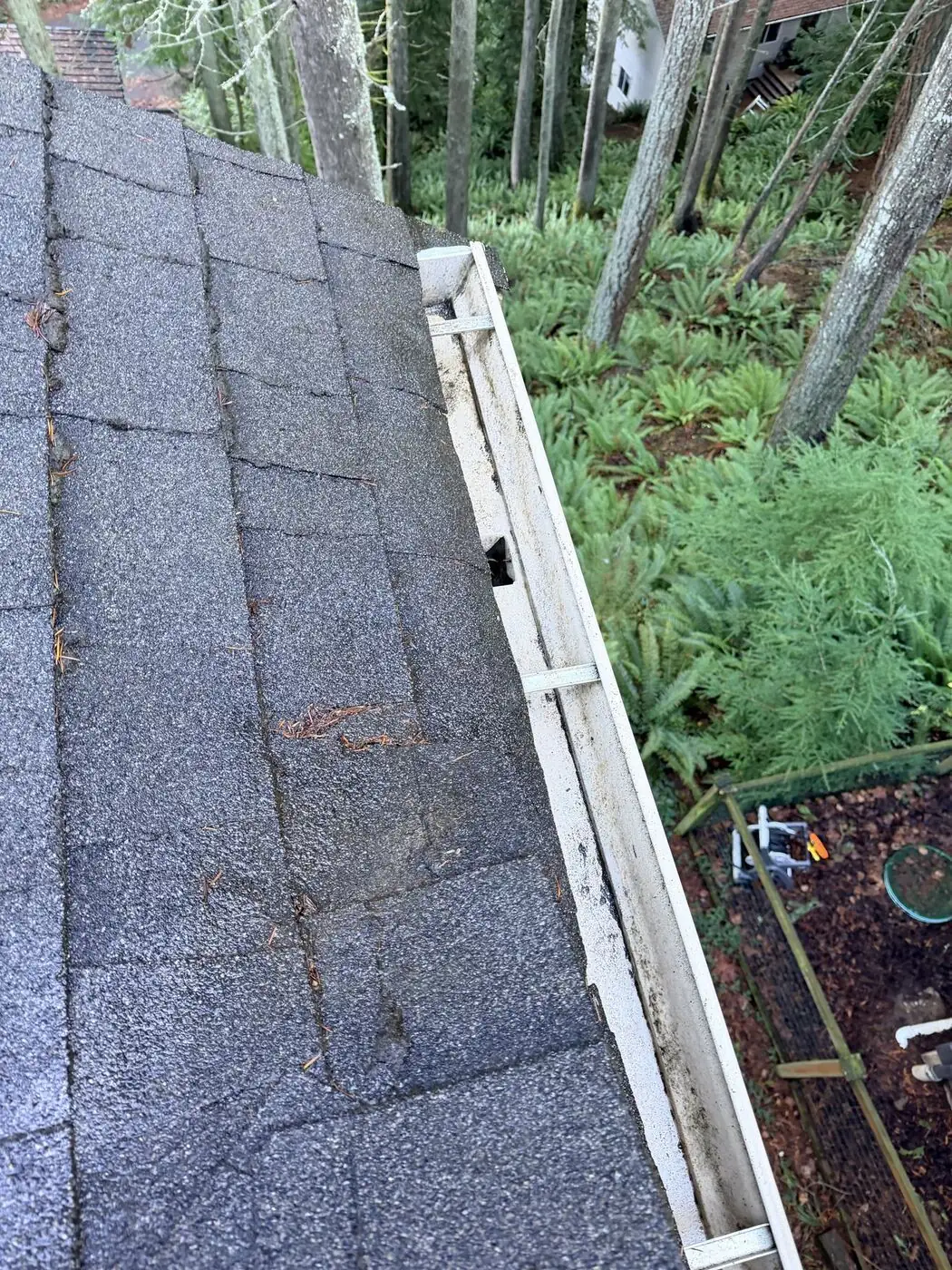
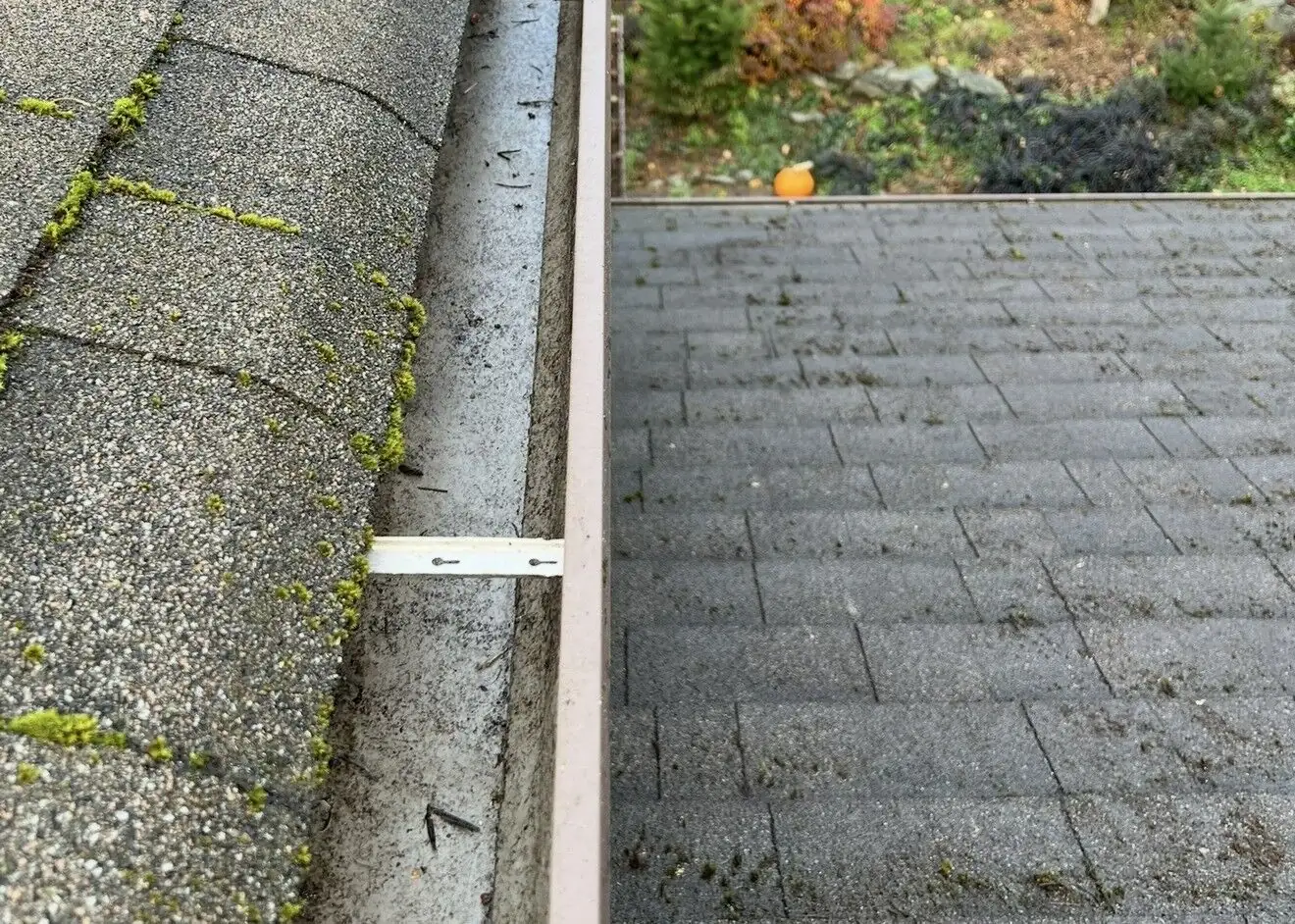 After
How often should a Burlington gutter be cleaned?
Once a year is the baseline, and for a house with nothing overhanging the roof it is often enough. The single clean should land between leaf drop and the heavy rain, which in Burlington generally means the last days of October or the first week of November.
From there the schedule moves with the lot rather than the calendar:
- Open lot, no trees over the roof: one autumn visit a year usually keeps the system flowing.
- A tree or two within reach of the eaves: an autumn clean plus a late winter check, because storms bring down twigs, needles and cones after the main leaf fall is over.
- Heavy cover on one or more sides: two to three visits, set by what the trees drop and when.
- A roof carrying moss: expect the gutters to refill steadily until the roof itself is treated.
After the first visit we can tell you which of these your house falls into, because we will have seen what was in the gutter and how much of it there was. A trough half full of seed pods tells a different story from one lined with roof grit, and the answer sets how soon we should come back.
The one season we do not push is midsummer. Gutters in July are generally dry and quiet, and cleaning them then just means cleaning them again once autumn has had its say.
What is included in a gutter clean?
Every visit covers the same core work, whatever the size of the house:
- Every run cleared by hand, corner to corner, including the inside corners where debris packs tightest
- Debris bagged and removed, not blown across the lawn or rinsed into the street
- Each downspout flushed from the top and checked for flow at the outlet
- Outlet screens and elbows cleared where they are accessible
- The roof edge checked for anything loose that will slide into the gutter next week
- Photographs of anything worth your attention, taken on the day
Gutter guards, where fitted, are lifted and cleaned beneath if they come off without damage. If they are fixed in a way that makes removal a risk, we say so before starting rather than prying them off.
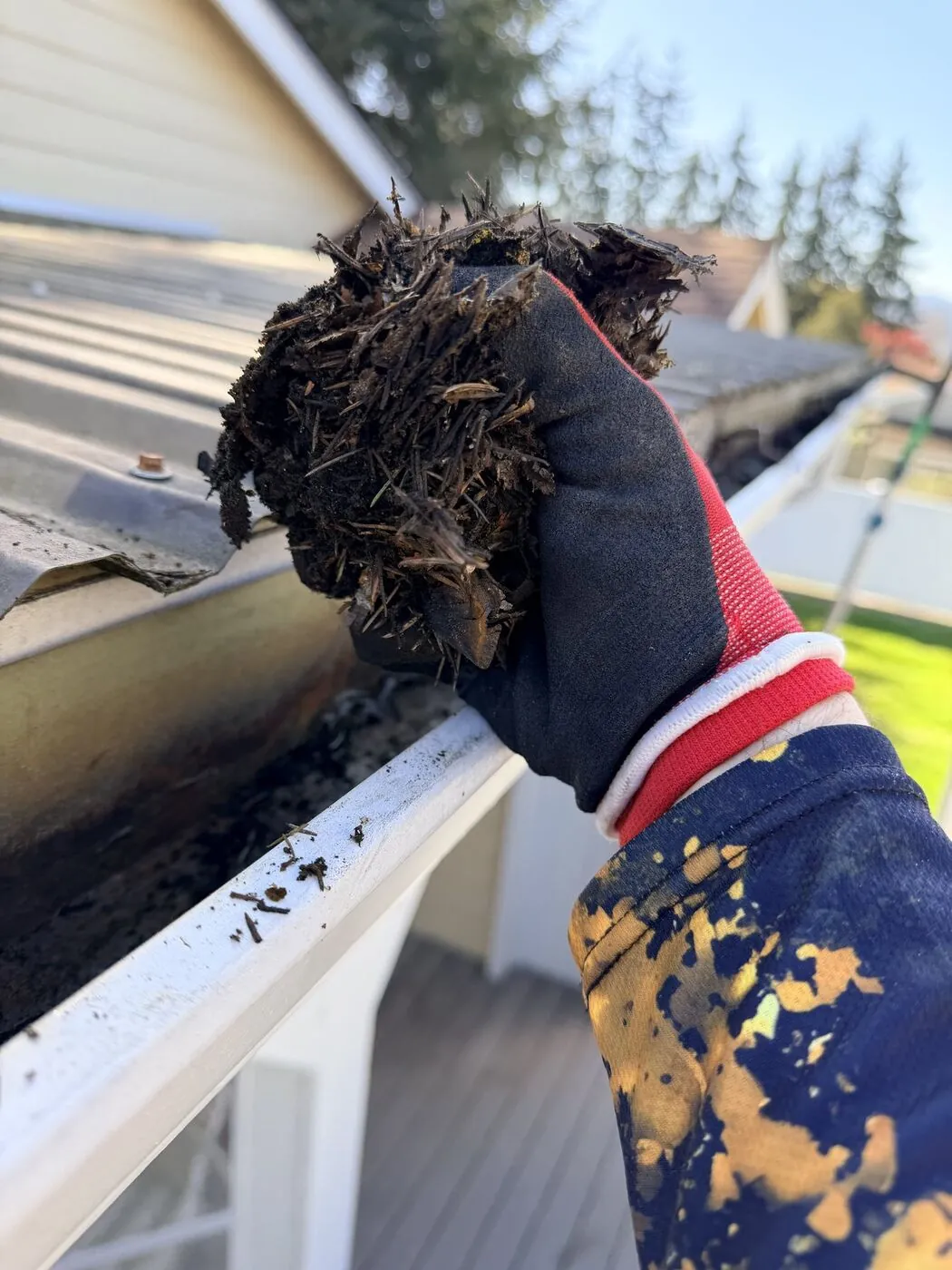
How are the gutters actually cleared?
By hand and by ladder, for the most part. A scoop and a gloved hand are slower than a leaf blower, but they remove the compacted sludge at the bottom of the trough that a blower skips over, and they put the debris in a bag instead of on your roof, your car or your neighbour’s driveway.
Once a run is empty, we rinse it through with plain water toward the outlet and watch it drain. That rinse tells us two things at once: whether the downspout is clear, and whether the gutter is pitched so water actually reaches it. A run that holds a puddle in the middle after rinsing is sagging or has lost its fall.
Downspouts that do not clear from the top get worked from the bottom. The underground drains some houses have at the base of their downspouts are a different matter; we can tell you whether water is reaching them, but we do not excavate or jet buried lines.
Where does the water go after it leaves the downspout?
Somewhere sensible, ideally. On Burlington’s level ground the discharge point matters more than people think. A downspout that empties straight onto the soil beside the foundation puts the whole roof’s runoff into one spot every time it rains, and on flat ground that water has nowhere to go but down and sideways.
A few things we check while we are there:
- Whether each downspout has an extension or splash block carrying water away from the wall.
- Whether any outlet is disconnected, crushed or has pulled away from its bracket.
- Whether overflow has left mud splash or staining on the siding below.
We will point out what we find. Fixing grading or drainage is not our trade, but knowing about it early is worth a great deal to the house.
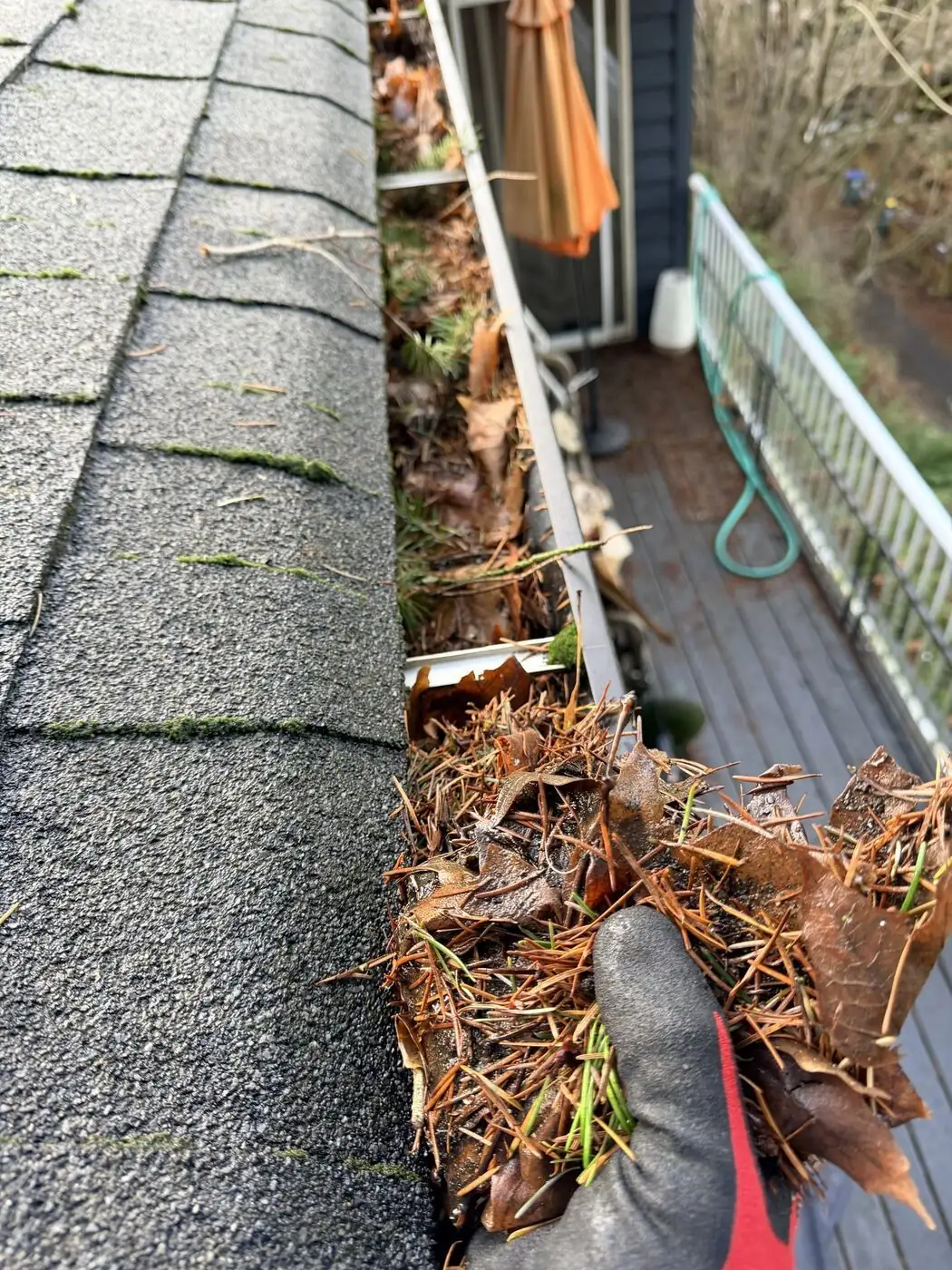
What affects the price of a gutter clean in Burlington?
Every quote is written on site, after walking round the building, and it rests on a handful of things:
- Linear footage. The total length of gutter is the starting point.
- Height and storeys. A single-storey ranch clears quickly; a two-storey with a steep pitch above the gutter line takes more setup.
- Condition. A gutter cleaned last autumn is a light job. One that has not been touched in several years may hold packed sludge and growth.
- Access. Planting beds, fences, decks and tight side passages between buildings slow the work.
- Building type. Attached and multi-unit buildings often have long continuous runs and shared downspouts, which we price on the building rather than per door.
Pairing the gutters with roof cleaning or a house wash usually brings the total down, because the ladders, the setup and the drive are shared.
Gutters on rentals and multi-unit buildings
Burlington has an unusually large share of housing that is not a detached house: of 4,246 units, only 2,137 are. Rental ownership is common too. That means the person arranging a gutter clean here quite often does not live under the gutter in question.
We make that easy. Tell us who approves the quote, who has access, and whether tenants need notice, and we will arrange the rest. After the work you get photographs of the cleared runs and a short note of anything that needs attention, which is useful if you are a long way from the property or managing several at once.
Keeping gutter debris out of Gages Slough
Burlington Municipal Code 14.05.070(B) bars anyone from discharging pollutants, or water carrying them, into the city’s storm system. Rotting leaf sludge washed off a driveway counts, and the destination makes it more than a technicality: most of Burlington’s runoff flows into Gages Slough and is pumped from there to the Skagit River.
So the debris is bagged, the flush water goes down your own downspouts rather than across the pavement, and any spill on a driveway is swept up rather than hosed toward the kerb. The wider picture is on our page about wash water and storm drains.
Which problems start in the gutter?
A blocked gutter rarely stays a gutter problem for long. The ones we see most often, with more detail on each:
- Overflow at corners and over doorways, covered in overflowing gutters.
- Black streaks down the face of the trough, which a clean inside does not touch; that is gutter brightening.
- Moss creeping up from the gutter line into the lower shingles, where it holds water against the roof. If that is happening, book roof cleaning in Burlington alongside.
Our main gutter cleaning page covers the service across every town we work.
How do I book a gutter clean in Burlington?
Ring (360) 303-6806, or send a request with your address and whether the building is a house, a duplex or something larger. Autumn is the busy season for gutters, so a September or early October call gets you a slot before the rain rather than during it. Crews are trained by the owner himself, and the visit, the walk-round and the written figure cost you nothing.
For everything else we do in town, start from the Burlington page.
Gutters questions from Burlington homeowners
- When is the right time to clean gutters in Burlington?
- Late October into early November suits most houses: the leaves are down, and the wettest month at the nearby Mount Vernon station has not yet arrived. A house with trees hanging over the roof may want a second pass in late winter to clear what came down during the storms.
- Do you flush the downspouts as well?
- Yes, every one. Clearing the trough and leaving a blocked downspout just moves the overflow a few feet along the wall. We run water through each drop, confirm it exits at the bottom, and clear or report anything we cannot shift.
- Where does the gutter debris go?
- Into bags, which we either take away or leave for your own green-waste bin, whichever you prefer. It is never rinsed into the street. Burlington's storm system drains to Gages Slough, and wet leaf muck is exactly the kind of load the city is trying to keep out of it.
- Can you clean gutters on a duplex or a small apartment building?
- Yes. We quote from the building itself, counting the runs, the storeys and the downspouts, rather than charging per unit. Tell us who approves the work and who can give access, and we will coordinate with tenants directly if that is easier for you.
- Will you tell me if a gutter is damaged?
- We will tell you what we see: a sagging section, a joint that leaks, a bracket pulled loose, a downspout that has come apart. We are a cleaning company, not a gutter installer or inspector, so we point it out and photograph it rather than diagnose the cause or sell you a repair.
- Do you clean the outside of the gutters too?
- That is a separate job called gutter brightening, which removes the grey and black streaking from the face of the trough. It pairs well with a house wash and is quoted on its own so you can choose.
- What if my roof has moss as well?
- Then the roof is usually the reason the gutters keep filling, because moss sheds into them all year. Treating the roof first and clearing the gutters afterwards stops the cycle, and doing both on one visit saves a second setup.