Skagit County
Roof Cleaning & Debris Removal in Burlington, WA
The short answer
The median Burlington home was built in 1993, which puts many roofs at an age where moss, algae streaks and lichen are well established. We treat them at low pressure with no pressure washer on the shingles, work in the drier summer months, and route the runoff so treatment never reaches the storm drains that feed Gages Slough.

Randy Fee — Owner, King of Kings Window Cleaning
Washington business licence, UBI 605476674 · L&I insured · BBB rated A
Randy runs the company himself, so you are dealing with the owner, not a call centre — and every technician here is personally trained by him. Working Whatcom and Skagit County since 2024.
I run the Burlington route personally.
From the street, a Burlington roof usually looks fine until it suddenly does not. The first sign is a faint dark streak running down from the ridge, or a line of green tufts along the lower edge where the shingles meet the gutter. By the time the moss is visible from the pavement it has generally been growing for a few seasons.
Cleaning it early is cheaper and gentler on the roof than cleaning it late. This page explains what we find on roofs in this town and how we treat them.
What grows on Burlington roofs?
Three things, usually in combination.
Moss forms cushions on the shaded slopes and along the lower courses, where the roof holds moisture longest. Its roots work into the gaps between shingles, and every clump acts like a small sponge.
Algae shows as the black or dark grey streaking that runs down a roof in vertical stripes. It is mostly cosmetic, but it signals a surface that stays damp long enough for more to follow.
Lichen appears as flat, crusty grey-green or pale spots, firmly attached and slow to shift. It grips hard and is the stubbornest of the three.
Burlington gives all of them what they need. The town lies low on the Skagit floodplain, with the river along its southern and southeastern edges, and roofs on flat valley ground spend long stretches of the cool season damp. Any slope that faces north or sits under a tree stays wet longest and greens up first.
Is my roof old enough to need cleaning?
In Burlington, quite possibly. The median house here was built in 1993, and 1,517 of the town’s 4,246 housing units date from 2000 or later. That puts a large share of the town’s houses somewhere between their second and fourth decade, and their roofs with them: old enough for growth to be well established, and young enough that removing it is still protecting a roof with useful years ahead of it.
Age alone does not decide it, though. A newer roof in heavy shade can carry more moss than an older one in full sun. The questions that matter more:
- Is there green along the lower edge or in the valleys?
- Are there dark vertical streaks on any slope?
- Do your gutters keep filling with granules or green debris?
- Does one face of the roof look noticeably darker than the others?
A yes to any of these is worth a look.
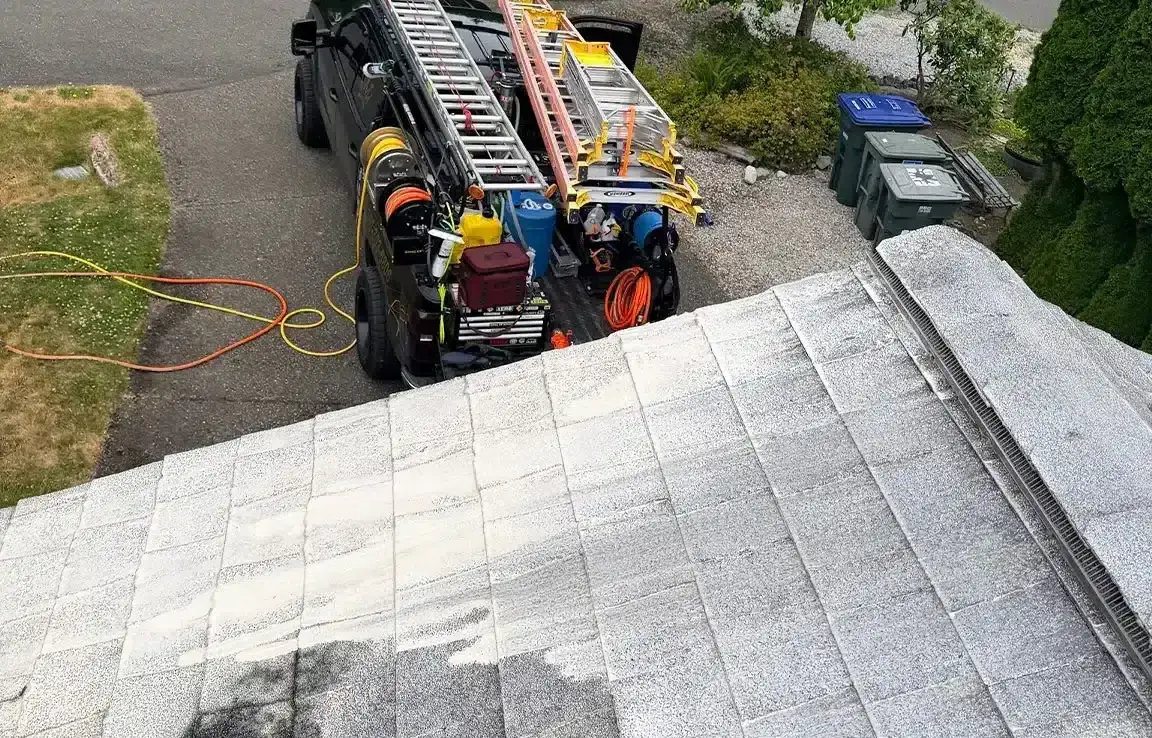
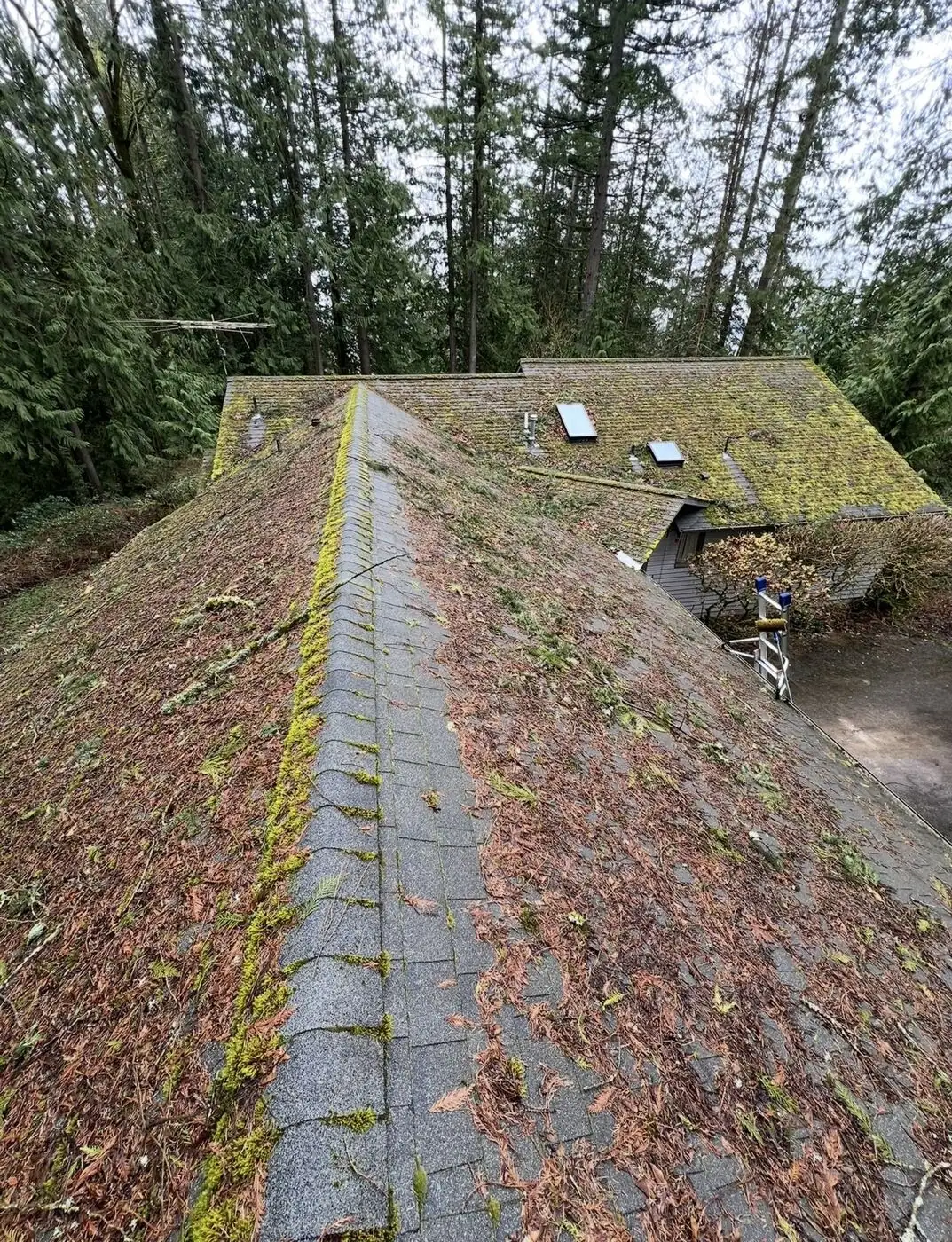 Before
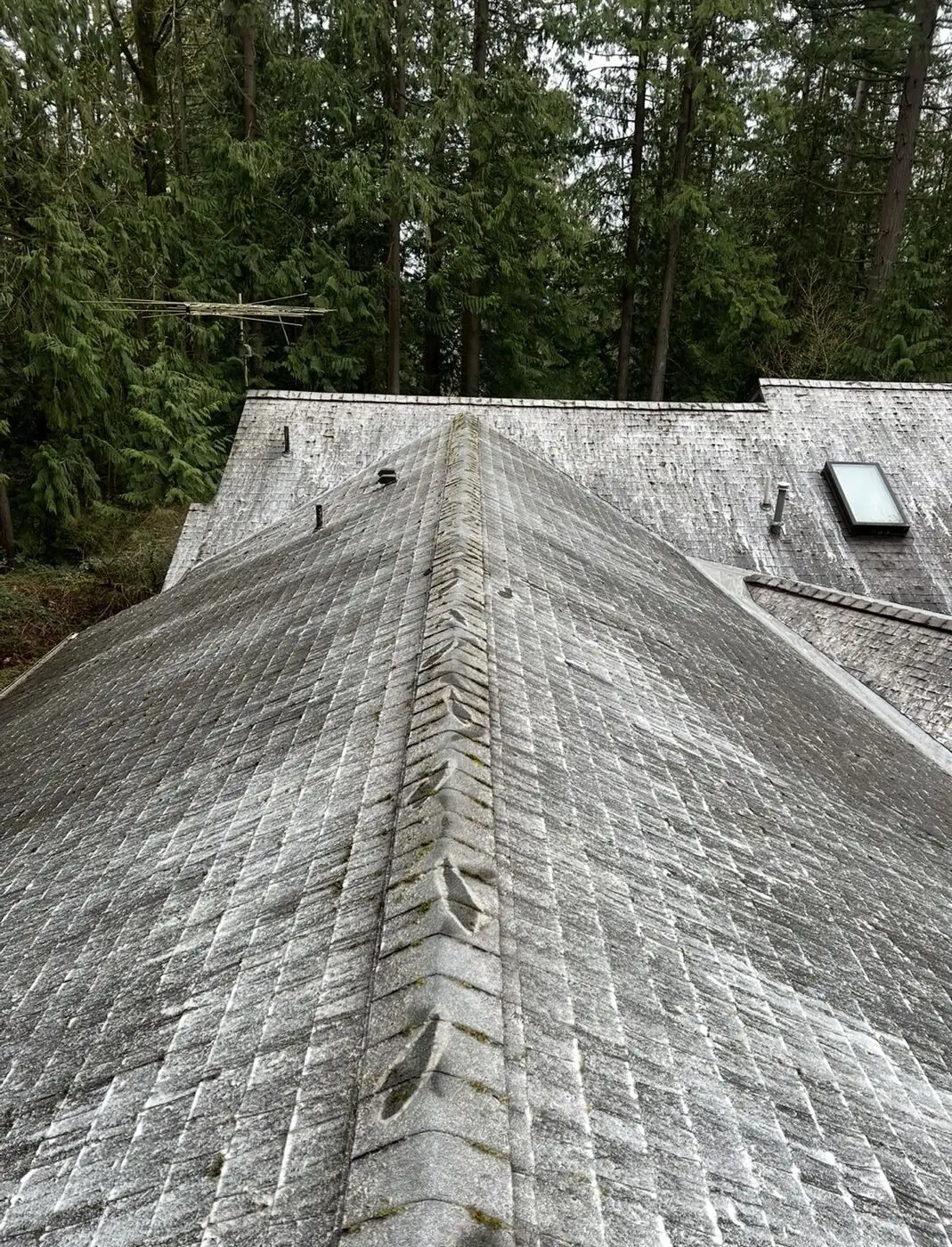 After
What does a roof clean include?
A standard clean covers the whole roof surface and the edges that affect it:
- Loose moss removed by hand from the shingle surface, working with the lay of the shingles rather than against it
- A low-pressure treatment applied to every slope to kill remaining moss, algae and lichen
- Ridges, valleys and the lower courses given extra attention, since these hold growth longest
- Planting and hard surfaces below the eaves protected, wetted and rinsed
- Gutters cleared of the moss and debris that comes off the roof
- Photographs before and after, and of anything you should know about
Skylights, chimney crowns and roof-mounted solar panels are cleaned or worked around as agreed on the quote.
How is a roof cleaned without damaging it?
By not using pressure on it. A pressure washer will take moss off a shingle roof, but it takes the protective granule layer with it and can drive water up under the laps. The roof looks clean for a season and has lost part of its life.
Instead, the treatment does the work. We apply it at low pressure across the roof, let it dwell, and let the growth die back. Loose moss is brushed or scraped off gently by hand first so the treatment reaches the surface beneath. Over the following weeks the dead growth dries, loosens and washes away with ordinary rain.
How shingle roofs respond to this is covered in our profile of composition asphalt shingle. Painted metal roofs need a different approach again, covered under metal roof soft washing.

What if the moss has already worked under the shingles?
Then removal needs more care, not more force. Moss that has rooted into the gaps between shingles lifts their edges and lets water wick underneath. Tearing it out aggressively can crack or break the shingle it has grown into. We loosen what comes away freely, treat the rest, and let it release on its own time.
If we see lifted or damaged shingles, we photograph them and tell you. We are roof cleaners, not roofers or inspectors, and a shingle that needs replacing is a job for a roofing contractor. The pattern is explained in more detail on moss under shingles, and ongoing moss control is covered under moss removal.
Where does the roof runoff go?
Down the roof, into the gutters, and through the downspouts, which is exactly why it needs managing. Wherever a downspout ties into an underground line that could reach the street system, treatment runoff can end up in the city’s drainage. In Burlington that drainage mostly empties into Gages Slough and is pumped on into the Skagit River.
Burlington Municipal Code 14.05.070 prohibits anything other than storm water entering that system and names soaps, detergents and ammonia among the illicit discharges. So on a roof job we:
- Identify every downspout and where it discharges.
- Divert outlets that may lead to the storm system onto lawn or planting.
- Keep treatment off driveways and paths that shed toward the street.
- Rinse plants below the eaves before and after the application.
- Walk the ground at the end to be sure nothing is still running off.
The full reasoning is set out on wash water and storm drains.

What affects the cost of a roof clean in Burlington?
Every price is set on site, after seeing the roof. What moves it:
- Roof area, the base of every quote.
- Pitch and height. A low single-storey roof is quick to access; a steep or two-storey roof needs more setup and more care.
- How much growth there is. A roof with light streaking is a treatment visit. One with thick moss along every lower course needs hand removal first.
- Complexity. Valleys, dormers, skylights and chimneys all add time.
- Runoff control. Downspouts that connect underground, or a driveway sloping to the street, need more preparation.
Booking roof and gutters together is almost always more economical than two separate visits.
When should a Burlington roof be cleaned?
In the dry part of the year. Burlington has no long-term weather station of its own; the nearest, Mt Vernon 3 WNW, recorded July as its driest month over 1956-2005, averaging 1.16 inches. A treatment applied then has time to dry onto the growth and work before rain returns.
Late spring and early autumn are workable on a settled spell. What we avoid is treating a roof ahead of a forecast downpour, which rinses the treatment off before it has done its job, and working on a roof slick with frost or rain, which is a safety matter first.
Once clean, most roofs here go several years before needing another full treatment, and the shaded slopes set the pace. A light maintenance treatment partway through that interval, applied before growth becomes visible again, is usually quicker and cheaper than waiting for a full return of moss, and it is the simplest way to keep the lower courses clear.
Cleaning roofs on rentals and shared buildings
Burlington has more renters than owner-occupiers, and only about half its housing is detached houses, so a roof here often belongs to someone who seldom sees it. That tends to be the roof that goes longest between cleans, because nobody living underneath is looking up at it.
For a landlord or manager the practical questions are access and notice. We can arrange the visit through a tenant, keep cars and paths clear of the work area, and send photographs of every slope before and after, so an owner who lives elsewhere can see what was done without driving over. On attached buildings with a shared roof, tell us who approves the work for the whole structure; a roof treated on one unit and not the next simply reseeds itself.
A roof clean between tenancies also fits neatly with the other work a turnover usually brings, since the ladders are already up.
Why do roof cleaning and gutter cleaning go together?
Because one feeds the other. A mossy roof sheds into the gutters all year, and a roof treatment loosens growth that ends up in the gutters over the following weeks. Clearing the gutters as part of the roof job, and again in autumn, keeps the whole system flowing. The gutter side of that is covered on gutter cleaning in Burlington.
How do I book a roof clean in Burlington?
Call (360) 303-6806, or send us your address and a note about what you can see from the ground. We will come out, look at the roof with you, explain what is growing and where, and give you a figure. Every technician on our crews learns the method directly from the owner, and there is no charge for the visit.
It helps to know roughly when the roof was put on and whether it has been treated before. If you do not know, that is fine; we can usually tell a good deal from the surface itself, and we will say plainly if something is better checked by a roofer before any cleaning starts.
Our general roof cleaning page covers the service across the whole territory, and the Burlington page covers everything else we do in town.
Roof cleaning questions from Burlington homeowners
- Do you pressure wash roofs?
- No. Pressure strips the protective granules from composition shingles and can force water under the laps. We apply a treatment at low pressure that kills the growth, and let weather and a gentle rinse carry it away.
- How soon will the moss disappear after treatment?
- Loose moss is brushed off on the day. What remains is killed by the treatment and dries, shrinks and releases over the following weeks, with rain doing much of the final work. Algae streaks usually fade faster than moss clumps.
- Which time of year suits roof cleaning in Burlington?
- High summer, when the roof is dry and a treatment is not rinsed off by the next shower. The nearest long-term station, in Mount Vernon, records July as its driest month. Late spring and early autumn work on a settled dry spell.
- Will the treatment harm my garden or the slough?
- It is managed so it does not. Planting below the eaves is wetted and rinsed, downspouts that may lead to the storm system are diverted onto soil, and no runoff is allowed to reach a street drain. Most of Burlington's storm runoff goes to Gages Slough.
- Can you tell me if my roof needs replacing?
- No, and we will not pretend to. We are cleaners, not roofing inspectors. We will point out and photograph anything we notice, such as a cracked shingle or a lifted flashing, so you can have a roofer look at it.
- How long does a clean roof stay clean here?
- It varies with shade more than anything. An open roof with sun on every face can stay clear for several years. A roof shaded by trees or a taller neighbour greens up sooner, and the north-facing slope is usually the first to show growth again.
- Do you clean metal roofs as well?
- Yes, with a separate soft-wash approach suited to painted metal. Tell us the roof type when you call so the right equipment and treatment come on the day.